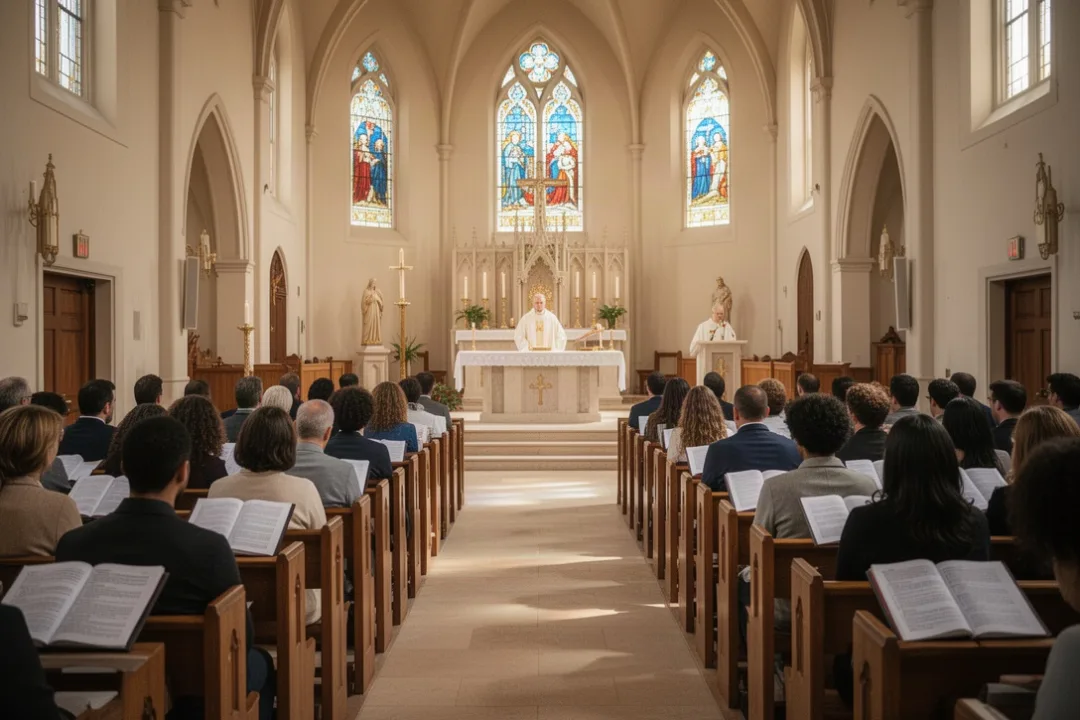
If you are sitting in a Catholic church and wondering when to stand, sit, kneel, or speak, you are not alone. The Catholic Mass responses follow a familiar pattern, but several phrases can be easy to miss if you are visiting a new parish or returning after time away. The quickest answer is that you can follow the congregation’s posture and listen for the priest’s words; the people’s response usually comes immediately afterward.
The responses are more than lines to memorize. They express the congregation’s shared faith, answer the priest’s prayers, and help everyone participate in the liturgy together. The wording below follows the ordinary form of the Roman Catholic Mass used in the United States, with notes about responses that may vary by parish or occasion.
If you are unsure: Do not feel pressured to speak perfectly or keep up with every movement. Listen for the congregation, use the worship aid if one is provided, and participate with reverence at your own pace.
The Mass includes dialogue between the priest, deacon, readers, cantor, and congregation. When the priest says, “The Lord be with you,” the people answer, “And with your spirit.” This exchange is not casual conversation; it recognizes the presence of God and the role of the ordained minister in the liturgy.
Set responses also make the Mass unified across parishes. A Catholic can attend Mass in another state, or often another country, and recognize much of the structure. Local music, language, customs, and readings may differ, but the central responses remain familiar.
Some responses are spoken, while others may be sung. The words usually stay the same even when a parish uses a different melody. Your parish may also use one of several approved forms for parts such as the Penitential Act, the Creed, or the dismissal.
The opening responses from the entrance through the Collect
The first part of Mass gathers the people and prepares them to hear Scripture and celebrate the Eucharist. You will usually stand for the entrance procession and remain standing for the opening greeting. The exact music and form can change, but the spoken responses follow a recognizable sequence.
The Sign of the Cross and opening greeting
The Mass begins with the Sign of the Cross. The priest says, “In the name of the Father, and of the Son, and of the Holy Spirit,” and the congregation responds, “Amen.” “Amen” means that you affirm or agree with what has been said; it is not merely a closing word.
The priest then greets the people with one of several approved forms, most commonly, “The Lord be with you.” The standard response is:
And with your spirit.
This response is not “And also with you,” which appeared in the former English translation of the Roman Missal. Since the revised English translation was introduced in the United States, the wording has been “And with your spirit.”
The Penitential Act
The Penitential Act gives the congregation an opportunity to acknowledge sin and ask for mercy. The priest may lead the familiar form that begins with a confession of sin, or the parish may use a shorter dialogue or a sprinkling rite during certain seasons and celebrations.
In the familiar form, the people acknowledge responsibility for their thoughts, words, actions, and failures to do good. The congregation then asks Mary, the angels, the saints, and one another to pray for them. The response concludes with repeated appeals for mercy, such as:
Lord, have mercy.
Christ, have mercy.
Lord, have mercy.
These petitions may be sung in Greek as Kyrie, eleison or Christe, eleison. The meaning remains the same: the congregation asks the Lord and Christ for mercy.
The Penitential Act is not the same as the Sacrament of Reconciliation. It expresses repentance and prepares you for worship, but it does not replace individual confession when that sacrament is needed.
The Gloria response
On Sundays outside Advent and Lent, and on solemn celebrations, the congregation usually sings or recites the Gloria. It is a hymn of praise that glorifies God the Father and honors Jesus Christ as Lord. Because it is a complete liturgical text, the congregation generally follows the music or worship aid rather than responding to separate prompts.
The Gloria is normally omitted during Advent and Lent, when the Church uses a more restrained liturgical character. It may also be omitted at weekday Masses. If it is not included, simply follow the priest and congregation as they move to the opening prayer.
The Collect, or opening prayer
The priest invites everyone to pray, often with the words “Let us pray.” The congregation pauses in silence while the priest offers the Collect. At the end, the people answer “Amen.” This response confirms the prayer and completes the opening portion of the Mass.
The Liturgy of the Word and its congregational responses
The Liturgy of the Word centers on readings from Scripture, the homily, the profession of faith, and the Prayer of the Faithful. You will generally sit for the readings and homily, then stand for the Gospel. The worship aid may show the day’s readings and responses, but you do not need to locate every passage in a personal Bible.
Responses after the first and second readings
After the first reading, the lector says, “The word of the Lord.” The congregation responds:
The same exchange normally follows the second reading. The response expresses gratitude for God’s revelation through Scripture. It is not necessary to repeat the lector’s words or add anything after the response.
Between the readings, the congregation sings or recites a responsorial psalm. A cantor or leader presents the verses, and the people repeat a short refrain. The refrain changes from day to day, so use the worship aid or follow the cantor. The psalm response is part of the biblical prayer, not an optional song inserted between readings.
The Gospel acclamation and Gospel response
Everyone usually stands for the Gospel acclamation. Outside Lent, this is commonly an Alleluia with a verse; during Lent, a different acclamation is used. The congregation repeats the sung response according to the parish’s music.
Before the Gospel, the deacon or priest announces the Gospel reading, such as “A reading from the holy Gospel according to Matthew.” The people respond by naming the appropriate evangelist, such as “Glory to you, O Lord.” Many Catholics make a small cross with the thumb on the forehead, lips, and heart at this point, silently asking to understand, proclaim, and live the Gospel.
At the end of the Gospel, the minister says, “The Gospel of the Lord.” The congregation answers:
Praise to you, Lord Jesus Christ.
The people then sit for the homily. The homily applies the readings to Christian life and may be given by a priest or deacon, and sometimes by a bishop or another authorized preacher.
The Profession of Faith
On Sundays and solemnities, the congregation usually stands and recites either the Nicene Creed or the Apostles’ Creed. The Nicene Creed is used often, while the Apostles’ Creed is especially common during some seasons or celebrations. The parish may print the chosen text in its worship aid.
The Creed is not a call-and-response section in the same way as the Gospel acclamation. Everyone says the profession of faith together, usually beginning with a statement of belief in one God. If the Creed includes the mystery of Christ’s incarnation, the congregation may bow at the appointed words; on certain feasts, the prescribed gesture may be a genuflection instead.
Do not worry if you cannot recite the entire Creed from memory. You can follow the printed text, listen quietly, or join the parts you know. The purpose is a communal profession of faith, not a test of memorization.
The Prayer of the Faithful
The lector, deacon, or another minister announces intentions for the Church, public authorities, people facing hardship, the local community, and the deceased. After each intention, the congregation gives a response such as:
Lord, hear our prayer.
We pray to the Lord.
Another response selected by the parish or celebrant.
The exact wording can vary, so listen to the first petition and follow the congregation. After the intentions, the priest offers a concluding prayer, and the people respond “Amen.”
The Eucharistic Prayer responses from the Preparation of the Gifts onward
The Liturgy of the Eucharist begins with the preparation of the altar and the gifts of bread and wine. You usually sit while the gifts are prepared, then stand when the priest invites the congregation to pray. The central Eucharistic Prayer follows, with several important responses that the congregation says or sings together.
The response during the presentation of the gifts
The priest may praise God for the bread and wine and then invite the people to pray that the sacrifice be acceptable. The congregation responds:
May the Lord accept the sacrifice at your hands for the praise and glory of his name, for our good and the good of all his holy Church.
This response connects the offerings on the altar with the spiritual offering of the entire community. The word “sacrifice” refers to the worship offered to God, not simply to the money or material gifts collected during Mass.
The Preface dialogue and Holy, Holy, Holy
The Preface begins with an exchange that invites everyone to lift their hearts in prayer. The priest says, “The Lord be with you,” and the people answer, “And with your spirit.” The priest then calls the congregation to lift up their hearts, and the people respond that they have lifted them up to the Lord.
The priest next invites everyone to give thanks to the Lord. The congregation answers that doing so is right and just. The priest continues the Preface, which changes according to the season, feast, or occasion.
The congregation then sings or recites the Sanctus, commonly known in English as “Holy, Holy, Holy.” It praises God’s holiness and blesses the one who comes in the Lord’s name. The text is ordinarily printed in the worship aid, and the melody differs from parish to parish.
After the consecration, the priest introduces the memorial acclamation. The congregation chooses or sings one of several approved responses, including an acclamation that addresses Christ, remembers his death and resurrection, and looks forward to his coming again.
Because the words differ, do not assume that every parish uses the same form. Wait for the musical cue or read the response in the missal. The acclamation is a proclamation of the Paschal Mystery: Christ’s suffering, death, resurrection, and continuing saving work.
The Great Amen
At the end of the Eucharistic Prayer, the priest, often with the deacon, elevates the consecrated gifts and gives praise to God through Christ. The congregation responds with a strong “Amen,” frequently sung several times. This is called the Great Amen because it confirms the entire Eucharistic Prayer.
Although it may be brief, the Great Amen is one of the congregation’s most significant responses. It means that the people agree with and affirm the prayer offered in their name. You may remain standing until the Lord’s Prayer begins, according to local custom.
The Communion Rite responses and gestures
The Communion Rite begins with the Lord’s Prayer and continues through the sign of peace, the breaking of the bread, and Holy Communion. Postures can differ slightly by parish, especially around kneeling and standing, so follow the local instructions and the people around you.
The Lord’s Prayer and the embolism
The entire congregation recites or sings the Lord’s Prayer together. Since Bible translations vary and the prayer is part of the liturgy, the wording is normally printed in the worship aid. Afterward, the priest expands on the final petition and asks for peace and protection from sin.
The congregation responds with a brief conclusion, often asking that the peace of Christ remain with the community. The priest then offers peace, and the people answer “And with your spirit.”
The sign of peace
The priest or deacon may invite the people to offer one another a sign of peace. In the United States, this commonly means a handshake, nod, wave, or simple greeting such as “Peace be with you.” The response is usually “And with you,” “Peace,” or another brief expression permitted by local custom.
The sign of peace is not a time to start extended conversations. Offer peace to the people near you, then turn your attention back to the altar and the Eucharistic Prayer.
The Lamb of God
During the breaking of the consecrated bread, the congregation sings or recites the Agnus Dei, known in English as “Lamb of God.” The people ask the Lamb of God to have mercy, and then ask for peace. The response is repeated according to the approved liturgical form and the parish’s music.
After this, the priest presents the Eucharist and invites the people to communion. The congregation responds together with a prayer of humility and trust. The words acknowledge that Christ’s word can heal and that no one approaches the Eucharist because of personal worthiness alone.
The response when receiving Holy Communion
When the minister holds up the consecrated host and says, “The Body of Christ,” the communicant responds:
Amen.
If receiving from the chalice, the minister says, “The Blood of Christ,” and the communicant again answers, “Amen.” This is a personal profession of faith in Christ’s real presence in the Eucharist. Say the response clearly enough for the minister to hear before receiving.
In the United States, you may receive the host in the hand or on the tongue, according to the Church’s norms and your preference. If receiving in the hand, place one hand over the other, allow the minister to place the host in your hand, and consume it immediately before stepping away.
Those who are not receiving Communion may remain in the pew, or they may approach for a blessing where that is the parish custom. Practices concerning blessings vary, so you can ask a parish usher beforehand. You should not receive the Eucharist simply because everyone else is doing so.
The Prayer after Communion
After a period of silence or a Communion hymn, the priest invites everyone to pray. The congregation stands, and the priest offers the Prayer after Communion. The people answer “Amen.” This prayer asks that the Eucharist bear fruit in the lives of those who have received it and in the Church’s mission.
The concluding responses and dismissal
The final part of Mass sends the congregation back into daily life. The priest may give announcements before or after the concluding prayer, depending on local practice. The people generally stand for the final blessing and dismissal.
The final blessing
The priest greets the congregation once more with “The Lord be with you,” and the people answer, “And with your spirit.” He then gives a blessing in the name of the Father, Son, and Holy Spirit. The congregation makes the Sign of the Cross and responds, “Amen.”
On some Sundays and special occasions, the blessing has several parts, with the people answering “Amen” after each one. Follow the worship aid or listen to the congregation if the form is unfamiliar.
The deacon or priest dismisses the congregation with one of several phrases. The most familiar is “Go forth, the Mass is ended.” The people respond:
Thanks be to God.
Other approved dismissals may send the congregation forth to proclaim the Gospel or glorify the Lord by their lives. The response remains “Thanks be to God.” It expresses gratitude and recognizes that worship leads to Christian service beyond the church building.
Remember the basic pattern: The priest or minister speaks, the congregation listens and answers, and the people’s response often ends with “Amen,” “And with your spirit,” “Thanks be to God,” or a seasonal acclamation.
Practical tips for following Catholic Mass responses
You do not need to study every response before attending Mass. A few practical habits make the order much easier to follow, especially if you are visiting a parish where the music and local customs are unfamiliar.
Pick up a worship aid. It usually includes the people’s responses, musical settings, and posture cues.
Watch the congregation. Standing, sitting, and kneeling are often the clearest immediate signals.
Listen for the priest’s final words. Phrases such as “The Lord be with you” and “The word of the Lord” tell you which response follows.
Speak at a natural volume. The congregation answers together, so you do not need to lead the room.
Stay silent during pauses. The quiet after a reading, homily, or Communion is intentional prayer, not an indication that you missed a response.
Ask an usher discreetly. Parish volunteers can explain local customs, seating, Communion procedures, and printed materials.
Common mistakes with Catholic Mass responses
Most mistakes happen because of changes in the English translation, differences between parishes, or uncertainty about when to speak. They are rarely serious, and the congregation usually moves on without drawing attention to them.
Using “And also with you.” The current response to “The Lord be with you” is “And with your spirit.”
Speaking during the priest’s prayer. Wait until he finishes and gives the cue for the congregation’s response.
Trying to memorize every musical setting. The melody can change, while the worship aid provides the words.
Confusing the Gospel responses. Before the Gospel, answer “Glory to you, O Lord.” After it, answer “Praise to you, Lord Jesus Christ.”
Forgetting the Communion response. Say “Amen” after the minister says “The Body of Christ” or “The Blood of Christ.”
Assuming every parish uses identical postures. Local practice can affect when people kneel or stand, so follow the parish’s instructions.
Leaving immediately after Communion. Remain for the Prayer after Communion, final blessing, and dismissal unless there is a serious reason to leave.
The most helpful approach is attentive participation rather than perfection. If you say the wrong response, remain calm and rejoin the congregation at the next opportunity. The structure of the Mass will guide you from one section to the next.
How the responses differ at weekday, Sunday, and special Masses
Not every Mass contains every response. A weekday Mass may omit the Gloria and Creed, while a Sunday Mass normally includes both outside the seasons when the Gloria is not used. A memorial, feast, wedding, funeral, or other celebration may also use different prayers and readings.
Advent and Lent have distinctive patterns. The Gloria is normally omitted during both seasons, and the Gospel acclamation changes during Lent. During Easter, the Gloria returns, and the sprinkling rite may be used in place of the usual Penitential Act, especially on Sundays.
A Mass celebrated for a particular sacrament or occasion can include additional forms. For example, a wedding or funeral may have selected readings, special blessings, or customary responses. The essential exchanges remain recognizable, but the printed program is the best guide for the specific celebration.
What “Amen” means throughout the Mass
“Amen” appears at several important points: after the opening prayer, the Collect, the Creed’s concluding prayer, the Eucharistic Prayer, the Prayer after Communion, and the final blessing. It also serves as your personal response when receiving Holy Communion.
The word conveys agreement, trust, and affirmation. Its meaning depends slightly on context, but it generally says that you accept the prayer or blessing as true and place your faith in God. Saying “Amen” attentively can turn a familiar response into a conscious act of participation.
How to participate when you are not Catholic
You are welcome to attend Mass respectfully even if you are not Catholic. You may join the standing, sitting, and kneeling postures as you feel comfortable, and you may say the responses if you wish. You are also free to remain quiet and observe.
Because Catholics believe the Eucharist is a sacramental sign of full communion in faith and Church life, people who are not Catholic ordinarily do not receive Holy Communion. You can remain in your seat during the Communion procession or follow the parish’s local practice for approaching without receiving. A priest, deacon, or usher can answer questions privately before or after Mass.
The responses are meant to help the whole assembly pray together. Once you recognize the repeated pattern—greeting, proclamation, response, prayer, and dismissal—the order becomes much easier to follow, even when the music, readings, or season changes.
Frequently asked questions
What is the most common Catholic Mass response?
“And with your spirit” is one of the responses you will hear most often because it follows the priest’s greeting at the beginning, before the Gospel, during the Preface dialogue, and near the final blessing. Other frequent responses include “Amen,” “Thanks be to God,” and “Praise to you, Lord Jesus Christ.”
What should I say when the priest says, “The Body of Christ”?
Respond clearly with “Amen.” This brief answer expresses your belief in the Eucharist and should be spoken before you receive the host. If you are receiving from the chalice, the minister says “The Blood of Christ,” and your response is also “Amen.”
Do Catholic Mass responses change from parish to parish?
The main English responses are standardized, but the music, translations used in multilingual communities, approved options, and local customs can vary. You may hear different forms of the Penitential Act, memorial acclamation, dismissal, or Creed. A missal or parish worship aid will show the form being used that day.
Can I attend Mass if I do not know the responses?
Yes. You can follow the printed worship aid, listen to the congregation, and participate quietly until the order becomes familiar. No one expects a visitor to know every word. You may also remain seated or standing according to your comfort and ask an usher about local customs.











Leave a Reply