Have you ever wondered what is happening after the readings and homily at Mass, when the altar is prepared and the gifts of bread and wine are brought forward? The liturgy of the Eucharist is the central part of the Catholic Mass in which the Church gives thanks to God, recalls Christ’s sacrifice, and receives his Body and Blood in Holy Communion.
It is not simply a symbolic meal or a quiet prayer service. Catholics believe that, through the Eucharistic Prayer and the work of the Holy Spirit, bread and wine become the Body and Blood of Jesus Christ while retaining their outward appearance. The liturgy joins the congregation to Christ’s self-offering and to the worship of the whole Church.
Where the liturgy of the Eucharist fits in the Mass
The Mass has two closely connected major parts: the Liturgy of the Word and the Liturgy of the Eucharist. The first centers on Scripture, proclamation, preaching, and the response of faith. The second centers on the altar, the Eucharistic Prayer, and Holy Communion.
These parts should not be treated as separate services placed next to each other. The readings announce God’s saving work, and the Eucharist makes that saving work sacramentally present. The congregation first listens and responds, then brings its life, needs, and praise into the Church’s offering through Christ.
The liturgy described here follows the Roman Rite, the form of the Mass most commonly celebrated in the United States. Some prayers, gestures, music, and local customs differ by parish, season, or approved liturgical form, but the basic movement remains the same.
The central idea: The Eucharistic liturgy is both thanksgiving and offering. The Church gives thanks to the Father through Christ, and the faithful are invited to offer themselves—not as a replacement for Christ’s sacrifice, but by joining their lives to it.
The four movements of the liturgy of the Eucharist
After the Creed and the Prayer of the Faithful, the Mass moves into the Eucharistic liturgy. You can follow it as four connected movements:
Preparation of the gifts: Bread, wine, and the offerings of the faithful are brought to the altar.
The Eucharistic Prayer: The priest leads the great prayer of thanksgiving and consecration.
The Communion Rite: The Church prepares to receive Christ and shares in Holy Communion.
The concluding prayer: After Communion, the priest prays that what has been received will bear fruit in Christian life.
The dismissal follows these movements and belongs to the concluding rites of the Mass. It sends the congregation into the world to live what it has celebrated. The Mass does not end with a private spiritual experience; it leads to worship, service, reconciliation, and witness in ordinary life.
Step 1: The altar and gifts are prepared
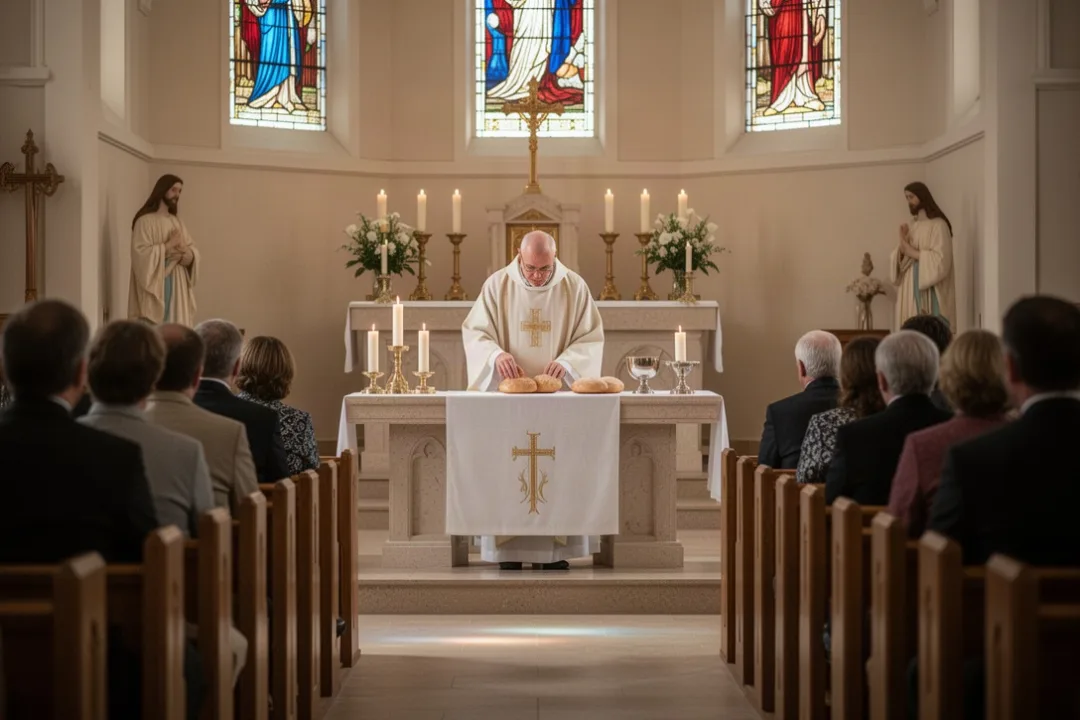
The altar, which has already been present as a visible sign of Christ, becomes the focus of the Eucharistic celebration. A priest or deacon may prepare it with a corporal, purificator, missal, and chalice. The details can vary, but the purpose is consistent: the altar is readied for the offering and sacramental meal.
Members of the congregation may bring forward the bread and wine that will be used in the Eucharist. They may also present money or other gifts for the support of the Church and the care of people in need. These offerings express the community’s participation, even though only bread and wine become the sacramental signs of the Eucharist.
The bread used for the Roman Catholic Eucharist is unleavened bread made from wheat, and the wine is made from grapes. The Church uses these elements because Christ instituted the Eucharist with bread and wine at the Last Supper. The priest places them on the altar and prepares the chalice.
The priest may bless the bread and wine with prayers that acknowledge God as the giver of creation. He offers thanks for the bread and wine and asks that they become spiritual food and drink. The congregation responds with its assent, usually by saying “Blessed be God forever”.
During this part of Mass, the congregation may sit or stand according to local custom. The collection, offertory procession, and music are not merely a break between the readings and the Eucharistic Prayer. They show that worship involves the whole community and that Christian life includes concrete generosity.
What the offering represents
The bread and wine represent more than material objects. They are gifts from the earth and from human work, and they point to the way human life is received from God and returned to him in gratitude. The faithful can also bring their own burdens, work, relationships, decisions, and hopes into this offering.
This does not mean that the congregation creates the Eucharist by its own effort. The priest acts in the person of Christ in the liturgy, while the baptized faithful participate according to their baptismal calling. Their active participation includes attentive listening, prayer, singing, bodily gestures, and a willing heart.
Step 2: The Eucharistic Prayer gives thanks and consecrates the gifts
The Eucharistic Prayer is the heart of the liturgy of the Eucharist. The priest proclaims it in the name of the Church, and the people join by listening, responding, and offering the acclamations. Several Eucharistic Prayers are approved for use, so the exact wording can differ from one Mass to another.
Although the prayers vary, they contain the same essential elements. The priest does not improvise the central prayer; the Church’s approved texts preserve the faith and worship handed down through the Church. The prayer unfolds as a single act of thanksgiving, remembrance, offering, intercession, and praise.
The main parts of the Eucharistic Prayer
The Preface: The priest invites the people to lift their hearts to God and gives thanks for God’s work in creation and salvation.
The Holy, Holy, Holy: The congregation joins the angels and the whole Church in praising God’s holiness.
The epiclesis: The priest invokes the Holy Spirit over the bread and wine, asking that they be sanctified for the Eucharistic mystery.
The institution narrative and consecration: The priest recalls Christ’s words and actions at the Last Supper. Through the power of the Holy Spirit and Christ’s word, the bread and wine become his Body and Blood.
The memorial acclamation: The people proclaim their faith in Christ’s death, Resurrection, and coming again.
The anamnesis and offering: The Church remembers Christ’s saving work and offers the Eucharist to the Father through him.
The intercessions: The prayer includes the pope, the bishop, the living, the dead, and the needs of the Church and world.
The doxology: The priest gives glory to the Father, through the Son, in the unity of the Holy Spirit, and the people make the prayer their own with a strong “Amen.”
The Greek-rooted term anamnesis means more than recalling a past event mentally. In biblical worship, memorial makes God’s saving work present to the worshiping community in a sacramental way. The Mass does not repeat Christ’s death as though Calvary happened again; it makes the one sacrifice of Christ present sacramentally.
What Catholics mean by the Real Presence
Catholic teaching holds that Christ is truly, really, and substantially present in the Eucharist. This presence is not limited to the priest’s thoughts or to the congregation’s shared memories. At the same time, the consecrated elements still look, taste, and feel like bread and wine.
The Church uses the word transubstantiation to describe this change. The substance—the deepest reality of what the bread and wine are—changes, while the outward appearances remain. The Eucharist is therefore treated with reverence because Catholics believe Christ is present in a unique sacramental way.
The consecration is not a magical performance by the priest. The priest serves Christ and the Church through an ordained ministry, and the Eucharist is the work of the Triune God. The congregation’s “Amen” at the end of the Eucharistic Prayer confirms its faith in what has been celebrated.
A helpful distinction: The Eucharist is a memorial, but not merely a reminder. Catholic worship remembers Christ’s once-for-all sacrifice in a sacramental manner and allows the Church to participate in its grace here and now.
Step 3: The Communion Rite prepares the congregation to receive Christ
After the Eucharistic Prayer, the Mass turns toward Holy Communion. The newly consecrated gifts are not only adored; they are received as spiritual food. The Communion Rite forms the congregation into one body and prepares people to approach the altar with faith and charity.
The Lord’s Prayer and the sign of peace
The priest invites the congregation to pray the Lord’s Prayer. This prayer asks for daily bread, forgiveness, and deliverance from evil. In the context of the Eucharist, it also expresses the Church’s dependence on the Father and its need for reconciliation before sharing one sacramental bread.
The priest then prays for peace and unity in the Church and in the world. The congregation exchanges a sign of peace, usually through a handshake or a simple verbal greeting, according to local custom. This gesture is not meant to become a social interruption; it represents reconciliation and the communion that should mark those who approach the Eucharist.
The breaking of the bread and the Lamb of God
The priest breaks the consecrated host. This action recalls Christ’s breaking of bread and also expresses that, although the Church is made up of many people, it receives the one Bread of Life. A small portion may be placed into the chalice, a rite whose symbolism points to the unity of Christ’s Body and Blood.
During the Lamb of God, the congregation asks Christ for mercy and peace. The title comes from the Christian understanding of Jesus as the sacrificial Lamb who takes away sin. The prayer prepares worshipers to receive Christ with humility rather than treating Communion as an ordinary meal.
The priest presents the Eucharist and invites the faithful to receive it. The words draw attention to the heavenly banquet and to the fact that those who receive Communion do so by God’s grace, not because they have earned a right to Christ.
The congregation responds with an expression of humility and trust. This response recognizes that Christ is the one who heals and saves. Catholics approach Communion as people who need mercy and who are being drawn into deeper union with Christ and his Church.
Step 4: Receiving Holy Communion reverently
At Communion, a minister presents the consecrated host and says, “The Body of Christ.” The communicant responds, “Amen,” affirming belief in Christ’s presence. The host may be received on the tongue or in the hand, following the norms and customary practice permitted in the local Church.
If the chalice is offered, the minister says, “The Blood of Christ,” and the communicant again responds, “Amen.” Receiving under either species is understood to be receiving the whole Christ, because Christ is fully present under the appearance of bread and fully present under the appearance of wine.
Those receiving should approach calmly and reverently. You can prepare by reflecting on the Gospel, praying for a person in need, or asking for the grace to live more faithfully. After receiving, return to your place and allow a period of silence, song, or quiet prayer to support thanksgiving.
Who may receive Communion?
In ordinary circumstances, Holy Communion is received by Catholics who are properly disposed and able to receive according to Church discipline. A person conscious of serious sin should ordinarily seek sacramental confession before receiving. Catholics also observe a Eucharistic fast of at least one hour before Communion, with exceptions for water and medicine.
People who are not Catholic are generally asked not to receive Communion because receiving signifies full unity in faith, sacramental life, and Church governance. Practices can differ in particular situations, so visitors should follow the guidance of the local parish or priest. Everyone is welcome to attend Mass and pray for unity.
If you cannot receive: Remain in prayer at your seat and unite yourself spiritually with the celebration.
If you are unsure: Ask a priest or parish minister privately about your situation.
If you are receiving: Respond “Amen,” consume the host immediately, and follow the parish’s Communion procession.
If you are bringing a concern: Remember that receiving the Eucharist is an act of faith and communion, not a measure of personal perfection.
What happens after Communion?
After the distribution of Communion, the ministers purify the sacred vessels according to the liturgical norms. The congregation may sit in silence or sing a Communion hymn. This time is not empty space; it allows the faithful to give thanks for receiving Christ and to consider how the sacrament should shape their lives.
The priest then prays the Prayer after Communion. This prayer asks that the Eucharist strengthen the Church, deepen holiness, heal division, and produce lasting fruit. The prayer connects the sacrament received at Mass with the work of Christian discipleship outside the church building.
The concluding rites normally follow the Prayer after Communion. Announcements may be made, the priest gives a blessing, and the deacon or priest dismisses the people. The dismissal sends the congregation to serve God and neighbor, carrying the Eucharistic life of the Church into homes, workplaces, communities, and public life.
How to participate more fully in the Eucharistic liturgy
Active participation does not require performing a visible role. It means taking part with your mind, voice, body, and heart. A person who is quietly attentive may be participating deeply, while a person with a public ministry may still need to grow in prayerful attention.
These practices can help you follow the movement of the liturgy:
Read the Sunday readings beforehand when possible, and listen for how they lead toward Christ and the Eucharist.
Bring your real life to the altar: Offer your work, relationships, suffering, gratitude, and hopes rather than trying to pray in abstract terms.
Join the responses and acclamations: The congregation’s words express the faith of the whole Church.
Pay attention to the Eucharistic Prayer: Notice its thanksgiving, invocation of the Spirit, remembrance of Christ, intercessions, and praise.
Approach Communion with reverence: Make the response of faith clearly and receive according to local practice.
Remain afterward for thanksgiving: Even a few quiet minutes can help you connect Communion with a concrete act of love or service.
Posture also communicates prayer. Depending on the point in the Mass and the local norms, the congregation may stand, sit, or kneel. These gestures are not intended as empty choreography; they express attention, reverence, unity, humility, and readiness.
How the liturgy of the Eucharist changes daily Christian life
The Eucharist forms a person to become more closely united with Christ. That union should affect how you treat other people, respond to suffering, use possessions, repair relationships, and care for those who are vulnerable. The sacrament is received at the altar but lived in ordinary places.
Because the Eucharist makes the Church one body, it challenges individualism and division. A congregation cannot sincerely celebrate communion while refusing every obligation toward neighbors. The Eucharistic liturgy therefore includes a call to forgiveness, generosity, justice, and service.
The gifts placed on the altar also remind Catholics that creation and human work are meant for thanksgiving. Bread and wine come from the earth and from labor. In the Eucharist, ordinary material gifts become signs of divine grace, and ordinary human lives are invited to become offerings of love.
The liturgy also gives Christians a way to unite personal suffering with Christ’s suffering. This does not mean that pain is good or that every hardship has an obvious explanation. It means that grief, illness, loneliness, and sacrifice can be entrusted to Christ and joined to his self-giving love rather than carried without hope.
The Eucharist leads from communion with Christ to communion with his people and service of the world.
When you understand the sequence of the liturgy, the gestures and prayers become easier to follow. The gifts, Eucharistic Prayer, Communion, and dismissal are not disconnected moments. Together they form one movement: God gathers his people, Christ gives himself, the Church receives him with faith, and the faithful are sent to live that gift.
Why the liturgy of the Eucharist is the center of Catholic worship
The liturgy of the Eucharist stands at the center of Catholic worship because it makes present the mystery at the heart of Christian faith: Jesus Christ gives himself for the salvation of the world and rises in glory. The Church does not merely talk about that mystery; it celebrates and receives it sacramentally.
Every Mass therefore contains both something familiar and something greater than familiarity. The prayers may follow a repeated pattern, but the people arrive with different needs, and Christ’s saving presence is not reduced to routine. The repeated form gives the Church a stable way to give thanks, remember, offer, receive, and go forth.
To participate well, you do not need to understand every detail immediately. Begin by recognizing the basic movement of the celebration: the gifts are prepared, Christ’s sacrifice is made present sacramentally, Communion unites the faithful to him, and the Church is sent into the world. That pattern provides a clear way to pray the Mass with greater attention and understanding.
Frequently asked questions
Is the liturgy of the Eucharist the same as the entire Mass?
No. The liturgy of the Eucharist is the second major part of the Mass, following the Liturgy of the Word. It includes the preparation of the gifts, Eucharistic Prayer, Communion Rite, and Prayer after Communion. The Mass also includes the introductory rites and concluding rites, which prepare the congregation and send it out.
Why does the priest add a small piece of the host to the chalice?
This action is called the commingling. It takes place during the preparation for Communion and expresses the unity of Christ’s Body and Blood. Its meaning is symbolic and liturgical; it does not suggest that Christ is only fully present after the action occurs.
Can someone receive Communion in a non-Catholic Christian service?
The rules depend on the denomination and the particular service. Catholics should follow the discipline of their own Church and the guidance of the local community. In Catholic teaching, receiving Communion expresses full ecclesial unity, so Catholics ordinarily receive in Catholic celebrations or in limited circumstances recognized by Church law.
What should I do if I am not receiving Communion?
You can remain in your place and pray quietly while others receive. You might thank God for the Eucharist, reflect on the readings, or ask for deeper unity with Christ and the Church. Some parishes offer a non-sacramental blessing, but local practices differ, so follow the parish’s instructions.










Leave a Reply