The Eucharist: meaning, practice, and Christian traditions
The Eucharist: meaning, practice, and Christian traditions
The Eucharist is a Christian act of thanksgiving and communion centered on Jesus Christ’s Last Supper.
Christians also call the Eucharist Holy Communion, the Lord’s Supper, or simply Communion. The name “Eucharist” comes from a Greek word associated with thanksgiving, reflecting the church’s response to God’s grace through prayer, bread, wine, and remembrance of Jesus.
Although Christian traditions celebrate it in different ways, the Eucharist usually includes a gathered congregation, readings from Scripture, prayers of thanksgiving, bread, and wine or grape juice. The service points to Jesus’ death and resurrection, strengthens the unity of believers, and looks toward the fulfillment of God’s kingdom.
The Eucharist is rooted in the meal Jesus shared with his disciples before his crucifixion. The three Synoptic Gospels—Matthew, Mark, and Luke—describe Jesus taking bread and wine, giving thanks, and connecting them with his body and blood. The apostle Paul also refers to this tradition in 1 Corinthians 11, one of the earliest Christian writings to discuss the practice.
Jesus’ final meal took place in the setting of Passover, the Jewish remembrance of God’s deliverance of Israel from slavery in Egypt. Christians understand the Last Supper through that setting while also connecting it with Jesus’ self-giving love, his new covenant with God’s people, and his sacrifice on the cross.
The Gospel of John does not describe the institution of the Eucharist in the same way as the other three Gospels. Instead, it gives extended teaching about Jesus as the bread of life in John 6 and places special emphasis on humble service through the washing of the disciples’ feet in John 13. Together, these passages shape Christian reflection on spiritual nourishment, self-giving love, and service.
Central idea: The Eucharist is not merely a symbolic meal or a private devotional moment. It is a shared act of worship in which Christians remember Christ, receive God’s grace according to their tradition, and express their belonging to one body.
How a Eucharistic celebration usually unfolds
The order differs among churches, but most Eucharistic services follow a recognizable movement from gathering to sending. The words, music, vestments, posture, and details of the meal may vary, while the basic purpose remains the same: the congregation gathers around Christ’s promise and gives thanks.
Gathering: The congregation assembles, often with a hymn, opening prayer, procession, or greeting. This marks the shift from ordinary activities to communal worship.
Hearing Scripture: Readings from the Old Testament, Psalms, Gospels, and New Testament place the meal within the larger story of God’s work.
Explaining the word: A sermon, homily, or reflection connects the readings with Christian faith and daily life.
Confession and peace: Many churches include confession, a declaration of forgiveness, prayers for others, and a gesture of peace before the meal.
Preparing the gifts: Bread and wine are brought forward, sometimes along with offerings for the church or people in need.
Giving thanks: The minister leads a Eucharistic prayer that praises God, remembers Jesus’ saving work, and asks for the Holy Spirit’s blessing.
Sharing the meal: Worshipers receive the bread and wine, or the bread and grape juice, according to the church’s practice.
Being sent out: A concluding prayer and blessing send the congregation into the world to live out the love and service proclaimed in worship.
This pattern is sometimes described as Word and Sacrament: Christians hear the message of Scripture and participate in the sacramental meal. In other settings, the emphasis may be described as proclamation and response, remembrance and thanksgiving, or table fellowship and mission.
What the bread and wine mean
The bread and wine carry several related meanings. They recall Jesus’ Last Supper and his death, but they also communicate God’s provision, Christ’s presence, and the promise of new life. The meal is therefore connected to the past, present, and future of Christian faith.
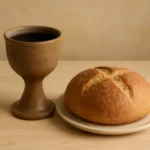
The bread recalls Jesus’ body given for others, while the wine recalls his blood and the covenant established through his death. Christians do not generally treat these elements as ordinary food with no religious significance. Even traditions that call the Eucharist symbolic usually understand the symbols as active signs that teach, proclaim, and strengthen faith.
The use of food also matters. A meal is received rather than merely observed. Worshipers come with open hands, receive what they did not create for themselves, and share in a practice that depends on the community rather than on individual achievement.
Remembrance: The congregation actively recalls Jesus’ life, death, resurrection, and promise.
Participation: Believers share in Christ and in the fellowship of the church.
Thanksgiving: The church praises God for creation, redemption, and ongoing grace.
Unity: People with different backgrounds receive one meal as members of one body.
Hope: The Eucharist anticipates the future celebration of God’s kingdom.
How major Christian traditions understand the Eucharist
Christians share the practice but do not all explain it in the same theological language. The main differences concern Christ’s presence, the meaning of sacrifice, who may receive Communion, and the frequency or form of celebration.
Catholic teaching on the Eucharist
In the Catholic Church, the Eucharist is one of the seven sacraments and is regarded as the source and summit of Christian life. Catholic teaching holds that Christ is truly present in the Eucharist, not only as a reminder or mental exercise. The bread and wine become Christ’s body and blood while their outward appearances remain those of bread and wine.
Catholic theology uses the term transubstantiation to describe this change. The word refers to a change in the underlying reality or substance of the elements, not to a visible physical transformation. The Eucharist is also understood in relation to Christ’s one sacrifice on the cross, made present sacramentally rather than repeated as a new historical crucifixion.
The Catholic Mass normally includes a Liturgy of the Word followed by a Liturgy of the Eucharist. Catholics are generally expected to be properly prepared, including observing the church’s discipline concerning serious sin and fasting before Communion. The specific rules and pastoral guidance can be discussed with a priest.
Eastern Orthodox teaching on the Eucharist
Eastern Orthodox Christians also regard the Eucharist as a central mystery of the church and affirm the real presence of Christ. Orthodox worship is usually called the Divine Liturgy, and its prayers, chants, icons, incense, and movements express the belief that the congregation participates in heavenly worship as well as earthly worship.
Orthodox theology generally emphasizes the mystery of what happens rather than defining the change through the same philosophical explanation used in Western Catholic theology. The Eucharist is received as Christ’s true body and blood, and it is closely associated with the church’s life, unity, and transformation.
Orthodox churches normally receive baptized and chrismated members who have prepared according to the practices of their church. Visitors may attend the Divine Liturgy, but receiving Communion depends on the church’s rules and the person’s relationship to that tradition.
Anglican and Episcopal perspectives
Anglican and Episcopal churches span a wide range of Eucharistic theology. Many emphasize Christ’s real presence in the sacrament without defining it in precisely the same way as Catholic or Orthodox teaching. Other congregations place greater emphasis on remembrance, faith, and the spiritual reception of Christ.
The service is commonly called Holy Communion or the Eucharist and follows a structured liturgy. Scripture readings, a sermon, prayers, confession, the peace, the Eucharistic prayer, and Communion often form the main pattern. Because Anglican provinces and congregations differ, the best way to understand local practice is to consult that church’s worship materials or clergy.
Lutheran, Reformed, and Presbyterian perspectives
Many Lutheran churches teach that Christ is truly present in the Eucharist and that believers receive the sacrament through the bread and wine. Lutheran theology usually avoids explaining the mystery through transubstantiation, while still affirming that Communion is more than a mental reminder.
Reformed and Presbyterian churches have often emphasized the spiritual presence of Christ. In this view, the risen Christ is genuinely encountered through the Holy Spirit as believers receive the meal in faith, even though the bread and wine do not become Christ’s body and blood in a physical or substantial sense.
These churches may celebrate Communion weekly, monthly, or on another regular schedule. The exact rhythm depends on the congregation, denomination, and local tradition. Many invite all baptized Christians who trust in Christ and are at peace with the church, while others use different guidelines.
Baptist, evangelical, and other Protestant perspectives
Many Baptist and evangelical churches call the practice the Lord’s Supper and understand it primarily as an ordinance given by Jesus to the church. It is commonly viewed as a serious act of obedience, remembrance, proclamation, and fellowship rather than as a sacrament that changes the substance of the elements.
Practices vary widely. Some congregations use bread and grape juice, invite all professing Christians to participate, and celebrate monthly or quarterly. Others celebrate weekly, use wine, or restrict participation to members of a particular church or to baptized believers. The church’s statement of faith usually explains its position.
Differences between traditions should not hide the shared center. Across a broad range of churches, the Eucharist directs worshipers toward Jesus Christ, calls them to examine their lives, and binds the community to a common confession of faith.
Why the Eucharist is connected with Jesus’ sacrifice
The Eucharist is inseparable from the cross. The words and actions associated with the Last Supper interpret Jesus’ approaching death as a deliberate act of love and covenant faithfulness. When Christians celebrate Communion, they proclaim that Christ died, was raised, and will come again, as Paul explains in 1 Corinthians 11.
Different traditions describe this connection using several models. Some emphasize atonement, meaning reconciliation between God and humanity through Christ. Others highlight covenant, victory over evil and death, thanksgiving, memorial, or participation in Christ’s self-offering. These descriptions are not always mutually exclusive, although churches may give different weight to each one.
The word “sacrifice” can cause confusion if it suggests that Jesus must be crucified again. Historic Catholic and Orthodox teaching, and many Anglican traditions, speak of the Eucharist as making present or representing Christ’s one sacrifice sacramentally. Many Protestant traditions prefer language of remembrance, proclamation, and thanksgiving while still affirming the unique importance of the cross.
How the Eucharist expresses Christian unity
Communion is both a sign of unity and a practice that forms unity. People who receive one bread and share one cup—or receive bread and wine served from the same celebration—are making a public statement that they belong to Christ and to one another.
That unity does not mean every worshiper has the same personality, history, or opinion. The congregation may include people from different generations, cultures, economic situations, and levels of spiritual maturity. The Eucharist places them together before God as recipients rather than as people proving their worth.
At the same time, the New Testament treats the meal as incompatible with contempt, exclusion, and indifference toward people in need. In 1 Corinthians 11, Paul criticizes a congregation whose shared meal reflected social divisions and neglected poorer members. His teaching shows that receiving Communion should lead to self-examination, reconciliation, and practical concern for others.
A useful question before Communion: Am I approaching this meal with faith and honesty, while remaining willing to repair relationships and treat other members of the church as people for whom Christ gave himself?
Who may receive the Eucharist
There is no single rule across all Christian churches. Some traditions practice open Communion, inviting all baptized or professing Christians who trust in Christ. Others practice closed or restricted Communion, reserving the Eucharist for members of that denomination, congregation, or a church with recognized agreement in faith.
Baptism often matters because it marks entry into the Christian community. In churches that understand the Eucharist as a sacrament of the church, receiving Communion normally follows baptism and, in some traditions, additional instruction or confirmation. Churches that treat the Lord’s Supper as an ordinance may also have specific expectations about conversion, baptism, church membership, or personal faith.
Visitors should not feel pressured to receive. You can ask a pastor, priest, deacon, or usher what the congregation’s practice is. In some churches, people who do not receive may come forward for a blessing, remain seated, or spend the time in prayer.
Check the church bulletin, website, or worship announcement for its Communion policy.
Ask a church leader privately if you are uncertain about baptism, membership, or preparation.
Follow the instructions about standing, kneeling, receiving in the hand, or drinking from the cup.
Do not receive simply because people around you are doing so if you do not understand the church’s practice.
Participate respectfully through prayer, listening, or receiving a blessing when that option is offered.
How to prepare for receiving Communion
Preparation is not about achieving perfect feelings or proving that you deserve the meal. It is about approaching with reverence, faith, and awareness of what the church is doing. Preparation may involve prayer, confession, fasting, reconciliation, or instruction, depending on the tradition.
Before the service, you might read the appointed Scripture passages, consider where you need forgiveness, and pray for a deeper love of God and neighbor. During the service, listen to the words of institution and the Eucharistic prayer. Let the actions of receiving, eating, and drinking remain deliberate rather than rushed.
If you have a serious concern about participation, speak with a trusted church leader. A priest or pastor can explain the tradition’s expectations without turning preparation into a source of unnecessary fear.
What the Eucharist means for daily Christian life
The Eucharist does not end when the service ends. Its meaning reaches into ordinary decisions about forgiveness, generosity, work, family, justice, and care for vulnerable people. A congregation that shares Christ’s table is called to become a community where people are welcomed, served, and treated with dignity.
The meal also offers a pattern for Christian identity. You receive before you achieve. You depend on God’s grace rather than your own status. You remember that Christian faith is not only an individual relationship with God but also membership in a people shaped by Christ’s love.
For many believers, frequent Communion provides a steady rhythm of repentance and renewal. The service returns them to the central story of the faith when work, grief, conflict, or distraction has pulled their attention elsewhere. The bread and wine become tangible reminders that God’s grace is proclaimed and shared within the gathered church.
Common misunderstandings about the Eucharist
The Eucharist is not simply a memorial service
The Eucharist includes remembrance, but Christian remembrance is more active than recalling a past event. The congregation proclaims what God has done, gives thanks in the present, and participates in a living relationship with Christ. Traditions disagree about how Christ is present, but many reject the idea that Communion is only a mental exercise.
The Eucharist is not a private spiritual achievement
Personal faith matters, yet the Eucharist is fundamentally communal. It is celebrated by the gathered church, with shared words, shared actions, and a shared meal. Treating Communion as a way to display spiritual superiority contradicts its emphasis on grace, dependence, and unity.
The Eucharist is not identical in every church
A service with bread and wine may look different in a Catholic parish, an Orthodox cathedral, an Episcopal congregation, a Lutheran church, or a Baptist meetinghouse. The differences in theology and practice are real. They should be learned carefully rather than reduced to the assumption that every church means exactly the same thing by Communion.
How to learn a church’s Eucharistic practice
If you are visiting a church or comparing traditions, focus on a few concrete questions. The answers will tell you more than the name used for the service.
What does the church believe happens to the bread and wine?
How often does the congregation celebrate Communion?
Who is invited to receive it?
What preparation is expected before receiving?
Does the service include confession, a Eucharistic prayer, and a blessing?
How does the church connect Communion with baptism and membership?
What does the congregation teach about Christ’s sacrifice and presence?
Listening to the prayers can be especially helpful. A church’s Eucharistic prayer often reveals how it understands creation, redemption, the Holy Spirit, Christ’s presence, the unity of the church, and the hope of God’s kingdom.
Why the Eucharist remains central to Christian worship
The Eucharist brings together the major themes of Christian faith: Jesus’ life and death, his resurrection, forgiveness, covenant, community, thanksgiving, and hope. It joins words with physical actions and turns belief into a shared practice that Christians can receive week after week or at another regular rhythm.
Its power does not depend on a particular style of music, building, or language. A solemn liturgy and a simple Communion service may look very different, yet both can direct worshipers toward the same central reality: Christ gives himself for the life of the world, and his people are called to receive that gift and embody its love.
For that reason, the Eucharist is more than one item in a worship service. It is a defining practice through which Christians remember Christ, give thanks to God, receive spiritual nourishment, and are sent to serve their neighbors.
Frequently asked questions
What is another name for the Eucharist?
Common names include Holy Communion, the Lord’s Supper, the Divine Liturgy, and the breaking of bread. The preferred term depends on the Christian tradition. “Eucharist” emphasizes thanksgiving, while “Communion” highlights fellowship with Christ and other believers. “The Lord’s Supper” points directly to the meal Jesus shared with his disciples before his crucifixion.
Do Christians believe the bread and wine become Jesus?
Christian answers differ. Catholic and Eastern Orthodox churches affirm Christ’s real presence in the Eucharist, though they explain the mystery differently. Many Anglican and Lutheran Christians also affirm a real presence. Reformed, Baptist, and other Protestant churches may emphasize spiritual presence, remembrance, or proclamation without teaching that the elements change substantially.
Can someone receive the Eucharist in a church they are visiting?
That depends on the church’s Communion policy. Some congregations welcome all baptized or professing Christians, while others limit reception to members or Christians whose churches share their faith and sacramental practice. Visitors can check the bulletin or ask a pastor, priest, or usher. No one should feel pressured to receive without understanding the local practice.
Why do some churches use wine while others use grape juice?
Churches use different beverages because of theological, cultural, historical, or pastoral reasons. Wine is traditional in many Catholic, Orthodox, Anglican, and other churches. Some Protestant congregations use grape juice to avoid alcohol or to make participation easier for people in recovery, children, or those with health concerns. The meaning of Communion is not determined only by the beverage.












Leave a Reply