Sacraments in the Bible: meaning, evidence, and traditions
Sacraments in the Bible: meaning, evidence, and traditions
The Bible does not use the word “sacrament,” but it describes several visible practices through which Christians receive grace, express faith, and enter more deeply into the life of the church.
The word sacrament comes from a Latin term associated with a sacred oath or holy sign. In Christian theology, it usually means an outward sign instituted by Christ that communicates spiritual grace. The precise definition varies among Christian traditions, so the phrase “sacraments in the Bible” can refer to both biblical practices and the later theological system used to describe them.
The Roman Catholic Church recognizes seven sacraments: baptism, confirmation, the Eucharist, penance or reconciliation, anointing of the sick, holy orders, and marriage. Eastern Orthodox churches also recognize these sacred mysteries, although their explanations and terminology may differ. Many Protestant churches use the word sacrament more narrowly, usually for baptism and the Lord’s Supper, because these are the practices most clearly commanded by Jesus.
That difference does not mean one group ignores the Bible while another follows it. Christians agree that the New Testament presents baptism and the Lord’s Supper as central acts of discipleship. They differ over whether the other five practices should be called sacraments and over how Christ’s grace works through each practice.
Central distinction: Scripture gives the practices, commands, and promises that underlie sacramental theology, but the complete list of seven and the technical definition of “sacrament” come from the church’s theological tradition.
Which practices are considered sacraments?
A useful first step is to identify the seven Catholic sacraments and the principal biblical passages connected with each one. The references do not all function in the same way. Some describe a direct command from Jesus, while others show a practice of the early church or provide the theological foundation for it.
Baptism: initiation into Christian discipleship, associated with repentance, forgiveness, new life, and incorporation into the church.
Confirmation: a strengthening or sealing of baptismal grace through the Holy Spirit and the laying on of hands.
The Eucharist: the sacred meal in which Christians remember and proclaim Jesus’ death and receive the bread and cup as signs of his body and blood.
Penance or reconciliation: the church’s ministry of repentance, confession, forgiveness, and restored fellowship.
Anointing of the sick: prayer and anointing for people who are ill, with attention to healing, forgiveness, endurance, and spiritual care.
Holy orders: the ordained ministry of bishops, priests, and deacons, understood as service to the church.
Marriage: the covenant union of husband and wife, presented in Scripture as a profound sign of faithful love.
These categories should not be treated as seven unrelated rituals. They are connected by a common pattern: God acts through a concrete sign, the church carries out a recognizable practice, and believers respond through faith. The Bible often joins physical actions with spiritual realities, such as water with cleansing, bread with sustenance, oil with healing, and the laying on of hands with commissioning or blessing.
How to evaluate a sacrament biblically
Readers often ask whether a practice is “in the Bible” as though the answer must be either yes or no. A more careful approach asks several questions about the biblical evidence.
Did Jesus directly command or institute the practice? Baptism and the Lord’s Supper have especially clear connections to Jesus’ commands.
Did the apostles practice it? The book of Acts and the letters show how the earliest churches taught, prayed, worshiped, and cared for believers.
Does Scripture connect it with God’s grace? Some practices are associated with forgiveness, the Holy Spirit, healing, covenant, or the church’s mission.
Is there a physical sign joined to a spiritual promise? Sacramental theology generally looks for both an observable action and a divine purpose.
Does the practice belong to the whole church? A private religious act and a public rite of the gathered church are not identical.
This approach helps explain why baptism and communion receive broad recognition while confirmation, reconciliation, anointing, ordination, and marriage are classified differently. The question is not only whether an action appears in Scripture. It is also how clearly Scripture presents it as a continuing church practice and how different traditions understand its purpose.
What the Bible says about baptism
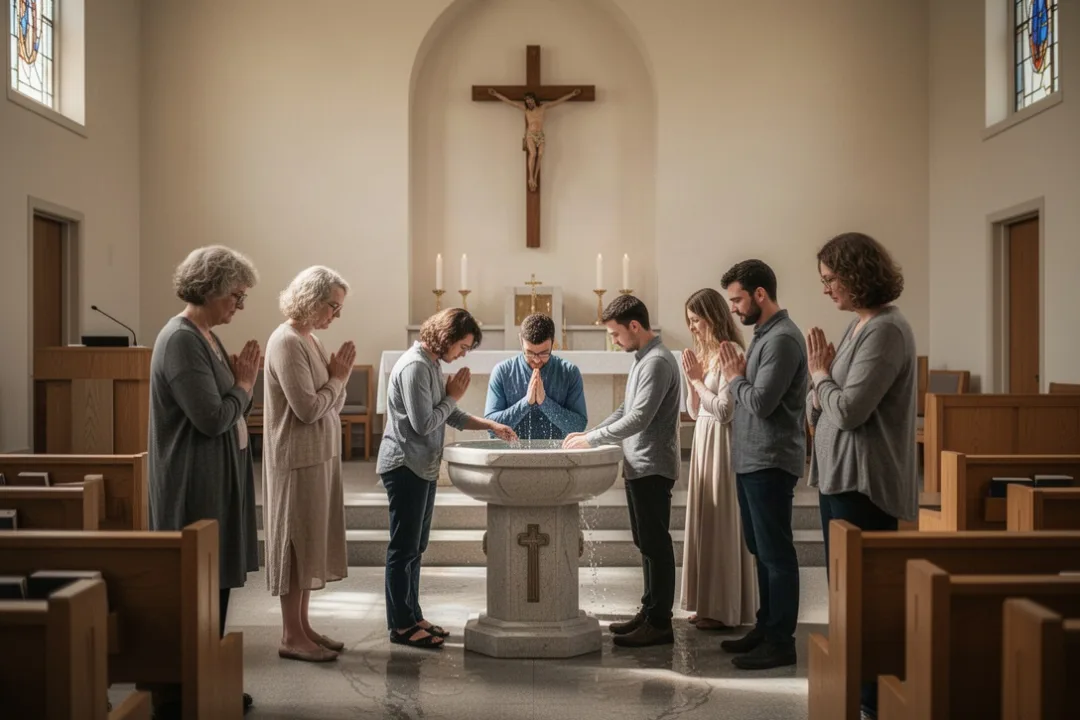
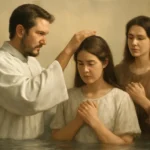
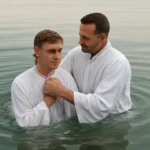
Baptism has the clearest sacramental profile in the New Testament. Jesus sends his disciples to make disciples and baptize them in Matthew 28:19. The book of Acts repeatedly presents baptism as the normal response to hearing the gospel, turning toward Christ, and joining the Christian community.
John the Baptist’s ministry connects baptism with repentance and preparation for God’s kingdom. Christian baptism goes further by identifying the believer with Jesus’ death and resurrection. Romans 6:3–4 describes baptism as participation in Christ’s death and a new way of life, while Galatians 3:27 presents baptized believers as people who have put on Christ.
Water itself does not appear as a magical substance. Its significance comes from God’s promise and the meaning assigned to the act. Scripture uses baptismal language to speak about cleansing, forgiveness, incorporation into one body, and the gift of the Holy Spirit. Acts 2:38 connects repentance, baptism, forgiveness, and receiving the Spirit, although Christian traditions explain the relationship among these realities in different ways.
Why Christians disagree about baptism
Churches disagree about the age of those who should be baptized, the amount of water used, and the precise relationship between baptism and salvation. Some baptize infants because baptism is understood as entrance into the covenant community and because the faith of the whole household matters. Others baptize only people who personally profess faith, emphasizing passages in which belief and baptism appear together.
Christians also differ over whether baptism is mainly a public testimony of faith or a means through which God actually gives grace. Catholic, Orthodox, Anglican, Lutheran, and some other traditions generally speak more strongly about baptism as an instrument of grace. Many Baptist and evangelical churches describe it primarily as an act of obedience and public identification with Christ.
Biblical balance: Baptism is neither an empty performance nor a substitute for faith. The New Testament consistently places the practice within repentance, trust in Christ, the work of the Spirit, and belonging to the Christian community.
What the Bible says about the Eucharist or Lord’s Supper
The Eucharist, also called Holy Communion or the Lord’s Supper, is rooted in the final meal Jesus shared with his disciples. Matthew 26, Mark 14, and Luke 22 describe Jesus taking bread and a cup, giving them a meaning connected with his body, blood, and the covenant. He tells his followers to continue the practice in remembrance of him.
Paul’s discussion in 1 Corinthians 10–11 shows that the meal was already central to Christian worship. Paul connects the shared cup and bread with participation in Christ and warns the Corinthian church against treating the meal casually while ignoring poverty, division, and the needs of fellow believers. The Lord’s Supper therefore involves both communion with Christ and responsible communion with the church.
John 6 is also frequently discussed in relation to the Eucharist. The chapter uses vivid language about receiving Jesus as the bread of life. Christians interpret that language in different ways. Some see it as a direct teaching about the Eucharist; others understand it primarily as a call to believe in and depend on Christ, while still acknowledging its connection with sacramental theology.
How traditions understand Christ’s presence
Catholic theology teaches that Christ is truly present in the Eucharist, with the bread and wine becoming his body and blood in a sacramental manner. Orthodox Christians also affirm a real mystery of Christ’s presence. Many Lutherans speak of Christ’s real presence while explaining the mystery differently.
Anglican, Methodist, Reformed, and other Protestant churches use a range of language. Some emphasize a spiritual presence, others focus on the meal as a covenant sign, and still others stress remembrance and proclamation. These positions share a conviction that Communion is more than an ordinary meal, even when they explain its effect in different ways.
Paul’s teaching in 1 Corinthians 11 also explains why many churches encourage self-examination and reconciliation before receiving Communion. The concern is not that only morally perfect people may approach the table. Rather, Christians are called to recognize the holiness of the meal, repent of known wrongdoing, and refuse to use worship while remaining indifferent to fellow believers.
What the Bible says about confirmation
Confirmation is understood in Catholic and Orthodox traditions as a strengthening or completion of baptismal grace. The New Testament does not give one universally described ceremony called “confirmation,” but it does present practices that form the biblical basis for it.
In Acts 8:14–17, baptized believers in Samaria receive prayer and the laying on of hands from apostles so that they may receive the Holy Spirit. Acts 19:5–6 describes Paul baptizing disciples and laying hands on them, after which the Holy Spirit comes upon them. Hebrews 6:1–2 mentions instruction about baptisms and the laying on of hands among foundational teachings.
These passages do not settle every question about confirmation. They do show a recurring biblical pattern: the Holy Spirit is central to Christian initiation, and the church may pray over believers and lay hands on them as a sign of blessing, empowerment, or commissioning.
Some Protestant churches retain confirmation as a public affirmation of baptismal faith, especially for young people. In those settings, it may not be considered a sacrament in the same sense as baptism and Communion. The shared biblical themes are spiritual growth, confession of faith, prayer, and dependence on the Holy Spirit.
What the Bible says about confession and reconciliation
The sacrament of penance, also called reconciliation or confession, rests on the biblical call to repentance and the church’s ministry of forgiveness. Jesus tells his disciples to forgive sins in John 20:21–23, and Matthew 16:19 and 18:18 use the language of binding and loosing for the church’s spiritual authority.
James 5:16 encourages Christians to confess sins to one another and pray for one another. First John 1:9 teaches that God forgives those who confess their sins, while 2 Corinthians 5:18–20 describes Christian ministry as a ministry of reconciliation. These passages make clear that confession is directed toward restored fellowship with God and others, not merely the release of private guilt.
Catholic theology understands ordained priests to serve as ministers of sacramental absolution. Many Protestant churches encourage confession to God directly and also practice pastoral confession, accountability, or corporate confession during worship. Some churches connect John 20 with a special authority given to ordained ministers; others understand it as authority entrusted to the church more broadly.
The biblical purpose should remain visible regardless of the tradition: honest repentance, trust in God’s mercy, repair of damaged relationships where possible, and a renewed commitment to live faithfully.
What the Bible says about anointing the sick
Anointing the sick has a direct New Testament connection. James 5:14–15 tells church elders to pray over a sick person and anoint that person with oil in the name of the Lord. The passage joins prayer with faith, forgiveness, and the Lord’s care, while leaving the precise outcome in God’s hands.
The Gospels also describe Jesus’ disciples anointing people with oil during a ministry of repentance, healing, and proclamation. Mark 6:13 records this practice among the disciples’ activities. Oil was a familiar biblical symbol associated with healing, consecration, hospitality, and the presence of God’s blessing.
Anointing does not promise that every illness will immediately disappear. Scripture includes faithful people who remain sick, suffer, or die. The practice expresses the church’s willingness to stand with the suffering person, pray for healing, ask for forgiveness and peace, and entrust the person’s body and spirit to God.
In Catholic theology, the sacrament is particularly associated with serious illness, frailty, and preparation for death, not only with the final moments of life. Other churches may practice anointing as a prayer service without classifying it as one of the seven sacraments.
What the Bible says about holy orders
Holy orders concerns the church’s ordained ministry. The New Testament describes apostles, elders or overseers, and deacons, although Christian traditions organize these offices differently. Acts 6 presents the appointment of servants for an important ministry, while Acts 14:23 describes the appointment of elders in local churches.
First Timothy 3 gives qualifications for overseers and deacons, and Titus 1 describes the character expected of elders. These passages emphasize integrity, self-control, faithful teaching, hospitality, and responsible care more than status or personal power.
Paul reminds Timothy in 1 Timothy 4:14 of a gift associated with prophecy and the laying on of hands by the elders. Second Timothy 1:6 also uses the image of a gift connected with the laying on of hands. These references support the practice of prayerful commissioning and the recognition of ministry by the church.
Roman Catholic and Orthodox theology understand ordination as a sacrament that gives a lasting spiritual character for service. Many Protestant churches recognize ordination as a solemn act of setting apart ministers, but reserve the term sacrament for baptism and Communion. Both approaches can affirm that Christian leaders are called to serve rather than dominate.
What the Bible says about marriage
Marriage has a deep biblical foundation, beginning with Genesis 2, where a man and woman are joined in a one-flesh relationship. Jesus refers to this creation pattern in Matthew 19:4–6 and Mark 10:6–9 while teaching about the seriousness and permanence of marriage.
Paul’s teaching in Ephesians 5:21–33 compares marital love with Christ’s self-giving love for the church. The passage is sometimes used carelessly to defend unequal treatment, but its central demand is sacrificial care, mutual responsibility, and a love that seeks the other person’s good. Ephesians begins with a call for believers to submit to one another, which shapes the instructions that follow.
Catholic theology views a valid marriage between baptized Christians as a sacrament because the covenant itself signifies Christ’s faithful relationship with the church. Other traditions may call marriage a covenant, ordinance, or sacred institution rather than a sacrament. All of these approaches recognize that Scripture treats marriage as more than a private contract.
The Bible also presents marriage within a broader account of faithfulness, sexual integrity, hospitality, family responsibility, and care for the vulnerable. A Christian understanding of marriage therefore includes promises kept over time, forgiveness, truthful communication, and practical service—not simply a wedding ceremony.
How the Old Testament prepares for sacramental practices
The seven sacraments are named and defined through Christian interpretation of the New Testament, but many of their themes appear earlier in Scripture. The Old Testament frequently joins visible signs with covenant promises. Circumcision marked belonging to the covenant community, the Passover meal remembered deliverance, and ritual washings represented purification.
These practices do not function as direct copies of Christian sacraments. The New Testament presents Jesus as bringing the old covenant’s hopes to fulfillment, so Christian rites must be understood through Jesus’ death, resurrection, and gift of the Spirit. Still, the earlier patterns help explain why physical actions can carry spiritual meaning.
Water, oil, bread, wine, touch, vows, meals, and the laying on of hands are not random symbols in the biblical world. They involve the body and the community. Biblical faith is not presented as a purely private idea held in the mind; it is expressed through worship, relationships, obedience, remembrance, and concrete acts.
Why the number of sacraments differs among churches
The number seven became established in Western Catholic theology through a long process of reflection and teaching. The Bible itself does not provide a single sentence listing seven sacraments. Instead, the church identified several practices that appeared to have the essential features of a sacrament: a visible sign, Christ’s institution or authority, a connection with grace, and continuing use in the church.
Many Protestant reformers argued that the term should apply only to practices explicitly instituted by Christ and associated with a promise of grace. On that basis, they retained baptism and the Lord’s Supper. Some Protestant communities also use sacramental language for marriage, ordination, foot washing, or other practices, but they generally do not count them as sacraments in the same formal way.
The disagreement reflects different views of church authority, tradition, biblical interpretation, and grace. Catholic and Orthodox Christians give a larger role to the church’s received tradition when interpreting Scripture. Protestant churches commonly emphasize Scripture as the final authority and ask for clearer direct evidence before establishing a sacramental category.
What sacraments are meant to do in Christian life
Sacraments are not intended to replace personal faith, ethical obedience, or prayer. The prophets repeatedly criticize worship that is separated from justice, and Jesus condemns religious behavior that hides hypocrisy. A sacramental practice can be performed outwardly while the heart remains resistant to God.
At the same time, Scripture does not reduce faith to inward sincerity. Baptism places a believer within a visible community. Communion proclaims the gospel through a shared meal. Anointing brings prayer into the experience of illness. Marriage turns promises into a public covenant, and ordination identifies people for accountable service.
For many Christians, sacramental worship helps them remember that God’s grace reaches the whole person. The physical elements do not make God present by human control. They are signs through which the church receives, proclaims, and responds to God’s promise.
They mark belonging: baptism identifies people with Christ and his church.
They nourish faith: Communion continually directs believers to Jesus’ death and resurrection.
They restore relationships: confession and reconciliation address sin honestly.
They strengthen people in hardship: anointing joins the sick to the prayers of the church.
They equip service: confirmation and ordination point toward the Spirit’s work and responsibility.
They embody covenant love: Christian marriage gives visible form to faithful commitment.
How to read sacrament-related passages responsibly
When studying a passage about baptism, Communion, healing, ministry, or marriage, begin by reading the whole section rather than isolating a single phrase. Ask who is speaking, what problem the passage addresses, and whether the action is a command, a description, a promise, or a metaphor.
It also helps to compare related passages. For example, baptism can be studied alongside Matthew 28, Acts 2, Romans 6, and Galatians 3. Communion can be read through the Gospel accounts of the Last Supper and Paul’s teaching in 1 Corinthians. A single verse may illuminate a doctrine, but a balanced theology should account for the broader biblical witness.
Identify the action: What is being done with water, bread, wine, oil, touch, vows, or prayer?
Identify the promise: What does the passage say God is doing or offering?
Identify the participants: Is the action personal, communal, apostolic, pastoral, or covenantal?
Identify the response: Does the passage call for repentance, faith, remembrance, service, or perseverance?
Compare traditions carefully: Learn why different churches read the same passages differently instead of assuming disagreement comes from carelessness.
This method keeps the focus on Scripture while recognizing that Christian communities have developed different theological explanations. It also prevents two common mistakes: treating every religious practice as a sacrament, or dismissing a practice simply because the word itself does not occur in the Bible.
What the Bible’s sacramental pattern means for believers
The biblical material points to a faith that is personal but not merely private, spiritual but not detached from the body, and centered on grace without becoming passive. God’s work is proclaimed through words and embodied through actions that gather people into a community.
For someone exploring Christianity, baptism and the Lord’s Supper are the clearest places to begin. Read the Gospel accounts of Jesus’ commands, examine the practices in Acts and 1 Corinthians, and ask how your church understands faith, grace, community, and obedience. If you belong to a Catholic, Orthodox, or Protestant church, its teaching can provide a framework, but Scripture remains essential for understanding the meaning of every practice.
The most faithful use of the sacraments is not mechanical repetition. It is participation with trust, repentance, gratitude, and love. The outward sign matters because it directs attention to the God who forgives, gathers, heals, strengthens, commissions, and remains faithful to his people.
Frequently asked questions
Does the word sacrament appear in the Bible?
No. The word “sacrament” comes from later Christian and Latin terminology. The Bible does describe the practices and spiritual realities that Christians associate with sacraments, especially baptism and the Lord’s Supper. Churches then developed theological language to explain how visible actions relate to God’s grace, the church’s worship, and believers’ participation in Christ.
Are there seven sacraments in the Bible?
The Bible does not present a numbered list of seven sacraments. The seven-sacrament system is the formal teaching of the Roman Catholic Church and is also reflected, with variations, in Eastern Christianity. Most Protestant churches recognize baptism and the Lord’s Supper as sacraments, while treating the other five as important biblical practices or church rites.
What are the two sacraments most Christians agree on?
Baptism and the Lord’s Supper have the broadest recognition because Jesus directly commands or institutes both practices in the New Testament. Baptism marks entry into Christian discipleship, while the Lord’s Supper remembers and proclaims Jesus’ death. Churches still disagree about their effects, but they generally regard both as central acts of Christian worship.
Do sacraments save a person automatically?
Christian traditions answer this differently, but sacramental churches generally reject the idea that rituals work as automatic spiritual machinery. Sacraments are understood within faith, God’s promise, repentance, and the life of the church. Performing a rite while deliberately rejecting God’s call does not represent the wholehearted response Scripture associates with grace and discipleship.









Leave a Reply