A Catholic dictionary is a practical guide to the words used in Catholic belief, worship, Scripture, church structure, and daily prayer. It helps you understand terms such as Eucharist, magisterium, liturgy, and apostolic succession without having to search through several separate sources.
The entries below give plain-English definitions, explain why each term matters, and identify distinctions that often cause confusion. Some words describe official Catholic teaching, while others refer to customs, devotional practices, people, places, or objects used in Catholic life.
Catholic vocabulary often has a specific meaning that differs from ordinary conversation. For example, tradition does not simply mean a habit passed down in a family, and communion can refer either to receiving the Eucharist or to the unity of the Church.
When you encounter an unfamiliar term, use this sequence to find its meaning accurately:
Identify the setting. Ask whether the word appears in Mass, theology, church government, Scripture, canon law, or personal devotion.
Check the grammatical form. A term such as “baptize,” “baptism,” or “baptized” may describe an action, a sacrament, or a person who has received it.
Separate official teaching from custom. Some practices are required or strongly defined, while others are popular devotions that Catholics may freely choose.
Look for related terms. Understanding “bishop” makes “diocese,” “episcopal,” and “apostolic succession” easier to understand.
Read the word in context. A definition is useful, but the surrounding sentence often shows whether a term is being used liturgically, historically, or casually.
Helpful distinction: Catholic terms are not all equal in authority. A dogma, a doctrine, a liturgical practice, a canon-law rule, and a local custom have different roles in Catholic life.
Core Catholic beliefs and teaching
Trinity
The Trinity is the Catholic belief that there is one God in three distinct Persons: the Father, the Son, and the Holy Spirit. The three Persons are not three gods, and each is fully divine.
The Trinity is central to Catholic prayer and worship. Catholics are baptized in the name of the Father, Son, and Holy Spirit, and many prayers begin or end with the Sign of the Cross, which invokes the same mystery.
Incarnation
The Incarnation means that the eternal Son of God became human in Jesus Christ. Catholic teaching holds that Jesus is truly God and truly human, not a mixture that is partly divine and partly human.
This belief explains why Jesus’ birth, earthly life, death, and Resurrection are at the center of Christian faith. It also gives a special dignity to human life because God entered human history and took on a human nature.
Revelation
Revelation is God’s self-disclosure to humanity. Catholics believe God reveals himself through creation, through the history of Israel, through the prophets, and most fully through Jesus Christ.
Public revelation is understood as complete in Christ and the apostolic witness. Private revelations may be reported by individual Catholics, but they do not add a new required belief to the faith and must be carefully evaluated by Church authority.
Scripture
Scripture, or the Bible, is the collection of sacred writings recognized by the Church as inspired by God. Catholic editions contain 73 books: the Old Testament and the New Testament, including books that are not found in many Protestant Bibles.
Catholics read Scripture in the life of the Church, especially through the liturgy. Catholic interpretation considers the literary form, historical setting, unity of the Bible, and the living faith of the Church rather than treating every passage as though it had the same genre or purpose.
Tradition
Tradition, with a capital T in theological writing, refers to the living transmission of the Gospel from the apostles through the Church. It includes the Church’s worship, teaching, prayer, and way of life, not merely old customs.
Tradition and Scripture are closely connected in Catholic teaching. Both serve the one deposit of faith, and the Church’s teaching office helps interpret them faithfully.
Magisterium
The magisterium is the teaching authority of the Church’s bishops in communion with the pope. Its task is to authentically explain the Word of God in Scripture and Tradition.
The magisterium does not stand above God’s revelation. It serves that revelation by guarding its meaning, clarifying disputed questions, and applying enduring principles to changing circumstances.
Doctrine
A doctrine is a teaching proposed by the Church as part of Catholic faith or moral life. Doctrines can concern God, the sacraments, human behavior, the Church, salvation, or other matters of faith.
Not every doctrine has the same level of definition or solemnity. Some are taught universally and definitively, while others may be explained through ordinary teaching and theological development.
Dogma
A dogma is a doctrine that the Church has definitively proposed as revealed by God and therefore binding on Catholics. Examples include the Trinity, the Incarnation, and the Immaculate Conception.
The word does not mean that a belief is arbitrary or invented. It indicates that the Church has identified a truth as essential to the faith and given it a definitive formulation.
Creed
A creed is a formal statement of Christian belief. The Nicene Creed is commonly recited during Sunday Mass and summarizes beliefs about the Trinity, Jesus Christ, the Holy Spirit, the Church, baptism, resurrection, and eternal life.
The Apostles’ Creed is another widely used profession of faith. Catholics may also express the faith through shorter formulas, especially in baptismal rites and personal prayer.
The sacraments and Catholic worship
Sacrament
A sacrament is an effective sign of grace, instituted by Christ and entrusted to the Church. Through the sacraments, God’s grace is given in visible actions, words, and material signs.
The Catholic Church recognizes seven sacraments:
Baptism, which begins Christian life.
Confirmation, which strengthens baptismal grace.
Eucharist, in which Catholics receive Christ under the signs of bread and wine.
Penance and Reconciliation, through which sins are forgiven after repentance and confession.
Anointing of the Sick, which brings spiritual strength and grace to the seriously ill.
Holy Orders, through which bishops, priests, and deacons receive a sacramental ministry.
Matrimony, the sacramental covenant of marriage between a baptized man and woman.
Grace
Grace is God’s free and undeserved gift of divine life and help. Catholics distinguish sanctifying grace, which establishes a person in friendship with God, from actual grace, which assists a person in a particular action or moment.
Grace does not eliminate human freedom. Catholic teaching describes it as God’s help that enables people to respond, grow in holiness, resist sin, and love others.
Baptism
Baptism is the first sacrament of Christian initiation. Through water and the Trinitarian formula, a person is incorporated into Christ, receives forgiveness of sin, and becomes a member of the Church.
Catholic practice includes the baptism of infants because salvation is God’s gift, not an achievement reserved for those who can make an adult profession. Adults who seek baptism normally receive preparation through the catechumenate.
Confirmation completes and strengthens baptismal initiation. The bishop, or a priest authorized to confirm, anoints the forehead with sacred chrism and invokes the Holy Spirit.
The sacrament deepens a Catholic’s connection to the Church and gives strength to witness to the Christian faith. It does not mean that a person has reached spiritual perfection or becomes an adult in every sense.
Eucharist
The Eucharist is the sacrament in which Catholics receive the Body and Blood of Christ under the appearances of bread and wine. It is also called Holy Communion, the Lord’s Supper, and the Divine Liturgy in Eastern Catholic churches.
The Eucharist makes present sacramentally the one sacrifice of Christ and nourishes the Church’s unity. Catholics who receive Communion are ordinarily expected to be properly disposed, including freedom from unconfessed mortal sin and observance of the Eucharistic fast.
Real Presence
Real Presence means that Christ is truly, really, and substantially present in the Eucharist. The Catholic Church teaches that this presence is not merely symbolic, although the Eucharist certainly has symbolic meaning as well.
The change by which the bread and wine become Christ’s Body and Blood is called transubstantiation. The appearances of bread and wine remain, while their underlying substance is changed by God’s power.
Mass
The Mass is the principal form of Catholic worship in the Latin Church. Its two central parts are the Liturgy of the Word, which includes Scripture readings and a homily, and the Liturgy of the Eucharist.
The Mass also includes an introductory rite and a concluding rite. Catholics gather not as spectators but as a worshiping assembly that listens, prays, gives thanks, and participates in Christ’s offering.
Liturgy
Liturgy is the public worship of the Church. It includes the Mass, the celebration of the other sacraments, the Liturgy of the Hours, and certain official rites and blessings.
Liturgy differs from private devotion. A rosary prayed alone is a genuine Catholic prayer, but it is not the same kind of worship as the Church’s public celebration of the Eucharist.
Liturgical year
The liturgical year organizes Catholic worship around the life, death, and Resurrection of Jesus. Its major seasons are Advent, Christmas, Lent, the Sacred Paschal Triduum, Easter, and Ordinary Time.
Each season uses distinctive Scripture readings, prayers, colors, and practices. The year helps Catholics repeatedly enter into the central events of salvation rather than remembering them only as historical anniversaries.
Common confusion: The terms “Mass,” “Eucharist,” and “Communion” overlap but are not identical. Mass is the full liturgical celebration; Eucharist names the sacrament; Communion usually refers to receiving it and to unity with Christ and the Church.
Sin, forgiveness, and moral life
Sin
Sin is a deliberate thought, word, action, or omission that contradicts God’s love and moral law. It harms a person’s relationship with God, other people, and the person’s own dignity.
Catholic teaching distinguishes personal sin from the effects of sin in society. A person’s responsibility can be affected by knowledge, freedom, pressure, habit, and other circumstances.
Venial sin
A venial sin weakens a person’s relationship with God but does not destroy it. It may involve a less serious matter, insufficient reflection, or incomplete consent.
Venial sins are forgiven through prayer, acts of charity, the penitential rite at Mass when properly disposed, and other means of grace. Catholics are still encouraged to bring them to confession, especially when seeking spiritual growth.
Mortal sin
A mortal sin is a grave violation of God’s law committed with full knowledge and deliberate consent. These three conditions must be present together; a grave matter alone does not establish mortal sin.
A Catholic conscious of mortal sin should seek sacramental confession before receiving Communion, except in the limited circumstances recognized by Church teaching. The purpose of this practice is reverence for the Eucharist and restoration to full communion.
Conscience
Conscience is the inner judgment by which a person recognizes the moral quality of a particular choice. It is not simply a personal preference or an emotion.
Catholics are responsible for forming their conscience through Scripture, prayer, sound moral teaching, and honest attention to truth. A well-formed conscience applies general principles to the concrete facts of a situation.
Confession
Confession is the sacramental acknowledgment of sins to a priest. The sacrament is also called Penance or Reconciliation, names that emphasize conversion, healing, and restored friendship with God and the Church.
A typical celebration includes examination of conscience, contrition, confession, a penance, and absolution. The priest is bound by the seal of confession, which prohibits him from revealing what he learns in the sacrament.
Absolution
Absolution is the prayer by which a priest, acting in the person of Christ and through the ministry of the Church, forgives the penitent’s sins. It follows an honest confession and genuine repentance.
Absolution is not merely advice or reassurance. It is the sacramental act that reconciles the person with God and restores full communion with the Church when the necessary conditions are present.
Virtue
A virtue is a stable habit that disposes a person to do what is good. The four cardinal virtues are prudence, justice, fortitude, and temperance.
The theological virtues are faith, hope, and charity. Catholics understand virtue as something developed through repeated good choices and strengthened by God’s grace.
Church structure, ministry, and authority
Church
The Church is the community of those united to Christ through faith, the sacraments, and ecclesial communion. Catholics also describe the Church as the People of God, the Body of Christ, and the temple of the Holy Spirit.
The Church is both visible and spiritual. It has a public structure, ordained ministers, sacraments, laws, and institutions, while also possessing a spiritual life that cannot be reduced to its organization.
Pope
The pope is the bishop of Rome and the visible sign of unity for the Catholic Church. Catholics believe his ministry has a special relationship to the apostle Peter and serves the unity of the bishops and the faithful.
The pope teaches, governs, appoints bishops, approves liturgical and disciplinary decisions, and represents the Church in relations with other communities. The title Holy Father is a traditional form of address.
Bishop
A bishop is an ordained minister who receives the fullness of the sacrament of Holy Orders. Bishops teach, sanctify, and govern the portions of the Church entrusted to them.
A bishop normally leads a diocese and works in communion with the pope and other bishops. Some bishops hold additional roles, such as leading an archdiocese or serving in the Roman Curia.
Priest
A priest is an ordained minister who shares in the ministry of the bishop. Priests ordinarily preside at Mass, hear confessions, anoint the sick, baptize, witness marriages, and serve local Catholic communities.
In the Latin Church, most priests are celibate, although the Catholic Church also has Eastern Catholic traditions with married priests under certain conditions. Celibacy and ordination are related disciplines, but celibacy is not itself a sacrament.
Deacon
A deacon receives the first level of Holy Orders. Deacons proclaim the Gospel, preach when permitted, assist at the altar, baptize, witness marriages, conduct funeral and prayer services, and serve people in need.
A permanent deacon may be married before ordination. A transitional deacon is preparing for priestly ordination.
Laity
The laity are Catholic members who are not ordained ministers. Lay Catholics participate in the Church’s mission through family life, work, civic responsibility, parish service, evangelization, and works of charity.
“Lay” does not mean unimportant or spiritually inactive. Baptism gives every Catholic a responsibility to live the Gospel and contribute to the Church’s life according to that person’s vocation and abilities.
Diocese
A diocese is a local Church entrusted to a bishop. It includes parishes, schools, ministries, clergy, religious communities, and other Catholic institutions within a defined territory.
An archdiocese is a diocese led by an archbishop. Its archbishop may have a coordinating or honorary role among neighboring dioceses, but each diocese generally remains directly governed by its own bishop.
Parish
A parish is a stable community of Catholics within a diocese, usually organized around a geographic area. A pastor, appointed by the bishop, ordinarily leads it.
The parish is where many Catholics encounter the Church regularly through Sunday Mass, sacramental preparation, religious education, pastoral care, service, and community life.
Apostolic succession
Apostolic succession is the continuity of the Church’s ministry from the apostles through the bishops. Catholic teaching connects this succession with the transmission of authority, doctrine, and sacramental ministry.
It does not mean that every bishop personally knew an apostle. It refers to an unbroken ecclesial and sacramental succession in which bishops are ordained within the apostolic ministry of the Church.
Religious life
Religious life is a form of consecrated life in which men or women make public vows, commonly of poverty, chastity, and obedience. Religious communities may be contemplative, active, or combine prayer and service.
A monk or nun usually belongs to a monastic community, while a friar belongs to a mendicant order. A sister may belong to a religious institute without living a monastic life.
Mary, the saints, and Catholic devotion
Mary
Mary is the mother of Jesus and is honored by Catholics as the Mother of God because the person she bore is the divine Son. Catholics do not worship Mary; they honor her as the foremost disciple and ask for her intercession.
Her place in Catholic faith is connected to Christ. Devotion to Mary is meant to lead believers toward Jesus, obedience to God, and deeper participation in the Church.
Immaculate Conception
The Immaculate Conception refers to Mary’s conception, not Jesus’ conception. Catholic teaching holds that Mary was preserved from original sin from the first moment of her existence by God’s grace and in view of Christ’s saving work.
This doctrine does not mean that Mary did not need a Savior. It means that she received salvation in a unique and preventative way.
Virgin Birth
The Virgin Birth means that Jesus was conceived in Mary by the Holy Spirit and born of a virgin. It is distinct from the Immaculate Conception, which concerns Mary herself.
The Virgin Birth is a belief about Jesus’ conception and the identity of the child born to Mary. The Immaculate Conception is a belief about Mary’s beginning.
Saint
A saint is a holy person who lives in union with God. In ordinary Catholic usage, the term often refers to someone officially canonized by the Church, but all who share eternal life with God are part of the communion of saints.
Canonization is the Church’s definitive declaration that a person is with God and may be honored publicly throughout the Catholic Church. The process examines the person’s life, writings, reputation for holiness, and reported miracles when applicable.
Intercession
Intercession is prayer on behalf of another person. Catholics ask the saints to pray for them because the saints remain united to Christ and are alive in God.
Asking a saint’s intercession is not treating the saint as a rival to God. Catholics direct worship to God alone and understand every effective prayer as dependent on God’s grace.
Veneration and adoration
Adoration, or worship, belongs to God alone. Veneration is the respect and honor shown to the saints, while a special form of veneration called hyperdulia is given to Mary because of her unique role in salvation history.
Images, statues, relics, and feast days can support veneration, but the material object itself is not worshiped. The honor given to an image is directed toward the person represented.
The Rosary is a traditional Catholic prayer that combines vocal prayers with meditation on events in the lives of Jesus and Mary. Its common structure includes the Apostles’ Creed, the Lord’s Prayer, Hail Marys, Glory Bes, and a concluding prayer.
The mysteries are traditionally grouped as joyful, sorrowful, glorious, and luminous. The Rosary is a private devotion, although it is also often prayed in groups.
Novena
A novena is a set of prayers or devotional practices carried out over nine days or another designated period. Novenas may ask for a particular grace, prepare for a feast, or seek the intercession of a saint.
A novena is not a magical formula or a guarantee that a specific request will be granted. Its purpose is persistent prayer, trust in God, and spiritual preparation.
Holy water
Holy water is water blessed by a priest or deacon. Catholics use it as a reminder of baptism and as a sign of their desire for God’s protection and grace.
It is a sacramental, not a sacrament. Sacramentals are sacred signs instituted by the Church that prepare people to receive grace and help sanctify different circumstances of life.
Important places, objects, and seasons
Church building
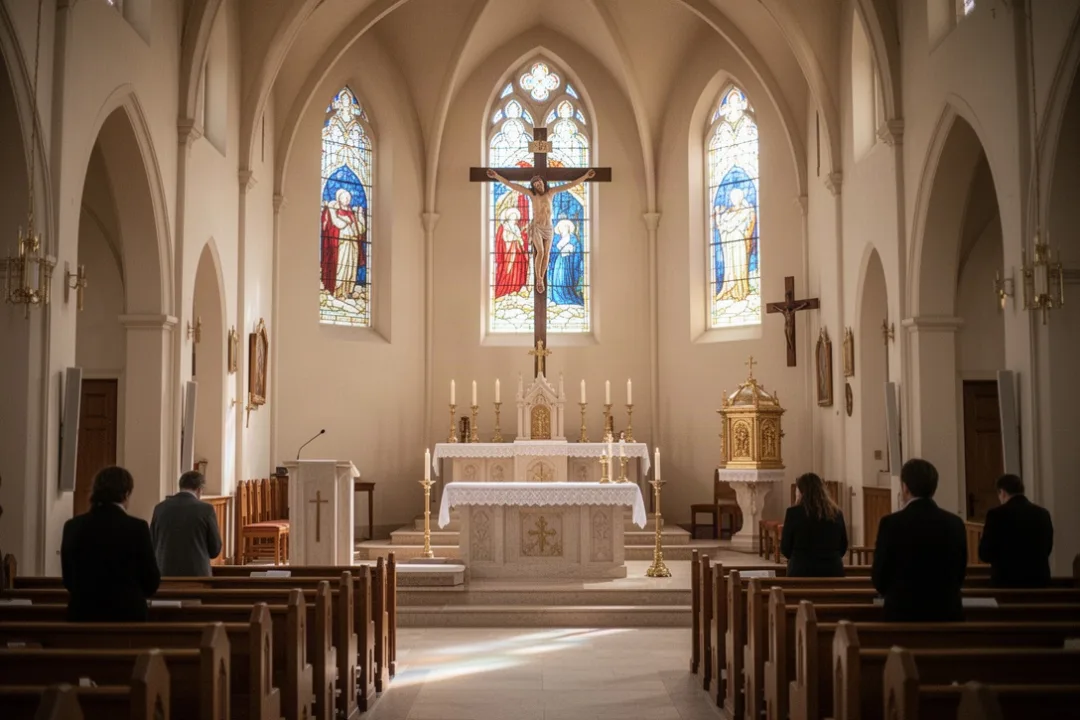
A Catholic church is a building set apart for worship, especially the celebration of the Eucharist. The central area includes the sanctuary, where the altar, ambo, and presider’s chair are located.
The tabernacle is the secure place where consecrated hosts are reserved. A sanctuary lamp near it signifies the presence of the Eucharist. Catholics genuflect or bow as a sign of reverence when entering or leaving the presence of the reserved sacrament.
Altar and ambo
The altar is the table on which the Eucharistic sacrifice is celebrated. It represents Christ and the meal of the Lord’s Supper while also recalling the sacrificial character of the Eucharist.
The ambo is the designated place from which Scripture is proclaimed. It is not simply a music stand or lectern; it has a particular role in the Liturgy of the Word.
Crucifix
A crucifix is a cross that includes a representation of Jesus’ body. It emphasizes Christ’s sacrificial death and is commonly displayed in Catholic churches, homes, schools, and other places of prayer.
A plain cross and a crucifix are both Christian symbols. Catholic use of the crucifix highlights the inseparable connection between Christ’s death and his Resurrection.
Advent
Advent is the liturgical season before Christmas. It recalls Israel’s hope for the Messiah, prepares for the celebration of Christ’s birth, and points toward Christ’s future coming.
Advent is marked by expectation and prayer. It is not simply a four-week countdown to Christmas, and its character differs from the penitential focus of Lent.
Lent
Lent is the season of preparation for Easter. Catholics emphasize prayer, fasting, almsgiving, repentance, and renewed attention to the Gospel.
Lent begins with Ash Wednesday, when ashes are placed on the forehead or head as a sign of mortality and repentance. The season leads into Holy Week and the Sacred Paschal Triduum.
Triduum
The Sacred Paschal Triduum is the central three-day celebration of the Church’s liturgical year. It begins with the evening Mass of the Lord’s Supper on Holy Thursday, continues through Good Friday and Holy Saturday, and reaches its high point in the Easter Vigil.
The Triduum commemorates the Passion, death, burial, and Resurrection of Jesus as one unified mystery. The Easter Vigil is the most important celebration of the liturgical year.
Easter
Easter celebrates the Resurrection of Jesus from the dead. Catholics believe the Resurrection is a real event and the foundation of Christian hope, not merely a symbol of renewal.
The Easter season continues beyond Easter Sunday and culminates in the celebration of Pentecost. The Church’s Sunday worship is connected to Easter because each Sunday recalls Christ’s Resurrection.
Terms that Catholics and visitors often confuse
Catholic and Christian: Catholics are Christians, but Christianity includes other traditions and communities.
Priest and pastor: A priest is ordained; a pastor is the priest entrusted with leadership of a parish. Not every priest is a pastor.
Basilica and cathedral: A cathedral is the principal church of a diocese and contains the bishop’s chair. A basilica is a church given that title because of its historical, devotional, or architectural significance.
Monk and friar: A monk generally belongs to a monastic community, while a friar belongs to a mendicant order whose tradition emphasizes ministry and community life.
Excommunication and damnation: Excommunication is a Church disciplinary penalty that restricts participation in certain sacramental and ecclesial activities. It does not declare that a person is condemned by God.
Infallibility and impeccability: Infallibility concerns protection from error in specific acts of teaching. It does not mean that the pope or any other Catholic is incapable of sin.
Celibacy and chastity: Celibacy is abstaining from marriage for a religious vocation or commitment. Chastity is the virtue of living sexuality according to one’s state in life and Christian vocation.
Devotion and worship: Devotion may refer to prayerful practices directed toward God or honoring Mary and the saints. Worship, in the strict sense, is due to God alone.
Where Catholic terms gain their meaning
A Catholic dictionary gives a starting point, but some words require theological, biblical, historical, or canonical context. The meaning of communion, for example, includes receiving the Eucharist, sharing in Christ’s life, and remaining united with the Church’s faith and discipline.
For questions about official teaching, consult the Catechism of the Catholic Church, official documents from the Holy See, or a trusted diocesan resource. For a personal sacramental question, a parish priest or deacon can apply general teaching to your circumstances.
Remember that translations and regional traditions can vary. Eastern Catholic churches may use terms such as Divine Liturgy rather than Mass, and different religious orders may have distinctive titles, clothing, spiritual practices, and forms of community life while remaining fully Catholic.
The most useful way to learn Catholic vocabulary is to connect each word with the life it describes: faith expressed in worship, teaching received through the Church, moral choices shaped by the Gospel, and prayer that leads toward deeper communion with God and neighbor.
Frequently asked questions
What is the best Catholic dictionary for beginners?
The Catechism of the Catholic Church is the principal reference for official Catholic teaching, while a specialized Catholic dictionary can provide shorter definitions and historical background. For beginners, choose a resource that identifies whether an entry describes doctrine, liturgy, canon law, Scripture, devotional practice, or local custom. A parish priest, deacon, or diocesan website can help clarify unfamiliar terms.
Are Catholic terms the same in every country?
Core teachings and sacramental terms are shared across the worldwide Catholic Church, but wording can vary by language, liturgical tradition, and region. For example, Catholics may say “Mass” in the Latin tradition and “Divine Liturgy” in many Eastern Catholic communities. Local customs, titles, and pronunciation can also differ without changing the underlying faith.
Does the Catholic Church worship Mary and the saints?
No. Catholics worship God alone. They honor Mary and the saints and ask them to pray for the Church, much as Christians ask living friends to pray. Catholic teaching distinguishes adoration, which belongs only to God, from veneration, which is respect shown to holy people whose lives point toward Christ.
Why does Catholic vocabulary use Greek and Latin words?
Christianity developed in cultures where Greek and Latin were important languages for Scripture, theology, administration, and worship. Terms such as “Eucharist,” “liturgy,” “communion,” and “magisterium” preserve parts of that history. Their origins can help explain meaning, but you do not need to know Greek or Latin to understand how Catholics use them today.












Leave a Reply