Eastern rite churches: traditions, types, and beliefs
Eastern rite churches: traditions, types, and beliefs
Eastern rite churches preserve the Christian traditions that developed in the eastern Mediterranean, Eastern Europe, the Middle East, and parts of Asia.
The phrase “eastern rite churches” is commonly used for Christian communities with eastern forms of worship, spirituality, and church life. It can refer specifically to the Eastern Catholic Churches, which are in full communion with the pope, or more broadly to Eastern Orthodox and Oriental Orthodox churches, which are separate Christian families.
That distinction matters because a rite is a pattern of liturgy, prayer, sacraments, and church discipline, while a church is an organized Christian community. Several different churches may share the same rite, and not every eastern church belongs to the Catholic Church.
What the term eastern rite churches actually means
In ordinary conversation, “eastern rite” may describe any church whose worship and customs come from Christianity’s eastern traditions. In Catholic terminology, however, the more precise expression is Eastern Catholic Churches. The Catholic Church consists of the Latin Church and 23 Eastern Catholic Churches, each with its own hierarchy and heritage.
These Eastern Catholic Churches recognize the pope as the universal pastor of the Catholic Church while retaining their own liturgical traditions, canon law, spiritual practices, and forms of church governance. They are not simply local versions of the Roman Catholic Church. Their traditions developed independently for centuries before some communities entered or restored communion with Rome.
The word “rite” often refers to one of several major liturgical families:
Byzantine tradition: used by churches such as the Ukrainian Greek Catholic, Melkite Greek Catholic, Ruthenian, Romanian Greek Catholic, and Chaldean? No—the Chaldean Church belongs to the East Syriac tradition, not the Byzantine tradition.
Alexandrian tradition: associated with Coptic and Ethiopian Christian worship.
West Syriac tradition: found among Maronite, Syriac, and Malankara communities.
East Syriac tradition: associated with the Chaldean Catholic and Syro-Malabar Catholic Churches.
Armenian tradition: preserved by the Armenian Catholic Church and Armenian Apostolic Church.
The first list above needs a correction in practical terms: the Byzantine tradition includes the Ukrainian Greek Catholic, Melkite Greek Catholic, Ruthenian, Slovak, Hungarian, Romanian, and Italo-Albanian Catholic Churches, among others. The Chaldean and Syro-Malabar Churches use the East Syriac tradition instead.
Terminology tip: “Eastern rite” is widely understood, but “Eastern Catholic Churches” is usually more accurate when you mean the Catholic communities specifically. “Eastern Orthodox” and “Oriental Orthodox” describe different church families.
Eastern traditions are not defined only by music, icons, or the use of languages other than English. They reflect a complete approach to Christian worship that includes the structure of the Divine Liturgy, the role of sacred images, the calendar of feasts and fasts, the organization of bishops and parishes, and the way believers understand prayer and spiritual formation.
Which church families are included in the eastern Christian tradition
Eastern Christianity includes several historic families. They share ancient roots but are not all in communion with one another. Understanding their relationships prevents the common mistake of treating every church with an eastern style as part of one denomination.
Eastern Catholic Churches in communion with Rome
Eastern Catholic Churches accept the authority of the pope while maintaining their own liturgical and theological traditions. They include churches connected to the Byzantine, Alexandrian, Armenian, East Syriac, and West Syriac traditions.
Examples include the Ukrainian Greek Catholic Church, the Melkite Greek Catholic Church, the Maronite Church, the Chaldean Catholic Church, the Syro-Malabar Catholic Church, and the Coptic Catholic Church. Each has its own identity, history, and governing structure. Some are headed by a patriarch or major archbishop; others have a different canonical status.
Eastern Catholic parishes may be found far from the region where their tradition began. Immigration, war, persecution, education, and family movement have created communities throughout the United States, Canada, Australia, Europe, and Latin America. A parish may celebrate the liturgy in English while still preserving its traditional structure and ceremonial customs.
Eastern Orthodox Churches
The Eastern Orthodox Churches include the Greek Orthodox, Russian Orthodox, Serbian Orthodox, Romanian Orthodox, Antiochian Orthodox, Bulgarian Orthodox, Georgian Orthodox, and other churches. They share the Byzantine liturgical tradition, although language, music, calendar customs, and local practices vary.
Eastern Orthodox Churches are not in full communion with the Catholic Church. Their bishops govern independent or self-governing churches, and the Ecumenical Patriarch of Constantinople holds a position of honor rather than centralized authority comparable to the pope’s role in Catholicism.
Orthodox worship is often called the Divine Liturgy, especially when referring to the services associated with St. John Chrysostom or St. Basil the Great. Orthodox Christians celebrate baptism, chrismation, and the Eucharist as connected mysteries, and many Orthodox parishes baptize infants by immersion when local circumstances permit.
Oriental Orthodox Churches
The Oriental Orthodox Churches form another ancient family. They include the Coptic Orthodox Church of Alexandria, Armenian Apostolic Church, Syriac Orthodox Church, Ethiopian Orthodox Tewahedo Church, Eritrean Orthodox Tewahedo Church, and Malankara Orthodox Syrian Church, among others.
These churches separated from the wider imperial church after disagreements connected with the Council of Chalcedon in the fifth century. The separation involved complex questions about Christology, language, terminology, and ecclesiastical politics. It is not accurate to reduce the issue to a simple statement that one side accepted or rejected belief in Christ’s divinity.
Oriental Orthodox Churches are neither Eastern Catholic nor Eastern Orthodox, although they share many ancient practices with both. Their worship may include distinctive languages, elaborate chant, long fasting seasons, processions, incense, and a strong tradition of monastic spirituality.
The Assyrian Church of the East and related traditions
The Assyrian Church of the East represents a separate ancient Christian tradition with historical roots in Mesopotamia and the Persian world. Its liturgical heritage is East Syriac. The Ancient Church of the East is a related church that separated from it in the twentieth century.
The Chaldean Catholic Church and Syro-Malabar Catholic Church also use East Syriac traditions, but they are Catholic and therefore belong to a different communion from the Assyrian Church of the East. Shared liturgical ancestry does not mean that these communities have identical theology, governance, or sacramental discipline.
How eastern worship differs from Western Catholic worship
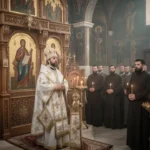
Eastern worship is often immediately recognizable through its icons, chant, incense, processions, and sense of sacred mystery. Yet the differences go deeper than visual style. The liturgy follows a different historical development, uses different prayers and ceremonial patterns, and often presents the biblical story through a strongly symbolic and participatory form of worship.
In Byzantine Catholic and Eastern Orthodox communities, the main Eucharistic service is usually called the Divine Liturgy. In many Western Catholic communities, the comparable service is called the Mass. Both celebrate the Eucharist, proclaim Scripture, include prayers of thanksgiving and intercession, and bring the congregation into sacramental communion, but their forms and inherited language differ.
Common features of eastern worship may include:
Icons: sacred images of Christ, Mary, angels, and saints that are honored as windows into heavenly reality rather than treated as ordinary decorations.
Iconostasis: a screen or wall of icons separating the sanctuary from the nave in many Byzantine churches.
Frequent standing: some congregations stand for much of the service, although local customs vary.
Chant without instruments: many eastern traditions rely primarily on the human voice for liturgical singing.
Incense and processions: physical movement and fragrance reinforce the holiness of the service and the unity of heaven and earth.
Ancient liturgical languages: Greek, Church Slavonic, Arabic, Syriac, Armenian, Ge’ez, and other languages may be used, often alongside the local language.
The iconostasis does not simply block the congregation from the altar. Its icons present the central figures and events of Christian faith, while the open and changing ceremonial movements of the liturgy reveal the connection between the heavenly and earthly church. In many churches, the sanctuary doors open and close at particular moments as part of the service.
Eastern Christian worship also tends to emphasize the continuity of the congregation with the saints and with Christians who worshiped before them. Feast days, hymns, fasting periods, and prayers repeat themes from Scripture and early Christian tradition throughout the year.
Eastern Catholic Churches may use the same or similar liturgies as their Orthodox counterparts while remaining in communion with Rome. A Byzantine Catholic parish can therefore look and sound very different from a Latin Catholic parish, even though both are Catholic and share the same sacraments.
What visitors should know: Practices about receiving Communion, taking photographs, standing, crossing oneself, and entering the sanctuary vary by church. Quietly follow the congregation and ask the priest or usher if you are unsure.
Eastern churches share core Christian beliefs about the Trinity, the incarnation of Jesus Christ, the resurrection, baptism, the Eucharist, prayer, and the communion of saints. Their distinctiveness usually lies less in rejecting central Christian doctrines and more in how those doctrines are expressed, celebrated, and woven into daily life.
A major eastern emphasis is theosis, often translated as “deification” or “participation in the divine life.” This does not mean that human beings become God by nature. It means that through God’s grace, prayer, sacramental life, and growth in holiness, people are invited to share more deeply in God’s life and likeness.
Eastern theology often presents salvation as healing and transformation as well as forgiveness. Sin damages the relationship between humanity and God, while Christ’s incarnation, death, resurrection, and victory over death restore human beings and open the way to spiritual renewal.
The sacraments are generally called mysteries in eastern traditions. The term highlights that God acts through visible signs in ways that cannot be fully reduced to a human explanation. Baptism, chrismation or confirmation, and the Eucharist are closely linked in many eastern communities.
In Byzantine Catholic and Orthodox practice, infants commonly receive baptism, chrismation, and their first Eucharist together. This differs from the usual sequence in the Latin Catholic Church, where baptism, confirmation, and first Communion are normally celebrated at separate stages, although Catholic practice can vary.
Eastern churches also maintain substantial traditions of fasting. The exact rules differ, but fasting may involve abstaining from meat, dairy, eggs, or other foods during particular seasons. The purpose is not simply dietary discipline. Fasting is joined to prayer, generosity, repentance, and self-control.
The liturgical calendar gives special prominence to feasts such as Pascha, the Nativity of Christ, the Theophany, the Transfiguration, and the Dormition or Assumption of Mary, depending on the tradition. Pascha, the eastern celebration of Easter, is often the central feast of the year and may be celebrated on a different date from Western Easter because different calendars and calculations are used.
Mary holds an honored place in eastern Christian prayer and theology. She may be called Theotokos, meaning “God-bearer” or “Mother of God,” a title affirming the belief that the person born from her is truly divine as well as truly human. Eastern churches also give major attention to apostles, martyrs, monastics, and local saints.
Marriage and ordination illustrate another difference among eastern traditions. In many Eastern Catholic and Orthodox churches, married men may be ordained to the priesthood, while bishops are normally chosen from celibate clergy or monastics. A priest generally cannot marry after ordination, and rules vary by church and jurisdiction.
Monasticism remains influential across eastern Christianity. Monks and nuns may follow traditions of communal prayer, solitude, fasting, hospitality, manual work, and spiritual guidance. The writings of early desert fathers, Byzantine theologians, Syriac ascetics, and other spiritual teachers continue to shape eastern prayer.
How eastern rite churches developed and spread
Christianity began in the eastern Mediterranean and quickly spread across regions with different languages, political systems, and cultural traditions. Important centers included Jerusalem, Antioch, Alexandria, Constantinople, and Rome. From these centers, Christianity developed varied forms of worship and church organization.
The Byzantine tradition grew around Constantinople and the Greek-speaking Christian world, later spreading through the Balkans, Eastern Europe, and parts of the Middle East. Missionaries such as Cyril and Methodius helped bring Christianity to Slavic peoples and contributed to a liturgical culture that eventually used Church Slavonic.
Syriac Christianity developed in communities that used forms of Aramaic and spread east and west from ancient centers in Syria and Mesopotamia. Armenian Christianity developed its own national tradition, alphabet, architecture, music, and liturgy. Egyptian, Ethiopian, and Eritrean Christianity preserved distinctive Alexandrian traditions shaped by local history and language.
Relations between eastern churches and Rome changed over many centuries. The East–West Schism traditionally associated with 1054 represented a long process of growing separation rather than a single event that instantly divided all Christians. Disagreements involved authority, theology, liturgical customs, language, and political tensions.
Some eastern communities later entered communion with Rome, while retaining their own traditions. Others remained Orthodox or Oriental Orthodox. These histories are often sensitive because church identity is tied to national survival, ethnic memory, migration, and experiences of persecution.
In the United States, eastern churches serve both historic immigrant communities and people who discover eastern Christianity through marriage, study, local friendships, or spiritual interest. Parish life may combine ancient worship with practical concerns such as bilingual education, youth programs, charitable work, and preserving heritage among younger generations.
When looking for an eastern church, consider the community’s specific communion and tradition rather than relying only on its name. “Greek,” “Maronite,” “Ukrainian,” “Coptic,” “Armenian,” “Byzantine,” and “Orthodox” can point to different histories and forms of worship.
Ask whether the parish is Eastern Catholic, Eastern Orthodox, Oriental Orthodox, or part of the Assyrian tradition.
Check which liturgical tradition the church follows, such as Byzantine, West Syriac, East Syriac, Alexandrian, or Armenian.
Look at the service schedule and language policy before attending.
Read the parish guidance for Communion and other visitor practices.
Speak with the priest or parish office if you want to learn about membership, instruction, or sacramental preparation.
How to attend an eastern church respectfully
Visitors are generally welcome at eastern Christian services, but the service may last longer and involve more standing, chanting, incense, and movement than you expect. Arriving a little early gives you time to observe the space, find a service book, and ask a quiet practical question.
You do not need to imitate every gesture immediately. Some people bow, make the sign of the cross, kiss icons, or approach for a blessing. These actions carry meaning within the tradition, but a visitor may simply stand respectfully and participate in the spoken responses if comfortable.
Communion rules differ significantly. Eastern Orthodox and Oriental Orthodox churches normally reserve Communion for members of their own communion who are properly prepared. Eastern Catholic Churches follow Catholic discipline, which also does not mean that every Christian visitor should automatically receive. Ask the priest before the service rather than assuming that shared belief in Christ makes reception permissible.
When visiting, keep these practical points in mind:
Wear clothing that is respectful and suitable for standing or kneeling during worship.
Silence your phone and avoid conversations once the service begins.
Do not touch or move icons, liturgical vessels, books, or other sacred objects without permission.
Ask before taking photographs, especially during the Eucharistic portion of the service.
Follow local guidance about head coverings, seating, candles, and entering the sanctuary.
Speak with the priest afterward if you want an explanation of the prayers or symbolism.
The most useful question is not whether an eastern church is “the same as” a Western church. It is which eastern tradition this particular community preserves. That answer will tell you much about its liturgy, calendar, language, leadership, fasting practices, and relationship with other Christian churches.
Frequently asked questions
Are eastern rite churches Catholic?
Some are. The 23 Eastern Catholic Churches are fully Catholic and in communion with the pope, but Eastern Orthodox, Oriental Orthodox, and Assyrian churches are not part of the Catholic communion. The phrase “eastern rite churches” is therefore broader and less precise than “Eastern Catholic Churches.” Identifying the church’s communion is the clearest way to understand its relationship to Catholicism.
Can a Roman Catholic attend an Eastern Catholic Divine Liturgy?
Yes. Roman Catholics are generally welcome to attend an Eastern Catholic Divine Liturgy, and the Eucharist is celebrated within the same Catholic communion. You should still follow the parish’s local customs and observe Catholic requirements for receiving Communion. Eastern Orthodox or Oriental Orthodox services may have different rules, so ask the priest before receiving there.
Why do some eastern churches use icons?
Icons are sacred images used in prayer and worship, especially in Byzantine, Eastern Orthodox, and several other eastern traditions. They are not treated as gods or ordinary decorations. Believers honor the person represented by the image, while worship belongs to God. Icons commonly depict Christ, Mary, angels, apostles, and saints.
Why is Easter sometimes celebrated on a different date in eastern churches?
Churches use different calendar traditions and methods for calculating the date of Pascha, or Easter. Some eastern churches follow the Julian calendar for fixed feasts or use calculations connected with it, while others use the Gregorian calendar. As a result, eastern and Western Easter dates sometimes coincide and sometimes differ.












Leave a Reply