How to make the sign of the cross and what it means
How to make the sign of the cross and what it means
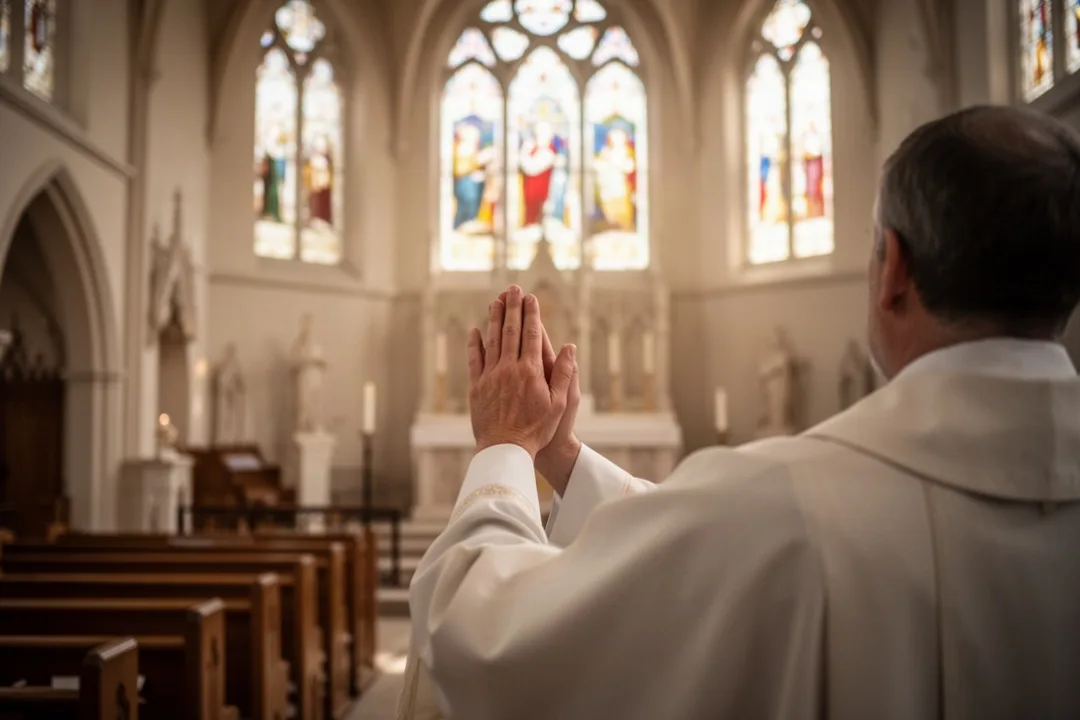
The sign of the cross is a short Christian prayer made by touching the forehead, chest, and shoulders while invoking the Father, Son, and Holy Spirit. In many Western churches, you touch your left shoulder before your right; in Eastern Christian traditions, the usual movement is from right to left.
As you make the gesture, you may say, “In the name of the Father, and of the Son, and of the Holy Spirit. Amen.” The movement brings together two central Christian beliefs: the Trinity and the cross of Jesus Christ. Christians use it during worship, prayer, and ordinary moments as a physical reminder of belonging to Christ.
To make the sign, use your right hand if that is comfortable and begin with your fingers together. Touch your forehead, move to the center of your chest, then touch one shoulder and the other while saying the words of the Trinitarian prayer.
In the most common Western form, the order is forehead, chest, left shoulder, right shoulder. The movement may be accompanied by the familiar formula, or you may make it silently when a quiet gesture is more appropriate.
Touch your forehead while saying or thinking “In the name of the Father.”
Touch your chest while saying or thinking “and of the Son.”
Touch your left shoulder and then your right shoulder while saying “and of the Holy Spirit.”
Finish with “Amen”, if you are using the spoken prayer.
The exact placement of the hand does not need to be measured. A respectful, unhurried gesture is more meaningful than trying to perform it with perfect precision. If you are learning from a particular church, follow the practice of that community, since the direction and hand position may differ.
Simple form: Forehead, chest, left shoulder, right shoulder in most Western traditions; forehead, chest, right shoulder, left shoulder in many Eastern traditions.
Some people hold their thumb and first two fingers together while folding the remaining fingers into the palm. This hand position can symbolize the three persons of the Trinity and the unity of God. Other Christians use an open hand or simply extend the fingers naturally. These differences generally reflect local custom rather than a different faith.
What the sign of the cross means in Christian prayer
The sign of the cross is both a profession of faith and a bodily prayer. The words name the Father, Son, and Holy Spirit, while the movement recalls the cross on which Jesus was crucified. Together, they point to the Christian understanding of God’s identity and of Christ’s death and resurrection.
When a person touches the forehead, the gesture can call attention to thought and understanding. Touching the chest can suggest the heart, will, and inner life. The movement across the shoulders forms the shape of a cross and places the whole person under the meaning of Christ’s sacrifice and redeeming love.
The gesture does not mean that Christians believe the physical motion has magical power. Its purpose is prayerful remembrance. It can help you pause, direct your attention to God, and express trust when words are difficult to find.
“In the name of the Father, and of the Son, and of the Holy Spirit. Amen.”
The prayer also recalls Jesus’ command to make disciples and baptize them in the name of the Father, Son, and Holy Spirit, recorded in Matthew 28:19. It connects private prayer with baptism, the sacrament or ordinance through which Christians are received into the life of the church according to their tradition.
For many Christians, the sign carries several related meanings:
Remembering baptism: The Trinitarian words recall the faith into which the person was baptized.
Confessing Christ: The shape of the cross identifies Jesus’ death and resurrection as central to Christian faith.
Offering the whole self: The gesture can represent thoughts, heart, body, and daily actions given to God.
Beginning and ending prayer: It marks a clear transition into worship or back into ordinary activity.
Seeking strength: It expresses dependence on God rather than trust in the gesture itself.
Where the practice came from and how it developed
Christians have used the cross as a visible sign since the early centuries of the church, although the precise movement and hand position developed over time. Early Christian writers describe believers marking themselves with the cross in ordinary situations as well as during formal worship.
The practice grew from the importance of the cross in Christian teaching. The New Testament presents the cross as central to Jesus’ saving work; passages such as 1 Corinthians 1 discuss the cross as the distinctive message Christians proclaim. The sign gave believers a simple physical way to remember that teaching.
Christians have not always made the gesture in exactly the same way. Differences developed between regions, churches, and periods of history. The most familiar Western pattern moves from the left shoulder to the right. Many Eastern Orthodox and Eastern Catholic Christians move from the right shoulder to the left.
The hand position also differs. In some Eastern traditions, three fingers are held together and two fingers are folded down. This can symbolize the Trinity and the union of Christ’s divine and human natures. In Western churches, people may use an open hand, two fingers, or another customary position.
These variations should not be treated as competing instructions about the core meaning. The essential elements are the invocation of the Trinity, the remembrance of the cross, and the intention to pray. Local customs tell you how a particular community expresses those beliefs physically.
When Christians use the sign of the cross
There is no single required moment for every Christian who makes the sign. In churches that use it regularly, people may make the gesture when entering the sanctuary, beginning a prayer, hearing the Gospel, receiving a blessing, or leaving worship.
In Roman Catholic worship, the sign commonly appears at the beginning and end of Mass and in several prayers. Many Catholics make it when passing a church, entering or leaving a pew, or receiving holy water. The practice varies among individuals, parishes, and cultures.
Eastern Orthodox and Eastern Catholic Christians may make the sign frequently during services, especially at certain prayers, hymns, blessings, and moments of reverence. The exact pattern depends on the liturgical tradition. A visitor can follow the congregation quietly or ask a priest, deacon, or church member beforehand.
Some Anglicans, Episcopalians, Lutherans, Methodists, and other Christians also use the sign of the cross, although it may be less frequent or associated with particular parts of worship. Many Protestant churches do not normally use it. That difference does not by itself establish whether someone is more or less devoted; it reflects different teachings and inherited practices.
People also use the gesture outside church services. Common occasions include:
Before meals, as a sign of gratitude and prayer.
Before travel, when asking for protection and a faithful spirit.
At the start of the day, to dedicate work and responsibilities to God.
During distress or temptation, as a brief reminder of Christian hope.
Before sleep, as part of an evening prayer routine.
At a funeral or graveside, when honoring the dead and affirming resurrection hope.
It can also be used without spoken words. A quick sign made before a difficult conversation may express a prayer for patience. Someone who sees a serious accident may make the sign while praying for the people involved. In these situations, the gesture works as a compact act of attention, compassion, and faith.
Use it prayerfully, not mechanically: Pause long enough to remember whom you are addressing and what the cross means. A slow, attentive gesture is more helpful than repeating it automatically.
How the sign of the cross differs among Christian traditions
Western Christian practice
In Roman Catholic and many other Western Christian settings, the person touches the forehead, chest, left shoulder, and right shoulder. The prayer usually uses the words “Father,” “Son,” and “Holy Spirit,” followed by “Amen.” The gesture may be made with an open hand or with the fingers held in a customary position.
Western Christians may connect the sign with a wide range of prayers, including the Lord’s Prayer, the rosary, the Apostles’ Creed, and blessings. It may appear at the beginning and end of personal prayer, but it is not limited to formal liturgy.
Eastern Christian practice
In many Eastern Orthodox and Eastern Catholic traditions, the movement goes from the right shoulder to the left. The hand is often formed with three fingers together and two folded into the palm. The three extended fingers can represent the Trinity, while the folded fingers recall aspects of Christ’s identity in traditional teaching.
Eastern Christians may make the sign at specific points during a service, including prayers addressed to the Trinity, references to the cross, and moments when a priest gives a blessing. Customs can vary among national churches and local parishes, so the practice of the congregation remains the best guide.
Churches that use the gesture less often
Some churches place greater emphasis on spoken prayer, congregational singing, inward devotion, or other forms of bodily worship. Members may rarely make the sign, or may use it only during special services. A Christian who does not make the gesture is not necessarily rejecting the cross or the Trinity; the church’s worship tradition may simply express those beliefs differently.
If you are attending an unfamiliar service, you do not need to imitate every movement immediately. You may remain still, observe respectfully, and learn the local custom over time. Asking a trusted church leader can prevent uncertainty, especially during a sacrament or formal blessing.
Common questions about performing the gesture respectfully
People sometimes worry that they are making the sign incorrectly. In most situations, the main concern is not athletic coordination but reverence and understanding. The gesture is a prayer, not a test of membership or physical skill.
If you reverse the shoulder order by accident, simply continue praying. Western and Eastern traditions already use different directions, and an honest mistake does not cancel the prayer. If a community has a specific practice, you can learn it gradually by watching how members move during worship.
Children can learn the sign through repetition and explanation. Rather than insisting on speed or exact hand placement, show the sequence slowly and explain that the gesture remembers Jesus’ cross and names the Father, Son, and Holy Spirit.
Someone who cannot use one hand, has limited mobility, or prefers not to make a visible gesture may pray the words silently or make a smaller movement. Christian prayer does not depend on physical ability. The sign should serve worship, not create an unnecessary burden.
Several practical guidelines can help:
Follow the local tradition when worshiping with a particular church.
Move deliberately rather than rushing through the gesture.
Keep the words connected to the movement so the action remains a prayer.
Do not treat it as a charm or guarantee that controls an outcome.
Respect other Christians who use a different pattern or do not use the sign.
The sign of the cross can become especially meaningful when it is connected to a specific prayer. You might make it before reading Scripture, after asking forgiveness, before serving someone who needs help, or when giving thanks for an unexpected kindness. Its value comes from directing your mind and heart toward God in the middle of real life.
For Christians who practice it, the gesture is small enough to use anywhere but rich enough to carry the central shape of the faith. It recalls Jesus Christ, names the Holy Trinity, and marks a moment of prayerful attention. The most faithful way to make it is with understanding, humility, and respect for the tradition in which you are praying.
Frequently asked questions
Do you have to be Catholic to make the sign of the cross?
No. Roman Catholics use it often, but the sign is also practiced by Eastern Orthodox, Eastern Catholic, Anglican, Episcopal, Lutheran, and other Christians. Some denominations use it rarely or not at all. If you are visiting a church, you may participate according to your own conscience or observe the congregation without feeling pressured to copy every gesture.
What should you say while making the sign of the cross?
The most common words are “In the name of the Father, and of the Son, and of the Holy Spirit. Amen.” You can say the prayer aloud, whisper it, or pray it silently. Some people make the gesture without words during worship or in a private moment, while keeping the Trinitarian meaning in mind.
Why do some Christians go from the left shoulder to the right?
Most Western Christians move from the left shoulder to the right, while many Eastern Orthodox and Eastern Catholic Christians move from right to left. The difference developed through distinct liturgical customs. Neither direction changes the central meaning: the person is invoking the Trinity and remembering Jesus Christ’s cross.
Is making the sign of the cross a form of superstition?
It can become superstitious if someone treats the motion as a magical object or guarantee. In Christian practice, it is intended as a bodily prayer and reminder of faith. Its meaning depends on the person’s intention: turning toward God, recalling baptism, honoring Christ, and asking for strength or blessing.









Leave a Reply