You may be looking at a cross during a difficult moment and wondering, What should I pray? A cross prayer is a prayer that turns your attention to Jesus Christ, his sacrifice, and the hope Christians find in the resurrection. It can be spoken in a church, prayed at home, or repeated quietly when you need comfort and direction.
There is no single required wording. Some Christians make the sign of the cross before and after praying. Others hold a cross, sit before a cross, or simply use the cross as the focus of their thoughts. The central purpose remains the same: to bring your fear, gratitude, repentance, requests, and trust before God through Christ.
The cross represents the crucifixion of Jesus, so cross prayer begins with the meaning Christians associate with that event. It points to self-giving love, forgiveness, suffering, obedience, and reconciliation with God. For many believers, the cross also points beyond death to the resurrection and the promise of new life.
Praying with the cross is not the same as treating a physical cross as a magical object. A wooden, metal, or displayed cross does not grant wishes or replace faith. Instead, it serves as a visible reminder of God’s presence and Christ’s work, helping you gather your attention when your mind feels scattered.
Different Christian traditions express this practice in different ways. Roman Catholic, Eastern Orthodox, Anglican, Lutheran, and some other churches commonly use the sign of the cross. Other Protestant Christians may focus on the cross through spoken prayer, Scripture reading, worship, or silent reflection without making a physical gesture.
The cross can hold several meanings at once during prayer:
Repentance: acknowledging sin and asking God for forgiveness and changed priorities.
Comfort: remembering that suffering is not hidden from God and that you are not abandoned.
Gratitude: thanking God for mercy, salvation, and the love represented by Christ’s sacrifice.
Dedication: offering your choices, relationships, work, and future to God.
Hope: looking toward resurrection, restoration, and the possibility of faithful action in a painful situation.
Keep the focus clear: A cross can direct your attention, but Christian prayer is addressed to God. The object is a reminder, not a source of supernatural power.
New Testament passages such as 1 Corinthians 1:18, Galatians 6:14, and Philippians 2:5–11 connect the cross with God’s wisdom, Christ’s humility, and the transformation of the believer’s life. These references do not require you to use one particular prayer formula. They provide a foundation for approaching the cross with humility, trust, and honest reflection.
How to pray with a cross step by step
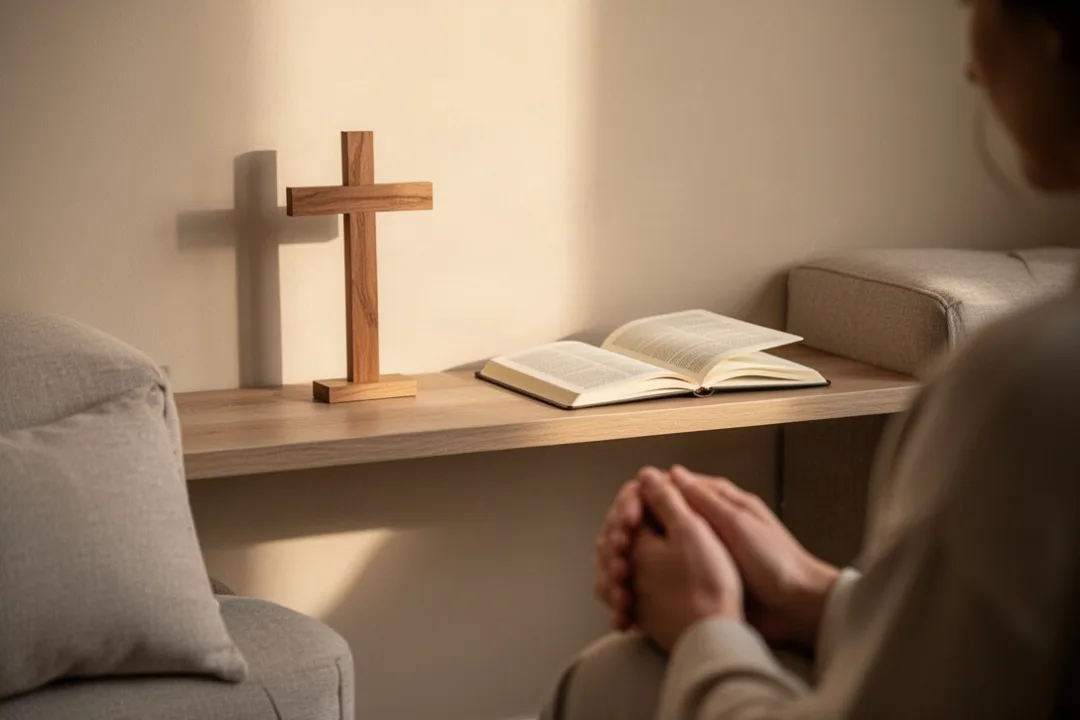
A cross prayer can take less than a minute or become a longer period of worship. You do not need special equipment, a particular posture, or perfect concentration. Choose a place where you can be reasonably still, then allow the cross to remind you whom you are addressing and why you are praying.
Become quiet. Take a few slow breaths and notice what you are carrying emotionally. You might name your fear, anger, grief, guilt, or gratitude without trying to hide it.
Turn your attention to God. Look at a cross, hold one respectfully, or picture the cross in your mind. Begin with a simple address such as “God,” “Father,” or “Lord Jesus.”
Remember the meaning of the cross. Reflect on Christ’s love, sacrifice, mercy, and victory over death. A short Bible reading or a few moments of silence can help.
Speak honestly. Tell God what you need, what you regret, and what you cannot control. Specific language is usually more helpful than trying to sound impressive.
Ask for a faithful response. Pray for wisdom, courage, forgiveness, patience, or the ability to serve someone else. Ask not only for circumstances to change but also for strength to act well within them.
End with trust. Place the situation in God’s hands and close with “Amen” or another ending that fits your tradition. You may make the sign of the cross if that is part of your practice.
Your body can support your attention. You might sit, kneel, stand, bow your head, open your hands, or gently trace the sign of the cross. The gesture itself is not a test of faith. Its value comes from the meaning you consciously attach to it and the reverence with which you use it.
If you make the sign of the cross, many Western Christians touch the forehead, chest, and shoulders while saying a Trinitarian formula. Eastern Christian traditions may use a different order or hand position. Customs vary, so you can follow the practice taught by your church rather than assuming that one form applies to everyone.
When your thoughts wander, return to three simple questions: What does the cross show me about God? What do I need to surrender? What loving or truthful step can I take next? These questions can turn a vague moment of distress into a focused prayer.
Cross prayer examples for ordinary situations
The wording below is original and can be adapted. You may shorten it to one sentence or expand it with the names and details of people you know. The most meaningful prayer is not necessarily the longest one; it is the one that helps you speak truthfully before God.
A short daily cross prayer
“God of mercy, as I look to the cross, remind me of Christ’s love and humility. Forgive what is wrong in me, strengthen what is good, and guide my words and actions today. Help me carry my responsibilities with patience and serve others with compassion. Amen.”
This prayer works well in the morning or before a demanding task. It combines remembrance, confession, guidance, and service without treating prayer as a way to avoid responsibility. After praying, identify one practical action that reflects the qualities you requested.
A cross prayer for fear and uncertainty
“Lord Jesus, I bring you the fear I cannot resolve and the questions I cannot answer. When I feel powerless, help me remember that suffering does not mean I am forgotten. Give me wisdom for the next step, courage to ask for help, and peace enough to act faithfully today. Hold me and those I love in your care. Amen.”
This prayer does not promise that every problem will disappear immediately. It asks for presence, wisdom, courage, and support. If fear is affecting sleep, work, safety, or daily functioning, prayer can accompany practical help from trusted people and qualified professionals.
A cross prayer for repentance and forgiveness
“Merciful God, I confess the harm I have caused, the good I have neglected, and the ways I have turned away from your love. Because of Christ’s mercy, receive my repentance and teach me to change. Show me whom I need to apologize to, what I need to repair, and how to walk in a new direction. Amen.”
Christian repentance is more than feeling ashamed. It includes honest confession, a willingness to change, and appropriate efforts to repair harm. Asking forgiveness does not require you to return to an unsafe relationship or to accept abuse. Wisdom and boundaries remain part of faithful action.
A cross prayer for grief
“God who sees sorrow, meet me in this grief. The cross reminds me that love can pass through suffering and that death does not have the final word. Receive my memories, tears, anger, and questions. Give comfort to my family, strength for the days ahead, and gentle companions who will remain near us. Amen.”
Grief is not a spiritual failure, and a cross prayer does not require you to hide anger or sadness. The Psalms include many prayers of lament, and Christian communities have long brought pain directly to God. Silence, tears, and a single repeated phrase can all be genuine prayer.
A cross prayer for gratitude
“Lord, I thank you for the mercy shown through Christ and for the gifts I often overlook. Thank you for the people who have helped me, for daily bread, for forgiveness, and for every opportunity to love. Keep gratitude from becoming words only; make it visible in generosity, patience, and care for others. Amen.”
Gratitude connected to the cross does not deny injustice or hardship. It helps you recognize grace while remaining truthful about what needs to change. You could name three specific gifts and then choose one way to share your time, attention, or resources.
Ways different Christians use the sign of the cross
The sign of the cross is a physical prayer gesture used in several Christian traditions. A person may make it when beginning or ending prayer, entering or leaving a church, receiving a blessing, hearing the name of the Trinity, or facing a moment of fear. Some people repeat it throughout the day as a brief act of remembrance.
In many Western traditions, the gesture moves from forehead to chest and from one shoulder to the other. In Eastern traditions, the order of the shoulders differs, and the fingers may be held in a particular way to express belief in the Trinity and the two natures of Christ. These differences are customary rather than evidence that one sincere worshiper is automatically more faithful.
To use the gesture prayerfully, avoid rushing through it as an empty habit. You can associate each movement with a short inward prayer:
At your forehead, ask God to guide your thoughts.
At your chest, offer your desires, emotions, and whole life to God.
At your shoulders, ask for strength to carry responsibilities and love your neighbor.
At the end, rest briefly in gratitude for Christ’s mercy.
A cross necklace, wall cross, crucifix, or small cross in a prayer space may also become a visual reminder. Some Christians prefer a crucifix, which shows Christ on the cross and emphasizes his suffering. Others prefer an empty cross, which emphasizes the resurrection. Both forms can direct prayer toward Christ, though local churches may have strong preferences.
If you are visiting a church or praying with people from another tradition, observe respectfully and do not assume that you must copy every gesture. You can pray silently in a way consistent with your conscience. The practice should lead toward faith, humility, compassion, and hope, not competition or pressure.
A helpful boundary: Do not use cross prayer to guarantee a particular outcome, control another person, or replace medical, legal, financial, or safety-related action. Prayer can shape your response while practical wisdom addresses the situation.
How to build a regular cross prayer practice
A regular practice becomes easier when you connect it to a stable part of the day. You might pray beside your bed in the morning, before turning on your phone, during a commute while keeping your eyes open and your attention on safety, or before sleep. A small cross in a consistent place can serve as a quiet cue rather than a decorative object you stop noticing.
Start with five minutes and use a simple pattern:
Adoration: acknowledge who God is and what the cross means to you.
Confession: name attitudes or actions that need forgiveness and change.
Thanks: identify specific gifts, people, or moments of grace.
Requests: pray for your needs and the needs of others.
Surrender: release the results while accepting your responsibility for faithful action.
You can add a short Scripture reference without reciting a copyrighted translation. Read or remember the central idea of Mark 8:34 about taking up one’s cross and following Christ, Luke 23:34 about forgiveness amid suffering, or Romans 5:8 about God’s love shown through Christ. Let one passage shape your prayer rather than turning the time into a race through many readings.
Journaling can make recurring concerns easier to recognize. Write the date, the situation, one honest sentence to God, and one next step. Over time, you may see where you need to seek reconciliation, set a boundary, ask for help, or practice patience. The journal is not a record of prayers you must perform perfectly; it is a tool for attention and spiritual honesty.
Group prayer can also give the cross a communal meaning. In a church setting, people may pray for the suffering, confess together, receive a blessing, or sing about Christ’s death and resurrection. At home, a family might pause before a meal or during a crisis. Keep participation voluntary and make room for people whose traditions or beliefs differ.
If the cross brings up painful memories connected with religious abuse, coercion, or trauma, you do not have to force a particular posture or image. Begin with safety: step away, speak with a trusted and informed pastor or counselor, or choose a gentler form of prayer. Healthy devotion does not depend on fear, compulsion, or self-hatred.
Questions to ask when a cross prayer feels difficult
Sometimes prayer feels empty, repetitive, or emotionally impossible. That experience does not prove that you have failed or that God has rejected you. You can pray with a single word such as “help,” sit in silence before the cross, or ask someone trustworthy to pray with you.
If you are unsure what you believe, honesty is still possible: “God, I am not sure you are there, but I want to understand.” A cross prayer can include doubt, anger, or confusion. Christian faith has room for lament and questioning, and you do not need to manufacture feelings that are not present.
If guilt dominates every prayer, distinguish conviction from destructive shame. Conviction identifies a wrong and can lead toward repair. Shame attacks your entire identity and may keep you isolated. Speak with a pastor, counselor, or other qualified helper if guilt becomes persistent, frightening, or connected with thoughts of self-harm.
If you worry that you are praying incorrectly, return to the basic purpose: turn toward God, remember Christ, speak truthfully, and seek a faithful response. The cross is not a test of eloquence. It is a place of remembrance where Christians bring both their brokenness and their hope.
Frequently asked questions
Is a cross prayer the same as praying to the cross?
Usually, Christians mean praying to God while focusing on the cross, not treating the cross as a deity. The cross points beyond itself to Jesus’ crucifixion, God’s mercy, and the hope of resurrection. If your wording feels unclear, address God or Jesus directly and use the cross as a reminder of whom you are trusting.
Can I pray a cross prayer if I am not Catholic?
Yes. Christians from many traditions reflect on the cross in prayer, although practices differ. Some make the sign of the cross, while others use spoken prayer, silent meditation, worship, or Bible reading. You can follow the customs of your own church or use a simple prayer focused on Christ’s love, sacrifice, forgiveness, and resurrection.
What should I do if I do not have a cross with me?
You can pray anywhere without a physical cross. Recall the meaning of the cross, read a relevant Bible passage, or place your hands together as a sign of attention. A cross is a helpful visual reminder, not a requirement. God is not limited by your location, possessions, posture, or ability to perform a particular gesture.
How long should a cross prayer last?
It can last a few seconds or much longer. A brief prayer such as “Lord Jesus, have mercy and guide me” may be appropriate during a stressful moment. At home, you might spend five to fifteen minutes in silence, reading, confession, requests, and gratitude. Consistency and honesty matter more than reaching a specific length.












Leave a Reply