If you are looking at the stations in a church or preparing for a Lenten prayer service, you may wonder why some sets have 14 images while others seem to have 15. The usual answer is that the traditional Stations of the Cross contain 14 stations. They follow Jesus from his condemnation to his burial.
Some churches, prayer books, and outdoor paths add a 15th station for the Resurrection. Other versions use only events directly described in the Bible, so their order and titles differ from the traditional form. The number depends on which form of the devotion you are using.
Quick answer: The traditional Catholic Way of the Cross has 14 stations. A 15th station may be added to represent the Resurrection, but it is not part of the historic 14-station sequence.
The Stations of the Cross are a sequence of prayerful stops that recall Jesus’ suffering and death. At each station, people usually pause, listen to a short meditation, pray, and move to the next image or cross. The practice is also called the Way of the Cross, the Via Crucis, or the Way of Sorrows.
The traditional sequence includes events described in the Gospels as well as several moments preserved by Christian tradition. For example, the Gospels do not explicitly describe Jesus falling three times, and they do not name the woman traditionally called Veronica. Those scenes remain part of the familiar devotional form because they have long helped worshipers reflect on Christ’s suffering.
The 14 stations are not intended to be a complete biography of the Passion. They are a structured meditation on key moments between Jesus’ sentence and his burial. The arrangement gives a congregation, family, school group, or individual a clear path for prayer.
How the traditional 14 Stations of the Cross are arranged
The standard sequence begins with Jesus’ condemnation and ends with his burial. Churches may use slightly different wording for the titles, but the order is generally recognizable. Here are the traditional stations in order:
Jesus is condemned to death. Jesus is sentenced even though the Christian account presents him as innocent. This station invites reflection on injustice, false accusations, and the willingness to suffer rather than return violence.
Jesus takes up his cross. Jesus receives the instrument of his execution and begins the journey to Calvary. The station focuses on obedience, suffering, and the heavy cost of his mission.
Jesus falls the first time. The weight of the cross and the brutality of the journey overwhelm him. This moment is traditionally connected with human weakness and the need to keep returning to the path after failure.
Jesus meets his mother. Mary encounters Jesus on the road. The Gospels do not record this meeting in the Passion narratives, but Christian tradition uses it to portray the sorrow of a mother sharing in her son’s suffering.
Simon of Cyrene helps Jesus carry the cross. Roman soldiers compel Simon to assist Jesus. The station highlights unexpected service and the way another person can help carry a burden that has become too heavy.
Veronica wipes the face of Jesus. According to tradition, Veronica offers Jesus a cloth during the journey. This scene is not directly reported in the Bible, but it represents compassion shown through a small, personal act.
Jesus falls the second time. Jesus falls again under the burden of the cross. The repeated fall allows people to consider exhaustion, discouragement, and the persistence required when suffering continues.
Jesus meets the women of Jerusalem. A group of women mourns for Jesus, and he responds by directing their concern toward the suffering that will affect Jerusalem and its people. The station connects personal grief with the wider consequences of violence.
Jesus falls the third time. Near the end of the road, Jesus falls once more. This station emphasizes the extreme physical and emotional cost of the Passion before the final place of execution is reached.
Jesus is stripped of his garments. Jesus is deprived of his clothing before crucifixion. The scene represents humiliation, vulnerability, and the loss of public dignity.
Jesus is nailed to the cross. Jesus is fastened to the cross and raised up for execution. The station turns attention to the physical violence of crucifixion and to the Christian belief that Jesus accepts suffering for the sake of others.
Jesus dies on the cross. Jesus gives up his life. This station is usually the central moment of the devotion, inviting silence and reflection on sacrifice, forgiveness, love, and the meaning Christians attach to Christ’s death.
Jesus is taken down from the cross. Jesus’ body is removed and placed in the care of his followers. The station presents the sorrow of those who remain and the tenderness involved in caring for the dead.
Jesus is placed in the tomb. Jesus is laid in a tomb and the burial is completed. The traditional 14 stations end here, before the Resurrection, leaving the worshiper at the threshold of Easter hope.
What each station is meant to do during prayer
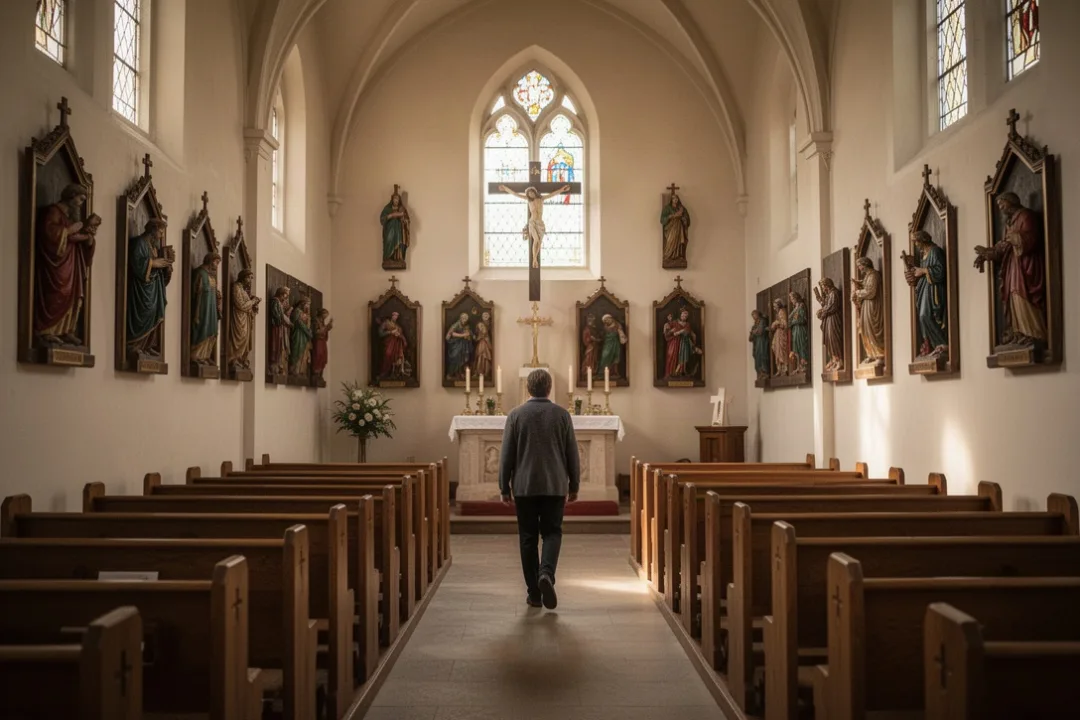
A station is more than a picture on a wall. It is a physical and spiritual pause that helps you stay with one moment of the Passion instead of treating the story as a single distant event. The movement from one station to another can make the prayer feel like a pilgrimage, even when you are walking only a short distance inside a church.
Most forms include four basic actions: announcing the station, listening to a meditation, praying, and moving onward. The prayers vary by parish and prayer book, but many include an act of sorrow, a response from the congregation, the Lord’s Prayer, the Hail Mary, or a short hymn.
Look at the image or cross and identify the event being remembered.
Listen to or read a reflection connecting the scene with the life of Jesus and human suffering.
Pray in silence or aloud, bringing personal concerns, gratitude, repentance, or intercession.
Move to the next station as a sign that the journey continues.
The person leading the devotion does not need to give a long explanation at every stop. A brief reading and a period of silence can be more effective than a detailed lecture. The purpose is prayerful attention, not simply learning the names in order.
Why some people count a 15th station
Many modern presentations add a 15th station called the Resurrection. It usually comes after Jesus is placed in the tomb and represents the empty tomb, Christ’s rising, or the joy of Easter. This addition gives the devotion a more explicitly hopeful ending.
The Resurrection is central to Christian faith, but it was not included in the historic 14-station form because the traditional devotion focuses specifically on the road to Calvary, the crucifixion, and burial. The original sequence ends before Easter morning. A 15th station therefore functions as an optional extension, not a replacement for the traditional count.
Adding the Resurrection can be especially appropriate for a parish, school, or family that wants to connect the sorrow of Good Friday with the joy of Easter. Some churches use it throughout the year, while others reserve it for a special service after the traditional 14 stations have been prayed.
How to count it: If a display has 15 images, the first 14 usually follow the traditional Way of the Cross and the final image shows the Resurrection. It is best described as 14 traditional stations plus an optional 15th.
How biblical Stations of the Cross differ
A Scriptural Way of the Cross uses scenes that are directly recorded in the New Testament rather than relying on later devotional tradition. It may include the agony in the garden, Peter’s denial, the trial before the Jewish council, or the promise to the repentant criminal. These events may not appear in the traditional 14-station sequence.
There is not one single universally required biblical list. Different churches and prayer books organize the Gospel events in different ways. A biblical version may still contain 14 stations, but several traditional scenes are replaced with events that have a clear Gospel reference.
One commonly used Scriptural arrangement may include moments such as:
Jesus prays in agony in the garden.
Jesus is betrayed and arrested.
Jesus is questioned by the religious authorities.
Peter denies knowing Jesus.
Jesus is judged by Pilate.
Jesus is scourged and crowned with thorns.
Jesus begins carrying the cross.
Simon of Cyrene helps carry it.
Jesus speaks to the women of Jerusalem.
Jesus is crucified.
Jesus promises paradise to the repentant criminal.
Jesus entrusts his mother and beloved disciple to one another.
Jesus dies.
Jesus is placed in the tomb.
This version answers a slightly different need. The traditional form emphasizes the inherited devotional path, while the biblical form emphasizes direct Gospel testimony. Neither approach requires you to dismiss the other. A parish can choose one based on its liturgical setting, audience, and pastoral goals.
Which traditional stations come from Christian tradition
Readers sometimes ask why the traditional stations include scenes that do not appear plainly in the four Gospel accounts. The answer is that the Way of the Cross developed as a devotional practice shaped by both Scripture and Christian tradition.
The following traditional scenes are generally understood to come from tradition rather than a direct Gospel description: Jesus’ three falls, his meeting with Mary, and Veronica wiping his face. The Gospel accounts do describe Simon of Cyrene and the women of Jerusalem, although the traditional presentation may add details that are not stated in the text.
That distinction matters if you are choosing a prayer format. A Scripture-focused group may prefer stations built only from biblical scenes. A congregation praying the historic form may value the traditional scenes because they have helped generations meditate on Jesus’ vulnerability and on the compassion of those around him.
Neither form should be treated as a claim that every artistic detail has the same status as a Gospel event. A meditation can use a traditional image to encourage prayer while still acknowledging that the scene is part of devotional heritage.
Where the Stations of the Cross came from
The devotion developed from the Christian desire to remember Jesus’ final journey in Jerusalem. Pilgrims who visited the Holy Land could pray at places associated with the Passion. Christians elsewhere gradually created local versions so that people who could not travel to Jerusalem could participate in a similar pattern of remembrance.
Religious communities, especially the Franciscans, played a major role in promoting the devotion in churches and public settings. Over time, the number and identity of the stations varied. Some early sets had fewer or more stops than the 14 familiar today, and the locations represented by images were not always identical.
The 14-station form became widely established in Catholic practice over the early modern period. Churches began placing crosses, paintings, or carved scenes along the walls so that worshipers could move from one to the next. The arrangement made the devotion accessible to people who could not make a pilgrimage to Jerusalem.
Because the practice grew over many years, you may encounter different artistic styles and wording. A church in the United States, an outdoor shrine, and a cathedral in another country may depict the stations differently while still following the same basic sequence.
How to pray the 14 Stations of the Cross by yourself
You do not need a large church or a formal group to pray the stations. A prayer book, printed list, or set of images can provide the structure. If you are at home, you can place 14 small pictures around a room, use a digital resource, or simply read the stations in order.
Choose a suitable time and place. Set aside enough time to move slowly rather than rushing through the names.
Begin with a short prayer. Ask for the grace to reflect honestly on Jesus’ Passion and on the suffering of others.
Read one station at a time. Look at an image if one is available, then read a short meditation or the relevant Gospel reference.
Keep a period of silence. Consider what the station reveals about suffering, mercy, courage, injustice, or hope.
Pray for a specific person or need. You might remember someone who is ill, grieving, imprisoned, abused, displaced, or carrying an unseen burden.
Move to the next station. The physical movement can be literal or represented by turning a page.
End with a prayer suited to the season. During Lent, this may be an act of repentance; near Easter, it may include thanksgiving for the Resurrection.
There is no requirement to make every station the same length. You might spend more time at the meeting with Mary if you are grieving a family member, or at Simon of Cyrene if you are thinking about caregiving. The devotion can be personal without becoming disconnected from its shared structure.
How long the Stations of the Cross usually take
A parish service commonly lasts about 30 to 60 minutes, depending on the number of readers, hymns, pauses, and length of the meditations. A private version can take 10 minutes if each station receives a short prayer, or much longer if you read Scripture references and remain in silence.
The number of stations does not determine the quality of the prayer. A hurried service may be less reflective than a short, carefully prepared one. What matters is giving each station enough attention to recognize the event and respond to it prayerfully.
For children or a school group, a leader may use a sentence or two at each station and invite a simple response. For adults, longer meditations can connect the Passion with poverty, war, discrimination, illness, grief, or the personal burdens people carry. The language should fit the group without weakening the seriousness of the subject.
What the Stations of the Cross are not
The stations are not a substitute for the Gospel accounts, the Mass, or the Resurrection. They are a devotional practice that helps Christians meditate on the Passion. Their purpose is to deepen prayer, not to create a second set of official biblical books or to require every Christian community to use one artistic arrangement.
They are also not limited to Lent. Catholic parishes often pray them during Lent, especially on Fridays, but individuals and groups may use them at other times. Some retreat centers, hospitals, schools, and outdoor pilgrimage sites offer stations throughout the year.
Finally, the stations are not merely a historical reenactment. The scenes point toward questions that remain relevant: How do people respond to unjust suffering? Who offers help? Who looks away? How can grief be carried? In Christian prayer, the Passion is remembered as a real event and also considered in relation to mercy, human dignity, and hope.
How to tell which version you are seeing
If you are counting images in a church, begin with the titles rather than the artwork. Some displays use a cross for every station, while others use elaborate paintings or sculptures. A 14-image set may omit a separate Resurrection image because it follows the traditional form.
Traditional sequence: It starts with condemnation and ends with burial, including the three falls, Mary, Veronica, Simon, and the women of Jerusalem.
Traditional sequence with an addition: It has those same 14 scenes followed by a Resurrection image labeled as the 15th station.
Scriptural sequence: It includes events such as the agony in the garden, Peter’s denial, or the repentant criminal.
Local devotional version: It may combine traditional scenes with regional artwork, additional prayers, or a different final meditation.
If a guide labels the Resurrection as the 15th station, that does not mean the church has miscounted. It usually means the community has chosen to extend the traditional devotion beyond the tomb. The clearest wording is “the 14 traditional stations, followed by an optional Resurrection station.”
Choosing the right form for a prayer service
Use the traditional 14 stations when your group wants to pray the familiar Catholic form or follow the images already installed in a church. This is often the simplest choice for a parish service because participants can recognize the scenes and move through them without additional explanation.
Use a biblical form when your group wants every station to be based directly on a Gospel passage. This can work well for Bible study groups, ecumenical settings, youth programs, and anyone who wants to compare the devotion closely with the New Testament accounts.
Add the Resurrection when the goal is to connect Good Friday meditation with Easter hope. You can treat it as a separate final prayer after the 14 stations, which preserves the historic count while making the full Christian story visible.
Whichever form you choose, identify it clearly at the beginning. Explain whether the service follows the traditional 14 stations, a Scriptural Way of the Cross, or a 14-plus-Resurrection format. That small clarification prevents confusion and helps people pray rather than wonder which number comes next.
Why the number can matter less than the prayer
The question “How many Stations of the Cross are there?” has a precise answer for the historic form: 14. Still, counting the stations is only the starting point. The devotion is designed to lead people into reflection on Jesus’ suffering and death, on the choices of the people around him, and on the hope Christians associate with Easter.
If you see 14 stations, you are probably looking at the traditional Way of the Cross. If you see 15, the final scene is likely the Resurrection. If the titles include the garden, Peter’s denial, or the repentant criminal, you are probably seeing a biblical adaptation. In each case, the central practice is the same: pause, remember, pray, and respond.
Frequently asked questions
Are there always 14 Stations of the Cross in a Catholic church?
The historic and most widely recognized Catholic form has 14 stations, but churches may display an additional Resurrection scene as a 15th station. Some communities use a Scriptural Way of the Cross with different scenes, and outdoor prayer paths may adapt the number or wording for their setting.
Is the Resurrection one of the traditional Stations of the Cross?
No. The traditional 14 stations end with Jesus being placed in the tomb. Many churches and prayer resources add the Resurrection afterward because it gives the devotion an Easter-centered ending. It is usually described as an optional 15th station rather than part of the original 14.
Why are some Stations of the Cross not found in the Bible?
The traditional devotion developed from Scripture alongside long-standing Christian tradition. Jesus’ three falls, his meeting with Mary, and Veronica wiping his face are familiar devotional scenes, but they are not directly narrated in the Gospel accounts. A Scriptural version replaces some of these scenes with events explicitly recorded in the Bible.
Can I pray the Stations of the Cross outside of Lent?
Yes. Lent is the most common season, especially the Fridays before Easter, but the devotion can be prayed at any time. Individuals and groups may use it during retreats, personal prayer, parish gatherings, or times when they want to reflect on suffering, compassion, sacrifice, and Christian hope.













Leave a Reply