14th Station of the Cross: Jesus is laid in the tomb
14th Station of the Cross: Jesus is laid in the tomb
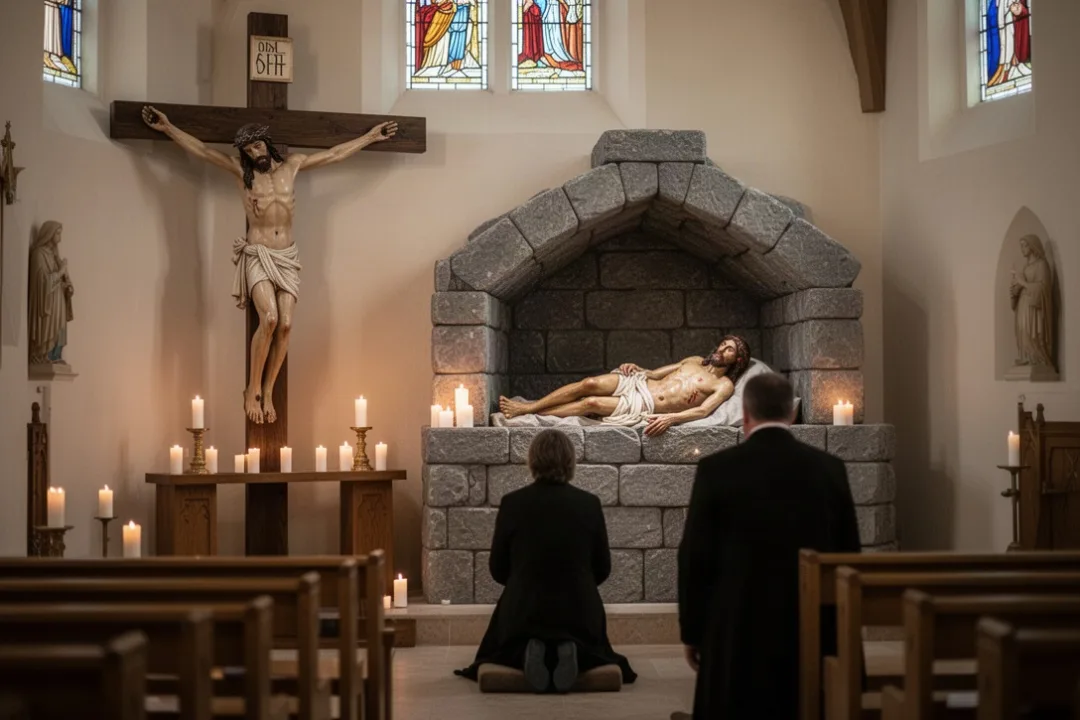
The 14th Station of the Cross is Jesus being laid in the tomb after his death. It brings the traditional Stations of the Cross to the silence of Holy Saturday, when Christ’s body rests in the grave and his followers wait in sorrow.
This station does not treat the tomb as the end of the Christian story. Instead, it holds together two realities: the genuine death of Jesus and the hope of his resurrection. The body is placed in a sealed tomb, the mourners leave, and nothing outward seems to change. Yet Christian prayer understands this stillness as part of the passage from the cross to Easter.
At the 14th Station, Jesus is taken down from the cross, prepared for burial, and placed in a tomb. The Gospel accounts describe Joseph of Arimathea asking for Jesus’ body and arranging for it to be buried. The women who had followed Jesus observe where he is laid, while the day of preparation approaches its end. These details appear, with variations, in Matthew 27:57–61, Mark 15:42–47, Luke 23:50–56, and John 19:38–42.
The station therefore follows directly from the 13th Station, which remembers Jesus being taken down from the cross. The movement is from public execution to private burial: from the noise of the crowd to the quiet of a tomb, and from the exposed body on Calvary to a place closed off by stone.
Traditional prayers often invite worshipers to contemplate Jesus’ body being placed in the tomb and to express sorrow for sin. The exact wording differs among prayer books, parishes, and devotional traditions. The central act remains the same: standing before the buried Christ with reverence, grief, gratitude, and trust.
Central idea: The 14th Station honors the reality of Jesus’ death while directing prayer toward the hope that death will not have the final word.
Why the burial of Jesus matters in Christian belief
Jesus’ burial confirms that his death was real. The Christian proclamation of the resurrection is not based on the idea that Jesus merely appeared to die or entered a temporary trance. The tomb represents the full consequence of his crucifixion: his life on earth has ended, his body has been entrusted to the earth, and his disciples are left to grieve.
This matters because the resurrection is not simply a symbol of optimism or the recovery of an inspiring memory. Christian faith proclaims that the crucified Jesus was raised by God. The burial gives that claim its proper setting. The one who rises is the same Jesus who suffered, died, and was laid in a tomb.
The station also emphasizes the dignity owed to the dead. Joseph of Arimathea’s care for Jesus’ body and the women’s attention to the burial show that love does not stop when a person can no longer respond. Respectful burial, mourning, remembrance, and prayer remain meaningful acts of mercy.
For Christians, the tomb also points toward baptism. Through baptism, believers are understood to share symbolically in Christ’s death and rising. The burial of Jesus can therefore become a prayer about surrender: leaving behind sin, pride, fear, or an old way of life so that God can bring forth something new.
How the 14th Station connects sorrow with resurrection hope
The station is deliberately quiet. Unlike some earlier stations, it does not focus on another fall, a spoken encounter, or a dramatic public event. The stone closes over the tomb, and the faithful are asked to remain with the uncomfortable space between loss and fulfillment.
That waiting has spiritual importance. People often want grief to resolve quickly, but the 14th Station does not rush past death. It makes room for sadness, confusion, and the experience of not knowing what will happen next. In this sense, it can speak powerfully to anyone living through bereavement, illness, disappointment, or a period when prayer seems unanswered.
Christian hope is not the same as pretending that suffering is unimportant. The tomb does not erase the pain of the cross. Instead, hope trusts that God is present even when his work cannot yet be seen. The station teaches patience without asking you to deny the seriousness of what has happened.
The resurrection is not normally counted as one of the traditional fourteen stations. The Stations of the Cross generally end at the tomb, while the resurrection is proclaimed afterward in the Church’s liturgy and Easter celebrations. Some modern devotional forms add a resurrection station, but the traditional ending preserves a meaningful pause before Easter joy.
What the Gospel accounts say about Jesus’ tomb
The four Gospels provide complementary details about the burial. Matthew, Mark, and Luke identify Joseph of Arimathea as a respected member of the Jewish council who cared for Jesus’ body and placed it in a tomb. John also names Joseph and describes Nicodemus helping with burial preparations.
The accounts describe a new or unused tomb associated with Joseph. A large stone is placed at the entrance. The women who had witnessed the crucifixion remain connected to the burial, and the Gospel narratives later return to the tomb when they come after the Sabbath.
These details help keep the station grounded in a physical event rather than an abstract idea. There is a body, a burial place, mourners, ritual care, and a stone at the entrance. Prayer can include these concrete images while still opening onto deeper questions about death, love, and God’s promise.
The Gospel passages should be read with care because each writer arranges the story and emphasizes particular details. The accounts are not identical in every point, but they agree on the central truth remembered by this station: Jesus died and was buried.
What the tomb symbolizes during prayer
The tomb can symbolize the places in your life that feel closed, silent, or beyond repair. That does not mean every hardship should be assigned a simple religious explanation. It means the image of the sealed tomb gives prayer a way to name experiences such as grief, isolation, shame, fear, and long waiting.
It can also represent the limits of human control. Once Jesus has been buried, his friends cannot solve the situation through effort. They cannot reverse the execution or force the stone open. Prayer at this station can help you release the demand to manage every outcome.
At the same time, the tomb is not a symbol of permanent abandonment. In Christian interpretation, it becomes the place from which God brings resurrection. A person praying the station may ask for the grace to trust that hidden work can be taking place, even when visible circumstances remain unchanged.
The stone has more than one meaning. It marks finality and separation, but it also becomes part of the Easter proclamation when it is found moved away. The same image that appears to close the story becomes part of the sign that death has been overcome.
How to pray the 14th Station of the Cross
You can pray this station alone, with a group, inside a church, or at home. Many people pray it as part of all fourteen stations, but it can also be used independently during Lent, Holy Week, a funeral season, or a time of personal grief.
Begin by becoming quiet. If you are praying in a church, look at the station image and allow yourself to notice the tomb, the people present, and the mood of the scene. If you are praying without an image, read one of the burial passages from the Gospels and form a respectful mental picture without forcing vivid details.
Approach the station: Name the event plainly: Jesus has died and is being laid in the tomb.
Stay with the scene: Consider the grief of his followers, the care given to his body, and the silence after the burial.
Connect the scene to your life: Bring before God a loss, fear, sin, or situation that feels sealed off.
Ask for a grace: You might ask for reverence for the dead, patience in uncertainty, deeper trust, or compassion for those who mourn.
End in hope: Remember that the station points toward the resurrection without rushing past the sorrow of the tomb.
Many traditional forms include an opening act of contrition, a meditation, a prayer of thanksgiving, and a response such as the Lord’s Prayer or another familiar prayer. You do not need elaborate language. Honest attention and a willingness to remain present can be more fruitful than trying to create a strong emotional response.
Practical tips and common mistakes when praying this station
The 14th Station can be emotionally demanding because it asks you to stay with apparent defeat. A few practical choices can make the prayer more attentive and respectful.
Read the Gospel passage first. This gives your meditation a scriptural foundation instead of relying only on artistic depictions or imagination.
Use a measured pace. Spend several quiet minutes with the station rather than moving immediately to the next prayer.
Let grief be honest. You do not have to manufacture comfort or feel hopeful in a particular way.
Pray for someone who has died. The station naturally opens into intercession for family members, friends, victims of violence, and all who mourn.
Include practical mercy. Ask whether someone grieving needs a phone call, a meal, help with arrangements, or patient company.
Keep the resurrection in view. Hope belongs in the prayer, but it should not be used to dismiss the pain of death.
One common mistake is to treat the station only as a lesson about “moving on.” The Gospel does not portray the disciples as instantly cheerful or emotionally finished. Another mistake is to focus so heavily on sadness that the station becomes detached from Christian hope. Both the grief and the promise belong together.
It is also easy to make the meditation too centered on personal problems. Personal application is valuable, but the station first asks you to contemplate Christ’s burial. Begin with him, then consider how his suffering illuminates your own experiences.
Helpful balance: Do not force Easter joy before you have acknowledged Good Friday grief. The station offers hope through the tomb, not by pretending the tomb is insignificant.
How to pray this station during Lent and Holy Week
During Lent, the 14th Station can serve as a final pause after the other stations. It invites you to examine what you have been carrying through the season and what you need to place in God’s hands. You might pray it at the end of a weekly Stations of the Cross devotion or use it as a quiet reflection before Holy Week begins.
On Good Friday, the station fits naturally after the remembrance of Jesus’ death. It can be especially meaningful when prayed without background music or hurried commentary. A period of silence helps convey that the disciples have no immediate explanation for what they have witnessed.
Holy Saturday gives this station its fullest liturgical atmosphere. The Church waits between the crucifixion and the resurrection. In personal prayer, that waiting can become an opportunity to remember people who are living in an unresolved situation: families awaiting medical news, refugees separated from loved ones, people mourning a recent death, or anyone whose future is uncertain.
When Easter arrives, the station does not become irrelevant. Instead, the empty tomb gives the burial its complete meaning. You can return to the station with a different emphasis, giving thanks that God’s silence was not absence and that the grave did not have authority over Christ.
What the 14th Station teaches about mourning and care
The burial scene recognizes that mourning is both emotional and practical. Someone must receive the body, prepare it, carry it, and place it in a fitting location. The people involved do not solve death, but they respond to it with dignity. Their actions offer a model for the quiet works of mercy that accompany bereavement.
For someone who has lost a loved one, this station may bring back memories of a funeral home, a cemetery, a hospital room, or the moment a house became suddenly quiet. It can be prayed gently, without assuming that every person grieves in the same way. If the meditation becomes overwhelming, pause, breathe, and seek support from a trusted person or pastoral care provider.
The station also encourages Christians to care for people whose suffering is hidden. Not every “tomb” is a literal grave. Some people feel buried under addiction, depression, poverty, guilt, abuse, or loneliness. Prayer should not replace appropriate medical, professional, legal, or community support, but it can move the person praying toward compassionate action.
Respect for the dead and care for the living belong together. The 14th Station can lead to prayers for funeral workers, caregivers, hospice staff, clergy, family members, and all those who accompany people through the final stages of life.
Questions for personal meditation at the tomb
Good questions do not need immediate answers. They can keep the mind and heart present to the station rather than turning prayer into a quick exercise. Choose one or two questions and sit with them in silence.
What do I notice when I contemplate Jesus’ body being entrusted to the tomb?
Where am I experiencing grief, waiting, or uncertainty right now?
What loss have I been avoiding naming before God?
How can I show greater dignity and tenderness toward someone who is grieving?
Where am I trying to control an outcome that I need to entrust to God?
What would faithful hope look like before circumstances visibly improve?
Whom should I remember in prayer among the dead and among those who mourn?
Silence may be the most appropriate response after asking these questions. You can end with a familiar prayer, a brief expression of trust, or simply the name of Jesus. The aim is not to produce a dramatic experience but to remain reverently present to the mystery of death, burial, and promised resurrection.
How the 14th Station points beyond the tomb
The traditional Stations of the Cross end with Jesus in the tomb, but Christian prayer does not end there. The burial is the threshold between the cross and the resurrection. It protects the meaning of both: the cross is not reduced to tragedy, and the resurrection is not separated from the real suffering that came before it.
When you pray this station, you are invited to trust a hope that is deeper than immediate relief. The tomb may still look sealed, and the answer may not yet be visible. Christian faith looks toward the resurrection while honoring the truth of the present moment.
That is why the 14th Station remains a powerful prayer for Lent, Holy Week, funerals, and ordinary seasons of waiting. It teaches you to place sorrow before God without surrendering to despair, to honor the dead with love, and to wait for life where human vision sees only an ending.
Frequently asked questions
Is the 14th Station the same as the resurrection?
No. The traditional 14th Station remembers Jesus being laid in the tomb. The resurrection is proclaimed afterward and is not usually included among the original fourteen stations. Some newer devotional versions add a fifteenth station focused on the resurrection, but the traditional form ends at the tomb to preserve the silence and waiting before Easter.
Which Bible passage should I read for the 14th Station?
You can read any of the four burial accounts: Matthew 27:57–61, Mark 15:42–47, Luke 23:50–56, or John 19:38–42. They share the central account while emphasizing different details. Reading one passage slowly is usually more helpful than trying to compare all four during a short prayer period.
Can I pray the 14th Station for someone who has died?
Yes. The station is especially suitable for praying for the deceased and for people who are grieving. You can name a loved one, ask for comfort for the family, and entrust the dead to God’s mercy. If grief feels unbearable or interferes with daily life, prayer can be accompanied by pastoral, medical, or professional support.
Why does the Stations of the Cross traditionally end at the tomb?
Ending at the tomb gives full attention to Jesus’ death and burial instead of moving too quickly to Easter. It creates a deliberate period of silence and expectation. The resurrection remains the essential hope of the devotion, but the final station allows worshipers to acknowledge suffering, death, and grief honestly before celebrating new life.












Leave a Reply