Resurrection Sunday: Meaning, history, and ways to observe it
Resurrection Sunday: Meaning, history, and ways to observe it
Resurrection Sunday is the Christian celebration of Jesus Christ rising from the dead after his crucifixion. It is observed on the Sunday commonly called Easter Sunday and is regarded as the central celebration of the Christian faith. The date changes each year, but it always falls between late March and late April.
For Christians, the day proclaims that death did not have the final word over Jesus. Churches often gather for worship, Scripture reading, prayer, music, baptism, Communion, and fellowship, while families may mark the day with meals or other traditions. The celebration can be deeply joyful, but its meaning rests on the events of Jesus’ death, burial, and resurrection.
The phrase Resurrection Sunday points to the belief that Jesus was raised bodily from the dead on the first day of the week. The Gospel accounts describe women discovering an empty tomb and receiving the message that Jesus had risen. Later passages describe Jesus appearing to his followers, who came to understand the resurrection as God’s confirmation of Jesus’ identity and mission.
The resurrection is more than a symbol of hope or a seasonal image of new life. In Christian teaching, it is a historical and theological claim: Jesus truly died, was buried, and was then raised by God. The apostle Paul presents the resurrection as essential to Christian faith in 1 Corinthians 15, explaining that without it, Christian preaching and trust would lose their foundation.
Different Christian traditions use slightly different language for the same observance. Easter is the most common name in the United States, while Resurrection Sunday emphasizes the specific event being celebrated. Some congregations use both terms, and others prefer Resurrection Day or Pascha, a name connected to the Christian celebration of Passover and Christ’s passage from death to life.
Central message: Resurrection Sunday celebrates Jesus’ victory over death and the Christian hope that those who belong to him will share in resurrection and eternal life.
The resurrection also shapes how Christians understand Jesus’ death. The New Testament connects the cross with forgiveness, reconciliation with God, and deliverance from sin. The resurrection then announces that Jesus’ sacrifice was not defeated or meaningless. Together, the cross and empty tomb form the heart of the Christian message.
For many believers, this celebration has both a present and future meaning. The present hope is that God brings forgiveness, new spiritual life, and strength for faithful living. The future hope is the resurrection of the dead, described in passages such as John 11, 1 Corinthians 15, and 1 Thessalonians 4. These references are interpreted differently across denominations, but the shared emphasis is that death will not ultimately overcome God’s purposes.
What the Bible says about Jesus’ resurrection
The four Gospels—Matthew, Mark, Luke, and John—each describe the resurrection from a distinct perspective. They differ in some details of presentation, including which women visited the tomb and how the appearances are arranged, yet they agree on the central claims: Jesus died, his tomb was found empty, angels or messengers announced his resurrection, and his followers encountered him afterward.
According to Matthew 28, women came to Jesus’ tomb after the Sabbath and found that the stone had been moved. The chapter describes the risen Jesus meeting his disciples in Galilee and commissioning them to make disciples among all nations. The passage links the resurrection with the continuing mission of the church.
Mark 16 presents the discovery of the empty tomb and the announcement that Jesus had gone ahead of his disciples into Galilee. Some Bibles include a longer ending to Mark with additional resurrection appearances, while many modern editions identify that ending separately because ancient manuscript evidence differs. Readers who want to study Mark carefully should consult the notes in a trusted Bible translation.
Luke 24 describes the women finding the tomb empty, Jesus explaining the Scriptures to two travelers on the road to Emmaus, and the risen Christ appearing to the gathered disciples. Luke emphasizes that the disciples were not responding to a vague spiritual impression; they were confronted with the claim that the crucified Jesus was alive.
John 20 records Mary Magdalene’s encounter near the tomb, Jesus’ appearance to the disciples, and Thomas’ later response after seeing Jesus’ wounds. John presents belief as a response to the signs and testimony surrounding Jesus, while also addressing people who would come to believe without seeing the risen Christ in person.
The New Testament letters add theological meaning to these accounts. Romans 6 connects Christ’s resurrection with the believer’s new life. Philippians 3 speaks of knowing Christ and the power associated with his resurrection. First Peter 1 connects the resurrection with a living hope, while Revelation uses resurrection imagery to point toward God’s final renewal of creation.
Why the empty tomb matters
The empty tomb is important because Christian belief concerns the resurrection of Jesus’ body, not merely the survival of his ideas or influence. The Gospels describe Jesus as recognizable yet transformed, able to be seen and touched, and capable of sharing meals with his disciples. These descriptions communicate both continuity with the crucified Jesus and a new mode of life beyond ordinary mortality.
Christians do not all explain the resurrection in exactly the same philosophical terms. Some focus on the historical evidence, others on the theological meaning, and many hold both together. The shared confession is expressed in the early Christian statement that Christ died, was buried, was raised, and appeared to witnesses, as summarized in 1 Corinthians 15.
When Resurrection Sunday occurs each year
Resurrection Sunday does not have a fixed date on the Gregorian calendar. It is celebrated on the Sunday after the first full moon occurring on or after the spring equinox, according to the traditional Western method used to calculate Easter. Because the calculation involves both the solar calendar and a lunar cycle, the date moves from year to year.
The Western and Eastern Christian churches sometimes celebrate the resurrection on different Sundays. The difference comes from calendar use and calculation traditions. Many Western churches use the Gregorian calendar, while many Eastern Orthodox churches retain the Julian calendar for determining the date. Both traditions are observing the same Christian feast, even when their calendars do not align.
Resurrection Sunday follows several significant days in the Christian calendar:
Palm Sunday remembers Jesus’ arrival in Jerusalem and begins Holy Week.
Maundy Thursday recalls the Last Supper and Jesus’ teaching about servant love.
Good Friday focuses on Jesus’ crucifixion and death.
Holy Saturday marks the interval between Jesus’ burial and resurrection.
Resurrection Sunday celebrates the empty tomb and Jesus’ victory over death.
The sequence gives the celebration its full context. A service focused only on celebration can lose the seriousness of the cross, while a service focused only on suffering leaves the Christian story unfinished. Holy Week allows congregations to move through grief, silence, expectation, and joy in a deliberate pattern.
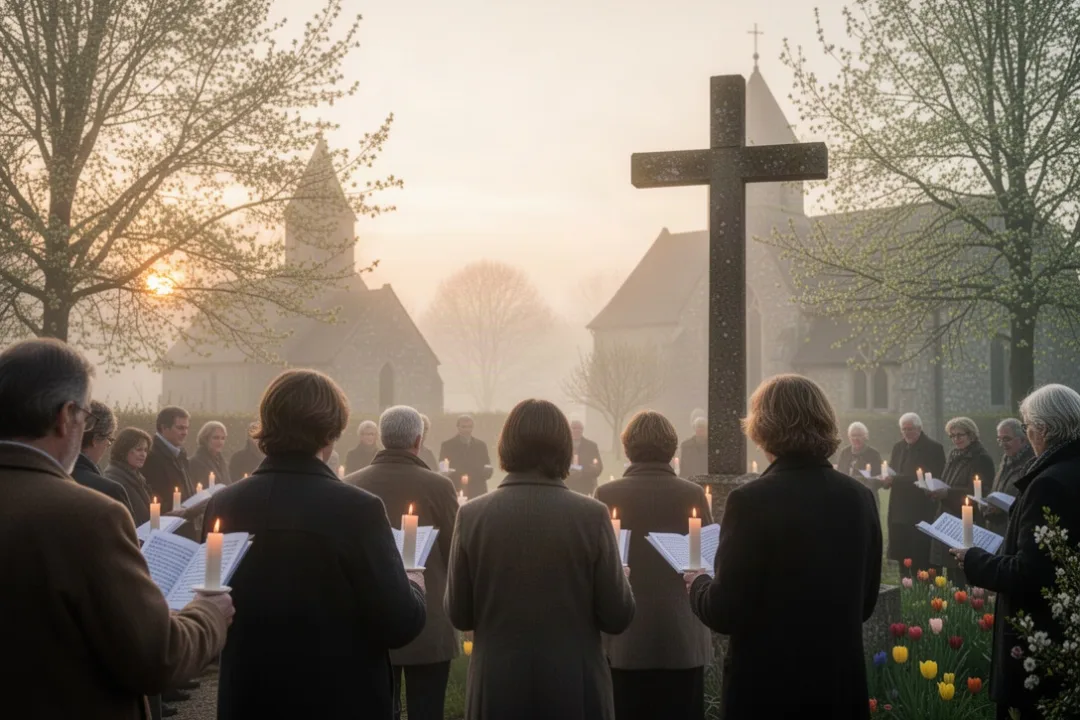
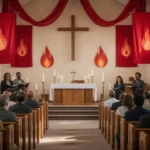
Churches may begin the celebration before sunrise because the Gospel accounts describe the women approaching the tomb early in the morning. Sunrise services often take place outdoors or in simple settings, using readings, prayer, and music to mark the dawn. Other congregations hold services later in the morning, when larger numbers of worshipers can attend.
Common Resurrection Sunday worship practices
Worship traditions vary by denomination, culture, and congregation, but most services center on the biblical resurrection accounts. The pastor or minister may preach about the empty tomb, Christian hope, forgiveness, or the promise of new life. Readings often come from one or more Gospel accounts, along with passages from the letters of the New Testament.
Music has a prominent place in many services. Congregations may sing traditional hymns, contemporary worship songs, or music shaped by local cultural traditions. The subject matter often includes Christ’s victory, the cross, the empty tomb, praise, and hope. Some churches use choirs, orchestras, handbells, or other musical groups, while others keep the service simple.
Communion, also called the Lord’s Supper or Eucharist, is observed on Resurrection Sunday in many churches. The practice remembers Jesus’ death and points to the promise of his return. The meaning, frequency, and method of receiving Communion differ among denominations, so visitors should follow the guidance provided by the congregation.
Some churches celebrate baptisms during the Easter season. Baptism is associated with dying and rising with Christ, especially through the imagery in Romans 6. A baptism service may include people publicly professing Christian faith, parents presenting children in traditions that practice infant baptism, or believers completing a period of instruction before joining the church.
Other common elements include:
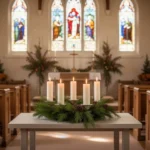
Lighting candles as a sign of Christ’s light and life.
Decorating the sanctuary with white or gold fabrics and flowers.
Ringing bells after a quieter period during Lent or Holy Week.
Reciting a historic statement of Christian faith.
Sharing a communal breakfast or meal after worship.
Collecting offerings for local ministries, missions, or people in need.
White is often used because it represents joy, purity, and celebration. Gold may communicate glory and honor. Churches may also use lilies or other spring flowers, although floral choices are cultural rather than required by the Bible.
For visitors: You do not need to know every custom before attending. Arrive a little early, read the service guide, and ask an usher or church leader when you are unsure about Communion, seating, or participation.
Resurrection Sunday is also a time when people who do not attend regularly may return to church. Congregations often welcome guests, provide children’s programs, and offer services at multiple times. If you are attending for the first time, a church website or office can usually explain dress expectations, parking, child care, and whether the service is traditional or contemporary.
How families and individuals can observe the day
A meaningful observance does not require an elaborate program. You can begin by reading one of the resurrection accounts slowly and considering what it says about Jesus, his disciples, and God’s action. Matthew 28, Mark 16, Luke 24, and John 20 are natural places to start, though the surrounding chapters add context about the crucifixion and burial.
Prayer can give the day a personal focus. You might thank God for Christ’s resurrection, confess areas where you need forgiveness, pray for grieving people, or ask for courage to live with greater faithfulness. Christian prayer does not need to use formal language; it can be honest, specific, and shaped by the themes of the day.
Families with children can explain the resurrection in age-appropriate terms. Younger children may understand that Christians believe Jesus died and that God raised him to life. Older children can discuss why the empty tomb matters, how the Gospel accounts differ in detail, and why Christians connect resurrection with hope, forgiveness, and future life.
Practical ways to observe Resurrection Sunday include:
Attend worship at a local church or join a service online if attending in person is not possible.
Read the Gospel account aloud and allow time for questions or quiet reflection.
Share a meal with family, friends, neighbors, or someone who might otherwise be alone.
Serve another person through a meal, donation, visit, or practical act of care.
Reach out to someone grieving without offering shallow explanations or pressuring them to feel cheerful.
Keep the focus on Christ while enjoying cultural traditions that are meaningful to your household.
Some people use an Easter meal to symbolize abundance after the fasting or restraint of Lent. Others avoid particular foods, continue a fast, or keep the day quiet. No single menu, outfit, decoration, or family activity defines Christian observance.
Eggs, rabbits, baskets, and spring clothing are common in American Easter culture, especially for children. These customs may represent fertility, new life, or seasonal celebration, but they are not central biblical symbols of the resurrection. Christian families can include them as cultural traditions while clearly explaining that Jesus’ resurrection is the reason for the day.
People who are grieving may experience the holiday differently from those celebrating with large gatherings. Resurrection hope does not require pretending that loss no longer hurts. A thoughtful church or family can make room for both joy and sorrow, remembering that the Christian promise of resurrection is meant to meet people in suffering rather than dismiss it.
How Resurrection Sunday connects with Christian hope
The resurrection gives Christian hope a specific foundation. It is not simply confidence that circumstances will improve or that every painful experience has an obvious purpose. Christian hope rests on God’s action in raising Jesus and on the promise that God will ultimately defeat sin, death, and corruption.
This hope affects how Christians understand identity. In Romans 6, baptism is used as an image of sharing in Christ’s death and resurrection. The passage teaches that believers are called to live differently because they have been given new life. This does not mean Christians become perfect immediately; it means their relationship with sin, God, and other people is being transformed.
The resurrection also supports Christian courage. The early disciples who had been frightened and scattered became public witnesses to Jesus. The book of Acts describes them preaching that God raised Jesus and calling people to repentance and faith. Christians today interpret that witness as a reason to practice faith openly while still acting with humility and respect toward people who do not share their beliefs.
First Corinthians 15 describes resurrection as a future promise as well as a past event. Paul uses agricultural imagery to explain that the future resurrection body will be connected to the present person but transformed. The passage does not provide a complete physical description, yet it emphasizes that Christian hope is not escape from creation; it is God’s renewal of life.
That future hope can shape everyday choices. If life matters to God, then care for people, mercy, justice, truthfulness, and service matter now. The resurrection does not encourage withdrawal from ordinary responsibilities. Instead, it gives Christian service a larger horizon and assures believers that faithful work is not ultimately wasted, as 1 Corinthians 15 teaches.
Resurrection Sunday therefore combines remembrance and expectation. Christians remember what they believe God did in Jesus, celebrate what that event means for forgiveness and new life, and look forward to the final defeat of death. Worship, prayer, generosity, and fellowship all become ways of responding to that message.
For someone exploring Christianity, the most direct place to begin is the Gospel testimony itself. Read one account carefully, compare it with another, and consider the claims it makes about Jesus’ death, resurrection, authority, and invitation to follow him. A trusted local church or mature Christian can provide conversation without requiring you to have every question settled first.
Frequently asked questions
Is Resurrection Sunday the same as Easter Sunday?
Yes. In most American Christian usage, Resurrection Sunday and Easter Sunday refer to the same celebration: the Sunday honoring Jesus Christ’s resurrection. “Resurrection Sunday” places greater emphasis on the biblical event, while “Easter” is the more familiar calendar name. Churches may use either term, or both, depending on their denomination and local tradition.
Why does the date of Resurrection Sunday change?
The date is calculated using a traditional relationship between the spring equinox, a full moon, and the following Sunday. As a result, the celebration moves each year within a range from late March to late April in Western Christianity. Eastern Orthodox churches may celebrate on another date because they use different calendar and calculation traditions.
Do Christians have to attend church on Resurrection Sunday?
Many Christians consider worship attendance an important way to celebrate, but practices differ by denomination and personal circumstance. Illness, caregiving, travel, work, or limited access may prevent someone from attending in person. Reading Scripture, praying, joining a service remotely, and practicing generosity can help mark the day meaningfully.
What is the best Bible passage to read on Resurrection Sunday?
Any of the four Gospel resurrection accounts is appropriate: Matthew 28, Mark 16, Luke 24, or John 20. Each presents the empty tomb and appearances of Jesus from a different perspective. Reading the preceding crucifixion and burial passages can provide fuller context and show why the resurrection is central to Christian faith.











Leave a Reply