Palms Sunday, also called Palm Sunday, is the Sunday before Easter and the beginning of Holy Week in many Christian churches. It remembers Jesus’ arrival in Jerusalem, when crowds welcomed him with palm branches and praised him as a king.
The day has a distinctive contrast: worship begins with celebration but turns toward the account of Jesus’ arrest, suffering, and death. Churches may distribute blessed palms, process with them, read the Passion narrative, and encourage worshipers to carry the day’s message into the rest of the week.
Palms Sunday does not fall on the same calendar date every year because Easter is a movable feast. It takes place seven days before Easter Sunday, so it can occur anywhere from late March to late April in the Western Christian calendar.
The date is connected to the lunar pattern used to determine Easter. In Western churches, Easter is celebrated on the Sunday after the first full moon on or after the spring equinox according to the church’s traditional calculation. Palms Sunday follows that date by one week.
Some Eastern Christian churches use a different calendar or calculation for Easter. As a result, their Palm Sunday may fall on a different date from Palm Sunday observed by Roman Catholic, Anglican, Lutheran, Methodist, Presbyterian, and many other Western churches.
If you want to attend a service, check the church’s schedule rather than relying only on a calendar. Some congregations hold a Palms Sunday procession before the main service, while others distribute branches inside the sanctuary or provide them after worship.
What the first Palm Sunday remembers
The central event is Jesus’ entry into Jerusalem shortly before his crucifixion. The Gospel accounts describe him entering the city while riding a young donkey or colt. Crowds spread cloaks on the road and waved or placed branches before him as they shouted words of praise.
The event appears in Matthew 21, Mark 11, Luke 19, and John 12. The accounts share the main outline, although they differ in details such as how the crowd, branches, garments, and surrounding events are described.
The donkey carries symbolic meaning. It presents Jesus as a humble king rather than a military conqueror and recalls the prophetic image in Zechariah 9:9. Christians understand the scene as showing that Jesus fulfills a hope for a peaceful ruler, while also challenging ordinary ideas about power and status.
The crowd’s welcome is often associated with the Hebrew expression Hosanna. In its biblical setting, the word carries the sense of a plea for salvation and also became an expression of praise. The people were not simply greeting a traveler; they were expressing hope that Jesus would bring deliverance.
Many Christians also connect the branches with victory, peace, and recognition of Jesus’ kingship. The symbolism is especially striking because the same week that begins with public acclaim leads to rejection, execution, and grief.
Why Palms Sunday begins Holy Week
Holy Week is the period that leads from Jesus’ entry into Jerusalem to Easter. Palms Sunday opens that period by placing two realities side by side: the promise of a kingdom and the path of suffering Jesus is about to face.
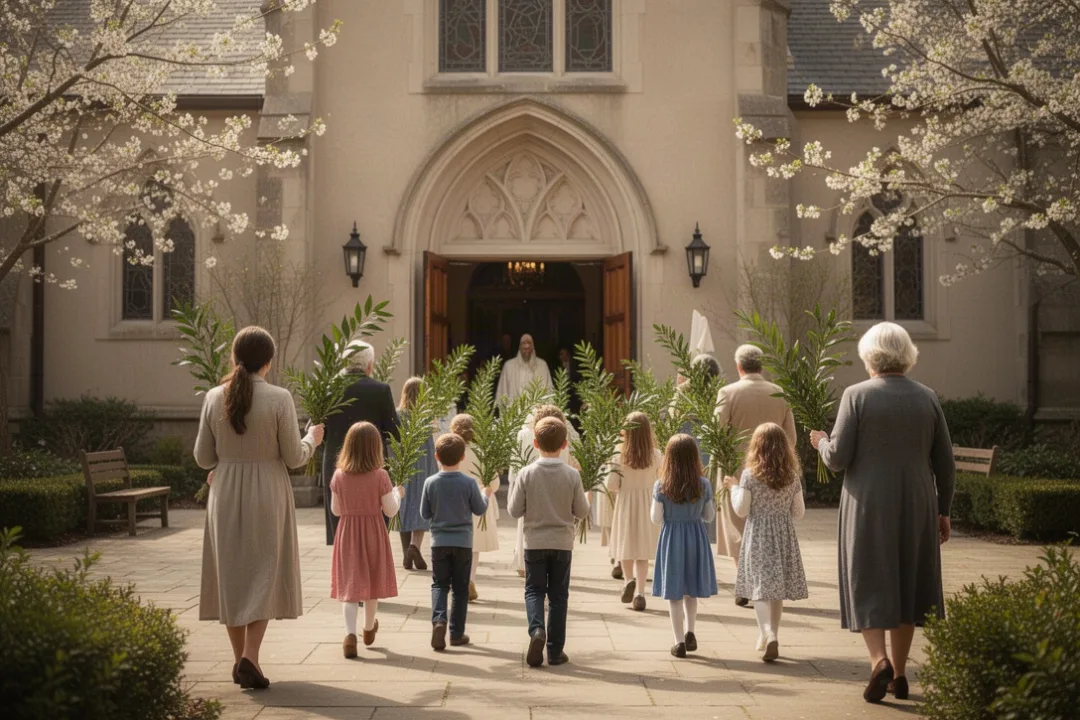
In many churches, the service begins outdoors or at the back of the building. Worshipers receive branches, hear a reading about Jesus’ entry, and walk together while singing. The congregation then gathers for the regular service, where the mood may become more reflective.
A major turning point is the reading of the Passion narrative, the biblical account of Jesus’ betrayal, trial, crucifixion, and death. Depending on the church tradition and the year’s schedule, the Passion may be read on Palms Sunday or reserved for Good Friday.
This movement from praise to sorrow is deliberate. It prevents the day from treating Jesus’ entry as a simple victory parade and invites worshipers to consider the cost of his mission. The service looks ahead to Maundy Thursday, Good Friday, and Easter rather than isolating one moment from the larger story.
The central theme: Palms Sunday holds celebration and suffering together. The branches point to Jesus’ royal welcome, while the Passion reading points toward the cross.
How different churches observe Palms Sunday
Practices vary by denomination, congregation, country, and local custom. There is no single required way for every Christian community to observe the day, but several traditions are widespread.
Palms are distributed: Worshipers receive palm leaves, fronds, crosses made from palm leaves, or branches from another local plant.
A procession is held: The congregation walks into the church or around the grounds while singing hymns and carrying branches.
The palms are blessed: In traditions that use a formal blessing, a minister, priest, or pastor prays over the branches before they are given to the congregation.
The Gospel story is read: The service includes an account of Jesus’ entry into Jerusalem and may also include the Passion narrative.
Hymns and responses are sung: Music often emphasizes praise, kingship, salvation, humility, and the cross.
Children participate: Some churches invite children to carry branches, lead a procession, or reenact parts of the entry in an age-appropriate way.
Palms are taken home: Worshipers may place them near a cross, crucifix, prayer space, or another respectful location.
Where palm trees are not readily available, churches may use olive branches, willow, boxwood, yew, cedar, or other greenery. The local plant is not the central point; the branch serves as a visible sign of the biblical welcome and the congregation’s participation in the day.
Some traditions include a formal service before the procession, while others begin with the procession itself. A congregation may also observe Palms Sunday quietly, especially when the community follows a service pattern that emphasizes the Passion more strongly than the public celebration.
What the palm branches symbolize
Palm branches have long been associated with triumph and honor in the ancient Mediterranean and broader biblical world. Their use in the Gospel story signals that the crowd recognized Jesus in royal or messianic terms, even though his kingship would not look like the political power many people expected.
The branches can also symbolize the tension between public praise and lasting faith. A crowd can celebrate a leader when hopes are high, but Christian worship asks whether praise remains when following Jesus becomes difficult. The physical branch therefore becomes more than a seasonal decoration.
In some churches, the branch is shaped into a small cross. This connects the welcome of Palms Sunday with the crucifixion remembered later in Holy Week. The shape itself teaches that Christian faith links Jesus’ identity as king with his self-giving suffering.
Many congregations preserve the branches after the service. In some traditions, they are burned before the next year’s Ash Wednesday, and the ashes are used in that service. This custom creates a physical connection between the beginning of Holy Week and the start of Lent.
Branches should be treated respectfully, but they are not magic objects. Their meaning comes from the story and prayer surrounding them. Keeping a palm at home can prompt prayer and reflection, yet the branch itself is not believed to provide protection or guarantee a particular result.
The difference between Palms Sunday and Easter
Palms Sunday and Easter are related but emphasize different events. Palms Sunday remembers Jesus’ entry into Jerusalem and opens Holy Week. Easter celebrates the resurrection of Jesus after his crucifixion and burial.
The two observances also have different emotional tones. Palms Sunday may begin with music, movement, and branches but become solemn as the Passion is read. Easter services are centered on resurrection, renewed life, and joyful praise, although the exact style varies among churches.
It is also helpful to distinguish Palms Sunday from the entire week that follows it. The usual sequence is:
Palms Sunday: Jesus enters Jerusalem and is welcomed by crowds.
Holy Monday through Holy Wednesday: Churches may remember events and teachings associated with Jesus’ final days, although observances differ.
Maundy Thursday: Christians remember the Last Supper, Jesus’ command to love, and the beginning of his final night.
Good Friday: The church focuses on Jesus’ crucifixion and death.
Holy Saturday: The day is marked by waiting, silence, and preparation for Easter in many traditions.
Not every church holds a separate service on each day. Still, understanding the sequence helps explain why Palms Sunday can sound both festive and serious. The day is the doorway into the most important week of the Christian liturgical year.
How to participate respectfully in a Palms Sunday service
You do not need to know every response or hymn to attend. Most congregations provide a bulletin, projected words, or spoken instructions. You can follow the procession, receive a branch, and remain observant if you are unfamiliar with the tradition.
Participation may involve standing, walking, singing, kneeling, or responding aloud. These practices differ between churches, so watching the people around you is usually enough. If you have mobility concerns, ask an usher or church staff member where you can participate comfortably.
If children are attending, explain that the branches are signs of welcome and that the service tells a story moving toward Easter. Children may understand the procession more easily when they know why people are carrying branches and why the mood changes during the reading.
Photography rules also vary. A procession may be suitable for photographs in one congregation and considered a prayerful moment in another. Ask before taking pictures, especially during the Scripture reading, Communion, or a children’s presentation.
Practical tips and common mistakes
A little preparation can make the day more meaningful and help you avoid misunderstandings. These points apply whether you are attending for the first time, bringing children, or planning worship for a congregation.
Check the service time: A procession may begin before the advertised worship time, so arrive early enough to receive a branch and gather with the congregation.
Wear suitable clothing: Outdoor processions can involve uneven ground, changing weather, or a longer period of standing.
Do not assume every branch is a palm: Local churches may use greenery that grows in their region, and that does not make the observance less authentic.
Do not treat the branch as a charm: Keep it as a reminder of faith, not as an object believed to possess automatic spiritual power.
Ask about disposal: A church may collect old branches for burning, composting, or another respectful use. Do not throw them away without checking local practice.
Expect a serious reading: The Passion narrative can be long and emotionally difficult, particularly for young children. Learn the service plan in advance if that would help your family.
Do not leave after the procession automatically: In many churches, the procession is only the opening part of the service.
Respect different customs: Some churches emphasize celebration, while others focus strongly on the coming Passion. Neither approach should be assumed to represent every Christian tradition.
Use the branch at home thoughtfully: Place it near a Bible, cross, or prayer space, and remove it when it becomes damaged or dusty.
For home observance: Read one of the Gospel accounts of Jesus’ entry into Jerusalem, place a branch somewhere visible, and use it as a reminder to pray through Holy Week rather than as a decoration alone.
How families can explain Palms Sunday to children
A simple explanation is often best: “The church remembers the day people welcomed Jesus into Jerusalem. We carry branches because they carried branches, and we listen to the story of what happened during the week that followed.” This gives children the basic meaning without requiring a long lesson.
Children may ask why the service becomes sad after beginning happily. You can explain that the church tells the whole story, including Jesus’ suffering and death, because Easter’s joy is connected to what comes before it. The change in mood is part of the worship rather than a mistake in planning.
Allow children to hold a branch, but set clear expectations about waving it near other people, blocking aisles, or interrupting the reading. If a congregation has a children’s procession, ask whether children should meet in a particular location before worship.
At home, children can help place the branch in a safe spot, draw the Jerusalem scene, or make a simple cross from fallen greenery with adult supervision. Keep the activity focused on the meaning of welcome, humility, love, and the approach of Easter.
What the Gospel accounts emphasize
Reading the four Gospel accounts side by side shows both common ground and distinct emphases. Matthew highlights connections with prophecy and describes the entry in a way that emphasizes Jesus as the promised king. Mark presents the movement into Jerusalem with a direct, urgent narrative.
Luke gives attention to praise and to the significance of Jesus’ approach to the city. John connects the event with signs surrounding Jesus and includes details about the crowd’s response that reflect the Gospel’s broader emphasis on belief and recognition.
These differences do not require readers to choose one account and reject the others. They show that each Gospel writer presents the event with a particular theological purpose. Together, the accounts offer a fuller picture of the welcome, the symbolism of the donkey and branches, and the conflict that follows.
When reading the passages, look for more than the crowd’s actions. Notice Jesus’ humility, the expectations surrounding a king, the role of prophecy, and the speed with which public acclaim gives way to danger. Those themes explain why Palms Sunday remains both celebratory and sobering.
Questions Palms Sunday can raise for personal reflection
The day invites reflection on the difference between admiration and discipleship. It is easy to celebrate a figure when success appears near; it is more demanding to remain faithful when the path includes sacrifice, uncertainty, or opposition.
You might consider what the crowd expected Jesus to do and how his actions challenged those expectations. The entrance into Jerusalem does not portray power through weapons or status. It presents a king who arrives with humility and accepts a mission that leads through suffering.
The branches can also prompt a practical question: What does public faithfulness look like after the service ends? For some people, the answer may involve reconciliation, generosity, prayer, care for someone who is lonely, or a renewed commitment to worship during Holy Week.
Palms Sunday does not ask worshipers to ignore the sorrow ahead. Instead, it teaches them to hold praise, grief, hope, and uncertainty together. That combination is one reason the day has remained a significant observance across many Christian communities.
How to observe Palms Sunday at home
If you cannot attend a church service, you can still mark the day in a simple and respectful way. Read Matthew 21:1-11, Mark 11:1-11, Luke 19:28-40, or John 12:12-19 in a Bible, then spend a few minutes considering what the entry into Jerusalem means to you.
Use a local branch or another green plant if you do not have a palm. It does not need to be elaborate. A small visible reminder can serve as a prompt to pray for humility, courage, compassion, and deeper attention during Holy Week.
Families can listen to a recording of a church service, sing a familiar hymn, or walk quietly through the neighborhood while discussing the story. Avoid presenting a home activity as a replacement for every tradition; its purpose is to create space for remembrance and reflection.
If your church offers blessed palms, follow its guidance about taking them home and returning them later. If you are observing privately, dispose of a dried branch respectfully according to your own tradition and local environmental rules.
Why Palms Sunday still matters
Palms Sunday gives Christians a way to enter Holy Week with the biblical story in view. It recalls a public welcome, but it does not stop there. The day asks worshipers to consider the kind of king Jesus is, the meaning of faithful love, and the cost of following a path that leads to the cross.
Its most recognizable custom, the palm branch, is small and easy to overlook. Yet it connects the congregation with an ancient scene, gives children a concrete way to participate, and carries the worshiper from celebration toward the solemn days before Easter.
The observance may look different from one church to another, but its central message remains recognizable: Jesus enters Jerusalem in humility, receives the crowd’s praise, and moves knowingly toward the suffering that precedes resurrection. That tension gives Palms Sunday its distinctive place in the Christian year.
Frequently asked questions
Is Palms Sunday the same as Palm Sunday?
Yes. “Palm Sunday” is the more common name, while “Palms Sunday” is also used by some churches and communities. Both refer to the Sunday before Easter that remembers Jesus’ entry into Jerusalem. The observance may include palm branches, another type of greenery, a procession, Scripture readings, hymns, and a reading about Jesus’ final days.
What should you do with palm branches after Palms Sunday?
Keep the branch in a respectful place, such as near a cross, Bible, or prayer area, if that is customary in your church. Many congregations collect old palms for burning before Ash Wednesday. Ask your church about its practice rather than placing a blessed branch in ordinary trash or treating it as a protective charm.
Why do some churches use plants other than palms?
Palm trees are not available everywhere, especially in colder climates. Churches may use olive branches, willow, boxwood, cedar, yew, or other local greenery. The branch represents the crowd’s welcome and the symbolism of the biblical account; using a regional plant allows the congregation to participate without changing the central meaning of the observance.
Why can a Palms Sunday service feel both joyful and sad?
The service begins by remembering Jesus’ public welcome in Jerusalem, so it may include music, movement, and celebration. It can then turn toward the Passion, the account of his betrayal, suffering, and crucifixion. This change reflects the structure of Holy Week and connects the celebration of Jesus’ kingship with the suffering that comes before Easter.












Leave a Reply