What should you notice first when reading Matthew 28:1-10? The passage answers with a startling claim: Jesus, who had been crucified and buried, is no longer in the tomb. Matthew presents the resurrection not as an idea formed by the disciples later, but as an event announced at the tomb and confirmed when the women meet Jesus.
The scene begins after the Sabbath, at dawn on the first day of the week. Mary Magdalene and another Mary go to see the tomb. They encounter an earthquake, an angel, frightened guards, an empty burial place, and finally the risen Jesus himself. Their experience moves from grief and fear to worship, joy, and faithful obedience.
Matthew places the visit at the tomb shortly after the Sabbath has ended. The women come as morning begins, connecting the resurrection with the start of a new day. Their purpose is not described as a plan to preach or investigate a theological question; they go to the tomb because Jesus has died and the burial site matters to them.
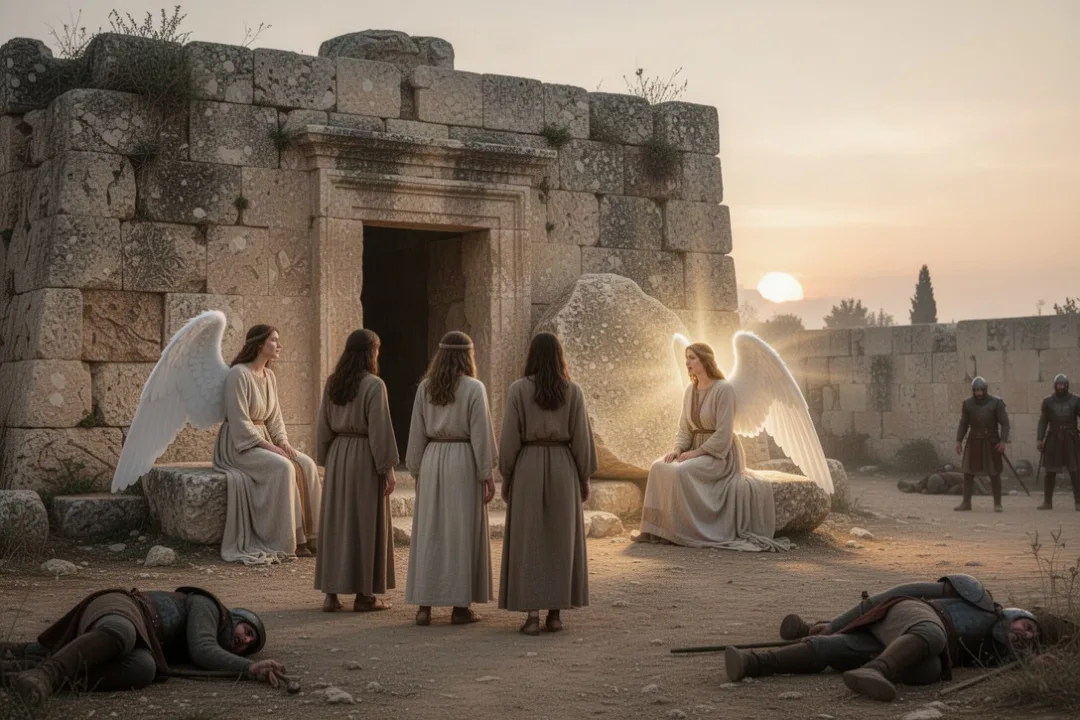
Before they arrive, or as they reach the tomb, a great earthquake occurs. An angel descends from heaven, rolls the stone away, and sits on it. Matthew describes the angel’s appearance with images of brightness and purity, while the guards become so afraid that they are unable to act. The scene shows that the opening of the tomb is not the result of human strength or a quiet nighttime escape.
The angel tells the women not to be afraid. He knows why they have come: they are looking for Jesus, the one who was crucified. Then he gives the central announcement of the passage: Jesus has been raised, and the women should come and see the place where he had been lying.
The women are also given a task. They must go quickly and tell Jesus’ disciples that he has been raised from the dead and will go ahead of them into Galilee. There, the disciples will see him. The women leave with fear and great joy, and while they are on their way, Jesus meets them.
They take hold of his feet and worship him. Jesus repeats the command not to be afraid and tells them to inform his brothers that they should go to Galilee. Matthew 28:1-10 therefore includes both the empty tomb and an encounter with the living Jesus.
Why Matthew emphasizes the empty tomb
The empty tomb is not presented as a vague symbol of hope. It is a physical location that the women are invited to inspect. The angel points them toward the place where Jesus had been laid, making the contrast clear: the tomb is known, the burial is real, but Jesus is no longer there.
Matthew does not suggest that the women merely feel close to Jesus after his death. Their message is based on something that has happened to him: he has been raised from the dead. The resurrection changes the meaning of the crucifixion because death does not have the last word over Jesus.
The guards also underline the public seriousness of the event. They had been assigned to secure the tomb, yet the angel’s arrival leaves them shaken and helpless. Their reaction does not prove the resurrection by itself, but it shows that Matthew is describing a dramatic disturbance at a guarded burial place rather than a private moment of imagination.
The stone is another important detail. Its removal makes the tomb accessible and visible; it does not function as a way for Jesus to escape unnoticed. The women can see the place, receive the announcement, and become witnesses to what has occurred.
Central message: Matthew 28:1-10 does not merely say that the disciples continued Jesus’ work after his death. It announces that God raised Jesus, and that the risen Jesus then met his followers and gave them a message to deliver.
How the angel’s message explains the resurrection
The angel’s words guide the women through three movements: do not fear, come and see, and go and tell. Each movement answers a different need. Fear must be addressed, the empty tomb must be observed, and the news must be carried to the disciples.
“Do not be afraid” does not mean the women have no reason to feel astonished. The earthquake, angel, empty tomb, and heavenly message are overwhelming. Instead, the command redirects their fear. They do not need to fear the angel or interpret the empty tomb as a disaster, because the event is good news about Jesus.
“Come and see” gives the women a concrete basis for the announcement. They are not asked to accept an unexplained statement while remaining outside. The angel invites them to look at the place where Jesus had been laid. Their witness includes both what they hear and what they observe.
“Go quickly and tell” shows that resurrection faith is not meant to stop at personal amazement. The women have received news that concerns the disciples, so they must communicate it. Their obedience is urgent, but Matthew does not portray them as emotionless messengers. They leave with both fear and joy.
The message also includes a destination: Galilee. This is significant because Galilee is associated with much of Jesus’ ministry and with the disciples’ earlier life with him. The resurrection does not erase Jesus’ relationship with his followers; it restores their future with him and prepares them for the mission that follows later in the chapter.
What the women reveal about faithful witness
Mary Magdalene and the other Mary occupy a central place in Matthew’s account. They come to the tomb, remain present at the announcement, receive the commission, meet Jesus, worship him, and carry his words to the disciples. Their role is not a minor detail added around the main event.
The women are faithful before they understand everything. They go to the tomb while still living with the reality of Jesus’ death. Their initial action is shaped by love and grief, not by confidence that they will find an empty tomb. That makes their response especially significant: they become witnesses because God acts, not because they had already worked out the answer.
Matthew also describes their physical response to Jesus. They take hold of his feet and worship him. This detail presents the risen Jesus as someone they can encounter, not merely as a memory or spiritual influence. Their worship is joined to a bodily recognition that the person they had followed is alive.
Their witness also carries a reversal of expectations. In the cultural setting of the ancient world, women’s testimony could be treated as less authoritative than men’s. Matthew nevertheless makes women the first human messengers of the resurrection in his account. The story gives them a responsibility that the disciples must receive from them.
The passage does not claim that the women have no fear. It shows that fear does not prevent obedience. They can be shaken and still go. They can be uncertain and still speak. They can feel overwhelmed and still worship.
Why Jesus meets the women on the road
The angel has already announced the resurrection, but Jesus himself meets the women as they go to the disciples. This encounter confirms that the resurrection is not only an empty-tomb discovery. The women see Jesus, approach him, hold his feet, and worship him.
Jesus begins with the same reassurance the angel gave: they should not be afraid. His words acknowledge their emotional state while directing them toward the task ahead. The risen Lord does not shame them for being frightened; he gives them peace and a clear responsibility.
Jesus calls the disciples his brothers. That description is striking because the disciples had failed him during the arrest and crucifixion. Yet the resurrection message does not define them only by their failure. Jesus still claims them and calls them to meet him in Galilee.
Galilee represents a meeting place where the disciples will again see Jesus and receive further direction. Matthew’s account continues beyond these ten verses, eventually describing the disciples’ commission to make disciples of all nations. In Matthew 28:1-10, the women’s message begins the chain of communication that leads to that larger mission.
Jesus’ meeting with the women also shows that revelation and relationship belong together. The women hear an angelic announcement, inspect the tomb, and then encounter Jesus. Christian faith in this passage is not detached from the person of Jesus; it centers on him as the living one who speaks, receives worship, and directs his followers.
How fear and joy work together in this passage
Matthew deliberately holds two emotions together. The women leave the tomb with fear and joy, a combination that may seem contradictory until the nature of the event is considered. They are afraid because they have encountered something beyond ordinary experience, and they are joyful because the news they have received is good.
Fear in this passage is not simply the expectation of punishment. It includes awe, shock, uncertainty, and the natural response to divine power. The earthquake and angel reveal that the women are standing at a moment of enormous significance. Their fear recognizes that the resurrection is not a routine event.
Joy comes from the specific promise that Jesus is alive and will meet his disciples. It is not shallow optimism or an attempt to ignore the crucifixion. The women know Jesus died. Their joy arises because death has been overcome and because Jesus has given them a message of renewed relationship.
This emotional combination offers a realistic picture of responding to God’s work. You may understand that something is good while still feeling unsettled by its implications. Faithful action does not require the absence of fear; in Matthew’s account, the women act while fear and joy are both present.
Jesus’ command, “Do not be afraid,” should therefore be read as a promise of his authority and presence, not as a demand to pretend that nothing is frightening. The women are not told to deny what they feel. They are told that fear must not stop them from delivering the resurrection message.
What Matthew 28:1-10 teaches about evidence and belief
The passage gives several forms of testimony. There is the visible empty tomb, the angel’s announcement, the women’s direct encounter with Jesus, and the message delivered to the disciples. Matthew presents belief as a response to God’s revealed action, not as a conclusion based only on private emotion.
At the same time, the passage does not describe the resurrection as something that can be reduced to a laboratory demonstration. The women are not given a mechanical explanation of how Jesus was raised. They receive a declaration about what God has done and are called to trust the person who has been raised.
The empty tomb matters because it protects the meaning of the resurrection from being reduced to metaphor. If Jesus remained in the tomb, the announcement would be false. If the tomb is empty but Jesus never meets his followers, the account would still be incomplete. Matthew joins the two realities: the tomb is empty, and Jesus is present.
The women also illustrate the difference between evidence and control. They can see the burial place and encounter Jesus, but they cannot make the resurrection happen or explain every detail. Their role is to receive, worship, and report what they have been shown.
For readers, this means the passage invites careful attention to its claims. It does not ask you to treat the resurrection as an inspirational slogan. It asks whether you will take seriously the testimony that Jesus was raised and consider what his resurrection means for your understanding of death, hope, worship, and discipleship.
Common mistakes when reading Matthew 28:1-10
Several readings can miss the emphasis of the passage. The following corrections help keep the text connected to what Matthew actually says.
Treating the passage as only a story about an empty tomb: The women do not merely find that Jesus is absent. They are told he has been raised, and they meet him on the way.
Assuming the women expected the resurrection: Matthew shows them going to the tomb, not arriving with a confident plan to verify a prediction. Their response is astonishment, fear, joy, and obedience.
Reducing the earthquake and angel to decoration: These details communicate divine authority and show that the resurrection is presented as God’s decisive action.
Ignoring the women’s role: They are the first messengers in Matthew’s account. Their testimony and obedience are essential to the narrative.
Separating worship from mission: The women worship Jesus, but they also carry his message. Devotion and responsible witness appear together.
Reading “do not be afraid” as a command to feel nothing: The women still experience fear. The command means they should not let fear prevent them from trusting and obeying Jesus.
Overlooking the word “brothers”: Jesus’ description of the disciples emphasizes restored relationship despite their earlier failure.
Assuming Galilee is an incidental location: Jesus directs the disciples there as a place where he will meet them and continue leading them.
Practical ways to study Matthew 28:1-10
A careful reading can become more useful when you slow down and trace the passage’s movements. Read the text more than once, paying attention to who speaks, who acts, and how the women’s understanding changes.
Mark every command: Notice “do not be afraid,” “come and see,” and “go quickly and tell.” These commands show how the resurrection announcement leads to action.
Track the locations: The women go to the tomb, leave it, meet Jesus on the road, and are told to direct the disciples to Galilee. The movement reflects the spread of the message.
Compare the reactions: The guards are overwhelmed, the women are fearful and joyful, and the women worship Jesus. The different responses reveal how people react to divine power.
Ask what is observed directly: The women see the open tomb and later encounter Jesus. Separate those observations from the angel’s interpretation, then consider how the two fit together.
Identify the people who carry the message: The angel speaks to the women, the women speak to the disciples, and Jesus confirms the message. Matthew emphasizes reliable communication.
Connect the passage with its surrounding context: Read the crucifixion account before it and the disciples’ commission after it. The resurrection stands between Jesus’ death and the mission of his followers.
Apply the passage without flattening it: Ask where fear may be delaying obedience, but do not turn the text into a generic lesson about positive thinking. Its foundation is the resurrection of Jesus.
These steps help you see that Matthew 28:1-10 is carefully structured. The women go to a place of death, receive a message of life, encounter Jesus, and become messengers themselves. The passage’s movement is from burial to resurrection, from silence to proclamation, and from fear to worshipful obedience.
A useful reading question: What does the passage ask the women to do because Jesus has been raised? The answer is not merely to feel encouraged. They are told to see, worship, go, and tell the disciples where they will meet Jesus.
How Matthew 28:1-10 applies to Christian life
The passage gives Christian hope a definite center. Hope is not based on the assumption that every painful situation will quickly improve. It rests on the claim that God raised Jesus from the dead and that the risen Jesus remains active in relationship with his followers.
That hope can change how you understand failure. The disciples had abandoned Jesus, yet he calls them his brothers and summons them to meet him. Matthew does not excuse their failure, but he shows that failure does not have the final authority to define their relationship with Jesus.
The women also provide a model of obedience that begins with the next clear step. They cannot explain every mystery surrounding the resurrection. They can follow the angel’s instruction, respond to Jesus, and deliver the message they have received.
Christian witness in this passage is similarly grounded. The women do not invent a message based on their personal preferences. They report what the angel has announced and what Jesus has told them. Their authority comes from being sent by the risen Lord.
Worship is another practical response. The women take hold of Jesus’ feet and worship him, showing that resurrection faith leads to reverence, not merely information. The risen Jesus is not only a subject to discuss; he is the Lord whom his followers honor.
Finally, Matthew 28:1-10 reminds readers that fear and faith may coexist for a time. The women are not portrayed as fearless heroes. They are ordinary people who receive extraordinary news and obey while still shaken. Their example encourages honest faith that brings fear into the presence of the risen Jesus rather than allowing fear to make the final decision.
Why Matthew 28:1-10 remains central to the resurrection account
These ten verses contain the essential sequence of Matthew’s resurrection announcement. Jesus has been crucified, the tomb is opened, the women are told that he has been raised, the burial place is shown to be empty, Jesus meets them, and the disciples are called to gather with him in Galilee.
The passage combines public signs with personal encounter. The earthquake and guards show the event’s power, while the women’s meeting with Jesus shows its relational character. The resurrection is both an act of God and a reality that transforms the lives of those who encounter the risen Christ.
Matthew also shows that the good news spreads through people who are willing to carry it. The women are not given every answer, but they are given a message. They leave the tomb and become the first witnesses in the continuing story of Jesus’ followers.
The passage therefore asks more than whether the tomb was empty. It asks what you will do with the announcement that Jesus has been raised. Matthew’s answer is clear: fear should not silence you, worship should not remain private, and the risen Jesus’ words should be carried faithfully to others.
Frequently asked questions
Who were the women mentioned in Matthew 28:1-10?
Matthew names Mary Magdalene and “the other Mary.” The second woman is not fully identified within these verses, though Matthew had mentioned another Mary near Jesus’ crucifixion. Both women come to the tomb, hear the angel’s announcement, see Jesus, worship him, and receive the responsibility of telling the disciples what has happened.
Does Matthew 28:1-10 say that the women touched Jesus?
Yes. After Jesus meets them on the road, the women take hold of his feet and worship him. This physical detail supports Matthew’s presentation of the risen Jesus as personally present, not merely remembered through an inner experience. It also connects their direct encounter with the earlier announcement that Jesus had been raised.
Why does Jesus tell the disciples to go to Galilee?
Galilee is connected with Jesus’ ministry and with the disciples’ earlier life as his followers. By directing them there, Jesus promises a renewed meeting and points toward the continuing work that follows the resurrection. The location also shows that the disciples’ relationship and calling are not ended by their failure during Jesus’ arrest.
What is the main message of Matthew 28:1-10?
The central message is that Jesus was raised from the dead and is no longer in the tomb. The passage also shows how people should respond: receive the announcement, do not let fear control you, worship the risen Jesus, and faithfully tell others what he has commanded. Resurrection belief leads to witness and obedience.













Leave a Reply