Matthew 21:21-22 teaches that faith-filled prayer is marked by genuine trust in God and confidence that he can act beyond human ability. Jesus is not presenting faith as a technique for getting every personal desire; he is teaching his disciples to pray with undivided reliance on God, in harmony with God’s purposes.
The passage also connects faith with action. When Jesus speaks about moving a mountain and then says that prayer should be offered believing, he uses vivid language to describe apparently impossible obstacles. The promise calls you to bring those obstacles to God honestly, trust his authority, and remain willing to follow where that trust leads.
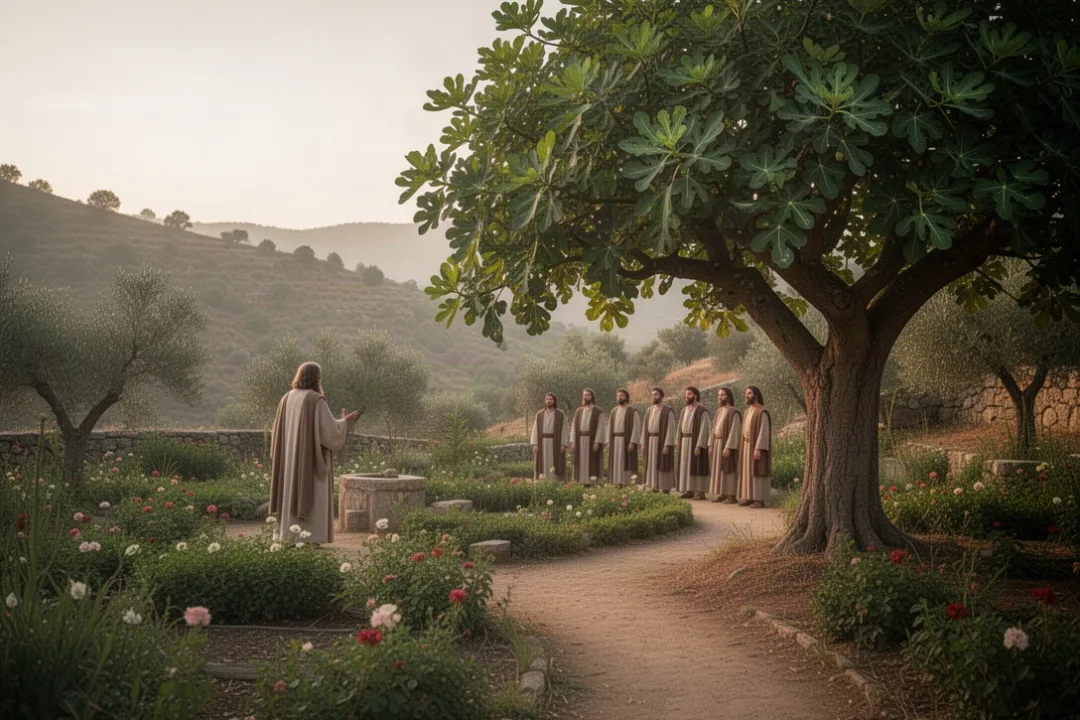
Jesus’ words come after an unusual event involving a fig tree. Jesus had found the tree covered with leaves but without fruit, and the tree withered after he spoke. The disciples were surprised by what happened and asked how it could have occurred.
Matthew places this event near Jesus’ arrival in Jerusalem and his cleansing of the temple. The surrounding chapters contain strong warnings about outward religious appearance without the corresponding fruit of faith and obedience. The fig tree therefore functions as more than a lesson about plants. It points toward the serious difference between appearance and spiritual fruit.
Jesus answers the disciples by directing their attention to faith and prayer. His response is not a promise that human beings can control nature by positive thinking. It is a call to trust God’s power when circumstances look impossible, while understanding that prayer belongs within a relationship of obedience to God.
Matthew 21:21-22 broken down by point
Faith in God: The focus is confidence in God’s character and authority, not confidence in your own ability to believe hard enough.
Mountain-moving language: The mountain represents an obstacle that appears immovable from a human perspective.
Prayer and belief: Jesus links believing prayer with trust that God hears and can respond.
God’s purposes: The promise should be read alongside other biblical teaching that prayer is not a demand for whatever contradicts God’s will.
Spiritual fruit: The surrounding fig-tree scene challenges empty appearance and calls for a faith that produces a changed life.
Read together, these points keep the passage from being reduced to a slogan. Faith is not a force you manipulate, and prayer is not a way to place God under obligation. The passage gives encouragement for difficult circumstances while also asking what kind of faith your prayer reveals.
Key idea: Matthew 21:21-22 is about confident dependence on God, not a guarantee that every request will be granted exactly as requested.
What “this mountain” means in Matthew 21:21
The image of a mountain communicates something that appears fixed, enormous, and beyond ordinary human power. Jesus’ point is that no obstacle is beyond God’s ability to overcome. The language is deliberately striking because the disciples needed to understand that God’s authority is not limited by the apparent size of a problem.
Some readers connect the mountain with the Mount of Olives, since the conversation takes place in that area. Others understand it as a general image for an impossible barrier. The central meaning does not depend on identifying one physical mountain. Jesus is teaching that faith looks past the apparent finality of an obstacle and brings it under God’s authority.
Possible “mountains” may include opposition, fear, injustice, spiritual resistance, grief, or a responsibility that seems greater than your strength. The passage does not require you to pretend that these difficulties are small. Faith acknowledges their size but refuses to treat them as larger than God.
At the same time, “moving a mountain” should not be used carelessly to blame someone whose problem remains. A person can pray sincerely and still experience illness, loss, delay, or unanswered questions. The persistence of an obstacle does not automatically prove that the person lacked faith.
What faith means in this passage
In Matthew 21:21, faith means trusting God rather than treating prayer as a desperate attempt to persuade an uncertain power. It includes confidence that God is capable of acting, but it also includes confidence in God’s wisdom, goodness, and authority. Those qualities belong together.
Faith is therefore different from optimism. Optimism may expect circumstances to improve because the future looks promising. Biblical faith can remain steady even when the outcome is unknown because its foundation is God himself. You may hope for healing, reconciliation, provision, or deliverance while still admitting that you do not control the result.
Faith is also different from certainty about a specific outcome. You can believe that God hears your request without claiming that you know precisely how God will answer. This distinction protects prayer from becoming a test in which a disappointing result is interpreted as proof that God was absent or that you failed spiritually.
Faith is directed toward God, not toward faith itself
People sometimes speak as if faith were an impersonal power that produces results when it reaches a certain intensity. Matthew 21:21-22 does not present faith that way. Faith has an object: the living God. Its strength depends primarily on whom you trust, not on creating perfect emotional confidence.
A struggling prayer can still be an act of faith when it turns honestly toward God. Doubt, grief, and questions do not automatically cancel faith. The important issue is whether you bring those struggles to God or allow them to become a reason to withdraw from him entirely.
How Matthew 21:22 explains believing prayer
Jesus says that what the disciples ask for in prayer, believing, will be received. That statement must be read with the rest of Scripture, including passages that describe prayer as submission to God’s will and passages that warn against selfish motives. The wording encourages bold prayer, but it does not turn God into a mechanism for fulfilling every request.
Believing prayer begins with the conviction that God listens. It continues with the conviction that God can act. It reaches maturity when the person praying trusts God’s answer, even when that answer differs from the hoped-for result.
This does not make prayer passive or vague. You can ask specifically for reconciliation in a damaged relationship, strength for a demanding responsibility, wisdom for a difficult decision, or protection for someone you love. Specific requests help you speak honestly. They also make it possible to recognize God’s guidance and provision without pretending that every answer must look the same.
Name the obstacle clearly. Describe the situation without minimizing its seriousness or exaggerating your helplessness.
Ask God for a specific kind of help. Request wisdom, courage, healing, justice, provision, forgiveness, or another need that fits the situation.
Place the request under God’s authority. Trust that God sees more than you can see and knows consequences you cannot predict.
Take the next faithful step. Prayer may lead you to apologize, seek counsel, set a boundary, contact a professional, or wait patiently.
Continue praying without demanding a timetable. Persistent prayer expresses dependence; it does not force a particular schedule.
This pattern brings together confidence and humility. You do not need to pray as though your words are weak or irrelevant. Neither do you need to pretend that your preferred outcome is the only faithful answer.
Why the fig tree matters to the meaning
The fig tree helps explain why Jesus speaks about faith immediately afterward. Its leaves suggested that fruit might be present, but the tree did not provide what its appearance promised. In the larger setting, this image is connected with the danger of religious activity without genuine faithfulness.
The scene does not mean that every hardship is a direct punishment for personal failure. Instead, the tree becomes a symbolic sign in a wider conversation about Israel’s leaders, the temple, and the response people give to Jesus. External signs of religion cannot substitute for repentance, justice, mercy, and trust in God.
That connection gives Matthew 21:21-22 a moral and spiritual dimension. Faith is not merely confidence that God will remove obstacles for your benefit. Genuine faith should produce fruit in the way you treat God and other people. Prayer that seeks power without character misses the point of the passage.
Faith that bears fruit
A person can say the right words and still resist God’s direction. Jesus’ teaching challenges that kind of divided life. Believing prayer should gradually shape your priorities, choices, relationships, and response to correction.
Fruit may appear as patience when you have a reason to retaliate, generosity when resources feel limited, integrity when dishonesty would be easier, or courage when obedience carries a cost. These actions do not purchase God’s favor. They show that trust in God is becoming visible in ordinary life.
Practical test: After praying about an obstacle, ask not only, “Will God remove this?” but also, “What faithful response is God asking of me while I face it?”
Matthew 21:21-22 does not promise that every request will be granted exactly as spoken. Such a reading would conflict with the broader biblical picture of prayer, where people ask boldly but also submit to God’s wisdom. It would also turn prayer into a way of measuring a person’s spiritual worth by visible success.
The passage does not teach that negative events happen because someone failed to believe enough. That interpretation can deepen shame and cause people to ignore practical help. A person facing depression, addiction, serious illness, financial hardship, or danger may need prayer alongside medical care, counseling, community support, legal assistance, or other responsible action.
It also does not teach that Christians should deny reality. Faith is not a refusal to acknowledge pain, evidence, or danger. Jesus’ teaching gives you permission to face the mountain honestly while refusing to assume that the mountain has the final word.
Not wish fulfillment: Prayer is not a method for obtaining every preference.
Not emotional perfection: Faith does not require you to feel fearless at every moment.
Not blame: Unanswered prayer should not automatically be explained as personal failure.
Not inaction: Trust in God can include wise planning, professional help, and responsible work.
Not manipulation: God cannot be controlled by formulas, repeated phrases, or spiritual performance.
How to pray Matthew 21:21-22 faithfully
A prayer based on this passage can be both confident and surrendered. Begin by recognizing who God is rather than beginning with the size of the problem. This turns your attention from panic toward trust without pretending that the situation is easy.
Then describe the obstacle in concrete terms. Instead of praying only for “a better life,” you might ask for wisdom in a job decision, courage to have a necessary conversation, strength to resist a destructive habit, or provision for a pressing need. Clear requests help you pray honestly and act responsibly.
Ask God to move what must be moved, but also ask God to change what must be changed in you. Sometimes the obstacle is external; sometimes fear, pride, resentment, or avoidance is part of the difficulty. A prayer that welcomes correction is more consistent with the passage’s emphasis on genuine faith than a prayer focused only on comfort.
Finally, leave room for God’s timing and method. You may continue to ask for the same need while remaining open to an answer that comes through gradual change, another person’s help, a new opportunity, endurance, or a deeper understanding of what faithfulness requires.
Prayer can be bold about God’s power while remaining humble about your own understanding.
How the passage applies to impossible situations
When a problem feels immovable, begin by separating what you can control from what you cannot. You cannot force another person to repent, guarantee a medical outcome, or control every economic condition. You can often choose honesty, seek appropriate help, make a wise plan, apologize for your part, or refuse to respond with revenge.
Prayer brings both categories before God. It asks him to work in circumstances beyond your reach and to form your character in the responsibilities within your reach. This prevents two opposite errors: trying to control everything yourself and using prayer as an excuse to avoid action.
For example, someone praying about a broken relationship may ask God to soften both hearts. That person may also need to acknowledge specific wrongdoing, respect the other person’s boundaries, and accept that reconciliation cannot be forced. Faith trusts God with the relationship while taking responsibility for personal obedience.
Someone facing financial pressure may pray for provision and guidance. A faithful response might include seeking assistance, creating a realistic budget, communicating with creditors, applying for work, or asking trusted people for counsel. These steps do not replace prayer. They may be part of the answer to prayer.
Matthew 21:21-22 and unanswered prayer
Unanswered prayer is one of the hardest questions raised by this passage. Jesus’ words sound expansive, while many sincere prayers seem to receive no visible response. The tension should not be dismissed with an easy explanation. Scripture itself contains prayers of lament, waiting, confusion, and continued petition.
When an answer does not come, you can continue to affirm two truths: God is able to act, and you do not fully understand his purposes. Holding both truths may feel uncomfortable, but it is more honest than pretending either that God lacks power or that every delay has an obvious explanation.
Waiting can include continued prayer, wise action, community support, and lament. It may also involve changing the wording of your prayer as your understanding develops. You might begin by asking God to remove a problem and later ask for endurance, wisdom, or a faithful response within it. Such change is not necessarily surrender to hopelessness; it can reflect deeper trust.
Do not measure the value of prayer only by immediate visible results. Prayer may reshape desires, expose motives, strengthen endurance, repair a relationship, or help you recognize support that you previously overlooked. These effects do not erase the pain of an unanswered request, but they show why prayer cannot be reduced to receiving a particular outcome.
Questions for personal reflection
Matthew 21:21-22 invites examination rather than mere repetition. Consider the obstacle you are bringing to God and ask what your prayer reveals about your understanding of faith.
What situation currently feels impossible or immovable?
Am I trusting God, or am I trying to use religious language to control the result?
What specific request can I make honestly?
What part of the situation requires responsible action from me?
Is there resentment, fear, pride, or avoidance that I need to bring to God?
Can I continue to trust God if the answer comes differently or later than I hope?
What kind of spiritual fruit would faith produce in my response?
These questions keep the passage connected to real life. Faith is not proven by dramatic language alone. It becomes visible when trust in God shapes your choices, your endurance, your treatment of other people, and your willingness to obey when the outcome remains uncertain.
A balanced way to understand the promise
The promise in Matthew 21:21-22 gives you permission to pray with expectation. You do not need to approach God as though your concerns are too small, your obstacles too large, or your requests automatically disqualified. Jesus directs his disciples toward active confidence in God’s power.
That confidence belongs with humility. God is not required to follow your preferred plan, and faith is not a demand that reality conform to your expectations. The mature response is to ask boldly, listen carefully, act faithfully, and trust God with the outcome.
Read in its setting, the passage joins faith, prayer, obedience, and spiritual fruit. It challenges passive despair, but it also challenges shallow confidence that seeks results without transformation. The mountain may be an external obstacle, an inward stronghold, or a task that appears beyond your ability. Whatever form it takes, bring it to God with honest words and a willingness to live faithfully while you wait.
Frequently asked questions
Does Matthew 21:21-22 mean I will receive anything I ask for?
No. The passage encourages confident prayer, but it does not make God a guarantor of every request. The promise should be understood alongside the broader biblical teaching that prayer is shaped by God’s wisdom, good purposes, and the character of the person praying. You can ask specifically and expectantly while remaining open to a different answer, timing, or method than you imagined.
What is the mountain Jesus says faith can move?
The mountain is best understood as vivid imagery for an obstacle that seems impossible to overcome. It may describe an external crisis, spiritual resistance, fear, opposition, or another barrier. The main point is not identifying one geographic mountain but recognizing that no obstacle is beyond God’s power. The image should encourage trust without blaming people when difficulties remain.
Does unanswered prayer prove that I do not have enough faith?
No. A delayed or different answer does not automatically show that your faith is defective. Faith involves trusting God’s ability and character, not producing a perfect emotional state or controlling an outcome. Unanswered prayer can be painful and confusing, and faithful responses may include lament, continued prayer, practical help, wise counsel, and patient waiting.
How can I apply Matthew 21:21-22 to daily life?
Bring a specific obstacle to God, ask for help with confidence, and identify the next obedient step you can take. That step might involve apologizing, seeking professional support, making a plan, setting a healthy boundary, or persevering in a difficult responsibility. Keep praying while surrendering the timing and outcome to God, and look for faith to produce practical spiritual fruit.














Leave a Reply