Introduction: Why the Bible Verse About Peter Walking on Water Matters
The moment when Peter steps out of the boat to walk toward Jesus on the water is one of the most vivid teaching pictures in the New Testament. Found in Matthew 14:22-33, this incident sits at the crossroads of trust and fear, human weakness and divine power, and the ongoing invitation to live by faith in the midst of life’s storms. Read across translations and traditions, the scene retains its peculiar power: a human being willing to try the miraculous, a storm that unsettles, and a Savior who reaches out in rescue. This article surveys the passage, explores its themes, and offers a broader look at how the story functions within the Gospel of Matthew and within Christian practice today.
Scriptural Narrative: The Core Text in Matthew 14
The sequence begins after the feeding of the five thousand, a moment that demonstrates Jesus’ compassion and divine provision. In the wake of that miracle, Jesus makes the disciples get into the boat and sends them to the other side of the sea while he dismisses the crowds. Then, according to the narrative, Jesus goes up on the mountain to pray alone, signaling a pattern in which spiritual formation and dependence on the Father accompany public ministry.
Meanwhile, as a strong wind arises and the waves grow rough, the disciples are far from shore. It is in this night-time moment that Jesus approaches by walking on the sea. The tension of the scene is heightened by the disciples’ fear and surprise: the disciples cry out in fear, assuming they are seeing a ghost. Yet Jesus reassures them with his voice, saying, “Be of good cheer; it is I; be not afraid.”
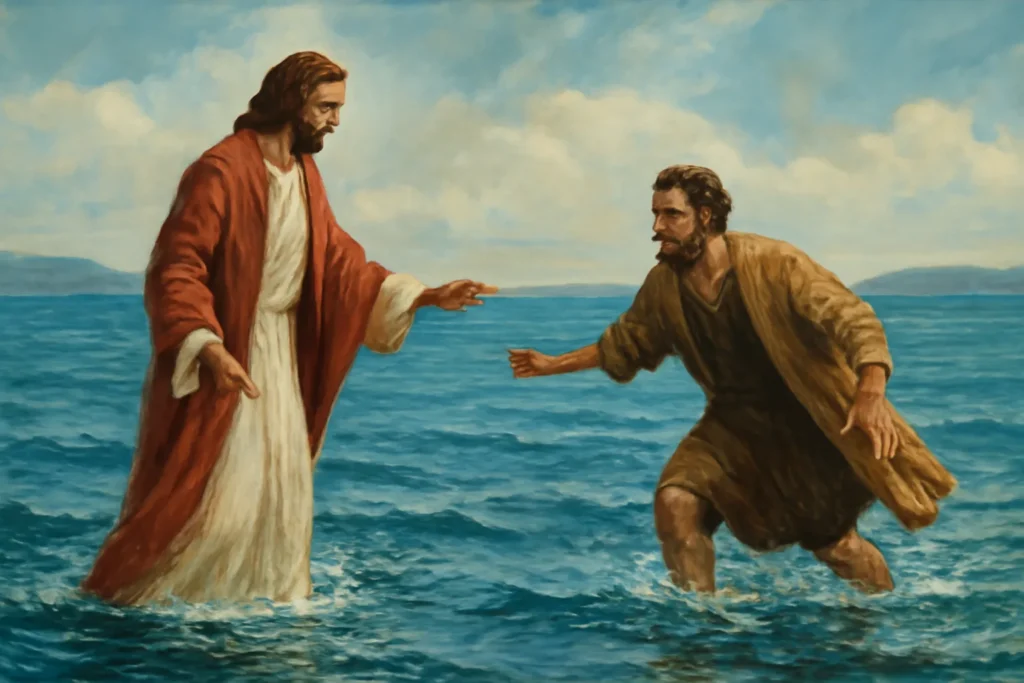
The drama intensifies with Peter’s bold response. He calls out to Jesus, “Lord, if it be thou, bid me come unto thee on the water.” Jesus invites him with a simple command, “Come.” And Peter steps onto the water and begins walking toward Jesus, a moment that becomes a powerful symbol of faith in action.
But as the wind boisterous and the storm intensify, Peter’s gaze shifts away from Jesus and toward the tumult of the waves. He experiences fear and begins to sink, crying out, “Lord, save me.” In response, Jesus immediately reaches out his hand and catches him, saying, “O thou of little faith, wherefore didst thou doubt?” The scene culminates with Jesus and Peter returning to the boat, the wind ceasing, and those in the boat worshiping Jesus as the Son of God.
The account closes with a note about the disciples’ awe: “Truly you are the Son of God”—a recognition that emerges in the heat of fear transformed by the presence and action of Christ.
Across translations and generations, several core themes stand out in the Matthew narrative. Here are some of the most consequential ideas to grasp when engaging with the text.
Jesus’ authority over nature: Walking on water is a display of divinely empowered action that belongs to Jesus alone. It signals that Jesus is not merely a teacher but the one who commands the very elements.
Faith and perception: Peter’s faith enables him to walk; his fear upon noticing the storm leads to sinking. The contrast invites readers to consider what their own faith is anchored to when life’s storms rise.
Fear, doubt, and rescue: The moment of fear triggers doubt, but the rescue is immediate and personal—Jesus’ hand reaches out to save, symbolizing grace in response to human frailty.
Calling and response: The invitation, “Come”, is not merely a command to Peter but a model for discipleship: Christ calls followers to step out in trust, even when the outcome is uncertain.
Apostolic witness and worship: The event moves the boat’s occupants toward a confession of Jesus’ identity—recognizing him as the Son of God.
Textual Variations and Translations: How the Wording Changes, How the Meaning Deepens
The story of Peter walking on the water is part of a broader biblical landscape where the New Testament writers present Jesus’ mastery over creation and the response of faith in various idioms. Here are some ways the passage is rendered and interpreted across translations and related books.
Variations in Key Lines (Matthew 14:22-33)
Across translations, the core events remain, but the phrasing shifts in ways that illuminate different theological emphases. Here are representative renderings of pivotal lines:
Verse 28 (Peter’s question) — KJV: “And Peter answered him and said, Lord, if it be thou, bid me come unto thee on the water.” In modern translations the phrasing is streamlined, but the underlying request remains: a desire to imitate Jesus in the realm beyond ordinary life.
Verse 28–29 (the invitation) — KJV: “And he said, Come. And when Peter was come down out of the ship, he walked on the water, to go to Jesus.” Various translations render the moment with emphasis on the concrete action of walking, and the close alignment with Jesus’ command.
Verse 30 (fear and sinking) — KJV: “But when he saw the wind boisterous, he was afraid; and beginning to sink, he cried, saying, Lord, save me.” Modern paraphrases highlight the sequence: sight of the storm leads to fear, fear leads to sinking, and the cry for rescue reveals reliance on Jesus.
Verse 31 (Jesus’ response) — KJV: “And immediately Jesus stretched forth his hand, and caught him, and said unto him, O thou of little faith, wherefore didst thou doubt?” Translations vary in how they frame the rebuke and the tenderness of the rescue, with some emphasizing exhortation, others focusing on reassurance preceding correction.
Verse 32–33 (re-entry and confession) — “And when they were come into the ship, the wind ceased. Then they that were in the ship came and worshipped him, saying, Of a truth thou art the Son of God.” The core claim—recognition of Jesus’ divine identity—appears across translations with nuanced emphasis: awe, worship, and confession coalesce in these lines.
Translations to consider include:
King James Version (KJV): retains traditional cadence and ceremonial phrasing, which many readers associate with the classic Bible language.
New International Version (NIV): emphasizes readability and contemporary phrasing while preserving the essential details of the narrative.
English Standard Version (ESV): balances literary precision with accessible language, often useful for study and sermon preparation.
New Revised Standard Version (NRSV): recognizes scholarly nuance and inclusive language where appropriate, while respecting the original context.
Parallels and Variations in the Gospels
While the explicit event of Peter walking on the water is uniquely described in Matthew 14:22-33, other Gospel writers portray Jesus walking on the sea in separate scenes, which some readers see as related but distinct Johannine or Markan motifs:
Jesus walking on the sea (John 6:19-21): In John’s account, the disciples are crossing the Sea of Galilee and struggle against wind until Jesus comes to them, calming fears as they move toward him. The emphasis is less on Peter’s personal response and more on Jesus’ presence among his followers in danger.
Jesus walking on the sea (Synoptic parallels): In some Gospel harmonies, readers notice a recurring motif: Christ’s mastery of creation as a sign of his divine identity. The differences in emphasis—breath-taking miracle, calming presence, and the disciples’ worship—shape each Gospel’s portrait of Jesus.
Theological Reflections: Faith, Fear, and the Call to Trust
The scene invites readers to reflect on the nature of faith and the conditions under which it thrives. Several theological threads emerge when we listen closely to the passage and its variations.
Faith as action under command: Peter’s initiative to step onto the water responds to Jesus’ direct invitation, “Come.” This correlation suggests that genuine faith involves an obedient response to Jesus’ word, even when the path seems dangerous or improbable.
Faith in the context of danger: The storm represents the uncontrollable elements of life that threaten to overwhelm. The narrative teaches that faith is not the absence of danger but trust in Jesus amid danger.
Appearance versus reality: Peter begins to walk by faith, yet his perception wavers when he focuses on the wind and waves. The text invites readers to examine what they fix their eyes on when storms rise—Christ’s presence or the surrounding circumstances.
Rescue as a sign of divine mercy: Jesus’ immediate response—reaching out, rescuing, and addressing doubt—emphasizes that divine rescue is both personal and timely, reinforcing the relational nature of salvation.
Confession through crisis: The storm serves as a crucible that prompts a confession among the disciples: Jesus is the Son of God. Crisis becomes an context for corporate worship and recognition of Christ’s identity.
Historical and Cultural Context: What Surfaces When We Look Closely
To understand Matthew 14:22-33 fully, it helps to situate the passage in its historical and literary milieu. Several points bear noting:
Location: The event takes place on the Sea of Galilee, a region rich in fishing culture and maritime weather patterns. The sea often functions in biblical narrative as a theater for divine intervention and revelation.
Audience and purpose: Matthew’s Gospel unfolds with a strong emphasis on Jesus as the fulfillment of Old Testament expectation and the Messiah who calls disciples to radical trust. The Peter episode aligns with Matthew’s overall trajectory: discipleship is learned in the crucible of challenge.
Character development: Peter’s journey from bold willingness to doubt and rescue traces a pattern seen in other parts of the Gospels, offering readers a concrete case study of the dynamics of faith under pressure.
Practical Applications: What Peter’s Walk on the Water Teaches Modern Readers
For many readers, the Peter-on-water episode is not merely an ancient narrative but a living invitation. Here are several ways to translate its insights into contemporary faith practice.
Step out in obedience: When Christ calls, real faith responds with action, even when the outcome cannot be predicted. This is not reckless bravado but trust anchored in the one who invites us to come.
Keep your eyes on Christ: The peril of the moment comes when one loses sight of Jesus. Practicing spiritual disciplines—prayer, Scripture reading, contemplation—helps disciples keep their gaze steady in the storm.
Expect divine rescue: The narrative does not promise a life free from danger, but it does promise that Christ will sustain and rescue. The emphasis is on divine presence in the crisis, not merely safety from it.
Embrace the growth that comes through fear: Fear is not automatically the enemy of faith; it can be a signal that a deeper reliance on Christ is needed. The story invites believers to bring fear to Jesus, not pretend it doesn’t exist.
Worship as response: The outcome of the event—worship and confession—points readers toward a posture of reverence when God acts in power. Theology moves from theory to praise as a result of encounter with Jesus.
Guided Study: Questions for Personal Reflection or Group Discussion
What concrete steps can you take this week to “come” to Jesus in a situation that seems overwhelming?
In what ways has fear shaped your perception of God’s actions in your life, and how can you cultivate a posture that trusts his timing?
How does the idea of Jesus “reaching out” to rescue you change your view of God’s grace and mercy?
What elements of the storm represent your current circumstances, and what evidence do you see of Christ’s presence in the midst of them?
How does the disciples’ response of worship following the event shape your understanding of true recognition of Jesus?
Variations and Variants: A Quick Guide for Readers
If you are using different Bible translations or studying parallel accounts in a Bible atlas, keep these notes in mind:
In Matthew 14, the focus is on Peter’s leap of faith, his sinking, and the immediate rescue that leads to worship and a declaration about Jesus’ identity.
In John 6 (not the same moment), Jesus also walks on the sea; the emphasis is on Jesus’ presence among his followers as they travel through danger to reach him, followed by reassurance and teaching about faith.
Across translations, the essential elements hold: the invitation to come, the reality of fear, the rescue, and the confession of Jesus’ divine role. Translational choices affect cadence, nuance, and the exact phrasing of Jesus’ rebuke and Peter’s cry for help.
Conclusion: The Enduring Message of Peter Walking on Water
The narrative of Peter walking on water offers a layered portrait of faith under pressure. It presents a compelling paradox: faith enables a person to do what seems impossible, yet when focus shifts to the surrounding hazards, doubt can overwhelm even a strong believer. The central move in the story is Jesus’ invitation, the disciple’s response, and the divine rescue that follows. The result is not merely an extraordinary miracle but a transformative confession: Jesus is the Son of God, worthy of worship and trust. For readers today, the passage remains a practical and hopeful guide: step out in faith when Jesus calls, keep your eyes on him through life’s storms, and trust that Christ’s hand will be there to save when you falter. In this way, the Peter-walking-on-water narrative continues to speak a timeless truth: with Christ, the boundaries of possibility expand, and faith grows strongest in the moment of rescue.
Further Reading and Resources
For those who want to explore this topic in more depth, consider the following directions:
Commentaries on Matthew 14 that address the narrative’s literary structure, its placement within Matthew’s Gospel, and its Christological significance.
Studies comparing the walking-on-water motif across the Gospels to identify common themes and unique emphases.
Devotional guides focusing on faith, fear, and reliance on Christ in times of trial.
Translations and phrase-by-phrase analyses to observe how modern English versions illuminate or shift the sense of key phrases.
Whether you approach the text as a historical document, a piece of spiritual literature, or a source of ongoing faith formation, the story of Peter stepping onto the waves invites you to consider what it means to trust Jesus in the storms, to heed his invitation, and to respond with worship and confession when he reveals his presence and power in your life.
















Leave a Reply