Baptism according to the Bible is a physical act involving water that publicly identifies a person with Jesus Christ. It is connected with repentance, faith, forgiveness, new life, and membership in the community of believers. Jesus was baptized, commanded his followers to baptize disciples, and the early church practiced baptism as a normal response to the gospel.
The New Testament presents baptism as more than a private religious symbol. It is an act of obedience and public identification with Christ, representing his death, burial, and resurrection. Christians differ on who should be baptized, how much water should be used, and how baptism relates to salvation, but they agree that baptism has a central place in Christian faith.
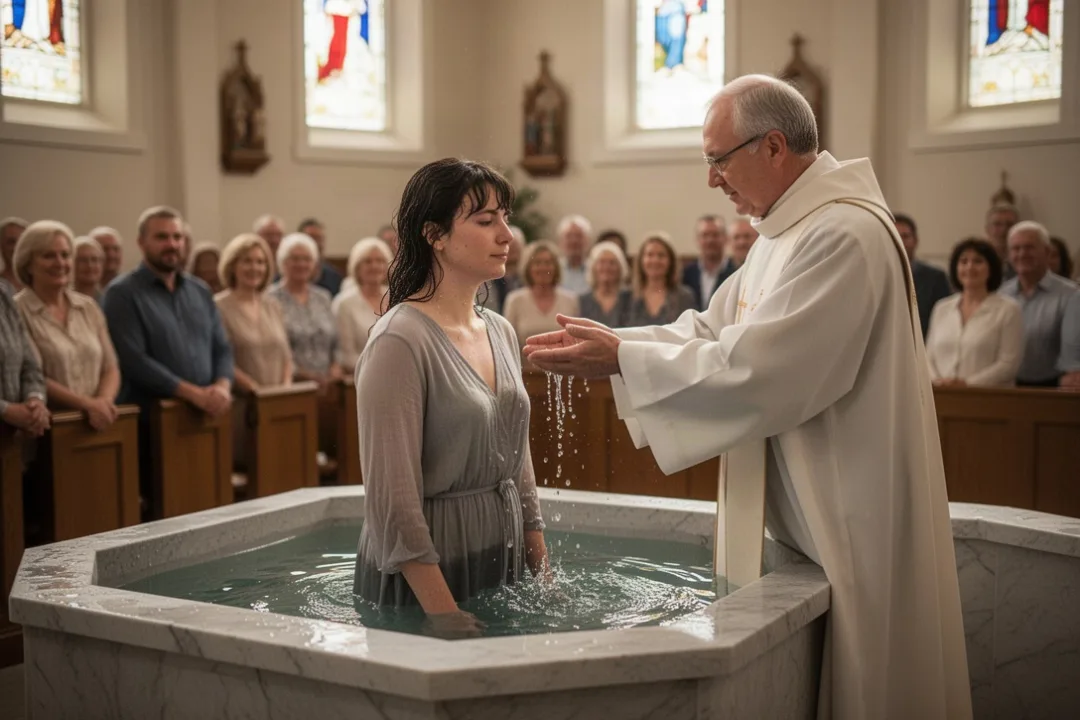
The word baptism comes from a Greek term associated with dipping, washing, or being immersed in water. The word itself helps explain the biblical practice, although the New Testament does not describe every baptism in exactly the same way. Some Christian communities baptize by immersion, while others pour or sprinkle water as a sign of cleansing and identification with Christ.
At its core, baptism is an outward act that expresses an inward response to God. A person who is baptized is saying, in a visible way, that he or she has turned toward Christ, trusts him, and wants to live as one of his followers. Baptism communicates belonging: belonging to Jesus and to the people who confess faith in him.
Several themes appear together when the Bible discusses baptism:
Repentance: turning away from sin and turning toward God.
Faith: relying on Jesus Christ rather than on personal goodness or religious effort.
Cleansing: using water as a visible sign of forgiveness and spiritual washing.
Union with Christ: representing participation in Jesus’ death, burial, and resurrection.
Public commitment: openly identifying with Christ and his church.
Obedience: responding to Jesus’ command to make and baptize disciples.
These meanings should not be separated from the gospel. The water does not work as a magical substance, and baptism does not give a person permission to continue rejecting Christ. The act has meaning because it points to God’s grace received through faith and to the new life made possible through Jesus.
Central idea: Biblical baptism is a visible declaration that a person has responded to Christ and now identifies with his death, burial, resurrection, and people.
How Jesus and the early church practiced baptism
Jesus’ own baptism is recorded in the Gospels. John the Baptist was calling people to repentance, and Jesus came to be baptized even though the Gospels do not present him as a sinner needing forgiveness. His baptism marked the beginning of his public ministry and showed his willing identification with God’s saving purpose.
At Jesus’ baptism, the Gospel accounts describe the presence of the Father, the Son, and the Holy Spirit. This event helps establish baptism as an act connected with the Triune God, not merely a personal ceremony. It also shows that baptism belongs within the larger story of Jesus’ obedience and mission.
After his resurrection, Jesus instructed his disciples to make disciples among all nations and to baptize them in the name of the Father, Son, and Holy Spirit, as recorded in Matthew 28:18-20. He connected baptism with teaching people to obey everything he had commanded. Baptism, then, is not an isolated ritual; it is part of becoming and living as a disciple.
The book of Acts shows how the first Christians applied Jesus’ command. On the day of Pentecost, Peter called his listeners to repent and be baptized in response to the message about Jesus, according to Acts 2:38. Many people in Jerusalem accepted the message and were baptized. This account presents baptism as a prompt, public response to hearing and believing the gospel.
Other stories in Acts show the same general pattern. People hear the message, respond in faith, and receive baptism. Examples include:
The Samaritans who believed Philip’s preaching were baptized in Acts 8.
The Ethiopian official was baptized after Philip explained the message about Jesus in Acts 8.
Saul, later known as Paul, was baptized after encountering the risen Christ in Acts 9.
Cornelius and his household were baptized after receiving the Holy Spirit and believing in Acts 10.
The Philippian jailer and his household were baptized after hearing the message of salvation in Acts 16.
The Corinthians who believed Paul’s preaching were baptized in Acts 18.
These accounts do not make every detail identical. Some emphasize repentance, some faith, some the work of the Holy Spirit, and some the response of an entire household. Taken together, they show that baptism was a recognizable Christian response to the announcement that Jesus is Lord.
The early church did not treat baptism as a private experience that could remain hidden indefinitely. It was a public act that could involve a person’s family, neighbors, and local congregation. Being baptized could also bring social cost because it identified a person with a movement that faced opposition.
What baptism symbolizes about salvation and new life
The clearest explanation of baptism’s symbolism appears in Romans 6:1-11. Paul connects baptism with being united to Christ in his death and resurrection. Going down into the water can represent burial with Christ, while coming out of the water can represent rising to live a new kind of life.
This symbolism does not mean the baptized person becomes morally perfect immediately. It means that the direction of life has changed. Christians are called to regard their former life of sin as something that no longer rules them and to live under Christ’s authority. Baptism announces a break with the old allegiance and a new identity grounded in Jesus.
Colossians 2:12 makes a similar connection by relating baptism to being buried and raised with Christ through faith in God’s power. The emphasis is not on the physical strength of the person being baptized. The emphasis is on God’s action and the believer’s faith in what God has done through Christ.
Galatians 3:27 describes those who have been baptized into Christ as having put on Christ. This language points to a new public identity. In the ancient world, clothing could communicate a person’s position or allegiance. Paul’s image suggests that baptism represents being identified with Jesus rather than relying on one’s old status, achievements, or social distinctions.
That same passage continues by emphasizing the unity of believers in Christ. Baptism does not erase every difference between people, but it declares that ethnic background, social position, and gender do not determine a person’s standing before God. Christ becomes the believer’s primary identity, and baptized Christians belong to one spiritual family.
First Peter 3:20-21 also connects baptism with salvation, while carefully directing attention away from the mere removal of dirt from the body. The passage presents baptism as an appeal or response toward God through the resurrection of Jesus Christ. Its point is that baptism matters because of a sincere relationship with God, not because water mechanically changes someone.
Important distinction: Baptism represents salvation and obediently expresses faith, but the Bible does not present water as a substitute for repentance, trust in Christ, or a transformed life.
The New Testament uses several related images to describe what baptism expresses:
Washing: God cleanses and forgives the person who turns to him.
Death and resurrection: the believer is united symbolically with Christ’s saving work.
Clothing: the person receives a new identity centered on Christ.
Crossing into a new community: the baptized person joins the people who follow Jesus.
Appeal to God: the act reflects a sincere response of faith and conscience.
These pictures reinforce one another. Baptism is not merely a statement that someone has become a better person. It is a statement that God has acted through Jesus Christ and that the baptized person now depends on him, belongs to him, and intends to follow him.
Does baptism save you according to the Bible?
This question requires careful wording because the Bible speaks of baptism in a very serious way, yet it also repeatedly emphasizes faith, grace, repentance, and the work of Christ. Christians have therefore reached different conclusions about the exact relationship between baptism and salvation.
Some passages connect baptism closely with forgiveness and salvation. Acts 2:38 links repentance and baptism with the forgiveness of sins and the gift of the Holy Spirit. First Peter 3:21 says that baptism saves, but the passage immediately explains that its meaning is not simply washing dirt from the body. These texts show that baptism is not an optional decoration added to Christianity without significance.
Other passages emphasize that people are made right with God through faith and God’s grace, not through human religious performance. Ephesians 2:8-9 attributes salvation to grace received through faith and rejects boasting in works. Romans 3:21-30 likewise explains that people are justified through faith in Jesus Christ rather than through keeping the law. The thief crucified beside Jesus received a promise of life with him without being able to undergo water baptism, as described in Luke 23:39-43.
These passages lead Christians to explain baptism in different ways. Many Protestant churches teach that baptism is a commanded sign of salvation rather than the cause of salvation. Roman Catholic, Eastern Orthodox, Anglican, Lutheran, and some other traditions generally speak more strongly about baptism as a means through which God gives grace. Even within these broad categories, beliefs and explanations vary.
A balanced biblical answer includes several points:
Jesus commands baptism. A person should not treat it as unimportant or optional merely because salvation is by grace.
Faith in Christ is essential. Baptism without genuine repentance and trust does not represent the response described throughout the New Testament.
Baptism does not replace Christ’s sacrifice. Forgiveness rests on Jesus’ death and resurrection, not on the amount of water or the skill of the person administering the baptism.
Baptism is normally the obedient response of a believer. The book of Acts repeatedly connects hearing the gospel, believing, and being baptized.
God is not limited by the ceremony. The account of the repentant criminal shows that a person’s inability to be baptized does not limit God’s power to save.
It is also helpful to distinguish between the sign and the reality to which it points. The sign is water baptism. The reality includes forgiveness, reconciliation with God, union with Christ, the Holy Spirit’s work, and a new life of obedience. The Bible treats the sign as meaningful because it is joined to that reality, not because the physical act operates independently of faith.
For someone who believes in Jesus and has the opportunity to be baptized, refusing baptism without a serious reason conflicts with the pattern of New Testament discipleship. At the same time, a person should not place confidence in baptism while rejecting Christ, refusing repentance, or assuming that a ceremony automatically guarantees spiritual life.
Who should be baptized, and how should it happen?
The New Testament most often describes baptism following a person’s response to the gospel. The Ethiopian official hears the message about Jesus and asks to be baptized. The jailer in Philippi hears the word of the Lord, and he and his household receive baptism. These accounts are among the reasons many churches practice believer’s baptism, meaning baptism for people who personally profess faith in Christ.
Other Christian traditions baptize infants. They understand baptism as a sign of God’s covenant, the church’s faith, and a child’s incorporation into the Christian community. Supporters often point to household baptisms in Acts and the importance of children within God’s covenant story, while acknowledging that the New Testament does not explicitly describe an infant being baptized.
Churches that practice believer’s baptism usually expect the person to make a personal confession of faith before baptism. Churches that baptize infants commonly provide later instruction and confirmation, or another public profession, when the child is old enough to affirm the faith personally. Both practices aim to connect baptism with belonging to Christ and life within his church, though they understand the timing differently.
The Bible does not provide one detailed ceremony that every congregation must copy. It does, however, give several clear features:
Water is used as the visible element.
Jesus Christ is central, rather than the personality of the minister.
Faith and repentance matter, especially in the baptism accounts in Acts.
The act is connected to the church and the life of discipleship.
The baptismal formula honors the Father, Son, and Holy Spirit, as Jesus teaches in Matthew 28:19.
The person enters a continuing life of obedience, not merely a single memorable event.
Immersion gives a particularly vivid picture of burial and resurrection, which is why many Christians prefer it. Pouring and sprinkling can also communicate washing, the gift of the Spirit, and dedication to God. The New Testament emphasizes the meaning and reality of baptism more clearly than it specifies one universal method of applying water.
How to prepare for baptism
Preparation should focus less on producing a perfect testimony and more on understanding the commitment being made. A person does not need to know every Christian doctrine before baptism, but should understand the basic message that Jesus died for sinners, rose again, calls people to repentance and faith, and is Lord.
Before baptism, consider these questions:
Do you personally trust Jesus Christ, rather than your own morality, as the source of reconciliation with God?
Have you turned from known sin and accepted Jesus’ authority over your life?
Do you understand baptism as an act of obedience and public identification?
Are you prepared to participate in the life of a Christian congregation?
Do you understand what your church teaches about baptism and how it practices it?
Baptism does not require a flawless past. The people baptized in Acts had different backgrounds, and the gospel was precisely a call to receive forgiveness and new life. What matters is not whether you have never failed, but whether you are responding honestly to Christ with repentance, faith, and willingness to follow him.
What baptism means for Christian life after the ceremony
Baptism is a beginning as well as a public declaration. Jesus’ command in Matthew 28 joins baptism with teaching disciples to obey him. A church that baptizes people but does not help them grow in faith misses part of that command.
After baptism, Christians are called to live consistently with the identity baptism represents. Romans 6 moves from the image of being raised with Christ to instructions about refusing sin’s rule and presenting one’s life to God. Baptism therefore points toward daily repentance and practical obedience, not simply a past religious experience.
The baptized Christian is also not meant to live alone. The New Testament describes believers gathering for teaching, prayer, fellowship, the Lord’s Supper, service, encouragement, and mutual care. Baptism identifies someone with a body of believers, so it naturally leads toward participation in a local church.
Baptism can also strengthen a Christian during seasons of doubt. It does not replace ongoing faith, but it provides a concrete reminder of a public commitment to Christ. When a believer struggles, the meaning of baptism points back to God’s promise, Jesus’ completed work, and the call to continue walking in new life.
The event should be remembered accurately. Baptism does not mean that every temptation disappears or that spiritual growth becomes effortless. It means the believer has publicly taken a new position: Christ is Lord, the old life no longer has the final claim, and the Christian belongs to God’s people.
For that reason, baptism is both personal and communal. You make a personal response to Christ, but you do so before and among other believers. The congregation witnesses the profession, welcomes the person into fellowship, and accepts responsibility to encourage continued faithfulness.
When understood this way, baptism brings together the central movements of the Christian life: hearing the gospel, trusting Christ, turning from sin, receiving God’s grace, entering the church, and learning to obey Jesus. The water is visible for a moment, but the identity it represents shapes the whole life of discipleship.
Frequently asked questions
Is baptism required for every Christian?
Jesus commanded his followers to baptize disciples, and the early church treated baptism as the normal response to faith. For that reason, a believer should receive baptism when it is reasonably possible. Christians disagree about whether baptism is necessary for salvation itself, but the New Testament does not support treating Jesus’ command as irrelevant or optional without a serious reason.
Can someone be baptized more than once?
Churches handle repeated baptism differently. Some regard a first valid baptism with water and a Christian confession as permanent, even if the person later renews faith. Others may baptize someone again if the earlier event did not involve personal faith or did not follow that church’s understanding. Speak with a trusted pastor before making that decision.
Does the Bible say baptism must be by full immersion?
Immersion strongly illustrates baptism’s picture of burial and resurrection, and the Greek terminology can support that practice. However, the Bible does not give one universal instruction about the amount of water or the method. Christian communities have used immersion, pouring, and sprinkling, while emphasizing different biblical images such as cleansing, the Spirit, and union with Christ.
What is the difference between water baptism and baptism with the Holy Spirit?
Water baptism is the visible Christian practice involving water. Baptism with the Holy Spirit describes the Spirit’s work of bringing people into relationship with Christ and his body, especially in passages such as 1 Corinthians 12:13. Churches differ on how these experiences relate, but the New Testament presents both water and the Holy Spirit as important parts of Christian initiation and life.















Leave a Reply