Overview of Matthew’s Gospel: Themes and Structure
Overview of Matthew’s Gospel: Themes and Structure
The Gospel of Matthew presents Jesus as the Messiah, the promised king, and the authoritative teacher who brings God’s kingdom into human history. It begins with Jesus’ genealogy and birth, follows his teaching and ministry in Galilee and Judea, and ends with his death, resurrection, and commission to his disciples.
Matthew contains 28 chapters and combines narrative scenes with five major teaching sections. Its central question is how Jesus fulfills Israel’s Scriptures and what it means to follow him as a member of the kingdom of heaven. The Gospel speaks both to Jewish expectations about the Messiah and to the expanding mission of Jesus’ followers among all nations.
Matthew’s story moves from Jesus’ identity to his public ministry, opposition, death, and resurrection. The book is not simply a collection of sayings or a chronological biography in the modern sense. It arranges events and teachings to show the meaning of Jesus’ mission and the kind of community his disciples are called to become.
A useful way to trace the Gospel is through these broad movements:
Chapters 1–2: Jesus’ genealogy, birth, infancy, and early threat from Herod.
Chapters 3–4: John the Baptist, Jesus’ baptism, temptation, and the beginning of public ministry.
Chapters 5–7: the Sermon on the Mount, a sustained presentation of kingdom righteousness.
Chapters 8–9: healings, deliverance, authority over nature, and the calling of disciples.
Chapters 10–18: mission, growing opposition, parables, and instruction about life among Jesus’ followers.
Chapters 19–25: movement toward Jerusalem, conflict with leaders, and teaching about judgment and the future.
Chapters 26–28: the Last Supper, arrest, trial, crucifixion, resurrection, and the commission to make disciples.
Matthew also uses five substantial teaching collections: the Sermon on the Mount, the mission discourse, the parables of the kingdom, teaching about community life, and the discourse concerning judgment and the coming of the Son of Man. Each section follows or surrounds narrative material, allowing readers to see both what Jesus does and what he teaches.
Reading tip: Pay attention to the repeated movement between action and instruction. Matthew shows Jesus announcing the kingdom, demonstrating its power, explaining its values, and forming people who will live under its rule.
Jesus as the promised Messiah and king
Matthew opens by identifying Jesus as the son of David and the son of Abraham. These titles connect him with the royal promise associated with David and with the covenant story that begins with Abraham. The genealogy is therefore more than a list of ancestors; it places Jesus inside Israel’s story and signals that his arrival has covenant significance.
The genealogy also includes several women, including Tamar, Rahab, Ruth, and the wife of Uriah. Their presence draws attention to unexpected and complicated parts of Israel’s history. It also suggests that God’s purposes have advanced through people whose backgrounds, circumstances, or ethnic identities did not fit a narrow picture of religious respectability. Matthew’s account of Jesus’ family line prepares readers for a mission that will eventually reach all nations.
The birth narratives emphasize Jesus’ unusual identity. He is conceived through the work of the Holy Spirit, and his name points to his role as the one who saves his people from their sins. The visit of the Magi presents non-Jewish seekers honoring the child, while Herod responds with fear and violence. From the beginning, Matthew places together worship, opposition, Jewish hope, and Gentile interest.
Jesus’ baptism marks the public beginning of his ministry. The voice from heaven identifies him as God’s beloved Son, and the Spirit rests upon him. Immediately afterward, Jesus faces testing in the wilderness. The temptations concern appetite, spectacle, and power, but they also reveal what kind of Messiah he will be: obedient to God rather than driven by self-protection or domination.
Matthew repeatedly connects Jesus with figures and events from Israel’s Scriptures. Jesus comes out of Egypt, brings light to Galilee, and teaches from a mountain. These patterns present him as a faithful representative of Israel and as one greater than earlier leaders. Moses, David, the prophets, and the temple all provide important background, but Matthew’s narrative directs attention to Jesus’ unique authority.
The title Son of Man is especially significant. In Matthew, Jesus uses it in connection with his earthly authority, suffering, death, resurrection, and future coming in judgment. The title joins humility and glory: Jesus is rejected and killed, yet he is also the figure through whom God’s purposes will be decisively revealed.
Matthew most often uses the phrase kingdom of heaven, while the other Gospels commonly use “kingdom of God.” The wording does not describe a different kingdom. It refers to God’s active reign, not merely to a place people enter after death. Jesus announces that this reign is drawing near, appearing in his ministry, and demanding a response.
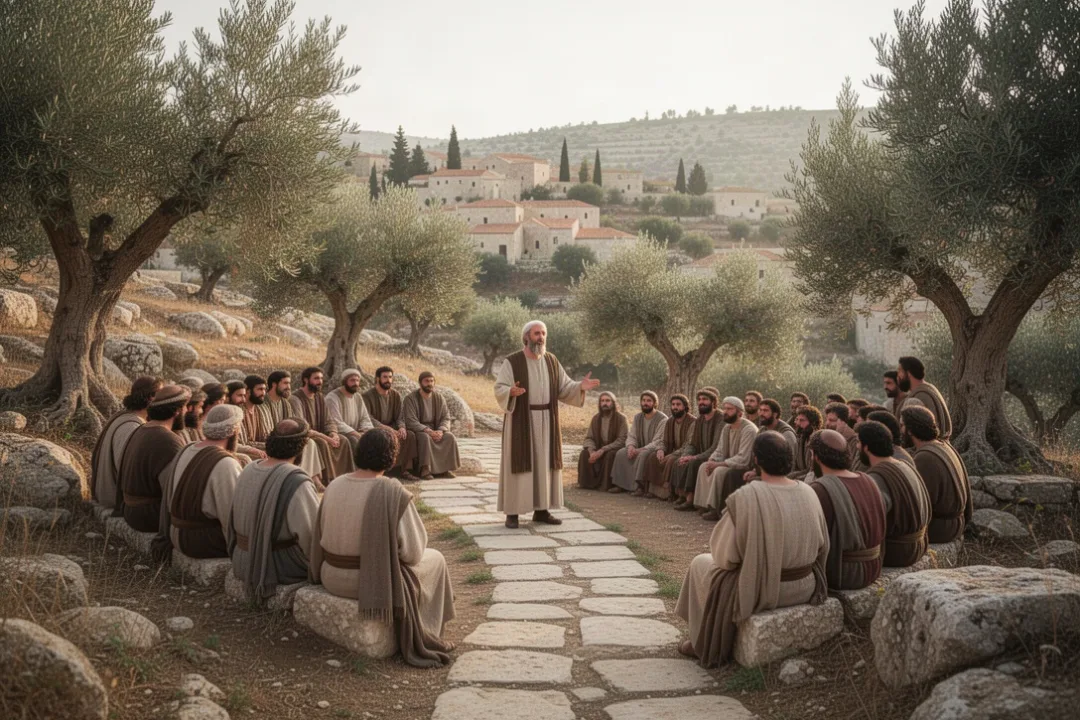
The Sermon on the Mount in chapters 5–7 is the Gospel’s best-known teaching section. It begins with blessings for people who recognize their dependence on God, mourn evil, pursue mercy, seek righteousness, and work for peace. These blessings do not present success according to ordinary social standards. They describe the character and hope of people who belong to God’s kingdom.
Jesus then addresses several areas of daily faithfulness, including anger, reconciliation, sexual integrity, marriage, truthfulness, retaliation, and love of enemies. He moves beyond outward compliance to the intentions of the heart. His teaching is demanding because kingdom righteousness involves the whole person and every relationship, not only public religious behavior.
The Sermon on the Mount also emphasizes hidden devotion. Giving, prayer, and fasting are not meant to be performances designed to win human approval. Jesus teaches his disciples to seek God’s will, depend on God for daily needs, forgive others, and place trust in God above wealth or anxiety. The model prayer in this section centers on God’s name, kingdom, and will before turning to personal needs.
Jesus’ teaching about the law is carefully balanced. He does not present his mission as a simple rejection of Israel’s Scriptures. Instead, Matthew portrays him as bringing them to their intended goal. The result is not a less serious morality but a deeper one, shaped by love for God, mercy toward others, and integrity before the Father.
Another major theme is decision. Listeners must choose between two ways, two kinds of foundation, and two kinds of allegiance. Hearing Jesus is not enough; his words must be practiced. The final image of the Sermon contrasts a secure house built on rock with an unstable house built on sand, emphasizing that obedience gives teaching a durable form.
Matthew’s parables explain why the kingdom can seem both present and hidden. Seeds grow gradually, yeast works invisibly through dough, and a small beginning can produce a much larger result. Other parables stress the kingdom’s value, the need for discernment, and the reality of final judgment. Together, they show that God’s reign is already active but has not yet reached its fully visible completion.
Miracles, discipleship, and the formation of a community
Matthew’s miracle stories demonstrate Jesus’ authority over sickness, demons, nature, and death. Healings are not included merely as impressive displays. They reveal the restoring character of the kingdom and show Jesus responding to suffering with compassion. He touches the excluded, welcomes the desperate, and restores people to bodily, social, and religious life.
Several episodes highlight faith, but Matthew does not reduce faith to confidence that a desired outcome will occur. Faith appears as trust in Jesus’ authority and willingness to approach him. The stories also expose fear, hesitation, and misunderstanding among the disciples. Matthew presents discipleship honestly: those who follow Jesus are called to trust him, yet they often learn slowly.
Jesus calls ordinary people to become his disciples, including fishermen, a tax collector, and others whose identities are not always fully explained. Discipleship involves following Jesus, learning his teaching, serving others, and accepting costly loyalty. The mission discourse in chapter 10 prepares the Twelve to proclaim the kingdom and warns them that service may bring rejection and hardship.
Matthew gives special attention to the community of believers. Chapter 18 addresses humility, care for vulnerable members, confronting wrongdoing, and repeated forgiveness. The community must not measure greatness by status. Instead, it should welcome the lowly, seek those who wander, and practice restoration rather than humiliation.
Forgiveness in Matthew is generous but not superficial. Reconciliation includes truth, accountability, and a willingness to address harm. The parable of the unforgiving servant shows the contradiction between receiving mercy and refusing to extend it. At the same time, Jesus’ teaching does not treat serious wrongdoing as insignificant; it calls the community to deal with it responsibly.
Leadership is another area where Matthew’s Gospel challenges ordinary expectations. Jesus criticizes religious leaders who seek honor, impose burdens, or use visible piety to gain recognition. He tells his disciples that greatness is measured by service. The model is Jesus himself, whose authority is expressed through giving rather than grasping.
The mission expands beyond Israel’s boundaries even though Jesus’ earthly ministry is presented primarily in relation to Israel. Matthew includes encounters with Gentiles, praise for unexpected faith, and a final command to make disciples of all nations. This progression shows continuity rather than cancellation: the message grows from Israel’s story toward a worldwide community.
Old Testament fulfillment and Matthew’s Jewish setting
Matthew frequently says that an event happened to fulfill what was spoken through a prophet. These fulfillment statements are one of the Gospel’s clearest literary features. They show Matthew reading Jesus’ life through Israel’s Scriptures and arguing that the Messiah’s story is consistent with God’s long-standing purposes.
The Gospel refers to Scripture in different ways. Sometimes a passage directly anticipates an event; sometimes an earlier pattern, image, or promise finds a fuller expression in Jesus. Matthew’s use of fulfillment can therefore include prediction, pattern, symbolism, and completion. Readers should avoid treating every reference as a simple one-to-one forecast.
Important connections include the promised Davidic king, the new Moses pattern, the servant who brings justice, and the righteous sufferer. Jesus’ journey from Egypt, his teaching from a mountain, and his entry into Jerusalem all evoke earlier biblical stories. Matthew uses these echoes to show both continuity with Israel and the distinctive authority of Jesus.
The phrase “kingdom of heaven” also reflects Matthew’s sensitivity to Jewish ways of speaking about God. The Gospel is deeply Jewish in its vocabulary, Scriptures, disputes, festivals, and hopes. At the same time, it contains strong criticism of certain religious leaders and announces that outsiders may be welcomed while presumed insiders may be excluded.
Those disputes should be read carefully. Matthew does not provide a license for hostility toward Jewish people. Jesus, his disciples, and the Scriptures they interpret are presented within Judaism. The conflicts concern competing interpretations of faithfulness, authority, purity, and leadership during a period of intense religious and political pressure.
Matthew’s treatment of the law is similarly nuanced. Jesus teaches that mercy, justice, and faithfulness express the law’s true weight. He challenges interpretations that use religious rules to avoid compassion, while also insisting that God’s commands should not be treated casually. The Gospel holds together continuity with Scripture and a decisive focus on Jesus.
Context reminder: Matthew’s conflicts belong to the world of first-century Jewish religious debate. They should not be turned into blanket accusations against an entire people or tradition.
The cross, resurrection, and the Gospel’s final mission
The final section of Matthew turns toward Jerusalem. Jesus enters the city publicly, teaches in the temple, and faces sustained opposition. His actions and words make clear that the conflict is not incidental. The question is who has legitimate authority and what kind of kingdom Jesus brings.
Matthew’s account of the Last Supper connects Jesus’ death with covenant and forgiveness. Jesus interprets his approaching death as purposeful rather than accidental. Yet the disciples misunderstand, scatter, and fail him. Their weakness contrasts with Jesus’ steady submission to God’s will, even as he faces abandonment, political manipulation, violence, and execution.
The crucifixion is presented as the death of the Messiah and king, not as a defeat that cancels his identity. The title placed over the cross identifies Jesus in royal terms, while the surrounding mockery ironically points toward the truth. Matthew also emphasizes signs accompanying the death, including darkness and the opening of tombs, indicating that the event has cosmic and covenantal significance.
The resurrection narrative begins with women discovering that the tomb is empty. An angel announces that Jesus has been raised, and the women meet him as they leave. Their testimony becomes part of the Gospel’s account of how the resurrection message is received, challenged, and proclaimed. The disciples eventually encounter the risen Jesus in Galilee.
Matthew ends with the risen Jesus commissioning his followers to make disciples of all nations. The command includes baptizing them and teaching them to obey everything Jesus has commanded. The Gospel therefore ends not with private comfort but with a public vocation: a community shaped by Jesus’ authority is sent to form other disciples.
The closing promise assures the disciples of Jesus’ continuing presence with them. This promise answers a major concern running through the Gospel. The kingdom may face resistance, disciples may be imperfect, and the mission may be demanding, but the risen Jesus remains the center of the community’s identity and work.
For a focused reading, move through Matthew with these questions:
What does this passage reveal about Jesus’ authority?
How does the scene connect with Israel’s Scriptures and hopes?
What kind of response does Jesus seek from his hearers?
How does the passage describe life within the kingdom community?
Where do mercy, judgment, faith, and obedience appear together?
Matthew’s Gospel ultimately presents a unified portrait: Jesus is the promised Messiah, the authoritative interpreter of Scripture, the compassionate healer, the suffering servant, the risen Lord, and the king who sends his people into the world. Its message joins fulfilled promise, demanding discipleship, forgiveness, judgment, and worldwide mission around the story of Jesus.
Frequently asked questions
Who wrote the Gospel of Matthew?
The Gospel is traditionally associated with Matthew, one of Jesus’ disciples and a former tax collector. The text itself does not name its author directly. Many scholars describe it as an anonymous work preserved under Matthew’s name, while Christian tradition has long received it as connected with his testimony and teaching.
Why does Matthew use “kingdom of heaven” instead of “kingdom of God”?
“Kingdom of heaven” refers to God’s reign rather than a separate heavenly location. Matthew’s wording may reflect sensitivity to Jewish ways of referring to God. The phrase describes God’s active rule, which Jesus announces, demonstrates, and teaches his disciples to embody.
What are the five major teaching sections in Matthew?
They are commonly identified as the Sermon on the Mount, the mission instructions to the disciples, the kingdom parables, teaching about community relationships, and the discourse about judgment and the coming of the Son of Man. Each collection helps interpret the surrounding narrative.
How is Matthew different from the other Gospels?
Matthew gives unusual emphasis to Jesus’ fulfillment of Israel’s Scriptures, organized teaching collections, church community, and the kingdom of heaven. It shares much material with Mark and Luke but arranges and develops that material to present Jesus as Messiah, authoritative teacher, and risen king.














Leave a Reply