The birth of Jesus in the Bible: What the Gospels say
The birth of Jesus in the Bible: What the Gospels say
When you picture the birth of Jesus in the Bible, you may wonder which details actually come from Scripture and which come from Christmas traditions. The answer is found mainly in Matthew 1–2 and Luke 1–2. Together, these chapters present Jesus as the promised Messiah, born to Mary in Bethlehem, announced by angels, and placed in a manger.
The two Gospel accounts share the central claim that Jesus was born to Mary through the work of the Holy Spirit. They also identify Bethlehem as his birthplace and connect his arrival with God’s promises to Israel. Matthew emphasizes Joseph, prophecy, danger from King Herod, and the family’s later move to Nazareth. Luke emphasizes Mary, the census, the manger, shepherds, and the worship of ordinary people.
The central message: The Bible presents Jesus’ birth not as an isolated miracle, but as the beginning of God’s promised salvation through the Messiah.
The birth narratives appear in only two of the four Gospels. Matthew and Luke give narrative details, while Mark begins with Jesus’ adult ministry and John describes his identity in theological language rather than recounting the events surrounding his birth.
Before the birth itself, both Matthew and Luke explain why Jesus’ conception matters. Matthew describes Joseph learning that Mary’s child was conceived through the Holy Spirit and connects the child with the name Jesus. Luke tells of the angel Gabriel’s announcement to Mary and presents the conception as an act of God’s power.
Matthew 1:18–25: Joseph learns about Mary’s pregnancy, receives guidance in a dream, and accepts the child as his own legal son.
Luke 1:26–38: Gabriel announces to Mary that she will give birth to Jesus, the Son of the Most High.
Luke 2:1–20: Jesus is born in Bethlehem, placed in a manger, and visited by shepherds.
Matthew 2:1–23: Magi visit Jesus, Herod seeks to kill him, and Joseph takes Mary and Jesus to Egypt before settling in Nazareth.
Matthew and Luke are not trying to provide modern birth certificates or a single continuous scene. Each selects and arranges material to communicate who Jesus is and why his birth fulfills God’s purposes. Reading both accounts carefully allows you to see their shared foundation as well as their distinct emphasis.
How the events unfold in the Gospel accounts
A useful way to follow the story is to separate the events that occur before Jesus’ birth from those that follow it. Some details belong to Luke, some to Matthew, and some are shared by the broader biblical setting.
Mary receives the announcement. In Luke 1, Gabriel tells Mary that she will conceive a son through the Holy Spirit. The child will be called Jesus and will reign in the line of David.
Joseph learns how to respond. Matthew 1 describes Joseph as a righteous man who plans to end his betrothal quietly. In a dream, an angel tells him to take Mary as his wife because the child is from the Holy Spirit.
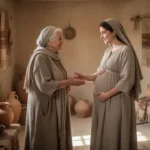
Mary visits Elizabeth. Luke records Mary’s visit to her relative Elizabeth, who is also expecting a child, John the Baptist. The meeting confirms the significance of Mary’s pregnancy and leads Mary to praise God.
Jesus is born in Bethlehem. Luke says Joseph travels there from Nazareth with Mary because of a registration connected with the Roman emperor’s rule. While they are there, Mary gives birth to Jesus.
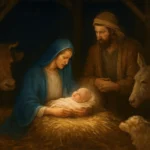
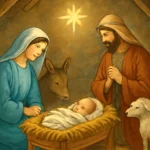
The baby is placed in a manger. Luke says Mary lays Jesus in a manger because there is no suitable guest space available. A manger is a feeding trough, which makes the scene humble and recognizable to the shepherds.
Shepherds hear the announcement. Angels tell shepherds that a Savior has been born. The shepherds go to see the child and then spread the news they have received.
Jesus is circumcised and presented at the temple. Luke 2 describes his circumcision, naming, and presentation in Jerusalem. Simeon and Anna recognize the importance of the child.
Magi visit Jesus. Matthew 2 says visitors from the east come to Jerusalem after observing a star associated with the king of the Jews. They later find Jesus and offer gifts.
The family escapes to Egypt. After being warned in a dream, Joseph takes Mary and Jesus to Egypt because Herod intends to destroy the child.
The family settles in Nazareth. After Herod’s death, Joseph returns with Mary and Jesus but avoids Judea because of political danger. The family settles in Galilee, in the town of Nazareth.
This sequence includes an interpretive caution: Matthew does not say that the Magi visited Jesus on the night of his birth. It describes them entering a house and refers to Jesus as a child. Luke’s shepherds, by contrast, find a baby in a manger soon after the birth. Christmas displays often combine these scenes, but the Gospel texts present them separately.
What Matthew emphasizes about Jesus’ birth
Matthew begins with a genealogy that traces Jesus’ ancestry through David and Abraham. This opening presents Jesus as connected to Israel’s royal line and to the covenant story that begins with Abraham. The genealogy also prepares readers for Matthew’s repeated claim that events in Jesus’ life fulfill the Scriptures.
Joseph receives much of Matthew’s attention. He discovers Mary’s pregnancy, considers ending the betrothal, and then obeys the angel’s instruction to marry her. Matthew shows Joseph receiving further guidance in dreams: he takes the family to Egypt, later returns to Israel, and settles in Galilee.
The name Jesus is linked in Matthew with the idea that he will save his people from their sins. Matthew also mentions the name Immanuel, explaining that it means “God with us.” Because Bible translations differ and some wording is protected by copyright, it is better to understand these references by meaning: Jesus’ identity is tied both to salvation and to God’s presence with his people.
Matthew’s account also places Jesus in conflict with Herod the Great, the ruler who fears the arrival of a rival king. Herod asks the Magi to report back after finding the child, but they are warned in a dream not to return to him. Joseph then takes his family to Egypt, and Herod orders the killing of young boys in Bethlehem and its surrounding area.
Matthew connects this violence with the grief described by the prophet Jeremiah. He also connects the family’s return to Nazareth with the prophetic pattern surrounding Jesus’ identity. These references show Matthew reading Jesus’ life as part of Israel’s larger story, including its suffering, exile, hope, and expectation of a righteous king.
What Luke emphasizes about Jesus’ birth
Luke places Jesus’ birth within the lives of several people: Mary, Joseph, Elizabeth, Zechariah, John the Baptist, shepherds, Simeon, and Anna. This broad cast gives the opening chapters a strong sense of public witness. The good news is announced not only to rulers or religious experts but also to people living ordinary and vulnerable lives.
Mary is central in Luke’s account. Gabriel tells her that God has chosen her to bear a son who will inherit David’s throne. Mary asks how this can happen, receives the explanation that the Holy Spirit will act, and responds with trust. Luke therefore presents her as an active participant who hears, considers, and accepts God’s calling.
Luke’s birth scene is marked by humility and reversal. Jesus is not introduced in a palace. His first bed is a manger, and the first people outside the family told about his birth are shepherds. In the social setting of the ancient world, shepherds were working people who spent their nights with their flocks, not representatives of political power.
The angels’ announcement identifies the child as Savior, Messiah, and Lord. These titles carry political and religious weight. They suggest that Jesus’ authority comes from God and that his arrival brings rescue, yet Luke shows this promised king appearing in an unexpectedly lowly setting.
Later, Luke describes Jesus being brought to the Jerusalem temple. Simeon recognizes him as the means of God’s salvation and speaks of light reaching the nations. Anna, an elderly prophet, also gives thanks and speaks about the child to people waiting for Jerusalem’s redemption. Their responses show that Jesus’ significance is recognized by faithful witnesses before he begins his public ministry.
How Matthew and Luke agree and differ
Matthew and Luke share several essential claims. Both identify Mary as Jesus’ mother, affirm a conception connected with the Holy Spirit, place the birth in Bethlehem, and connect Jesus with David’s line. Both also present his birth as part of God’s plan rather than an accident of history.
The differences arise because each Gospel has its own purpose and audience. Matthew focuses on Joseph, royal identity, Scripture fulfillment, Herod, the Magi, and Egypt. Luke focuses on Mary, the census, Bethlehem’s manger, shepherds, the temple, and the response of people who recognize God’s salvation.
Matthew’s setting: Joseph’s home, Jerusalem, Bethlehem, Egypt, and Nazareth.
Luke’s setting: Nazareth, the hill country of Judea, Bethlehem, and Jerusalem.
Matthew’s visitors: Magi from the east.
Luke’s visitors: Shepherds from the surrounding area.
Matthew’s major threat: Herod’s attempt to eliminate a rival king.
Luke’s major emphasis: God bringing salvation through a child born in humble circumstances.
These differences do not erase the shared center of the accounts. They invite you to read each Gospel on its own terms instead of forcing every detail into a single scene. Matthew and Luke both testify that Jesus’ birth fulfills God’s promises, but they highlight different witnesses and events to make that point.
Reading tip: Mark each detail as “Matthew,” “Luke,” or “both.” This prevents common Christmas imagery from being mistaken for a detail that appears in every Gospel.
Why Bethlehem matters in the biblical story
Bethlehem was a small town in Judea, but it held major significance in Israel’s history. It was associated with King David, Israel’s most important royal ancestor. By placing Jesus’ birth there, the Gospel accounts connect him with the expectation of a Davidic ruler.
Matthew refers to the prophet Micah when explaining why Bethlehem is important. Micah 5 describes a future ruler coming from Bethlehem, the town associated with David. Matthew presents Jesus as the fulfillment of this hope, while Luke’s account places the family in Bethlehem during the period when Jesus is born.
Jesus is later known as Jesus of Nazareth because he grows up in Nazareth in Galilee. This can seem surprising when the promised ruler is associated with Bethlehem. The Gospel narratives resolve the apparent tension by presenting Bethlehem as the birthplace and Nazareth as the town where Jesus is raised.
The combination of Bethlehem and Nazareth also contributes to the biblical pattern of unexpected origins. Jesus has royal connections, yet his family lives in an ordinary Galilean town. He is associated with David’s city, yet his birth takes place without visible royal privilege.
What the virgin conception means in Matthew and Luke
Both Matthew and Luke state that Mary conceives Jesus through the Holy Spirit rather than through a human father. This belief is not presented as a minor detail. It identifies Jesus’ origin as a direct act of God and helps explain why the child’s identity is unlike that of other human beings.
The accounts do not portray Mary as divine or as the source of Jesus’ power. Instead, God acts through the Holy Spirit, and Mary responds as a human servant who receives a difficult calling. Joseph likewise acts faithfully when he accepts Mary and gives the child the name Jesus.
The virgin conception also supports the Gospel claim that Jesus is both truly human and uniquely related to God. He is born from Mary, lives within Israel’s history, and experiences human life. At the same time, his conception signals that his mission begins through God’s initiative.
Christians interpret this teaching alongside other New Testament passages, especially John 1 and the opening of Hebrews, which speak about Jesus’ preexistence and divine identity in different ways. Those passages do not retell the nativity, but they deepen the meaning Christians give to the birth: the child born in Bethlehem is not merely another prophet or king.
What the shepherds, Magi, angels, and other witnesses represent
The people surrounding Jesus’ birth are not interchangeable. Each group contributes a different perspective to the Gospel message.
Mary represents humble obedience and becomes the human mother through whom Jesus enters the world.
Joseph demonstrates practical faithfulness by protecting Mary and Jesus and obeying guidance received in dreams.
Shepherds show that the announcement reaches ordinary workers, not only wealthy or influential people.
Magi represent outsiders who recognize Jesus’ royal significance and come from beyond Israel’s borders.
Herod represents fearful political power that treats the Messiah as a threat.
Simeon and Anna represent Israel’s faithful expectation and recognize that God’s promises are being fulfilled.
The contrast between the shepherds and the Magi is especially meaningful. The shepherds hear the news from angels and visit quickly. The Magi observe a sign, travel a considerable distance, and bring valuable gifts. One group is local and socially ordinary; the other is foreign and associated with learning or wealth. Both respond to Jesus, while the ruler in Jerusalem responds with hostility.
The gifts brought by the Magi are gold, frankincense, and myrrh. Matthew names them but does not explicitly explain a symbolic meaning for each item. Later Christian tradition often connects them with kingship, worship, and death, but those interpretations should be distinguished from what Matthew directly says.
What the manger tells readers about Jesus
Luke’s reference to the manger gives the birth story a concrete detail. It also creates a striking contrast between Jesus’ identity and his circumstances. The child announced as Savior and Lord is found in a feeding trough because there is no proper guest space available.
The manger does not mean Jesus is born outside all human care. Mary and Joseph are present, and shepherds soon arrive. It does show that the arrival of God’s chosen king does not follow the usual signs of status, security, or public recognition.
This theme continues through the Gospels. Jesus later welcomes people who are overlooked, teaches that greatness involves serving others, and enters Jerusalem without the display expected of a conquering ruler. The humble birth anticipates a mission shaped by compassion, sacrifice, and service.
Luke also makes the manger a sign for the shepherds. The angel gives them a recognizable way to identify the child. They are not asked to find a baby in a royal residence; they are told to look for one lying in a manger. The sign itself reinforces the unexpected nature of God’s work.
How prophecy shapes the birth narratives
Matthew repeatedly explains events through references to Israel’s Scriptures. He connects Jesus with the promise of a child called Immanuel, Bethlehem’s promised ruler, the family’s stay in Egypt, the grief after Herod’s violence, and the family’s life in Nazareth. These references are part of Matthew’s argument that Jesus completes the story begun in Israel’s Scriptures.
Luke uses a different style. Instead of repeatedly saying that an event fulfills a particular prophecy, Luke places prophetic words in the mouths of Mary, Zechariah, Simeon, and others. Their songs and speeches interpret Jesus’ birth as God remembering mercy, lifting the humble, helping Israel, and bringing light to the nations.
Some readers ask whether every Old Testament reference predicts the birth in a direct, detailed way. The Gospel writers often read earlier Scriptures through patterns, themes, promises, and repeated events, not only through predictions that resemble a modern forecast. Their use of Scripture includes direct expectation as well as theological interpretation.
When studying these connections, read the cited passage in its own setting and then ask how Matthew or Luke applies it to Jesus. That method respects both the original context and the Gospel writers’ conviction that Jesus brings Israel’s story to its intended fulfillment.
What the Bible does not tell us about Jesus’ birth
The nativity accounts leave out many details that later traditions commonly supply. The Bible does not name the Magi individually, state that there were exactly three visitors, or call them kings. It names three gifts, but the number of visitors is not given.
Matthew does not describe the Magi arriving at the manger. Luke does not mention the Magi, the star, Herod, or the flight to Egypt. The Bible also does not say that an innkeeper turned Mary and Joseph away or that animals were definitely present in the place where Jesus was born. Luke mentions a manger, which suggests an animal-feeding area, but does not provide every detail found in popular nativity scenes.
The date of Jesus’ birth is not given. December 25 is a later Christian observance, not a date stated in Matthew or Luke. The biblical accounts also do not give the exact hour of birth or describe Mary’s labor in detail.
Recognizing these limits does not weaken the story. It helps you distinguish biblical claims from later customs and focus on what the Gospel writers considered essential: Jesus’ identity, his connection to God’s promises, his humble arrival, and the responses of those who encountered the news.
How to read the birth of Jesus in the Bible for yourself
Reading the passages in a deliberate order makes their differences and connections easier to see. You do not need to begin with a harmonized Christmas story. Start with each Gospel’s account as a complete presentation.
Read Luke 1:26–56. Notice Gabriel’s message to Mary, Mary’s response, and the connection with David’s throne.
Read Matthew 1:18–25. Focus on Joseph’s dilemma, the angel’s guidance, and the meaning connected with Jesus’ name.
Read Luke 2:1–20. Observe the census setting, the manger, the angels, and the shepherds’ response.
Read Luke 2:21–40. Look for the roles of Simeon and Anna and the themes of salvation, light, and Israel’s hope.
Read Matthew 2:1–23. Track the Magi, Herod’s fear, the escape to Egypt, and the family’s return to Nazareth.
Compare the accounts. List shared facts, unique details, and the main emphasis of each Gospel.
As you read, ask three practical questions: What happens?Who recognizes Jesus?How does each person respond? These questions draw attention to the narrative’s central concern. The birth story is not only about where Jesus is born; it is also about whether people receive, worship, fear, or reject him.
You can also compare the birth narratives with the opening of John’s Gospel. John does not describe Bethlehem, Mary’s labor, shepherds, or Magi. Instead, John begins by presenting Jesus as the eternal Word who brings life and light. Read alongside Matthew and Luke, John gives the nativity its broadest theological horizon.
Why the birth of Jesus matters to Christian faith
For Christians, Jesus’ birth matters because it marks the beginning of the visible human life of the one they worship as Messiah and Lord. The story joins incarnation, salvation, and promise: God acts in history, Jesus enters human life, and Israel’s hopes move toward fulfillment.
The birth also shows that God’s work does not depend on social power. Mary is a young woman from an ordinary town. Joseph is a craftsman who must make courageous decisions. Shepherds receive the announcement outside the centers of influence. The promised king is found in humble surroundings rather than in Herod’s court.
Matthew and Luke also present salvation as reaching beyond one group. Jesus is born within Israel’s story, yet the Magi from the east point toward the nations. Luke’s language about light for the Gentiles likewise shows that Jesus’ mission will extend beyond the boundaries of Israel.
The story therefore holds together several themes that can seem opposite: glory and humility, divine action and human obedience, royal promise and poverty, danger and hope. The Gospels do not treat these tensions as problems to remove. They use them to show the unusual character of Jesus and the kingdom he brings.
Frequently asked questions
Was Jesus born in a stable according to the Bible?
The Bible says Jesus was placed in a manger because there was no suitable guest space available, but it does not specifically use the word “stable.” A manger suggests an area where animals were kept or fed, and later Christian tradition commonly represents the setting as a stable. The exact physical arrangement is not described in detail.
Were the wise men present when Jesus was born?
Matthew does not say that the Magi arrived on the night of Jesus’ birth. Luke describes shepherds visiting the newborn child, while Matthew later describes Magi finding Jesus in a house. Matthew also calls Jesus a child rather than specifically a newborn, so the visit may have occurred some time after the birth.
Why are Matthew and Luke’s birth accounts different?
Each Gospel writer emphasizes different witnesses and themes. Matthew focuses on Joseph, royal prophecy, the Magi, Herod, and Egypt. Luke focuses on Mary, the census, shepherds, the manger, and the temple. Both agree on the central claims about Jesus’ birth while selecting different details to communicate their theological purposes.
Does the Bible give the date of Jesus’ birth?
No. Matthew and Luke do not provide a calendar date for Jesus’ birth. December 25 is the date used by many Christians to celebrate Christmas, but it is a later observance rather than a date stated in the birth narratives. The biblical accounts focus on the meaning and circumstances of the birth instead.











Leave a Reply