Jesus’ family: Mary, Joseph, siblings, and relatives
Jesus’ family: Mary, Joseph, siblings, and relatives
Jesus’ family included Mary his mother, Joseph who raised him, several named brothers, and sisters whose names are not given. The Gospels also connect him with relatives such as John the Baptist’s household. The New Testament gives clear information about some family members, while other details remain uncertain or depend on Christian tradition.
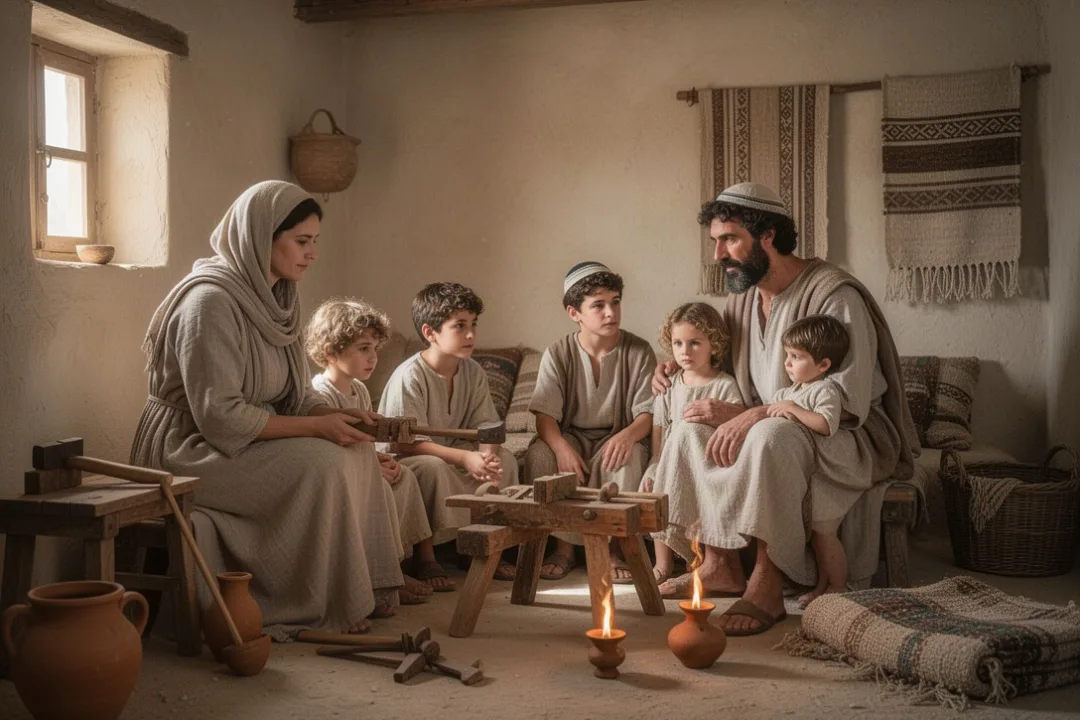
Jesus grew up in Nazareth within a Jewish household shaped by faith, work, Scripture, and community life. His family background matters because it shows both his genuine human upbringing and the relationships through which the Gospel accounts present his life.
Mary was Jesus’ mother. The opening chapters of Matthew and Luke describe her receiving the announcement that she would give birth to Jesus, and both Gospels present her as being engaged to Joseph at the time. Luke emphasizes her humble response to God, while Matthew shows Joseph accepting responsibility for Mary and the child after receiving guidance in a dream.
Joseph was Mary’s husband and the man who raised Jesus. Matthew identifies him as a descendant of David, and the birth narratives show him protecting Mary and Jesus by taking them to Egypt when Herod threatened the child. Luke later presents Joseph as part of Jesus’ upbringing in Nazareth, including the family’s visit to Jerusalem when Jesus was twelve.
Christian teaching traditionally describes Jesus’ conception as a work of the Holy Spirit rather than the result of a human father. For that reason, the Gospels call Joseph Jesus’ legal or earthly father in the sense that he protected, named, housed, and raised him, while they do not describe Joseph as Jesus’ biological father.
The Gospels name or mention Jesus’ brothers in several places. Mark 6:3 and Matthew 13:55 identify James, Joses or Joseph, Simon, and Judas. The same passages mention sisters, but they do not give their names or state how many there were.
Those references are important because they show that Jesus was known in Nazareth as part of a larger household. His neighbors recognized him through his family connections and ordinary trade, rather than viewing him as someone detached from local life. The question is how the word “brothers” should be understood, since Christians have interpreted it in different ways.
What the Gospels say about Mary, Jesus’ mother
Mary appears at several significant moments in the Gospel story. She is present at Jesus’ birth, at his presentation in the Jerusalem temple, during the family’s return to Nazareth, and at the wedding in Cana in John 2. She also appears near the cross and among Jesus’ followers after his ascension.
Luke portrays Mary as a thoughtful and faithful person who reflects on events surrounding Jesus’ birth. In Luke 2, she treasures and considers what she hears from shepherds and later from Simeon. That portrait does not present her as understanding every event immediately; it presents her as continuing to respond faithfully while the significance of her son’s life unfolds.
At Cana, Mary brings a practical concern to Jesus after the hosts run short of wine. Jesus’ response indicates that his public mission follows God’s timing, yet Mary then directs the servants to follow his instructions. The scene shows both a real family relationship and the beginning of a ministry in which Jesus’ identity cannot be reduced to his role as Mary’s son.
Mary is also present at the crucifixion according to John 19. Jesus entrusts her care to the disciple described as beloved, which has led many Christians to think that Mary may have been widowed and that Jesus’ brothers were not present or were not yet his followers at that point. The passage does not explain every family circumstance, so that conclusion should be held with care.
After Jesus’ resurrection and ascension, Acts 1 places Mary with Jesus’ brothers and the other disciples in prayer. This provides a clear link between Jesus’ household and the early Christian community. Mary is not described as a public leader in the same way as Peter or Paul, but she remains an honored witness within the community’s earliest days.
What Joseph’s role tells us about Jesus’ upbringing
Joseph’s part in Jesus’ childhood is concentrated in Matthew 1–2 and Luke 1–2. He accepts Mary, gives the child the name Jesus, follows warnings about danger, and settles the family in Nazareth. These actions make him a protector and responsible parent, even though the Gospel narratives do not record words spoken by him.
Matthew connects Joseph with the line of David, which supports the Gospel’s presentation of Jesus as the promised Davidic king. Luke also connects Jesus with David through a genealogy, although the two genealogical accounts differ in names and structure. Christians have proposed several explanations, including differences between legal and biological lines, but the texts do not provide a single universally accepted explanation.
Joseph is associated with the trade of a tekton, a term often translated as carpenter but broad enough to refer to a builder or craftsman. Matthew 13:55 calls Jesus “the carpenter’s son” in the sense of his household and public reputation, while Mark 6:3 refers to Jesus himself as a craftsman. These descriptions place the family within ordinary working life.
Joseph does not appear in the Gospel accounts of Jesus’ adult ministry. The most cautious statement is that the New Testament does not tell us when or how he died. Many readers infer that he died before Jesus began his public work, but that remains an inference rather than a reported fact.
A careful distinction: The Bible clearly presents Joseph as Jesus’ legal and earthly father and Mary as his mother. It does not describe Joseph as Jesus’ biological father, and it does not tell us exactly when Joseph died.
Who were Jesus’ brothers and sisters?
Mark 6:3 names James, Joses, Simon, and Judas as Jesus’ brothers. Matthew 13:55 gives a nearly identical list, using “Joseph” where Mark uses “Joses” in many English translations. The people in Nazareth also refer to Jesus’ sisters, but their names and number are not supplied.
James later became one of the most prominent leaders of the Jerusalem church. Paul refers to him as “the Lord’s brother” in Galatians 1:19, and Acts portrays James as a central voice during the discussion about Gentile believers. He is also traditionally associated with the Letter of James, although the letter itself does not identify its author in a full modern-style biography.
Judas is traditionally connected with the Letter of Jude, which begins by identifying its author as Jude and describing him as a brother of James. Simon receives no extended role in the New Testament, and Joses is mentioned mainly in the family lists. The limited information about them does not mean they were unimportant; it simply reflects the focus of the Gospel writers.
The phrase “brothers and sisters” has produced three main interpretations in Christian history. One view understands them as younger biological siblings born to Mary and Joseph after Jesus. Another view, common in Roman Catholic and Eastern Orthodox traditions, understands them as cousins or other close relatives, preserving the belief in Mary’s perpetual virginity.
A third view holds that they may have been Joseph’s children from an earlier marriage. This explanation appears in some early Christian traditions and fits the belief that Mary remained a virgin while also taking the Gospel language about a household of brothers seriously. The New Testament itself does not settle the question by explaining their exact biological relationship.
English readers should also remember that family vocabulary in the ancient Mediterranean world could be broader than modern nuclear-family language. At the same time, the Gospel passages do not use a completely different term that forces the word to mean cousins. The strongest responsible approach is to state what the texts say and identify where interpretation begins.
How Jesus’ extended family appears in the New Testament
The clearest possible connection is between Mary and Elizabeth. Luke 1:36 calls Elizabeth a relative of Mary, although English translations render the relationship in different ways. Elizabeth is the mother of John the Baptist, whose father is Zechariah, a priest. The passage establishes a family connection but does not define whether the two women were cousins, aunt and niece, or related through a more distant line.
John the Baptist and Jesus are therefore presented as relatives, but the Bible does not call them brothers or specify their degree of kinship. Their births are narrated together because both are connected to God’s purposes, not because the Gospel gives a complete family tree. John’s role is to prepare people for Jesus’ ministry.
Jesus’ genealogy also gives broader family context. Matthew 1 traces a line from Abraham through David to Joseph, while Luke 3 traces a line backward from Jesus through David, Abraham, and ultimately Adam. The lists contain substantial differences, and the Gospel writers appear to use genealogy for theological and literary purposes as well as ancestry.
Both genealogies place Jesus within Israel’s story. Matthew highlights Abraham, David, the royal line, and the history of exile. Luke reaches back to Adam, presenting Jesus in relation to humanity as a whole. Neither genealogy should be treated as a complete modern family record with every generation listed.
The New Testament also mentions Jesus’ relatives in connection with the early church. Paul refers to “James, the Lord’s brother” and mentions that Jesus’ brothers traveled as believers. This suggests that at least some of the men identified as Jesus’ brothers became active in the Christian movement after initially having a more complicated response to his ministry.
How Jesus’ family responded to his ministry
The Gospels do not present Jesus’ family as having one simple reaction from beginning to end. In Mark 3, Jesus’ mother and brothers come while he is teaching, and the crowd tells him they are looking for him. The passage describes tension around Jesus’ public activity and the demands it placed on ordinary family expectations.
Jesus responds by identifying those who do God’s will as his brother, sister, and mother. He is not rejecting Mary or denying family responsibility. Instead, he teaches that obedience to God creates a spiritual family that is not limited by blood, household, or social status.
John 7 says that Jesus’ brothers did not believe in him at that stage of his ministry. This account is significant because it avoids presenting every family member as an unquestioning supporter from the beginning. Later, Acts shows Jesus’ brothers praying with the disciples, and Paul refers to them as believers who traveled in ministry.
These passages allow for a realistic progression: family members could know Jesus intimately, misunderstand his mission, question his public claims, and later become convinced by the resurrection. The New Testament does not require readers to imagine that his relatives understood everything about him during his childhood or early ministry.
What “family” means in Jesus’ teaching
Jesus treated family relationships as serious obligations. He challenged religious leaders who used religious language to avoid caring for parents, and he provided for his mother at the cross in John 19. His teaching does not make biological family irrelevant or disposable.
At the same time, Jesus refused to make ancestry the measure of a person’s standing before God. In passages such as Matthew 12 and Mark 3, he identifies faithful hearers as members of his family. The point is not that natural relatives have no value; the point is that faithful relationship with God creates a deeper community.
This broader family includes people who would normally be separated by ethnicity, social class, gender, geography, or religious background. Jesus’ followers are repeatedly told to care for one another as members of one household. The early church adopted this language in practical ways through shared worship, generosity, hospitality, and care for vulnerable people.
Jesus also taught that following him could create conflict within a household. In Matthew 10, he warns that loyalty to his message may divide relatives. That warning recognizes the cost of discipleship without presenting family conflict as desirable. His teaching holds together two responsibilities: honor family relationships and place commitment to God above every human relationship.
Common mistakes when studying Jesus’ family
Calling Joseph Jesus’ biological father: The birth narratives distinguish Joseph’s parental role from the claim that Jesus was conceived by the Holy Spirit.
Giving Jesus’ sisters names from tradition as though Scripture names them: The canonical Gospels mention sisters but do not identify them by name.
Claiming the Bible proves one interpretation of “brothers”: The passages support discussion, but they do not explicitly explain whether the men were younger siblings, cousins, or stepbrothers.
Assuming Joseph’s death is directly recorded: Joseph disappears from the later narratives, but the New Testament does not describe his death.
Treating the genealogies as identical family registers: Matthew and Luke arrange and present Jesus’ ancestry differently, so their theological purposes should be considered.
Confusing John the Baptist with Jesus’ brother: The two are presented as relatives through Mary and Elizabeth, not as siblings.
Assuming Jesus’ relatives understood his mission immediately: Mark 3 and John 7 show that his family’s response was not uniform or simple.
Practical ways to read the family passages
Several reading habits make these passages easier to understand without forcing them to answer questions they do not address. Start with the immediate setting: ask who is speaking, what problem is being discussed, and whether the passage is describing ancestry, household life, discipleship, or church leadership.
Read parallel accounts together. Compare Matthew 1–2, Luke 1–2, Mark 3 and 6, Matthew 12–13, John 2, 7, and 19, and Acts 1. Similar events may emphasize different details.
Separate text from tradition. Mark and Matthew name Jesus’ brothers, while later Christian traditions offer explanations for their relationship to him. Keep those categories distinct.
Use family terms carefully. “Brother,” “sister,” and “relative” may not map perfectly onto modern family labels, especially across languages and cultures.
Notice changes over time. Some relatives appear uncertain during Jesus’ ministry but are later present with his followers. The resurrection shapes the family’s place in the early church.
Ask what the passage is teaching. A genealogy may emphasize covenant history, while a scene involving Jesus’ mother may focus on faith, obedience, care, or the cost of discipleship.
A helpful study method is to make two columns in your notes: one for explicit biblical information and one for reasonable interpretation. In the first column, write that Mary was Jesus’ mother, Joseph raised him, James was called his brother, and Elizabeth was Mary’s relative. In the second, record possibilities about the exact relationship of Jesus’ siblings or the timing of Joseph’s death.
For respectful discussion: Christians disagree about the meaning of Jesus’ brothers and sisters because they read the biblical language alongside different theological traditions. You can state your own view clearly without presenting an interpretation as an undisputed fact.
Why Jesus’ family matters for Christian faith
Jesus’ family places him in a recognizable human setting. He was not presented as an isolated spiritual figure with no household, ancestry, or community. He was raised by Mary and Joseph, lived in Nazareth, worked with his hands, attended Jewish religious life, and was known by neighbors through ordinary family relationships.
His family also connects him with the larger biblical story. Through Mary and Joseph, the Gospel narratives place Jesus among Israel’s people and within the promises associated with Abraham and David. Through John the Baptist’s family, his birth is linked to another household called into God’s work.
The family stories show that faith can exist alongside uncertainty, disagreement, and gradual understanding. Mary receives unusual news and continues faithfully. Joseph acts courageously without receiving a complete explanation of the future. Jesus’ brothers appear to move from skepticism or confusion toward participation in the early church.
For Christians, the subject ultimately points beyond genealogy. Jesus teaches that those who do God’s will belong to a new family shaped by faith and service. That spiritual family does not erase the responsibilities of parents, children, siblings, and relatives; it enlarges the circle of care around them.
The biblical picture is therefore both concrete and open-ended. It gives names where names matter, leaves some identities unknown, and resists turning every family question into certainty. What remains clear is that Jesus lived within a real household, honored family responsibility, and formed a community in which faithful people could belong to one another.
Frequently asked questions
Did Jesus have brothers and sisters?
The Gospels mention four brothers by name—James, Joses or Joseph, Simon, and Judas—and also refer to sisters without naming or numbering them. Christians disagree about whether these were younger children of Mary and Joseph, Joseph’s children from an earlier marriage, or close relatives such as cousins. The New Testament does not explicitly resolve that question.
Was Joseph Jesus’ biological father?
No. Matthew and Luke present Jesus’ conception as caused by the Holy Spirit and describe Joseph as Mary’s husband and Jesus’ earthly or legal father. Joseph raised, protected, named, and provided for Jesus. The biblical accounts give him an essential parental role while distinguishing that role from biological fatherhood.
Was John the Baptist Jesus’ cousin?
The Bible describes Elizabeth as a relative of Mary, and Elizabeth was John the Baptist’s mother. That makes John and Jesus relatives, but Scripture does not specify whether they were first cousins, more distant cousins, or related through another family connection. Calling John Jesus’ cousin is a common tradition, but the exact relationship is not stated.
What happened to Joseph after Jesus’ childhood?
Joseph appears in the birth and childhood narratives but not in the accounts of Jesus’ adult ministry. The Bible does not record his death or explain his absence. Many readers infer that Joseph died before Jesus began preaching, yet that remains an inference. Claims about the exact timing or circumstances of his death come from later tradition rather than explicit Gospel testimony.
















Leave a Reply