Joseph was Jesus’ legal and earthly father, but Christian teaching does not identify him as Jesus’ biological father. The Gospel accounts present Jesus’ conception as the work of the Holy Spirit, while Joseph serves as Mary’s husband, Jesus’ guardian, provider, and teacher.
That distinction explains why Joseph matters so much in the New Testament. He is not merely a name in a family tree. His decisions protect Jesus from danger, establish Jesus within David’s royal line, and show what faithful responsibility can look like when circumstances are confusing and costly.
What “father” means in relation to Joseph and Jesus
The phrase “Joseph, Jesus’ father” can mean several different things, so context matters. Joseph is called Jesus’ father in ordinary family and social terms because he raised Jesus in his household. He is also Jesus’ legal father because he accepted Mary as his wife and gave the child the name Joseph was instructed to give him.
At the same time, the Gospel writers distinguish Joseph from Jesus’ biological origin. Matthew describes Mary as becoming pregnant through the Holy Spirit, and Luke presents the same central claim through the angel’s announcement to Mary. These accounts are the basis for the Christian belief in the virgin conception of Jesus.
Joseph therefore occupies a unique place: he is not Jesus’ biological father, yet he is genuinely part of Jesus’ family life. His fatherhood is expressed through obedience, protection, daily care, and teaching rather than conception.
The central distinction: Joseph is Jesus’ earthly and legal father, while the New Testament identifies God as Jesus’ Father in a unique divine sense and presents the Holy Spirit as the agent of Jesus’ conception.
What the Gospels say about Joseph’s role
Joseph appears most prominently in the opening chapters of Matthew and Luke. He does not receive many spoken lines, and the Gospels do not record any speech from him. Instead, his character is revealed through the choices he makes when Mary’s pregnancy creates a painful and uncertain situation.
Matthew describes Joseph as a righteous man. When he learns that Mary is pregnant before their marriage, he plans to end the relationship quietly rather than expose her to public shame. In a dream, an angel tells him that the child has been conceived through the Holy Spirit and instructs him to take Mary as his wife.
Joseph responds by doing what he has been told. He accepts Mary, accepts the child, and gives the child the name Jesus. In the social world of the first century, this was a public act of responsibility. Joseph’s decision places Jesus within Joseph’s household and family line.
Luke emphasizes a different part of the early story. Joseph travels with Mary to Bethlehem because of the registration associated with the Roman government. Jesus is born there, and Joseph is present as Mary gives birth. The account does not portray him as a passive bystander; it places him beside Mary during a demanding and vulnerable time.
How Joseph protected Jesus from danger
Matthew records that Joseph receives further guidance in dreams after Jesus’ birth. When King Herod seeks the child’s death, an angel warns Joseph to take Mary and Jesus to Egypt. Joseph leaves during the night and remains there until the danger has passed.
This episode reveals the practical nature of Joseph’s fatherhood. He does not protect Jesus through power or public influence. He protects him by listening, acting quickly, traveling under difficult conditions, and putting his family’s safety first.
After Herod dies, Joseph is told to return to Israel. He initially intends to settle in Judea, but another warning leads him to Galilee instead. The family settles in Nazareth, where Jesus grows up. Matthew connects this move with the name “Nazarene,” although the Gospel does not present it as a simple quotation from one specific Old Testament verse.
The flight to Egypt is significant in Christian interpretation because Matthew presents Jesus as reliving aspects of Israel’s story. Egypt is both a place of refuge and a place from which God’s people are called. Joseph’s actions help preserve the child through whom Matthew says God’s purposes will continue.
Why Joseph’s legal fatherhood matters to Jesus’ identity
Joseph’s acceptance of Jesus gives the child a recognized place within Joseph’s family. In biblical societies, family identity was closely connected to a person’s legal standing, inheritance, community, and ancestry. Joseph’s decision to name Jesus is therefore more than a private gesture of affection.
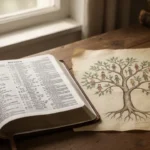
Matthew traces Jesus’ genealogy through Joseph and presents Joseph as a descendant of David. The genealogy connects Jesus with the royal line associated with Israel’s hopes for a coming ruler. Joseph’s role allows Jesus to be publicly identified with that Davidic household even though the Gospel attributes Jesus’ conception to the Holy Spirit.
Luke also includes a genealogy connected with Joseph, although its structure differs from Matthew’s account. Christians have proposed several ways to understand the difference, including different family lines, different legal relationships, or different purposes for each genealogy. The text does not spell out a single explanation that resolves every question.
What both accounts clearly establish is that Joseph belongs to the house of David and that Jesus is connected to David’s line through Joseph’s family and legal position. The point is theological as well as genealogical: Jesus is presented as the expected Messiah within Israel’s story.
Joseph as Jesus’ father in Nazareth
The Gospels provide few details about Jesus’ childhood, but they do show that Joseph’s household in Nazareth was a real family setting. Luke says that Jesus grew and became strong, increasing in wisdom, and that God’s favor was upon him. The statement places Jesus’ development within ordinary human life rather than depicting childhood as detached from family responsibilities.
Matthew refers to Joseph as a carpenter, and people in Nazareth later refer to Jesus in connection with that trade. Depending on translation and interpretation, the Greek term may describe a carpenter, builder, or skilled craftsman who worked with wood and other materials. Joseph likely taught Jesus practical work as part of family life.
Joseph would also have helped teach Jesus the customs and religious practices of Judaism. Luke describes the family traveling to Jerusalem for Passover when Jesus was twelve. During that visit, Jesus remains in the temple after Mary and Joseph begin the journey home. They search for him and find him among the teachers.
Luke’s account shows both Jesus’ growing awareness of a unique relationship with God and his continuing place within Joseph and Mary’s household. Jesus returns to Nazareth with them and remains subject to them. The episode does not erase Joseph’s parental authority; it shows Jesus developing within a family while also revealing a calling that reaches beyond it.
What happened to Joseph after Jesus’ childhood?
Joseph appears in the Gospel accounts surrounding Jesus’ birth and childhood, but he is not mentioned during Jesus’ public ministry in the same way Mary is. By the time of Jesus’ adult ministry, Joseph seems to have died, although the Bible does not directly state when or how he died.
One reason many readers reach this conclusion is that Jesus’ mother is present at important moments in John’s Gospel, while Joseph is absent. At the crucifixion, Jesus entrusts Mary to the care of the beloved disciple, which would make particular sense if Joseph were no longer living. This remains an inference rather than an explicit biblical statement.
The New Testament does not describe Joseph’s death, burial, final words, or age. Later Christian traditions offer additional stories, but those traditions are not part of the canonical Gospel accounts and should be identified as traditions rather than biblical facts.
How Joseph’s actions reveal his character
Joseph’s character is presented through a pattern of quiet faithfulness. He receives difficult information, seeks to act honorably, and changes his plans when he believes God has given new direction. His obedience repeatedly carries a personal cost.
He protects Mary’s dignity by refusing to treat her pregnancy as an opportunity for public punishment.
He accepts responsibility for Mary and Jesus when doing so could damage his reputation.
He acts promptly when warned that Herod threatens the child.
He provides stability by establishing a home in Nazareth after returning from Egypt.
He honors God’s instruction even when he does not receive a complete explanation of what will happen next.
These qualities help explain why Joseph is honored in Christian teaching as a model of humble obedience. The Gospels do not portray him as famous, wealthy, or politically powerful. His influence is seen in the way he takes responsibility for people placed in his care.
Joseph, God the Father, and the language of fatherhood
Christian readers must distinguish between several meanings of “father” in the Gospel accounts. Joseph is Jesus’ human parent and legal father. God is described as Jesus’ Father in a unique relationship that the New Testament connects with Jesus’ divine identity. These meanings overlap in family language but are not interchangeable.
Jesus refers to God as his Father, especially in the Gospel of John. The Gospel writers also describe Jesus as the Son of God and connect his mission with a relationship that existed before his earthly life. Joseph’s role does not compete with that claim; it belongs to Jesus’ human life in the world.
The same distinction helps explain why Christian theology can speak of Jesus as truly human and truly divine. Joseph provides a genuine human family context, while the accounts of Jesus’ conception and divine sonship express claims about his origin and identity that go beyond ordinary human parentage.
Joseph’s fatherhood is shown less by speeches than by the steady decisions he makes for Mary and Jesus.
That pattern also prevents two opposite mistakes. It is inaccurate to say that Joseph was Jesus’ biological father according to the Gospel accounts. It is equally misleading to treat Joseph as irrelevant to Jesus’ upbringing, because the Gospels give him a meaningful legal, family, and protective role.
What the Bible does not say about Joseph
The limited information about Joseph invites speculation, but the biblical accounts leave many details open. They do not tell us his exact age, physical appearance, education, income, date of death, or the full extent of his work. They also do not record conversations between Joseph and Jesus during Jesus’ adult life.
The Bible does not call Joseph one of Jesus’ apostles, describe him as present at the crucifixion, or name him among the disciples. It does not give a detailed portrait of his emotions after each dream or explain every practical difficulty involved in the family’s travel to Egypt.
These gaps are useful boundaries for interpretation. Joseph can be understood as a faithful husband, legal father, craftsman, and protector without filling the silence with invented details. Claims about his later life should be labeled as church tradition, devotional writing, or speculation when they do not come from the biblical text.
Common mistakes when discussing Joseph as Jesus’ father
People often use familiar family language without intending to make a theological claim. Still, a few distinctions make discussions of Joseph and Jesus more accurate.
Calling Joseph Jesus’ biological father: The birth accounts in Matthew and Luke attribute Jesus’ conception to the Holy Spirit, not to Joseph.
Calling Joseph only an adoptive father: This may communicate legal responsibility, but it can sound as though Joseph’s family role was merely symbolic. He raised Jesus within a real household.
Assuming Joseph spoke often in the Gospels: Joseph is important, but the Gospel narratives show his character mainly through actions rather than recorded speeches.
Treating every later story as Scripture: Traditions about Joseph’s age, previous marriage, or death may be meaningful to some Christians, but they are not all found in the New Testament.
Ignoring the genealogies: Joseph’s connection with David is central to understanding how Matthew presents Jesus’ messianic identity.
Assuming silence means insignificance: The short amount of material about Joseph does not cancel the importance of his decisions in the birth and childhood narratives.
For careful wording: Say that Joseph was Jesus’ earthly, legal, or human father and that he raised Jesus in Nazareth. Say that the Gospel accounts do not present Joseph as Jesus’ biological father.
How different Christian traditions honor Joseph
Christians across historic traditions honor Joseph as an important figure, although the emphasis varies. Roman Catholic teaching gives him a prominent role as the husband of Mary and protector of the Holy Family. Catholic devotion often presents him as a model for workers, fathers, husbands, and people who serve without recognition.
Eastern Orthodox Christianity also honors Joseph within the celebration of Christ’s birth, while maintaining a strong tradition about Mary’s perpetual virginity that shapes how Joseph’s family role is understood. Some Orthodox traditions describe Joseph as an older widower with children from an earlier marriage, but that detail comes from tradition rather than a direct statement in the canonical Gospels.
Many Protestant churches emphasize the biblical text itself: Joseph is a righteous man who obeys God, protects Mary and Jesus, and belongs to David’s family. Protestant interpretations differ on later traditions about Joseph, but they commonly affirm his significant role in Jesus’ early life.
These differences should not obscure the shared biblical picture. Joseph’s significance rests first on the Gospel accounts: he receives Mary, accepts Jesus, protects the family, and provides a home in Nazareth.
What Joseph teaches about responsible fatherhood
Joseph’s example is especially relevant to discussions of fatherhood because it separates biological connection from the responsibilities of care. The Gospels present him as a father through presence, provision, protection, and moral courage. He does not need public recognition for his actions to matter.
His story also shows that responsible care can require flexibility. Joseph changes his plans several times: he accepts Mary, travels to Bethlehem, escapes to Egypt, and settles in Galilee. Each change is connected with the safety and future of the family entrusted to him.
Joseph does not control every circumstance. He cannot prevent political violence, remove every hardship, or receive a complete explanation of the future. He can decide how he will respond, and the Gospel narratives consistently show him choosing faithfulness over self-protection.
For readers considering the meaning of fatherhood, Joseph offers a picture that includes more than authority or ancestry. His role involves showing up, making sacrifices, keeping promises, and creating a secure home. Those actions are the substance of his fatherhood in the Gospel story.
Where to read about Joseph and Jesus
The main passages about Joseph are found in the early chapters of Matthew and Luke. Matthew 1 describes Joseph’s discovery of Mary’s pregnancy, the angel’s message, Jesus’ naming, and the connection to David’s line. Matthew 2 describes the visit of the wise men, the threat from Herod, the journey to Egypt, and the family’s settlement in Nazareth.
Luke 1 presents the announcement to Mary, while Luke 2 describes Joseph’s journey to Bethlehem, Jesus’ birth, the presentation at the temple, the family’s observance of Passover, and Jesus’ visit to Jerusalem at age twelve. Luke 3 includes a genealogy associated with Joseph and Jesus’ family setting.
Other passages mention Jesus in relation to Joseph without adding much biographical detail. These references show that people knew Jesus as connected with Joseph’s household and occupation. John 1 and John 6, for example, preserve the kind of local identification people used when speaking about Jesus’ family background.
Reading these passages together gives a balanced picture. Joseph is not the subject of a long separate biography, but his actions are woven into the events that establish Jesus’ family, safety, legal identity, and early home.
Why Joseph remains important in the Gospel story
Joseph’s importance does not depend on the number of verses devoted to him. He stands at the meeting point of Jesus’ human family life, Israel’s royal hopes, and the Christian teaching about the incarnation. His decisions make room for Jesus to be raised within a recognizable family and community.
The Gospels also show a form of leadership that is easy to overlook. Joseph leads without seeking attention, protects without using force, and serves without demanding control. His faith is practical: he turns what he understands into action.
Calling Joseph Jesus’ father is therefore appropriate when the phrase refers to his earthly and legal role. Calling him Jesus’ biological father is not consistent with the Gospel accounts. The most accurate picture holds both truths together: Joseph truly raised Jesus as his son, and Christian Scripture presents Jesus’ conception as coming from the Holy Spirit.
Frequently asked questions
Was Joseph Jesus’ biological father?
No. Matthew and Luke present Jesus’ conception as occurring through the Holy Spirit rather than through Joseph. Joseph became Jesus’ husbandly, legal, and household father by accepting Mary, naming Jesus, protecting him, and raising him in Nazareth. In ordinary social language he was Jesus’ father, but the Gospel accounts do not describe him as Jesus’ biological parent.
Did Joseph adopt Jesus?
The Bible does not use the modern legal term “adoption” to describe Joseph’s relationship with Jesus. It does show Joseph accepting Jesus into his family, naming him, and providing a recognized household. “Legal father” or “earthly father” can communicate the biblical picture more precisely, while “adoptive father” may be used as a theological comparison rather than a direct biblical label.
What happened to Joseph later in life?
The canonical Gospels do not record Joseph’s death or give a definite explanation for his absence during Jesus’ adult ministry. Because Mary appears in later Gospel scenes while Joseph does not, many readers infer that Joseph had died by then. That inference is plausible, but the Bible does not provide his death date, location, cause, or burial details.
Why is Joseph included in Jesus’ genealogy?
Joseph’s ancestry connects Jesus with the house of David, an important part of the Messiah’s expected identity in the New Testament. Matthew especially uses Joseph’s family line to place Jesus within Israel’s royal history. Although Matthew and Luke arrange their genealogies differently, both associate Jesus with Joseph and the Davidic line.















Leave a Reply