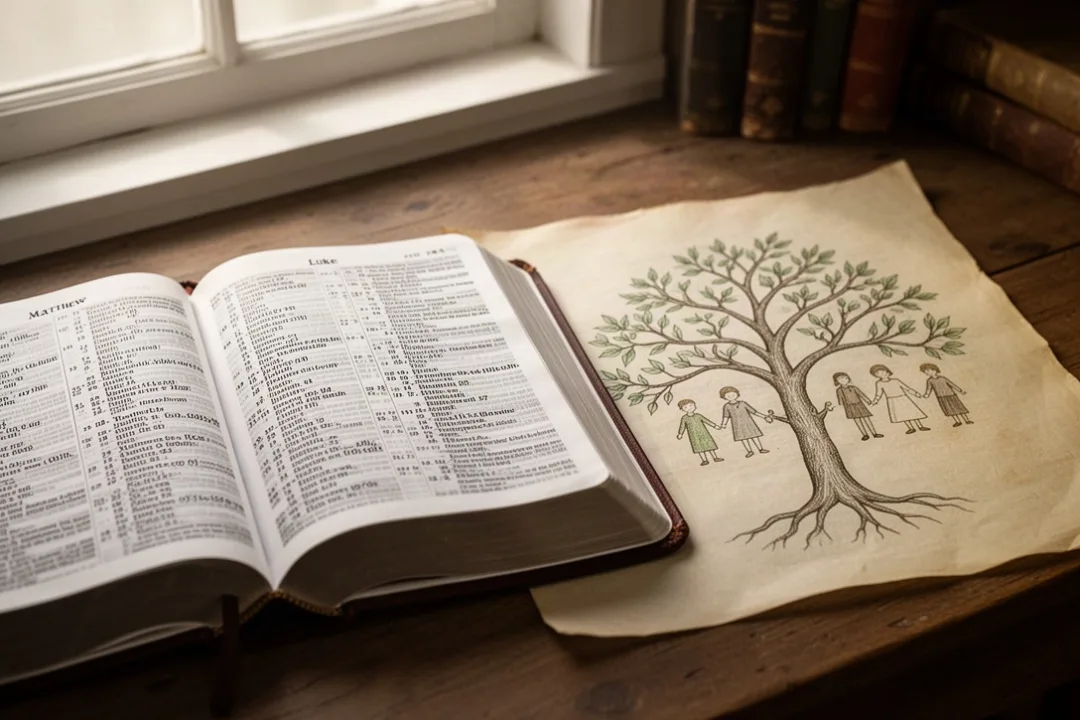
A genealogy is more than a family tree in the biblical world. It could establish identity, inheritance, tribal belonging, royal legitimacy, and continuity with earlier promises. By tracing Jesus through Israel’s history, Matthew and Luke place him within the story of Abraham, David, and the people of Israel.
The lists also make theological claims. Matthew emphasizes Jesus as the Messiah and royal heir associated with David. Luke places Jesus within the whole human family, tracing the line back to Adam. Neither genealogy should be treated as a modern civil registry. Each is a carefully arranged account that highlights relationships and meaning.
The central point: Matthew and Luke do not simply provide two copies of the same family tree. They use Jesus’ ancestry to answer different questions about who he is and why his life matters.
Where the two genealogies appear in the Bible
Matthew opens his Gospel with a genealogy, before describing Jesus’ birth. It begins with Abraham and moves forward through David and the kings of Judah until it reaches Joseph, the husband of Mary. Matthew identifies Jesus as the one connected to the Abrahamic and Davidic promises.
Luke places his genealogy after Jesus’ baptism. Rather than beginning with Abraham, Luke starts with Jesus and moves backward through Joseph’s line, eventually reaching Adam and then God. This placement connects the genealogy with Jesus’ public ministry and with the declaration that he is God’s beloved Son in Luke 3.
Matthew 1:1–17: moves from Abraham to Jesus and stresses royal and Jewish history.
Luke 3:23–38: moves from Jesus back to Adam and stresses his connection with all humanity.
Both accounts: connect Jesus with David, but they name different ancestors between David and Joseph.
How to read the genealogy of Jesus step by step
The names can seem difficult to follow, especially because many are unfamiliar and some appear in only one biblical book. A careful reading becomes easier when you separate the lists into their historical and theological movements.
Identify the starting point. Matthew begins with Abraham, while Luke works backward from Jesus to Adam.
Find the Davidic connection. Both genealogies connect Jesus with David, the king whose dynasty became central to Israel’s messianic hopes.
Observe the family line through Joseph. Both lists name Joseph, although they differ in the ancestors assigned to him.
Notice the women Matthew names. Tamar, Rahab, Ruth, and “the wife of Uriah” appear in Matthew’s list before Mary is introduced in the birth narrative.
Look for the larger pattern. Matthew organizes his list into three groups of fourteen generations, while Luke extends the line back to Adam.
Ask what each writer emphasizes. Matthew highlights kingship, covenant, and fulfillment; Luke highlights universal human identity and sonship.
Matthew’s genealogy from Abraham to Jesus
Matthew 1:1 describes Jesus as connected with David and Abraham. That opening immediately places him inside two major biblical lines of expectation. Abraham represents the beginning of Israel’s covenant story, while David represents the kingdom and the royal house from which a future ruler was expected.
Matthew’s list proceeds through Isaac, Jacob, Judah, and the descendants of Judah. It then reaches David, followed by the kings of Judah and the generations associated with the exile in Babylon. The final section moves from the postexilic period to Joseph and Jesus.
This structure gives the genealogy a strong sense of direction. It moves from promise to kingdom, from judgment to restoration, and from Israel’s past to Jesus. Matthew is not merely identifying biological ancestors; he is presenting Jesus as the climax of the national story.
Matthew’s three groups of fourteen generations
Matthew 1:17 divides the genealogy into three groups of fourteen: from Abraham to David, from David to the Babylonian exile, and from the exile to Jesus. The arrangement creates a memorable pattern and gives the list a literary shape.
Readers should not assume that the word “generation” always means a complete, uninterrupted list of every person in the line. Biblical genealogies sometimes compress generations by leaving out names that serve no purpose for the writer’s argument. Matthew’s wording and arrangement show that the genealogy has been selected and organized rather than copied from a modern database.
The repeated number fourteen may also draw attention to David, since the Hebrew letters of his name can be associated with the numerical value fourteen. That possibility fits Matthew’s emphasis on Jesus as David’s heir, although the text does not explain the number in a direct note. The safest conclusion is that the pattern reinforces the genealogy’s focus on Davidic kingship and ordered fulfillment.
The women in Matthew’s genealogy
Matthew’s genealogy is unusual because it names Tamar, Rahab, Ruth, and Bathsheba, whom Matthew identifies as “the wife of Uriah.” Mary appears in the final transition to Jesus. Ancient genealogies often focused on male lines, so the presence of these women is deliberate and significant.
These women come from complicated or unexpected circumstances. Tamar’s story in Genesis 38 involves questions of family duty and justice. Rahab is associated with Jericho in Joshua 2. Ruth is a Moabite who becomes part of David’s ancestry in the book of Ruth. Bathsheba is connected with David’s abuse of power, the death of Uriah, and the birth of Solomon in 2 Samuel 11–12.
The list therefore includes outsiders, morally complicated situations, and surprising turns in Israel’s history. It does not present Jesus’ ancestry as a polished line without human failure. Instead, Matthew’s selection prepares readers for a Messiah whose story includes mercy, restoration, and God’s work through people who do not fit a simple pattern.
The women also broaden the genealogy’s social and ethnic scope. Matthew does not spell out one single reason for including them, and readers should avoid claiming more than the text says. Still, their presence clearly signals that God’s purposes have moved through unexpected people and circumstances long before Jesus’ birth.
Luke’s genealogy from Jesus back to Adam
Luke 3:23 begins by saying that Jesus was regarded as the son of Joseph. That wording matters because Luke’s Gospel has already described Jesus’ conception and birth in a way that distinguishes Joseph’s role from biological fatherhood. The genealogy nevertheless follows the recognized family connection through Joseph.
Luke then moves backward through the generations, passing through David and Abraham before reaching Adam. The final reference to Adam connects Jesus with the entire human race, not only with the Jewish nation or the royal line of Judah.
This broad horizon fits Luke’s wider presentation. Luke repeatedly shows concern for the poor, women, outsiders, foreigners, sinners, and people at the edges of social respectability. The genealogy’s movement to Adam supports the idea that Jesus’ mission has universal reach.
Why Luke places the genealogy after Jesus’ baptism
Luke places the genealogy between Jesus’ baptism and the beginning of his public testing. At the baptism, the heavenly voice identifies Jesus as God’s Son. The genealogy then moves through human ancestors to Adam, who is also described in relation to God.
This arrangement creates a meaningful contrast. Jesus is connected to the human family through his ancestry, yet Luke also emphasizes his unique relationship with God. The genealogy therefore helps frame Jesus as both fully connected with humanity and uniquely appointed by God.
Why Matthew and Luke name different ancestors
The largest question about the two genealogies concerns the names between David and Joseph. Matthew follows the royal line through Solomon, while Luke follows a line through Nathan, another son of David. After that point, the lists diverge substantially before reaching Joseph.
Several explanations have been proposed throughout Christian history. One common explanation says that Matthew gives Joseph’s legal or royal line, while Luke gives Mary’s family line, even though Luke names Joseph. Another explanation holds that both lists concern Joseph but follow different legal and biological relationships, perhaps because of a levirate marriage or another family circumstance.
These proposals attempt to reconcile every name, but the New Testament does not explicitly state that Luke is listing Mary’s ancestors. Luke’s wording names Joseph, and the text does not provide a detailed explanation for the divergence. It is better to distinguish what the passages clearly say from theories developed to harmonize them.
Matthew’s line: runs through Solomon and the royal succession associated with Judah’s kings.
Luke’s line: runs through Nathan, another son of David, and continues toward Adam.
Possible explanations: include legal versus biological descent, different family lines, or different genealogical purposes.
What remains certain: both writers connect Jesus with David and present Joseph as his recognized family connection.
Read the differences carefully: A genealogy can be historically meaningful without functioning like a modern birth certificate. Matthew and Luke may be preserving family tradition while shaping it for different literary and theological purposes.
Joseph’s role in the genealogy of Jesus
Joseph is central to both genealogies even though the birth narratives emphasize that Jesus’ conception was not the result of Joseph’s biological fatherhood. In the social and legal world of the Gospels, a father’s recognition of a child could establish family identity, inheritance, and status.
Matthew’s account shows Joseph accepting Mary and naming Jesus after an angelic message. Luke presents Joseph as Mary’s betrothed and identifies Jesus as being regarded as Joseph’s son. These details allow the Gospels to hold two claims together: Jesus belongs to David’s household through Joseph, and his conception is attributed to the Holy Spirit rather than ordinary human generation.
That combination explains why the genealogies matter even when the Gospel writers make a theological distinction about Jesus’ birth. Joseph’s place in the family is not incidental. His legal and social relationship to Jesus supports the Davidic connection emphasized by both accounts.
David’s place in the genealogies reflects the expectation that God would continue the royal line associated with him. Several Old Testament passages connect David’s house with an enduring kingdom or future ruler, including 2 Samuel 7, Psalm 89, Isaiah 11, and Jeremiah 23.
The New Testament writers interpret Jesus through this background. Calling him the “Son of David” is not only a statement about ancestry. It is a messianic title that identifies him with hopes for restoration, righteous rule, and God’s faithfulness to Israel.
Matthew’s genealogy makes this royal theme especially visible by following the line through Solomon and the kings of Judah. The list includes both faithful and unfaithful rulers, showing that the royal line continued despite political collapse, exile, and human failure. Jesus is presented as the one who brings the story to its intended fulfillment.
How the genealogy connects Jesus with Abraham
Matthew’s opening reference to Abraham places Jesus within the covenant story that begins in Genesis. God’s promises to Abraham include descendants, blessing, and a role through which other nations would be blessed. Matthew does not quote the promise in the genealogy itself, but the opening name invites readers to recall that larger story.
Jesus’ connection with Abraham also establishes his Jewish identity. The genealogy passes through Isaac, Jacob, and Judah, rather than treating Israel’s history as a vague background. Matthew presents Jesus as belonging to a particular people and history before showing the wider reach of his mission.
The genealogy therefore works in two directions. It grounds Jesus in Israel’s specific covenant history, while the Gospel later expands the mission to all nations. Particular identity and universal significance are not opposites in Matthew’s presentation.
How the genealogy connects Jesus with Adam
Luke’s decision to continue past Abraham to Adam changes the scale of the genealogy. Adam stands at the beginning of the human story, so Luke presents Jesus as related to humanity as a whole.
This does not erase Jesus’ Jewish identity. Luke still passes through Abraham, Isaac, Jacob, Judah, and David. Instead, the line shows that Jesus’ significance reaches beyond one nation. The genealogy supports Luke’s emphasis on a salvation that is offered to people from every background.
The placement after baptism also invites a comparison between Adam and Jesus. Luke’s next scene describes Jesus being tested in the wilderness. Without forcing every detail into a direct parallel, readers can see a narrative contrast between human failure and Jesus’ faithful obedience.
What the genealogies reveal about biblical family records
Modern readers often expect a genealogy to answer one narrow question: who was the biological parent of each person? Biblical genealogies can answer that question, but they may also establish legal descent, tribal identity, royal succession, social belonging, or theological continuity.
They can also skip generations. A person may be called the “son” of an ancestor in a broad sense that includes a descendant. The word can refer to a direct child, but it may also describe a later member of a family line. This flexibility helps explain why comparisons with other biblical lists do not always produce identical sequences.
Matthew’s genealogy is also selective in another way: it includes women and notable events that serve his message. Luke’s list, by contrast, is longer and reaches Adam. The differences show that genealogies are not mechanically neutral lists. They are shaped accounts with a purpose.
Common mistakes when studying Jesus’ genealogy
Many disagreements arise because readers impose modern expectations on ancient texts or treat a proposed explanation as if it were stated directly in Scripture. A careful approach avoids both extremes: dismissing the genealogies as meaningless and pretending every uncertainty has been resolved.
Do not assume every ancestor is listed. Matthew’s structured groups show that the genealogy is selective.
Do not ignore the wording about Joseph. Luke names Joseph, even though some interpreters understand the line as representing Mary’s ancestry.
Do not treat Matthew and Luke as careless duplicates. Their placement, direction, and emphases are different.
Do not reduce the lists to biology alone. Legal and recognized family relationships mattered in the biblical setting.
Do not overlook the women and outsiders. Their inclusion contributes to Matthew’s message about God’s work through unexpected people.
Do not assume a difference means one writer had no purpose. The divergence may reflect different sources, lines, or theological aims.
A practical method for comparing Matthew and Luke
If you want to study the genealogy closely, read both passages several times rather than trying to compare every name at once. First observe the overall movement, then mark the points where the lists converge or diverge.
Read Matthew 1:1–17 without interruption. Mark Abraham, David, the exile, Joseph, and the women.
Read Luke 3:23–38 separately. Notice the backward movement and the final reference to Adam and God.
Compare the shared names. Look especially at David, Abraham, Isaac, Jacob, and Judah.
Note the different routes from David. Matthew uses Solomon; Luke uses Nathan.
Check the surrounding chapters. Matthew’s genealogy leads into royal and birth themes, while Luke’s follows baptism and precedes testing.
Separate certainty from interpretation. Record what the texts state before considering harmonization theories.
A study Bible or cross-reference tool can help identify the Old Testament background, but the genealogy should still be read in its immediate Gospel setting. The surrounding narrative often explains why a writer selected and arranged the names as he did.
What the genealogy says about human failure and divine faithfulness
The names in Jesus’ genealogy include kings who acted wisely, rulers who did great harm, families shaped by grief, and people whose stories involved moral difficulty. The line does not move forward because every ancestor was exemplary. It moves forward through God’s continued faithfulness amid human weakness.
Matthew’s inclusion of the exile is especially significant. The Babylonian exile represented national loss, judgment, and the collapse of David’s visible kingdom. By carrying the genealogy beyond the exile to Jesus, Matthew presents the story as continuing after apparent disaster.
This pattern gives the genealogy pastoral meaning without turning it into a promise that every family history will follow the same path. It does show that ancestry does not have to be perfect for a person to stand within a meaningful story. Jesus’ family line includes brokenness, but the Gospel presents that history as part of God’s redemptive purpose.
What Christians can and cannot claim from the genealogy
The genealogies support several clear claims: Jesus is connected with Abraham, David, and the people of Israel; Joseph is part of his recognized family identity; Matthew and Luke present Jesus within a purposeful account of salvation history; and the two writers emphasize different dimensions of his identity.
They do not settle every question about the exact relationship between Joseph’s line and Mary’s family. They also do not provide enough information to reconstruct a complete modern family tree. Claims about every missing generation or every difference between the lists require interpretation beyond what the passages explicitly explain.
The most responsible reading respects both the historical and theological dimensions. Matthew and Luke are not giving random names, but neither are they promising the kind of exhaustive documentation expected from a contemporary genealogy database. Their lists identify Jesus within Israel’s story, David’s royal line, and humanity’s wider family.
Why the genealogy still matters to readers today
The genealogy of Jesus can seem like a difficult list at first, but it answers foundational questions. It explains where Jesus belongs, what promises surround his identity, and how the Gospel writers understand his relationship to Israel and the human race.
Matthew presents a Messiah who stands at the end of a royal and covenant history marked by promise, sin, exile, and restoration. Luke presents a Savior whose lineage reaches back to Adam and therefore embraces the whole human family. Read together, the genealogies show Jesus as the Davidic Messiah rooted in Israel and the representative of humanity.
The two accounts do not need to be flattened into identical lists before they can be understood. Their differences invite closer reading, while their shared claims give the subject its center: Jesus is presented as the person in whom the biblical story of God’s people reaches its decisive point.
Frequently asked questions
Is Jesus’ genealogy in Matthew the same as the one in Luke?
No. Matthew traces the line from Abraham to Jesus through David’s son Solomon, while Luke traces backward from Jesus to Adam through David’s son Nathan. Both include Joseph and connect Jesus with David, but they use different names and arrangements. Christians have proposed several explanations, including different legal or family lines, but the Gospel texts do not fully explain the discrepancy.
Does the Bible give Jesus’ genealogy through Mary or Joseph?
Matthew and Luke both name Joseph in their genealogical passages. Some Christian interpreters understand Luke’s list as Mary’s family line represented through Joseph, while others see both lists as different forms of Joseph’s ancestry. The text does not explicitly label Luke’s genealogy as Mary’s, so that interpretation should be presented as a possibility rather than an unquestionable fact.
Why does Matthew include Tamar, Rahab, Ruth, and Bathsheba?
Their inclusion draws attention to unexpected people and complicated circumstances in the family history leading to Jesus. Some were outsiders to Israel, and several accounts involve moral or social difficulties. Matthew may be highlighting God’s work through people outside conventional expectations, although he does not give one explicit explanation for naming each woman.
How many generations are listed in Jesus’ genealogy?
Matthew organizes his genealogy into three groups of fourteen generations, but his list is selective and may omit intervening ancestors. Luke gives a longer backward list reaching from Jesus to Adam. Because ancient genealogies could compress family lines and use terms such as “son” broadly, the lists should not be treated as complete modern-style records of every generation.
















Leave a Reply