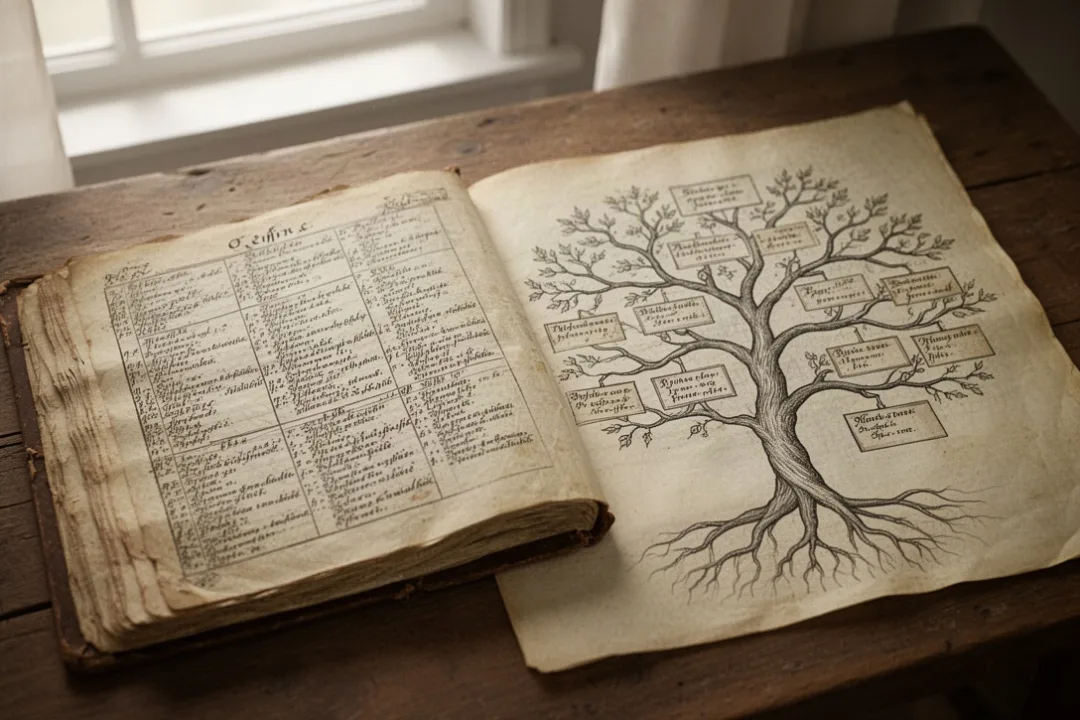
Abraham’s family tree begins with his father, Terah, and includes Abraham’s brothers Nahor and Haran, his wife Sarah, his sons Ishmael and Isaac, and the later families descended from them. Abraham also had six sons with Keturah, while Isaac became the father of Esau and Jacob. Jacob’s twelve sons became the ancestors of the tribes of Israel.
The main genealogy appears across Genesis 11–25, with later generations developed in Genesis and other biblical books. Because biblical genealogies sometimes focus on a particular line rather than naming every descendant, the family tree is best read as a record of major relationships, not as a complete modern-style register.
Abraham was first called Abram. Genesis presents him as the son of Terah and the brother of Nahor and Haran. His family came from Ur of the Chaldeans, and Terah later moved with part of the household toward Canaan, stopping at Haran. After God called Abram to continue the journey, he traveled into Canaan with Sarah and his nephew Lot.
Genesis 17 describes the change from Abram to Abraham and from Sarai to Sarah. The new names appear in the context of God’s covenant with Abraham, including the promise that he would become the ancestor of many nations. This name change is why both Abram and Abraham appear in biblical family-tree discussions.
Terah: Abraham’s father.
Nahor: Abraham’s brother, who remained connected to the family line in Mesopotamia.
Haran: Abraham’s brother and the father of Lot, Milcah, and Iscah.
Abraham: originally called Abram, and the central ancestor in the genealogy.
Sarah: Abraham’s wife and the mother of Isaac.
Lot: Abraham’s nephew, the son of Haran.
Abraham’s family was therefore larger than the line leading directly to Isaac. Lot’s relationship matters because he traveled with Abraham for a time and later became the ancestor of Moab and Ammon through the troubling episode recorded in Genesis 19. Those nations appear repeatedly in the later history of Israel.
Terah’s household: Nahor, Haran, and Lot
Terah had three sons named in Genesis: Abram, Nahor, and Haran. Haran died in Ur before Terah’s migration, leaving behind his son Lot and daughters Milcah and Iscah. Milcah married her uncle Nahor, creating another close connection between the branches of Terah’s family.
Nahor and Milcah had several children, including Uz, Buz, Kemuel, Chesed, Hazo, Pildash, Jidlaph, and Bethuel. Bethuel later became the father of Rebekah and Laban. Rebekah married Isaac, so Abraham’s family tree eventually joins back to Nahor’s branch through marriage.
This connection explains why Abraham sent his servant to the household of his relatives when seeking a wife for Isaac. Genesis 24 identifies Rebekah as Bethuel’s daughter and Laban’s sister. The arrangement links Isaac’s family to the Mesopotamian branch descended from Nahor.
Nahor also had children with Reumah, a concubine. Genesis names Tebah, Gaham, Tahash, and Maacah in that connection. These names are part of the broader family tree, although the biblical narrative gives them far less attention than Isaac, Ishmael, Jacob, and Esau.
Family-tree tip: Do not confuse Nahor, Abraham’s brother, with the later Nahor who appears in the genealogy as his grandfather’s name. Biblical families often reuse names across generations.
Abraham and Sarah’s marriage and household
Sarah was Abraham’s wife and his half-sister according to Genesis 20:12, where Abraham explains that she was his father’s daughter but not his mother’s daughter. The biblical account also shows that Sarah was initially called Sarai and that she remained childless for many years.
Before Isaac was born, Sarah gave her Egyptian servant Hagar to Abraham as a wife or secondary wife within the customs described in Genesis. Hagar conceived Ishmael. This arrangement produced a son but did not remove the tension between Sarah and Hagar, which became a major part of the family’s story.
God’s covenant promise was specifically associated with a son born through Sarah. Genesis 21 then records the birth of Isaac when Abraham was one hundred years old and Sarah was advanced in age. Isaac’s birth is central to the line later traced through Jacob and the people of Israel.
Sarah died at Hebron, and Abraham purchased the cave of Machpelah as a burial place. Genesis 23 identifies this site as the place where Sarah was buried. Abraham was later buried there as well, alongside the family line that included Isaac and Rebekah, and Jacob and Leah.
Abraham’s children: Ishmael, Isaac, and the sons of Keturah
Abraham had children through three women named in Genesis: Hagar, Sarah, and Keturah. Ishmael was the son of Hagar, Isaac was the son of Sarah, and Keturah became the mother of six sons. The biblical text presents Isaac as the heir of the covenant promise while still giving Ishmael and Keturah’s descendants their own genealogical place.
Ishmael: son of Abraham and Hagar.
Isaac: son of Abraham and Sarah.
Zimran: son of Abraham and Keturah.
Jokshan: son of Abraham and Keturah.
Medan: son of Abraham and Keturah.
Midian: son of Abraham and Keturah.
Ishbak: son of Abraham and Keturah.
Shuah: son of Abraham and Keturah.
Genesis 25 says that Abraham gave gifts to the sons of his concubines during his lifetime and sent them away from Isaac toward the east. The wording distinguishes Isaac’s inheritance from the other branches, even though all these sons were part of Abraham’s wider family.
Different English translations and later traditions may describe Keturah’s status differently, but Genesis clearly names her as the mother of six sons born to Abraham. The passage does not provide a detailed account of each son’s later life, so claims about their exact historical locations should be treated cautiously.
Ishmael’s branch and his twelve sons
Ishmael was Abraham’s first son, born through Hagar. Before Ishmael’s birth, an angel’s message in Genesis 16 describes his future as the father of a large people. Genesis 17 also says that God would bless Ishmael and make him fruitful, while the covenant line associated with Sarah would continue through Isaac.
Genesis 25 names Ishmael’s twelve sons: Nebaioth, Kedar, Adbeel, Mibsam, Mishma, Dumah, Massa, Hadad, Tema, Jetur, Naphish, and Kedemah. The passage calls them princes or tribal leaders and presents them as the ancestors of twelve groups.
Ishmael’s daughter is named Mahalath in Genesis 28, where she is connected with Esau’s marriage. Another passage refers to Esau’s wife as Basemath, and genealogical details can vary in names and relationships across the biblical accounts. Readers should avoid forcing every name into a single chart without checking the passage being studied.
Abraham and Ishmael buried Abraham together in the cave of Machpelah after Abraham’s death. That detail is significant because it shows a continuing family connection even though Genesis distinguishes Ishmael’s line from Isaac’s covenant line.
Isaac’s family: Rebekah, Esau, and Jacob
Isaac was Abraham and Sarah’s only named son. He married Rebekah, the daughter of Bethuel and the granddaughter of Nahor. Rebekah was therefore from Abraham’s extended family through his brother Nahor, not a stranger brought into the family from a distant people.
Isaac and Rebekah had twin sons, Esau and Jacob. Genesis 25 says that the older son, Esau, became the ancestor of Edom, while Jacob was later renamed Israel. Their relationship was marked by rivalry over the birthright and the paternal blessing, although the two brothers eventually met again after years of separation.
Esau’s family became the nation of Edom. Genesis 36 lists his wives, sons, chiefs, and kings, though the names and descriptions require careful reading because different passages use variations in the names of his wives. Esau is also called Edom because of the reddish stew associated with the birthright story.
Jacob’s name was changed to Israel after his night of wrestling described in Genesis 32. His descendants became the twelve tribes of Israel. In that sense, Abraham’s family tree expands from one household into a large national genealogy through Jacob’s sons.
Jacob had twelve sons through Leah, Rachel, Bilhah, and Zilpah. Their births are recorded in Genesis 29–30 and summarized in various genealogical passages. The sons are listed below in a common biblical order by mother and birth sequence, rather than as a claim about later tribal rankings.
Reuben: son of Leah and Jacob’s firstborn.
Simeon: son of Leah.
Levi: son of Leah and ancestor of the priestly and Levitical families.
Judah: son of Leah and ancestor of the tribe associated with David’s royal line.
Dan: son of Bilhah, Rachel’s servant.
Naphtali: son of Bilhah.
Gad: son of Zilpah, Leah’s servant.
Asher: son of Zilpah.
Issachar: son of Leah.
Zebulun: son of Leah.
Joseph: son of Rachel and father of Ephraim and Manasseh.
Benjamin: son of Rachel and Jacob’s youngest son.
Joseph’s two sons, Ephraim and Manasseh, received a special status in Israel’s tribal accounting. Jacob adopted and blessed them as his own in Genesis 48, so lists of the tribes may include Ephraim and Manasseh in place of Joseph. Levi may be counted separately because the Levites had a distinct religious role and land arrangement.
Judah’s line receives particular attention in later biblical history. Judah’s descendants include David, the king of Israel, through the genealogy given in Ruth 4 and developed in 1 Chronicles. The New Testament Gospel genealogies also connect Jesus with Abraham and David, though Matthew and Luke arrange and present the genealogy differently.
Abraham’s family through Keturah
After Sarah’s death, Abraham took Keturah as a wife, according to Genesis 25. Their six sons were Zimran, Jokshan, Medan, Midian, Ishbak, and Shuah. Jokshan’s sons were Sheba and Dedan, and Dedan’s descendants are mentioned in later biblical passages.
Midian is the best-known branch from Keturah’s children. The Midianites appear in several biblical narratives, including the story of Moses, who married Zipporah, the daughter of the Midianite priest Jethro. The relationship between Abraham’s descendants through Midian and the Israelites is complex, changing across different stories rather than remaining uniformly friendly or hostile.
Genesis does not give a full list of descendants for every son of Keturah. Later references to groups such as Sheba, Dedan, and Midian provide additional connections, but not every later use of these names can be mapped with certainty onto a single historical population. A careful family tree should show these branches without claiming more precision than the text provides.
Lot’s descendants and Abraham’s extended family
Lot was the son of Haran, Abraham’s brother, making him Abraham’s nephew. Lot separated from Abraham after their herds became too large to remain together, choosing the Jordan Valley and eventually settling near Sodom. His story is told separately from the main covenant line but remains part of Abraham’s extended family.
Genesis 19 describes Lot’s two sons as the ancestors of Moab and Ammon. The account presents their origins through an incestuous episode involving Lot and his daughters after the destruction of Sodom. Because the story is morally difficult and intentionally disturbing, it should not be treated as a simple ancestry note detached from its narrative setting.
The Moabites and Ammonites later appear in Israel’s history as neighboring peoples. Ruth, a Moabite woman, became part of Judah’s family through her marriage to Boaz. Her story shows that biblical ancestry can include both conflict between related peoples and the incorporation of an outsider into the line associated with David.
A simple text version of Abraham’s family tree
The following outline shows the principal relationships without attempting to include every named descendant:
Terah
Haran
Lot
Milcah
Iscah
Nahor and Milcah
Bethuel
Other children named in Genesis
Abraham and Sarah
Isaac and Rebekah
Esau
Jacob, also called Israel
Reuben, Simeon, Levi, Judah, Dan, Naphtali, Gad, Asher, Issachar, Zebulun, Joseph, and Benjamin
Abraham and Hagar had Ishmael, whose twelve sons are listed in Genesis 25. Abraham and Keturah had Zimran, Jokshan, Medan, Midian, Ishbak, and Shuah. This wider structure helps distinguish three major descendant groups: Ishmael’s line, Isaac’s line, and Keturah’s line.
Common mistakes when reading Abraham’s genealogy
Genealogical passages can be confusing because names recur, family relationships are sometimes described differently, and a single chart may combine several biblical books. These practical checks help keep the main relationships clear.
Do not call Isaac Abraham’s first son. Ishmael was born before Isaac. Isaac is the son of Sarah and the son identified with the covenant line in Genesis.
Do not make Ishmael the father of the twelve tribes of Israel. Ishmael had twelve sons, but Jacob, also called Israel, had the twelve sons connected with Israel’s tribes.
Do not confuse Nahor with Abraham. Nahor was Abraham’s brother, while another Nahor appears in the earlier genealogy of Terah’s ancestors.
Do not confuse Lot with Abraham’s son. Lot was Abraham’s nephew, the son of Haran.
Do not leave out Keturah. Her six sons form an important branch of Abraham’s family even though the biblical narrative gives them less space than Isaac and Ishmael.
Do not assume every tribal list is identical. Joseph may be represented through Ephraim and Manasseh, and Levi may be treated separately depending on the purpose of the list.
Do not treat every later tradition as equally explicit in Genesis. Some proposed connections come from interpretation or later sources rather than direct statements in the main genealogy.
Reading strategy: Start with the parent-child relationship stated directly in Genesis, then mark later traditions separately. This prevents uncertain identifications from being presented as if they were explicit biblical facts.
Why Abraham’s family tree matters in the Bible
Abraham’s genealogy is not simply a list of names. It explains how the biblical story moves from one household to several nations, while focusing on a particular line through Isaac, Jacob, Judah, and David. The family tree also preserves relationships among peoples who later lived as neighbors, allies, or opponents.
The distinction between Ishmael and Isaac is central to Genesis. Both are Abraham’s sons, and both receive promises concerning descendants, but the covenant narrative proceeds through Isaac and then Jacob. That distinction should be stated accurately without erasing Ishmael’s place in Abraham’s family.
The tree also emphasizes the importance of marriages between family branches. Isaac married Rebekah, whose father came from Nahor’s line. Jacob’s marriages connected him with Laban’s household, and the children born through those relationships became the foundation for Israel’s tribal identity.
For Christian readers, Abraham’s family is later recalled in the New Testament as part of the story of God’s promises. For Jewish readers, Abraham, Isaac, and Jacob are foundational ancestors of Israel. In Islam, Abraham, Hagar, and Ishmael also hold a central place, with traditions that do not always match every detail or emphasis of the biblical account.
How to study the genealogy without losing the main line
Begin by separating three levels of relationship: Abraham’s immediate household, his extended relatives, and the descendants who become nations or tribes. This keeps the chart from treating a brother, a nephew, a son, and a distant descendant as though they occupied the same place.
Read Genesis 11–12 for Terah’s family and Abraham’s departure from Haran.
Read Genesis 16–17 for Hagar, Ishmael, the covenant, and the name changes.
Read Genesis 21–25 for Isaac’s birth, Sarah’s death, Keturah’s sons, Ishmael’s sons, and Abraham’s death.
Read Genesis 24 and 27–36 for Rebekah, Isaac’s sons, Jacob’s family, and Esau’s descendants.
Compare 1 Chronicles and Ruth when following the lines of the tribes, Judah, and David.
Keep a separate note for direct biblical statements and for interpretations based on geography, later tradition, or similar names. That simple distinction makes Abraham’s family tree easier to understand and prevents a neat-looking chart from hiding genuine uncertainty.
Frequently asked questions
Who was Abraham’s first son?
Abraham’s first son was Ishmael, born to Hagar, Sarah’s Egyptian servant. Isaac was born later to Sarah and became the son through whom the covenant line was traced in Genesis. Both sons were part of Abraham’s family, and Genesis records promises concerning Ishmael’s descendants as well as Isaac’s role in the continuing covenant story.
How many children did Abraham have?
Genesis names eight sons of Abraham: Ishmael through Hagar, Isaac through Sarah, and six sons through Keturah. The text does not present a full list of daughters, although later passages name daughters or women connected with his descendants. For that reason, eight is the number of named sons, not necessarily a complete count of every child.
Was Jacob Abraham’s son?
No. Jacob was Abraham’s grandson. Abraham’s son was Isaac, and Isaac’s wife Rebekah gave birth to the twins Esau and Jacob. Jacob was later called Israel and became the father of twelve sons whose descendants were associated with the tribes of Israel. This makes Jacob an important third generation in the main biblical family line.
How is Jesus connected to Abraham?
The New Testament places Jesus within Abraham’s family through the line of Isaac, Jacob, Judah, and David. Matthew and Luke provide genealogies that arrange the names differently and serve different literary purposes. Both connect Jesus with Abraham, while their full lists should be read on their own terms rather than merged into one identical sequence.













Leave a Reply