Saint Joseph: His life, virtues, feasts, and prayers
Saint Joseph: His life, virtues, feasts, and prayers
Saint Joseph was the husband of Mary and the earthly legal guardian of Jesus. In the Gospels, he appears as a righteous man who protects his family, listens to God through dreams, and accepts difficult responsibilities without recorded words of his own.
Christians honor Joseph as the foster father of Jesus, the patron of the universal Church, workers, fathers, travelers, and many people facing practical hardship. His life points to faithful service: he responds to God, provides for his household, and remains close to Jesus and Mary in ordinary family life.
Joseph was a descendant of King David, from the town of Nazareth in Galilee. Matthew and Luke both connect him with David’s family line, although their genealogies differ in arrangement and details. This Davidic connection matters because the Hebrew Scriptures associate the promised Messiah with the house of David.
Joseph was betrothed to Mary when he learned that she was expecting a child through the Holy Spirit. In the culture of that time, betrothal was more binding than a modern engagement. Joseph therefore faced a serious decision when Mary’s pregnancy became known before they had begun married life together.
Matthew presents Joseph as a righteous man who did not want to expose Mary to public shame. In a dream, an angel told him to take Mary as his wife and explained that the child had a divine origin. Joseph accepted the message and carried out the instruction after waking, as described in Matthew 1:18-25.
The Gospels do not record any spoken words from Joseph. That silence does not mean he was passive or unimportant. His character is shown through decisive actions: he takes Mary into his home, names the child Jesus, protects the family from danger, and fulfills the duties entrusted to him.
Joseph is often called the foster father of Jesus or the earthly father of Jesus. These titles describe his legal, social, and family role while preserving Christian belief that Jesus is the eternal Son of God and that Mary conceived him through the Holy Spirit. Joseph did not replace God’s fatherhood; he served as Jesus’ human guardian.
A useful distinction: Joseph was not Jesus’ biological father, but he was truly responsible for Jesus as a husband, guardian, provider, and member of the household in Nazareth.
Joseph’s role in the childhood of Jesus
Matthew and Luke provide the main Gospel accounts of Joseph’s life. They focus on several moments surrounding Jesus’ birth and childhood, showing Joseph as a man who protects his family through uncertainty, travel, danger, and poverty.
Joseph accepts Mary and names Jesus
After the angel’s message, Joseph takes Mary as his wife. He also gives the child the name Jesus, an action that publicly recognizes the child as part of Joseph’s household and the line of David. In biblical culture, naming a child could express legal acceptance and paternal responsibility.
Luke describes Joseph traveling with Mary to Bethlehem because of a registration connected with his Davidic ancestry. Jesus is born there, and the family later returns to Nazareth. These events connect Jesus’ birth with Bethlehem while explaining why he is known as Jesus of Nazareth.
Joseph protects the family in Egypt
In Matthew 2, Joseph receives another dream warning that King Herod intends to harm the child. He takes Mary and Jesus to Egypt during the night. The journey would have required courage, planning, and endurance, especially for a family traveling under pressure with an infant.
Joseph remains in Egypt until another dream tells him that the immediate danger has passed. He then brings the family back, but because Herod’s successor rules Judea, Joseph settles in Galilee instead. Matthew presents these choices as careful obedience rather than spontaneous bravery.
Luke 2 describes Joseph and Mary traveling to Jerusalem for Passover. When Jesus, at age twelve, remains behind without their knowledge, they search for him and find him among teachers in the Temple. Joseph does not speak in the account, but the event shows the anxiety and responsibility of caring for a child.
Afterward, Jesus returns with Mary and Joseph to Nazareth and lives under their care. Luke says that Jesus grows in wisdom and maturity. The passage gives a glimpse of hidden family life: years of work, worship, learning, and daily responsibilities that receive little attention in the Gospel record.
What Saint Joseph represents in Christian faith
Joseph’s importance comes not from public speeches or political authority but from his faithful presence. He serves at the beginning of Jesus’ earthly life, when Mary and the child depend on his protection. His example is especially meaningful for people whose work is necessary but rarely recognized.
Obedience that becomes action
Joseph receives divine guidance in dreams, but he does not treat the dreams as abstract spiritual experiences. He acts on them. He changes his plans, accepts Mary, travels to protect Jesus, and returns when instructed. His faith is therefore practical and concrete.
For Christians, Joseph shows that obedience may involve ordinary decisions rather than dramatic public gestures. A person may live faithfully by telling the truth, caring for relatives, keeping promises, protecting someone vulnerable, or accepting an unplanned responsibility with patience.
Strength without domination
Joseph is often portrayed with tools, a staff, or the child Jesus, but Christian devotion does not define his strength by control. His authority is expressed through self-giving protection. He uses his position to shelter Mary and Jesus, not to demand attention for himself.
This makes Joseph a useful model of responsible fatherhood and leadership. His example includes firmness when danger threatens, tenderness toward family members, and restraint when another person’s dignity must be protected. The Gospel account of his decision regarding Mary is especially significant because he seeks a merciful course rather than public revenge.
Work and ordinary responsibility
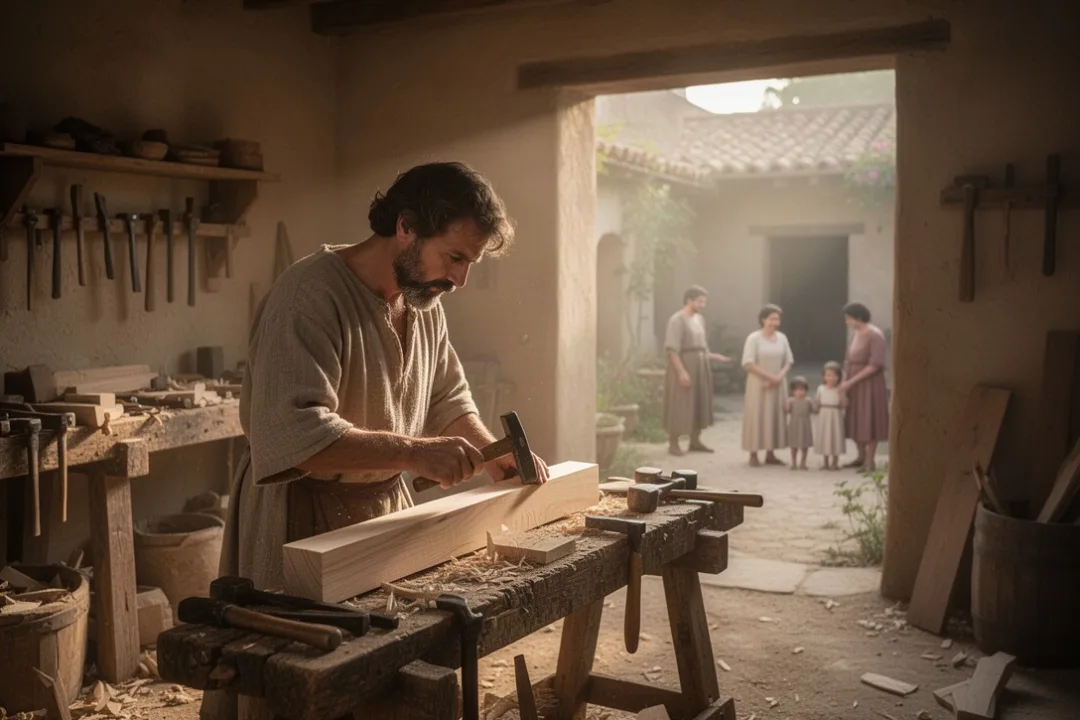
Matthew calls Joseph a tekton, a Greek term commonly translated as carpenter. The word can refer more broadly to a craftsman or builder who works with materials such as wood or stone. It is safer to picture Joseph as a skilled manual worker than to imagine a narrowly defined modern occupation.
Joseph’s work gave structure to family life in Nazareth. It provided income, taught practical skills, and helped place Jesus within a real village and trade. Christian reflection often sees this hidden labor as honorable because work can serve love, stability, and the common good even when it attracts no public praise.
Silence and contemplation
Because the Gospels record no direct speech from Joseph, he has become a strong symbol of quiet attentiveness. His silence is not withdrawal from responsibility. He listens, considers, and then acts. That pattern can help people distinguish thoughtful prayer from simply reacting to fear or pressure.
Joseph’s silence also leaves room for contemplation. He stands beside Mary and Jesus without competing for attention. In Christian prayer, this makes him a companion for people who struggle to find words, who carry responsibilities privately, or who want to serve without being noticed.
Saint Joseph’s titles, feast days, and patronage
Joseph is known by several titles that reflect different aspects of his vocation. Saint Joseph the Husband of Mary emphasizes his marriage and family life. Saint Joseph the Worker highlights his trade and the dignity of labor. Foster Father of Jesus points to his protective and parental responsibility.
He is also called the Patron of the Universal Church. Pope Pius IX proclaimed him patron of the Catholic Church in the nineteenth century. This title reflects the belief that Joseph, who guarded the Holy Family, continues to intercede for the Church as a spiritual household.
The Church also invokes Joseph as patron of fathers, families, workers, immigrants, travelers, craftsmen, and people seeking a good death. These associations arise from his life as a provider, migrant, laborer, husband, guardian, and faithful servant near the end of his earthly life, although Scripture does not describe the circumstances or date of his death.
March 19: Saint Joseph’s principal feast
The Solemnity of Saint Joseph is celebrated on March 19 in the Catholic Church. It honors Joseph as the husband of Mary and the guardian of Jesus. Because it is a solemn celebration, the liturgy gives special attention to his role in salvation history and family life.
In some places, March 19 is associated with family meals, processions, charitable giving, and the traditional Saint Joseph’s altar. These customs vary by region and culture. They often include bread or other foods shared with neighbors, especially as an expression of gratitude and care for people in need.
May 1: Saint Joseph the Worker
The feast of Saint Joseph the Worker is observed on May 1. It connects Joseph with the dignity of human labor and offers a Christian reflection on work as service. The day can be meaningful for employees, business owners, tradespeople, caregivers, job seekers, and anyone whose daily labor supports a household or community.
Joseph’s example does not suggest that work should consume a person’s entire life. Instead, it places work within a wider vocation of love, family responsibility, worship, and service. Fair treatment, safe conditions, rest, and concern for unemployed or exploited people fit naturally with this Christian understanding of labor.
March 19: Joseph is honored as the husband of Mary.
May 1: Joseph is honored as a model and patron of workers.
Everyday devotion: Joseph is remembered as a protector of families and a guide in practical difficulties.
How people pray with Saint Joseph
Prayer to Joseph is not worship. In Catholic teaching, worship belongs to God alone, while saints are honored as faithful examples and asked to pray for believers. A person who turns to Joseph is asking for his intercession, much as one might ask a trusted Christian friend to pray.
There is no single required way to pray with Joseph. You can use a traditional prayer, read the Gospel passages about him, sit quietly before an image, or speak honestly about a concern involving work, family, housing, protection, or responsibility.
A simple prayer might ask Joseph to help you:
act with courage when a family member needs protection;
make a wise decision without humiliating another person;
remain faithful during financial or employment difficulties;
serve your household with patience and reliability;
work honestly while preserving time for God and loved ones;
approach illness, aging, or death with trust and peace.
The Litany of Saint Joseph uses a series of titles such as “Glory of domestic life,” “Model of workmen,” and “Terror of demons.” These titles are poetic devotional expressions. They do not mean Joseph replaces God’s power; they express confidence that his faithful example and intercession can strengthen Christians in spiritual struggle.
The Rosary can also include reflection on Joseph’s place in the mysteries of Christ’s life. Although Joseph is not present in every mystery, meditating on the Nativity, the Presentation, and the Finding in the Temple can bring attention to his protective role within the Holy Family.
A practical prayer pattern: Name the situation clearly, ask Saint Joseph to pray for wisdom and courage, choose one faithful action, and leave room for silence rather than demanding an immediate answer.
Ways to follow Joseph’s example today
Joseph’s life can be applied to modern circumstances without pretending that every situation is identical to his. His example is most useful when translated into habits of responsible love: protecting people who depend on you, honoring commitments, and responding to uncertainty with care rather than panic.
For family life
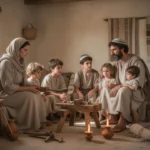
Joseph teaches that family care includes more than affection. It involves practical work: making decisions, earning or managing resources, arranging safe housing, accompanying children, and showing respect within marriage. These duties may be shared differently in different families, but they require reliability and mutual sacrifice.
His response to Mary also offers a lesson in protecting another person’s dignity. When a situation is confusing or painful, avoid rushing to public accusation. Seek the truth, listen carefully, and choose a response that is both honest and merciful.
For work and financial pressure
People who are unemployed, underpaid, overworked, or uncertain about their future may find Joseph a compassionate intercessor. His life includes travel, disruption, manual labor, and responsibility for a vulnerable household. Prayer does not remove the need for practical action, but it can support perseverance and sound judgment.
Following Joseph may mean updating a résumé, asking for fair treatment, learning a trade, seeking assistance, or helping another worker. It can also mean refusing dishonest practices that harm customers, coworkers, or a family’s long-term security.
For decisions that affect others
Joseph does not appear to decide impulsively. He considers what to do, receives guidance, and then accepts the consequences of action. A modern version of this pattern might include gathering reliable information, consulting wise people, praying, and identifying who may be affected before making a major choice.
That process is especially valuable when you have authority over someone else. A manager, parent, teacher, caregiver, or community leader can ask whether a decision protects people, respects their dignity, and serves a genuine good rather than personal pride.
For quiet service
Many forms of care remain unseen: preparing meals, repairing a home, driving someone to an appointment, checking on an older relative, or doing work that prevents a problem. Joseph’s hidden years in Nazareth affirm that unnoticed service still matters.
You can honor Joseph by choosing one dependable act of service and completing it without needing recognition. You can also make space for people whose labor is often overlooked, including custodians, construction workers, caregivers, delivery drivers, farmworkers, and stay-at-home parents.
Saint Joseph’s story is brief, but its message is concrete. He receives responsibility, protects his family, works with his hands, and remains faithful through uncertainty. For anyone seeking a model of humble courage and practical faith, Joseph offers a life shaped less by public words than by the good he quietly does.
Frequently asked questions
What is Saint Joseph best known for?
Saint Joseph is best known as the husband of Mary and the foster father of Jesus. He protected the Holy Family, provided for them as a craftsman, and followed divine guidance during the events surrounding Jesus’ birth. Christians also honor him as a model of quiet faith, responsible fatherhood, honest work, and compassionate leadership.
Why is Saint Joseph called the patron of workers?
Joseph worked as a craftsman and supported his household through manual labor. His life represents the dignity of ordinary work done skillfully and responsibly. The May 1 feast of Saint Joseph the Worker encourages Christians to respect laborers, pray for people seeking employment, promote just working conditions, and remember that work should serve human dignity rather than replace family, rest, or worship.
What is the traditional prayer to Saint Joseph?
One widely used prayer is the “Prayer to Saint Joseph,” which asks him to protect those who pray, guide them toward faithful living, and help them die in friendship with God. Many people also pray the Litany of Saint Joseph or simply speak to God while asking Joseph’s intercession for family, employment, housing, or difficult decisions.
Did Saint Joseph have children before marrying Mary?
The Bible does not say that Joseph had children before marrying Mary. Some later Christian traditions describe him as an older widower with children, while other traditions understand him as a young man who entered marriage without previous children. These details are not established by the Gospel accounts, so they should be treated as traditions rather than certain historical facts.













Leave a Reply