You may want a more deliberate way to entrust your family, work, or personal struggles to St. Joseph, but you are not sure what “consecration” actually requires. The consecration of St. Joseph is a prayerful act of entrusting yourself to his care and asking him to lead you closer to Jesus through his example of faithful, quiet obedience.
It is not a sacrament, a magical formula, or a promise that difficulties will disappear. It is a devotion to St. Joseph that can shape your daily choices, strengthen your prayer, and help you imitate the man who protected Mary and Jesus with humility and courage. Many people prepare through a set period of prayer, often 33 days, and then make a formal act of consecration.
To consecrate yourself to St. Joseph means to place your life under his spiritual care in a deliberate and personal way. The word consecration means setting something apart for a holy purpose. In this devotion, you entrust yourself to St. Joseph so that he may help you become more faithful to God and more closely conformed to Christ.
St. Joseph does not replace Jesus, and consecration to him does not compete with worship of God. Catholics worship the Holy Trinity alone. Mary and the saints receive honor because God’s grace was active in their lives; St. Joseph’s role is to point you toward Jesus Christ, just as his entire earthly life did.
The devotion usually includes three connected commitments:
Trust: You ask St. Joseph to intercede for you and to protect your spiritual life, family, work, and responsibilities.
Imitation: You study his virtues, including humility, purity, courage, patience, obedience, and diligence.
Mission: You try to live as a more faithful disciple of Christ, especially in ordinary duties that receive little public attention.
Keep the purpose clear: Consecration to St. Joseph is not a shortcut around prayer, repentance, or responsibility. It is a way of placing those parts of your life under the guidance of a trusted spiritual father.
Why Catholics turn to St. Joseph for spiritual guidance
The Gospels say relatively little about St. Joseph, but what they do reveal is significant. Matthew presents him as a righteous man who responds to God’s direction and accepts responsibility for Mary and Jesus. Luke shows him traveling with Mary, caring for the child Jesus, and bringing his family to Jerusalem according to Jewish custom.
St. Joseph’s holiness appears primarily through his actions. He listens, decides, works, protects, and obeys. He does not seek attention or record a speech in Scripture. That makes him a particularly meaningful patron for people whose daily faithfulness is expressed through family care, honest work, service, and perseverance.
The Church honors St. Joseph as the foster father of Jesus and the husband of the Blessed Virgin Mary. He is also honored as the patron of the universal Church. These titles point to his protective and fatherly role, while recognizing that his authority always serves God’s plan rather than his own reputation.
People commonly seek St. Joseph’s intercession for:
greater faithfulness in marriage and family life;
help with work, employment, business decisions, or financial pressure;
protection for children and vulnerable people;
purity, self-control, and freedom from sinful habits;
guidance during major decisions or periods of uncertainty;
the grace to serve quietly without needing recognition.
How to prepare for a 33-day consecration
There is no single universally required preparation that every Catholic must use. Several books and prayer programs offer a 33-day process, including the widely used method associated with Father Donald H. Calloway. Other people follow parish programs, diocesan materials, traditional prayers, or a simpler personal schedule.
The number 33 is commonly connected with the years traditionally associated with Jesus’ earthly life. It is a devotional structure rather than a rule established for all Catholics. You may choose a formal method, or you may ask a priest to help you create a shorter preparation if your circumstances make a full program difficult.
A useful preparation can include these steps:
Choose a starting date. Select a date that allows you to complete the preparation without rushing. Some people finish on a feast associated with St. Joseph, while others choose a meaningful family or parish date.
Select one reliable guide. Use a recognized prayer book, parish resource, or spiritual director’s plan instead of combining so many methods that prayer becomes confusing.
Set a daily time. A consistent time is more helpful than an ambitious plan that you cannot maintain. Ten to twenty minutes may be enough for the daily reading and prayer, with additional time when possible.
Include Scripture. Read passages that show St. Joseph’s role in the Gospel, especially Matthew 1–2 and Luke 1–2. Reflect on the decisions he makes rather than looking only for information about him.
Examine one virtue at a time. Consider how Joseph’s obedience, courage, purity, humility, or work ethic should affect one concrete choice in your life.
Go to confession if possible. Reconciliation is not a technical requirement for beginning the devotion, but it can help you make the act with a more open and honest heart.
Decide how you will continue afterward. Consecration should lead to a lasting pattern of prayer and imitation, not end with a ceremony or signature.
Some 33-day programs divide the preparation into stages that focus on the person making the consecration, Mary, St. Joseph, and Jesus. The exact divisions vary. What matters most is not completing pages mechanically, but allowing the prayers and reflections to form your understanding of Christian discipleship.
What to pray during the preparation period
A daily preparation can be simple enough to sustain. Begin by placing yourself in God’s presence and asking for the grace to pray attentively. Read the day’s passage or reflection, speak honestly to God about what it brings to mind, and then ask St. Joseph to intercede for a specific need.
You can use established prayers such as the Litany of St. Joseph, the Prayer to St. Joseph after the Rosary, or a prayer from your chosen consecration guide. The Rosary can also fit naturally into the preparation, particularly because it directs your attention to the life of Jesus with Mary.
Personal prayer does not need elaborate language. You might say:
St. Joseph, help me receive God’s will with faith, serve my family and neighbors with love, and lead me closer to Jesus.
You may also bring particular situations to prayer: a strained relationship, a job interview, a difficult child, an illness, a temptation, or a decision that requires wisdom. Ask not only for the result you want, but for clarity, courage, patience, and trust to respond faithfully.
A brief journal can make the preparation more concrete. Each day, write down one sentence answering one of these questions:
What does St. Joseph’s response to God teach me about my current situation?
Where am I being asked to act with greater patience or courage?
What ordinary duty can I perform today with more love?
What fear, attachment, or habit do I need to place in God’s hands?
How to make the act of consecration
At the end of the preparation, make a formal act of consecration using the text provided by your chosen guide or another approved prayer. The act can take place privately, with your family, or in a parish setting. A priest may lead a communal service, but priestly participation is not required for a personal act of devotion.
Before praying the act, pause long enough to understand what you are promising. You are not promising that you will never fail. You are offering yourself to God and asking St. Joseph to help you live with greater fidelity. The act should be made freely, without treating it as a contract that obligates God to give a particular answer.
A consecration prayer commonly includes several elements:
an acknowledgment of God’s goodness and authority;
an act of entrustment to St. Joseph;
a request for his protection and intercession;
a promise to honor him and imitate his virtues;
a renewed commitment to Jesus, the Church, and your Christian duties.
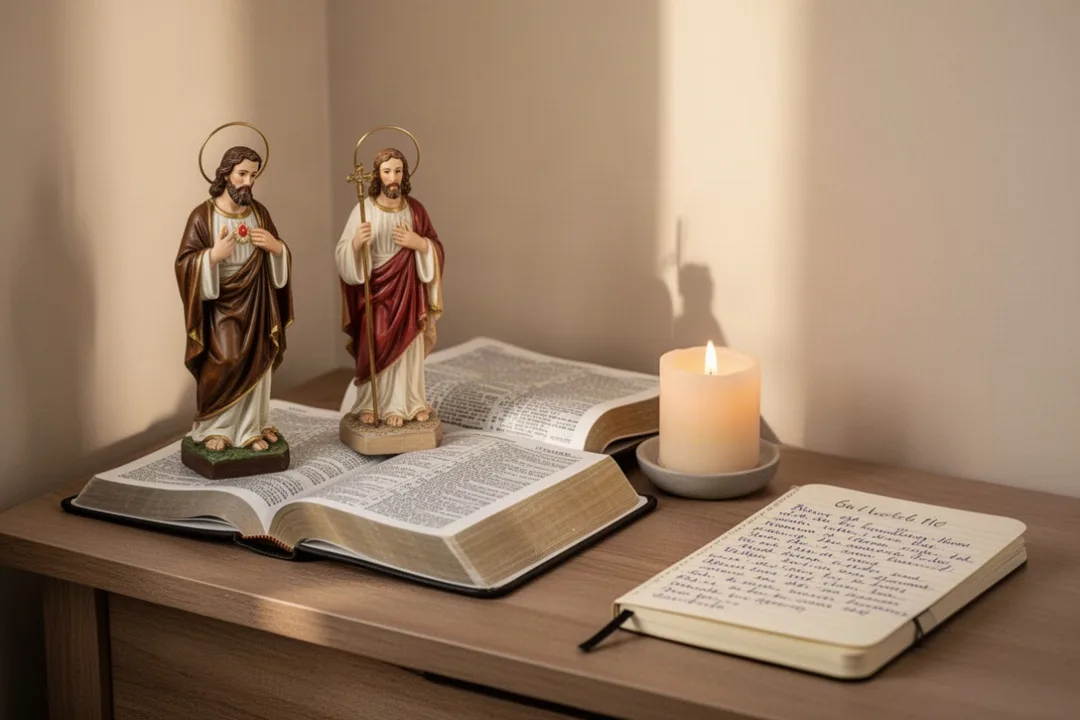
You may pray before a crucifix, an image of St. Joseph, or a Bible. These objects are not necessary for the act to be valid as a private devotion, but they can help create a focused setting. If you belong to a parish group, follow the leader’s instructions and allow enough time for silence rather than treating the ceremony as a rushed reading.
Remember the center of the act: The goal is not simply to “have St. Joseph” as a patron, but to become more available to God’s will through the example and intercession of St. Joseph.
How to live consecration after the prayer
The most meaningful evidence of consecration appears after the formal prayer. You continue by turning to St. Joseph regularly and by practicing the virtues you asked to receive. A short daily prayer can renew the act without repeating the full consecration formula.
For example, you might begin the morning by saying, “St. Joseph, guide me in my work and responsibilities today.” At night, review the day with three questions: Where did I respond faithfully? Where did I act from fear or selfishness? What do I need to entrust to God before I sleep?
St. Joseph’s example also gives the devotion a practical shape. Consider these applications:
In family life: Protect time for conversation, keep promises, correct with patience, and provide care without demanding praise.
At work: Practice honesty, diligence, and respect for coworkers, including when your contribution is overlooked.
In conflict: Avoid impulsive speech and ask for wisdom before making a decision that affects others.
In temptation: Turn quickly toward prayer, remove avoidable occasions of sin, and seek appropriate accountability.
In uncertainty: Gather the facts, seek sound counsel, and remain open to a direction different from your first preference.
In service: Notice practical needs and meet them without making your generosity the subject of attention.
Devotion should not become a way to avoid human help. If you are dealing with abuse, addiction, serious mental health symptoms, financial crisis, or a dangerous household situation, pray for St. Joseph’s protection while also seeking qualified professional, pastoral, legal, or emergency support.
In Matthew’s account, Joseph receives guidance through dreams and changes his plans in response. His obedience is not passive. He must interpret what he has received, accept a costly responsibility, and act promptly. For someone making this consecration, that can mean developing the habit of listening before reacting.
Prayerful obedience does not mean surrendering your judgment to every person who claims spiritual authority. It means seeking God’s will through Scripture, the Church’s teaching, wise counsel, prayer, and the honest examination of your responsibilities. St. Joseph can help you become less controlled by impulse and more willing to do what love requires.
Courage that protects without controlling
Joseph protects Mary and Jesus by taking action when their safety is at risk. His protection is not possessive or domineering. It is expressed through sacrifice, movement, work, and attention to the needs of those entrusted to him.
That distinction matters in family and community life. Christian protection should defend the vulnerable, establish healthy boundaries, and support the good of others. It should not be confused with controlling another person’s choices or using religion to excuse intimidation.
Humility that accepts hidden work
St. Joseph’s life is largely hidden from public view. He does not appear to seek status, and the Gospels do not describe him receiving recognition for the burdens he carries. His humility is a willingness to serve a larger purpose without making himself the center.
Consecration can expose a strong desire for approval. You may begin to notice how often you want credit, immediate results, or control over how others view you. The answer is not to deny your legitimate needs, but to practice faithful service without allowing recognition to determine your worth.
Purity that respects the dignity of others
St. Joseph is honored for his chaste love and his reverence for Mary. In this context, purity means more than avoiding certain actions. It includes learning to see other people as persons rather than objects, governing imagination and desire, and treating relationships with honesty.
People who struggle with compulsive sexual behavior, pornography, or other serious habits should combine prayer with practical support. Confession, accountability, counseling, and changes to daily routines can work alongside devotion to St. Joseph. Asking for his help is a reason to take concrete steps, not a substitute for them.
Diligence in ordinary work
St. Joseph’s traditional connection with carpentry has made him a beloved patron of workers. The Gospels show him providing for his household, and Christian tradition remembers him as a craftsman. His example gives dignity to honest work, whether it is paid employment, domestic labor, caregiving, study, or service to a community.
Consecration to St. Joseph can change your attitude toward repetitive or unrecognized tasks. You can offer your work to God while still seeking fair treatment, reasonable conditions, and appropriate rest. Sanctifying work does not mean accepting exploitation or pretending that every job is fulfilling.
How families and groups can practice the devotion
Consecration does not have to remain an individual practice. A household may prepare together, place an image of St. Joseph in a prayer space, or choose one day each week to pray for family needs. Keep the practice realistic, especially when children are young or family schedules are irregular.
A family prayer can include a short Gospel passage, a petition for each person, and one practical resolution. For example, the family might resolve to speak more respectfully during disagreements or to share one household responsibility without being reminded.
Parishes, schools, and men’s or women’s groups can organize a common preparation. A group may meet weekly to discuss one virtue, pray the Litany of St. Joseph, and encourage members to apply the devotion to work and family life. Leaders should avoid presenting one private method as mandatory for everyone.
When children participate, explain St. Joseph in concrete terms. Tell them that he cared for Jesus, listened to God, worked to support his household, and protected his family. Invite them to name one way they can show responsibility or kindness that week rather than requiring a lengthy theological explanation.
Common misunderstandings about consecration to St. Joseph
Some people assume that a consecration creates a guarantee of protection from illness, financial loss, or every danger. St. Joseph’s intercession is real within Catholic faith, but prayer does not give you control over every outcome. Jesus himself teaches his followers to trust the Father while accepting that suffering and uncertainty remain part of earthly life.
Another misunderstanding is that you must feel a strong emotional experience during the preparation or act of consecration. Feelings may vary from day to day. A sincere, freely chosen act can be fruitful even when prayer feels dry, distracted, or ordinary.
It is also possible to focus so intensely on St. Joseph that the devotion becomes detached from the Gospel. A sound practice keeps returning to Jesus, Scripture, the sacraments, charity, and the responsibilities of your state in life. St. Joseph’s greatness lies precisely in how completely his life served God’s plan for Christ and Mary.
Finally, no single completion date makes one person more devoted than another. A 33-day program can offer structure, but someone who must adapt the schedule because of illness, caregiving, work, or another serious obligation has not failed. Faithful prayer is measured by love and perseverance, not by creating unnecessary pressure.
Choosing a suitable date and prayer resource
You can make the consecration on a feast of St. Joseph, such as the celebration of St. Joseph the Worker on May 1 or the solemnity of St. Joseph on March 19, depending on your calendar and local liturgical practice. Some people choose a Marian feast or another date that has meaning for their family. The best date is one that helps you prepare attentively and continue the devotion afterward.
When selecting a resource, look for a guide that:
keeps Jesus and the Gospel at the center;
clearly identifies private devotional practices as private rather than universally required;
uses sound Catholic teaching about Mary, St. Joseph, the saints, and the sacraments;
encourages practical virtue instead of promising guaranteed worldly results;
fits your available time and spiritual maturity.
If a particular prayer or claim concerns you, ask a Catholic priest, deacon, religious sister, or trusted catechist for clarification. A spiritual director can also help you adapt the preparation and connect it with confession, the Eucharist, Scripture, and the demands of your daily life.
A simple daily pattern for continuing the consecration
After your formal act, a modest routine can keep the devotion alive. In the morning, entrust the day to St. Joseph and identify one duty you want to perform with greater love. During the day, use a short invocation when you need patience or courage.
In the evening, thank God for one grace, acknowledge one failure, and ask St. Joseph to help you begin again. Once a week, read a Gospel passage about the early life of Jesus and reflect on Joseph’s responsibility within it. Once a month, review whether the devotion is making you more prayerful, honest, generous, and attentive to others.
The consecration of St. Joseph reaches its purpose when it becomes visible in ordinary faithfulness. You may not notice dramatic changes, but you can learn to pray before reacting, accept responsibility without resentment, protect others without control, and offer your work to God. Those quiet changes reflect the kind of holiness associated with St. Joseph.
Frequently asked questions
Do I need a priest to make the consecration to St. Joseph?
No. You may make a personal act of consecration privately using a sound Catholic prayer. A priest can lead a parish celebration, offer guidance, or bless a devotional image, but his presence is not required for your personal entrustment. The essential elements are a free and sincere decision to seek St. Joseph’s intercession and a desire to follow Christ more faithfully.
Can I consecrate my family to St. Joseph?
Yes. A family may pray an act of entrustment together, ask St. Joseph to protect the household, and choose practical virtues to practice. However, adults should not treat the act as overriding another person’s freedom. Parents can introduce the devotion to children in an age-appropriate way, while each adult should make personal commitments freely.
What if I miss a day during a 33-day preparation?
Missing a day does not invalidate the devotion or mean you must abandon the preparation. Resume the prayers when you can, and decide whether to continue from where you stopped or repeat the missed day. A consistent, honest effort is more valuable than anxiety about completing a schedule perfectly. Ask a priest or spiritual director if you need help adapting the plan.
Is consecration to St. Joseph required for Catholics?
No. It is an optional Catholic devotion, not a sacrament, precept, or requirement for being a faithful Catholic. Catholics may grow in holiness through many devotions and spiritual practices. Consecration to St. Joseph can be helpful if it leads you toward Jesus, deeper prayer, charitable action, and greater faithfulness to your responsibilities.












Leave a Reply