When Catholics ask, “What is St. Joseph the patron of?” they are usually looking for more than a single title. St. Joseph is best known as the patron of the universal Church, but Christian tradition also turns to him for help with work, family responsibilities, fatherhood, housing, immigrants, and the final passage of life.
His patronages grow out of the way Scripture presents him: a just man, a husband of Mary, the legal father and protector of Jesus, a worker, and a quiet servant who acted decisively when his family needed him. Some titles are official declarations by the Catholic Church; others come from long-standing devotion, local customs, or the practical needs people have brought to him in prayer.
The most important formal title is patron of the universal Church. Pope Pius IX proclaimed Joseph the Church’s patron in 1870, recognizing the connection between his care for the Holy Family and the Church’s belief that he continues to protect the wider Christian family.
This title does not mean Joseph replaces Christ or stands apart from God’s grace. Catholics understand the saints as intercessors: people who pray with and for the faithful. Asking St. Joseph’s intercession means asking this trusted servant of God to pray for the Church, its leaders, its families, and all people who need protection and guidance.
Joseph’s role is especially meaningful because the Gospels show him protecting Jesus and Mary during danger. After learning of Mary’s pregnancy, he accepted the responsibility God placed before him. He then took Mary as his wife, protected the infant Jesus from Herod’s threat, and settled his family in Nazareth. These actions form the foundation of his reputation as a guardian, protector, and faithful provider.
The central answer: If you need one title for St. Joseph, use “patron of the universal Church.” His other patronages extend the same themes of protection, faithful work, family care, and trust in God.
Why St. Joseph has so many patronages
Joseph does not speak in any of the Gospel passages that mention him, yet his actions communicate a great deal. He listens, discerns, works, travels, protects, and accepts difficult responsibilities without seeking recognition. That combination makes him a natural patron for people whose duties are practical, demanding, or mostly unseen.
His patronages also reflect the ordinary conditions of family life. Joseph had to make decisions with limited information, earn a living, move his household, protect a child, and live with uncertainty. Devotion to him therefore reaches beyond church buildings and religious communities. It includes parents, employees, tradespeople, migrants, homeowners, caregivers, and people facing serious illness.
Different Catholic communities may name additional groups under Joseph’s protection. A parish, country, profession, or family may honor him because his example speaks directly to a particular need. Those local titles can be meaningful without having the same universal status as his patronage of the Church.
The main patronages associated with St. Joseph
The following list separates the best-known patronages from the reasons people connect them with Joseph. When you pray to him, you can ask for his intercession under the title that matches your situation.
The universal Church: Joseph is honored as the Church’s protector and patron.
Fathers and families: He is remembered as the husband of Mary and the guardian of Jesus.
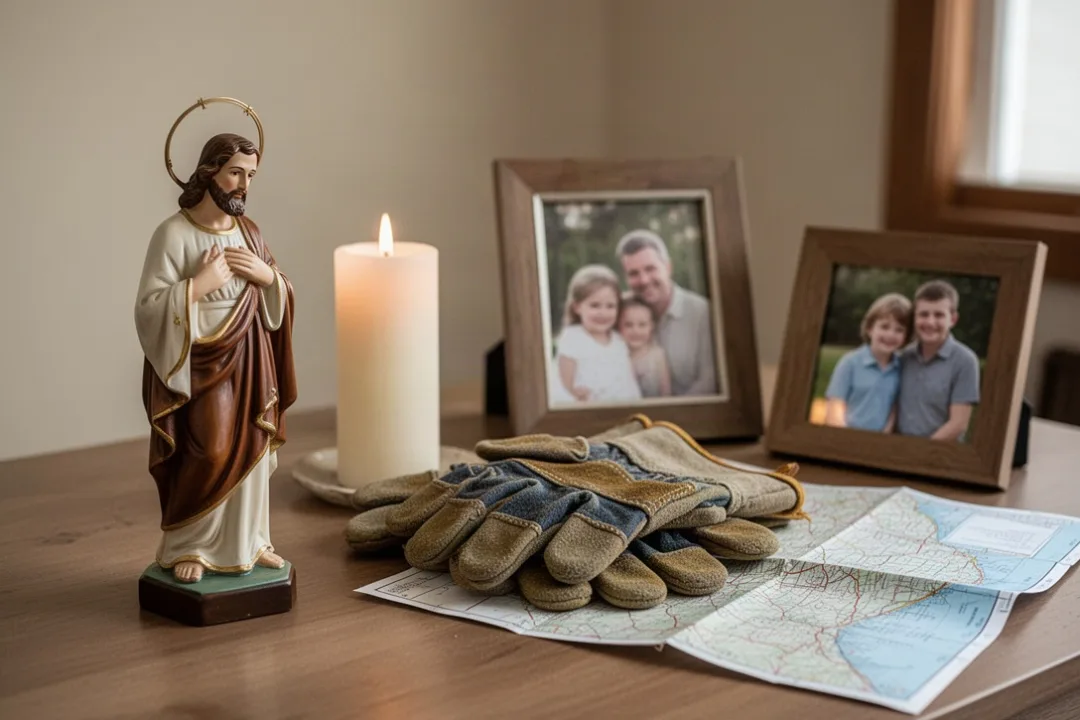
Workers and laborers: His traditional occupation as a carpenter connects him with honest work and working people.
Carpenters and craftsmen: Tradespeople look to him as a model of skill, patience, and responsible labor.
Immigrants, migrants, and refugees: His flight with Mary and Jesus gives special meaning to people forced to leave home.
A happy or peaceful death: Christian tradition turns to Joseph because Scripture does not describe his death and he is traditionally believed to have died with Jesus and Mary near him.
Housing and home life: His responsibility for the Holy Family has inspired prayers concerning homes, shelter, and household stability.
Purity and chastity: Joseph’s marriage to Mary is associated with faithful, self-controlled, and respectful love.
People facing difficult decisions: His response to confusing dreams and uncertain circumstances makes him a model of discernment.
Some lists also identify Joseph as a patron of travelers, expectant mothers, social justice, and people in financial difficulty. These connections often arise from particular devotions or regional customs. They fit his story, but they should not obscure the central pattern: Joseph protects vulnerable people and serves God through faithful responsibility.
St. Joseph as patron of fathers and families
Joseph is one of the most recognizable Christian models of fatherhood. Although Jesus was not Joseph’s biological child, Joseph accepted the calling to provide a home, protection, instruction, and daily care. His fatherhood was expressed through presence and action rather than through public speeches.
That makes him a meaningful patron for fathers who are raising children, supporting a household, or trying to repair a strained relationship. He can also be a source of comfort for adoptive fathers, foster fathers, stepfathers, grandfathers, and men who care for children in less traditional family circumstances. His example emphasizes that fatherhood is shown through dependable love and service.
Families may ask for Joseph’s intercession when they face conflict, unemployment, illness, housing problems, or a difficult transition. His life does not suggest that every hardship disappears quickly. Instead, it presents a person who remains faithful while taking the next responsible step.
Joseph’s family life also includes uncertainty. He and Mary had to make major decisions before they understood everything that would happen. For families trying to make wise choices about health, work, education, relocation, or care for an aging relative, Joseph represents calm attention rather than impulsive action.
St. Joseph as patron of workers and craftsmen
Joseph is traditionally identified as a carpenter or craftsman. The Gospel term associated with his trade can refer to a worker in wood or to a builder more broadly, so the exact nature of his daily tasks is not fully defined. What is clear is that he worked with his hands and supported his household through ordinary labor.
His patronage of workers includes more than people in construction or woodworking. Employees, business owners, tradespeople, farmers, nurses, teachers, drivers, engineers, and those seeking employment can all find a connection with him. Joseph represents work done with competence, integrity, patience, and concern for others.
Praying to Joseph about work does not mean treating him as a guarantee of a promotion or a particular job. A more grounded prayer asks for a fair opportunity, the wisdom to choose well, protection from exploitation, strength during tiring tasks, and the grace to treat coworkers with dignity.
Workers can also look to Joseph when employment is unstable. Losing a job often affects housing, family relationships, confidence, and mental health at the same time. Joseph’s patronage invites practical action alongside prayer: seek advice, update applications, use available assistance, and ask trusted people for help.
St. Joseph and the dignity of ordinary work
Joseph’s story gives spiritual importance to work that receives little public attention. Repairing a home, preparing meals, caring for children, cleaning, maintaining equipment, and handling routine responsibilities may not attract praise, but these tasks sustain families and communities.
His example also guards against two opposite mistakes. Work should not become an excuse to neglect health, family, or moral responsibilities. At the same time, ordinary labor should not be treated as meaningless simply because it is repetitive or poorly recognized. Joseph shows that faithfulness in hidden duties can be a genuine form of service.
Employers and supervisors can invoke Joseph as a patron of just treatment. That includes paying workers fairly, providing safe conditions, respecting limits, and making decisions with the human effects in view. Workers can ask his help to remain honest and responsible without accepting abuse as though it were a religious obligation.
St. Joseph as patron of immigrants, migrants, and refugees
One of the most compelling parts of Joseph’s Gospel story is his urgent departure with Mary and Jesus to escape Herod. The family became displaced because remaining in danger would have placed the child at risk. This is why many Christians see Joseph as a patron of refugees, migrants, immigrants, and displaced families.
The Holy Family’s experience can encourage compassion toward people who leave home because of war, persecution, violence, poverty, natural disasters, or the need to protect their children. Joseph’s example does not reduce migration to a simple political argument. It brings attention to the human responsibilities involved: safety, family unity, lawful protection, welcome, and practical support.
People who have moved to a new country may pray to Joseph for courage, employment, language learning, legal assistance, and a stable home. Families separated by borders may ask for endurance and reunion. Communities can honor him not only with prayers but also by offering meals, transportation, translation, companionship, and reliable information.
Another well-known title is patron of a happy death. In this expression, “happy” does not mean cheerful or painless. It means a death prepared for with faith, reconciliation, and trust in God. Because the Bible does not record Joseph’s death, Christian tradition commonly holds that he died before Jesus began his public ministry and that Mary and Jesus were near him.
This tradition makes Joseph a companion for people approaching death, for those caring for someone who is seriously ill, and for anyone grieving a parent or spouse. It can also help people speak about end-of-life concerns without reducing them to fear. Prayers to Joseph may include requests for competent medical care, peace, forgiveness, family support, and freedom from unnecessary spiritual isolation.
His patronage does not replace medical advice, hospice care, pastoral support, or honest conversations about a person’s wishes. Prayer and practical care belong together. Someone seeking Joseph’s intercession can also encourage a loved one to receive appropriate religious ministry, settle important affairs, and say what needs to be said while there is time.
For someone who is dying: A simple prayer can ask St. Joseph to accompany the sick person, comfort the family, guide caregivers, and help everyone meet death with faith, tenderness, and peace.
St. Joseph as patron of homes and housing
Joseph is often invoked by people buying, selling, renting, building, or repairing a home. This practice reflects his duty to provide shelter for Mary and Jesus, as well as the importance of a safe home in family life. The Church has no universal teaching that a statue or particular ritual will guarantee a successful real-estate transaction.
Devotion to Joseph can instead keep the deeper concern in view: a home is more than a property investment. It is a place where people should be safe, welcomed, and able to grow. Someone praying about housing might ask for honest negotiations, enough income, responsible decisions, protection from fraud, and compassion for people who cannot afford stable shelter.
Families dealing with eviction, overcrowding, domestic violence, or homelessness can turn to Joseph while also seeking immediate practical assistance. Contacting local housing agencies, shelters, legal aid, churches, and trusted advocates may be essential. Asking a saint’s intercession should never be used to delay urgent protection or professional help.
St. Joseph’s connection with purity and faithful love
Joseph is associated with purity because of his respectful relationship with Mary and his willingness to protect her dignity. In this context, purity is not limited to avoiding sexual wrongdoing. It includes seeing another person as someone with freedom, worth, and a vocation of their own rather than as an object to control.
Married couples may ask Joseph to strengthen fidelity, patience, and mutual respect. Single people may look to him for help with healthy boundaries and honest relationships. Parents, teachers, and pastoral leaders may invoke him when guiding young people toward a mature understanding of love and responsibility.
Joseph’s example is particularly relevant where power is misused. A true devotion to him cannot be separated from protecting vulnerable people, respecting consent, reporting abuse, and supporting those who have been harmed. His protective reputation should always mean safe and self-giving care, never control or silence.
How to pray to St. Joseph for a particular need
You do not need complicated words or a special object to ask for Joseph’s intercession. A focused prayer can name the situation, recognize Joseph’s role, and ask for practical wisdom. If you are praying with a group, connect the intention with a concrete act of care.
Name the need clearly. You might be praying for a job, a child, a safe home, a migrant family, a sick relative, or peace at the end of life.
Remember Joseph’s example. Consider how he protected, worked, listened, and accepted responsibility.
Ask for intercession. Request that Joseph pray for the person or situation before God.
Ask for the grace to act well. Pray for courage, patience, honesty, and sound judgment rather than only for a particular outcome.
Take a responsible next step. Make the call, seek the appointment, apply for assistance, apologize, rest, or offer practical help.
Leave room for trust. Continue praying even when the answer develops slowly or takes a different form than expected.
A short prayer might be: “St. Joseph, faithful protector of Jesus and Mary, pray for my family and help me carry today’s responsibilities with wisdom, courage, and love.” You can adapt the words to your situation. Catholics may also pray a novena, the Litany of St. Joseph, or another approved devotion, but a sincere personal prayer is also appropriate.
The principal feast of St. Joseph is celebrated on March 19. It honors Joseph as the husband of Mary and has long been associated with family life, fatherhood, and the Church’s confidence in his protection.
St. Joseph the Worker is commemorated on May 1. This observance connects Joseph with workers and the dignity of labor. It offers an opportunity to pray for people who are unemployed, underpaid, overworked, injured, or searching for a workplace where they are treated fairly.
Parishes and families may also honor Joseph on other days through local customs, processions, meals, altar displays, or service projects. These practices differ across cultures. The most meaningful observance usually combines prayer with a concrete expression of his concerns, such as helping a family find food, supporting a worker, or visiting someone who is isolated.
How to choose the right St. Joseph devotion
If you are unsure which title applies, begin with the situation rather than with a formal label. Joseph’s patronages overlap because real needs overlap: an unemployed parent may need help with work, family finances, housing, and confidence all at once.
For a family crisis, pray to Joseph as protector of families and fathers.
For unemployment or difficult working conditions, pray to him as patron of workers.
For a move across a border or forced displacement, pray to him as companion of migrants and refugees.
For a house purchase or housing insecurity, ask his help as guardian of the home.
For illness or the final stage of life, pray to him as patron of a peaceful death.
For a parish, diocese, or the worldwide Catholic community, turn to him as patron of the universal Church.
These titles are not magic formulas, and a devotion should not be judged only by whether it produces the result you requested. The purpose of prayer is to seek God’s help, become more attentive to the needs of others, and receive strength to act with faithfulness. Joseph’s silence in the Gospels can be a useful reminder that a life of service does not need constant recognition.
What St. Joseph’s example asks of you
Joseph’s patronages are ultimately connected by a particular style of life. He responds to danger by protecting, to uncertainty by listening, to responsibility by working, and to God’s call by acting. He does not appear as a powerful public figure; he appears as a dependable man whose choices preserve the lives and dignity of those entrusted to him.
That is why people pray to him in so many circumstances. St. Joseph is the patron of the Church in a formal sense, and a patron of many ordinary human needs through his example and intercession. Whether you are asking for help with work, family, migration, housing, or death, his story points toward faithful action, compassion, and trust.
Frequently asked questions
Is St. Joseph the patron saint of fathers?
Yes. Catholics honor St. Joseph as a patron of fathers because he cared for Jesus and Mary through protection, work, instruction, and daily responsibility. His example can speak to biological fathers as well as adoptive fathers, foster fathers, stepfathers, grandfathers, and other men who provide steady care. His fatherhood is understood through faithful presence rather than biology alone.
Why is St. Joseph associated with selling houses?
The custom comes from Joseph’s role as guardian of the Holy Family and from the desire to ask his help with shelter and household stability. Some people use a St. Joseph statue or another devotional practice during a sale, but no Catholic teaching guarantees a real-estate result through that ritual. Prayer should accompany honest contracts, professional advice, and practical preparation.
What does St. Joseph the Worker represent?
St. Joseph the Worker represents the dignity of honest labor and the value of work that supports families and serves the community. His patronage includes tradespeople, employees, business owners, and those looking for employment. It also encourages fair treatment in the workplace, safe conditions, responsible leadership, and respect for people whose necessary work is often unnoticed.
Can I pray to St. Joseph for someone who is dying?
Yes. Catholics commonly ask St. Joseph to intercede for a peaceful death, comfort the dying person, and support family members and caregivers. This prayer can be joined with appropriate medical care, hospice services, pastoral ministry, reconciliation, and conversations about the person’s wishes. A short, calm prayer is suitable even when the person cannot speak or respond.













Leave a Reply