The Divine Praises Catholic prayer is an act of adoration that blesses God, Jesus Christ, the Holy Spirit, Mary, Joseph, the angels, and the saints.
Many Catholics know the prayer from Benediction of the Blessed Sacrament, when it is recited after the Eucharistic blessing. It can also be prayed privately, especially as a response to disrespect toward God or as a way to place ordinary thoughts and speech under the care of divine grace.
The repeated word “blessed” is not asking God to become more holy. God is already perfect and eternal. Instead, the prayer praises God openly, honors the sacred realities of the Catholic faith, and expresses a desire that God’s name be treated with reverence.
What the Divine Praises prayer is and when Catholics pray it
The Divine Praises is a litany of short acclamations. Each line begins with “Blessed be” and names a person or mystery connected with Christian worship. The form is simple, but its scope is broad: it moves from the Trinity to Jesus’ sacred humanity, from the Eucharist to Mary and Joseph, and finally to the angels and saints.
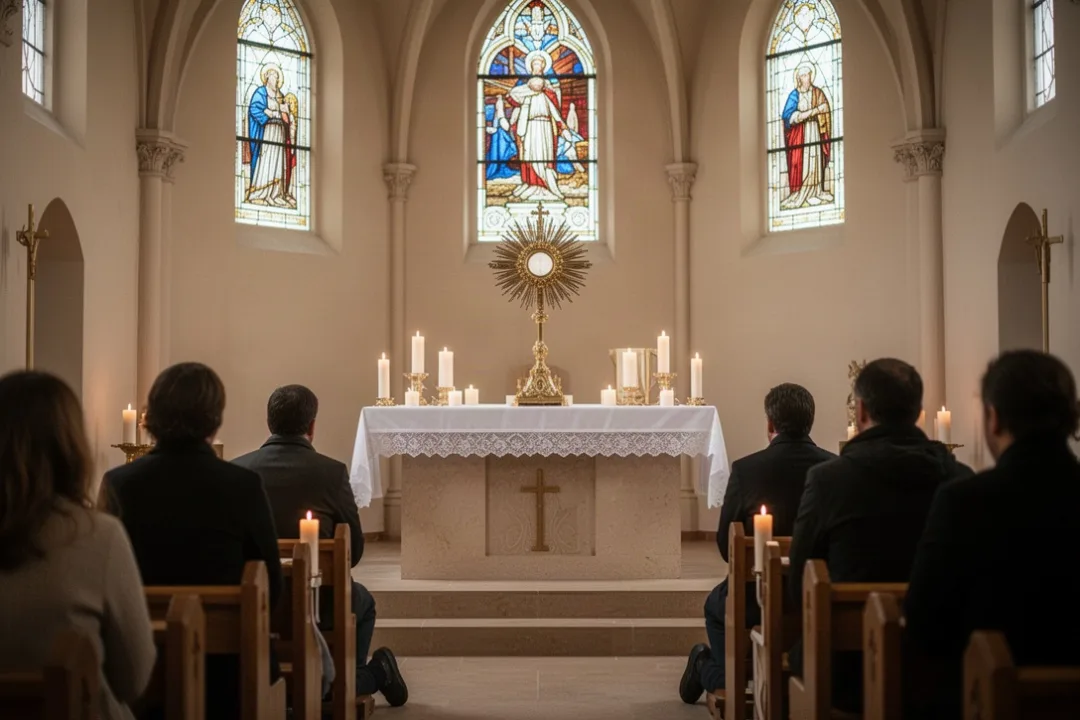
The prayer is most closely associated with Eucharistic Benediction. During Benediction, the priest or deacon exposes the consecrated Host, the congregation spends time in adoration, and the minister gives a blessing with the Blessed Sacrament. The Divine Praises are traditionally prayed after that blessing, although the exact order can vary according to the approved worship service used by a parish or diocese.
It is not a replacement for the Mass, the Liturgy of the Hours, or the Sacrament of Reconciliation. It is also not a magical formula that produces a result simply because the words are repeated. Its purpose is adoration, reparation, and praise.
Remember: The Divine Praises are a Catholic devotional prayer, not a Bible passage and not a required part of every Mass. Catholics may pray it in a church, at home, or wherever they wish to praise God reverently.
Some people pray the Divine Praises after receiving Communion, during Eucharistic adoration, or at the end of personal prayer. Others use it when they want to make a deliberate act of reverence after hearing God’s name used carelessly or seeing something sacred treated disrespectfully.
The prayer can be said alone or with a group. In communal worship, one person may lead each line while everyone responds, or the entire congregation may recite the words together. A slow and attentive pace usually fits the prayer better than rushing through it.
The traditional wording of the Divine Praises
The wording below is the traditional English form commonly used in Catholic devotion. Individual prayer books, parishes, and countries may use slightly different wording, especially for titles such as “Paraclete” or descriptions of Mary’s privileges.
Blessed be God.
Blessed be his holy name.
Blessed be Jesus Christ, true God and true man.
Blessed be the name of Jesus.
Blessed be his most Sacred Heart.
Blessed be his most Precious Blood.
Blessed be Jesus in the most holy sacrament of the altar.
Blessed be the Holy Spirit, the Paraclete.
Blessed be the great Mother of God, Mary most holy.
Blessed be her holy and Immaculate Conception.
Blessed be her glorious Assumption.
Blessed be the name of Mary, Virgin and Mother.
Blessed be Saint Joseph, her most chaste spouse.
Blessed be God in his angels and in his saints.
The final line widens the prayer from the names of God and the principal mysteries of Christ and Mary to the whole communion of saints. Catholics do not worship Mary, Joseph, or the saints. Worship belongs to God alone. The prayer honors them because God’s grace has worked in them and because they point believers toward him.
Different translations may say “Holy Spirit, Comforter” instead of “Paraclete,” or use “most holy Sacrament” rather than “most holy sacrament of the altar.” These differences do not change the prayer’s central meaning.
“Paraclete” comes from a Greek term associated with an advocate, helper, or comforter. In the Divine Praises, the title refers to the Holy Spirit and recalls the Spirit’s work of guiding, strengthening, and sanctifying the Church.
The opening lines, “Blessed be God” and “Blessed be his holy name,” establish the prayer’s foundation. The person praying first acknowledges God as the source and end of everything. God’s name represents God’s identity and presence, so honoring the name means treating God himself with reverence.
This emphasis connects with the biblical commandment against misusing the Lord’s name. The Divine Praises offer the positive counterpart: instead of using God’s name carelessly, the worshiper deliberately speaks it with love and respect. The prayer turns speech into an act of worship.
Honoring Jesus Christ as true God and true man
The line praising Jesus as “true God and true man” summarizes a central Christian belief. Jesus is not merely a moral teacher or spiritual example. Catholic faith teaches that the eternal Son of God truly became human while remaining divine.
This line also protects both sides of the mystery. Jesus is truly God, worthy of divine worship, and truly human, able to share human life, suffering, and death. The prayer therefore praises the person of Jesus rather than separating his divinity from his humanity.
The next acclamation honors the name of Jesus. In Scripture, a name is more than a label; it identifies the person and mission of the one named. The name Jesus is connected with salvation, so reverence for that name expresses trust in Christ as Savior and Lord.
Honoring the Sacred Heart and Precious Blood
The Sacred Heart of Jesus represents Christ’s human heart and his divine-human love. Catholic devotion to the Sacred Heart does not treat the heart as an isolated symbol. It focuses on the whole person of Jesus, whose love is revealed through his life, compassion, suffering, death, and self-gift.
The Precious Blood refers to the blood of Christ poured out for humanity and made sacramentally present in the Eucharist. It recalls the New Covenant, the Passion, and the Christian belief that salvation comes through Christ’s loving sacrifice. These lines invite the worshiper to respond with gratitude rather than treating the crucifixion as a distant historical event.
Adoring Jesus in the Eucharist
The phrase about Jesus in the most holy sacrament of the altar points directly to the Catholic doctrine of the Real Presence. Catholics believe that, after the consecration at Mass, Christ is truly present under the appearances of bread and wine.
That belief explains why Catholics genuflect before the tabernacle, kneel during Eucharistic adoration, and treat the consecrated Host with exceptional care. The Divine Praises make this faith explicit: the person being adored in the Eucharist is Jesus Christ.
For someone praying before the tabernacle or a monstrance, this line can become a quiet act of faith: Jesus is present, Jesus is worthy of worship, and Jesus is not forgotten. The prayer does not require the worshiper to produce a strong emotion. A sincere act of belief is enough.
Honoring the Holy Spirit
The Holy Spirit is praised as the Paraclete, the divine helper and advocate. Catholic teaching holds that the Spirit is not an impersonal force but the third Person of the Holy Trinity, fully divine with the Father and the Son.
This line can shape personal prayer in a practical way. The worshiper may ask the Holy Spirit for wisdom before making a decision, courage when facing suffering, or greater charity toward another person. Although the Divine Praises are primarily words of praise, praise naturally opens the heart to receive God’s help.
The prayer calls Mary the great Mother of God. This title refers to the fact that the person born from her is Jesus Christ, who Catholics confess to be both divine and human. The title does not mean that Mary existed before God or that she is the source of Christ’s divinity.
The references to Mary’s Immaculate Conception and Assumption name two Catholic teachings. The Immaculate Conception concerns Mary’s conception and the Church’s belief that she was preserved from original sin by God’s grace. The Assumption concerns her being taken, body and soul, into heavenly glory at the end of her earthly life.
Mary is also praised as Virgin and Mother, a title that holds together her virginity and her role as the mother of Jesus. Joseph is honored as Mary’s “most chaste spouse,” recalling his faithful care for Mary and Jesus and his place as the guardian of the Holy Family.
The final reference to the angels and saints acknowledges the heavenly community that worships God. Catholics ask the saints to pray for them, but the Divine Praises keeps the direction of worship clear: every honor given to the saints ultimately returns to God, the source of their holiness.
Why the Divine Praises are connected with reparation
The Divine Praises are often described as an act of reparation. In Catholic language, reparation means offering love, respect, and worship in response to sin, indifference, or disrespect directed toward God and sacred things. It does not mean that human prayer repairs God as if God were damaged. Rather, it expresses sorrow for wrongdoing and a desire to answer disrespect with reverence.
The devotional tradition became especially associated with reparation after the prayer was composed in the late eighteenth century. It is commonly attributed to the Jesuit priest Father Luigi Felici, and it was promoted in connection with Eucharistic Benediction. Historical accounts connect its spread with a need to counter blasphemy and hostility toward Catholic worship, although details about its earliest use can vary among sources.
The prayer’s repeated “Blessed be” makes reparation concrete. Instead of focusing only on the offense, the worshiper names what is holy and worthy of praise:
God’s holy name deserves reverence.
Jesus Christ deserves faith and adoration.
The Eucharist deserves careful and loving worship.
The Holy Spirit deserves trust and openness.
Mary, Joseph, the angels, and the saints deserve proper honor as God’s servants.
Reparation should not become anger toward other people. A Catholic who prays the Divine Praises is not being asked to condemn or humiliate someone who has acted disrespectfully. The prayer is better understood as a humble response that asks God to heal sin, purify the worshiper’s own heart, and restore reverence.
A balanced response: If you hear blasphemy or see something sacred treated carelessly, you can pray the Divine Praises quietly without escalating the situation. Charity, prudence, and respect for other people remain essential.
The practice can also expose the worshiper’s own habits. A person may discover that prayer has become rushed, that church attendance has become routine, or that God’s name is used casually in conversation. Reparation begins not with correcting everyone else but with asking for a more faithful and reverent life.
How to pray the Divine Praises with attention
The prayer is short enough to memorize, but familiarity can make it easy to recite mechanically. A few simple habits can help you pray it as an intentional act of worship rather than a list of words.
Begin with silence. Pause for a moment and become aware of God’s presence. If you are in a church, make a respectful genuflection or other appropriate act of reverence according to local practice.
Choose your intention. You may pray for deeper faith in the Eucharist, for reparation, for the needs of the Church, or simply to praise God.
Pray each line distinctly. Let the repeated phrase “Blessed be” express a real act of assent instead of treating it as a transition to the next line.
Pause at the names of Jesus and the Eucharist. These lines can receive special attention because they identify Christ’s person, saving love, and sacramental presence.
End with gratitude. After the final line, remain silent briefly or continue with another prayer such as the Our Father, a prayer of thanksgiving, or a personal petition.
At home, you might pray the Divine Praises after a period of Scripture reading, before going to sleep, or following a difficult conversation in which you want to respond with charity. In a chapel, you may pray it slowly before the tabernacle or during Eucharistic exposition.
The prayer can also be used as part of a family routine. Parents may explain one line at a time rather than expecting children to memorize all the words immediately. Older children can learn that adoration is different from asking for things: prayer includes petition, but it also includes loving attention to who God is.
When prayed in a parish setting, follow the directions of the priest, deacon, or service leader. Some communities use the traditional text, while others use a current approved translation. There is no need to argue over minor wording differences when the prayer’s purpose remains the same.
How the Divine Praises differs from other Catholic prayers
The Divine Praises is sometimes confused with other prayers because it appears in prayer books and Catholic worship services. Its distinctive feature is the repeated blessing of sacred persons and mysteries rather than a series of petitions.
The Mass: The Mass is the Church’s central act of public worship and includes the Liturgy of the Word and the Liturgy of the Eucharist. The Divine Praises is a devotional prayer and is not the Eucharistic Prayer.
Eucharistic adoration: Adoration is the act of praying before the exposed or reserved Blessed Sacrament. The Divine Praises is one prayer that may be used during or after that time.
The Litany of the Saints: The Litany of the Saints invokes saints by name and asks them to pray for the Church. The Divine Praises mainly offers acclamations of blessing and praise.
The Act of Contrition: An Act of Contrition expresses sorrow for sin and a resolve to change. The Divine Praises may accompany reparation, but it is not itself a sacramental confession or a complete Act of Contrition.
The Te Deum: The Te Deum is a longer hymn of praise with a different structure and history. The Divine Praises is a concise series of “Blessed be” acclamations.
Understanding these differences prevents confusion about what the prayer can do. The Divine Praises can deepen devotion and express reparation, but it does not replace the sacraments or the Church’s liturgical worship.
Its simplicity is one of its strengths. A person can pray it in a few minutes, yet each line opens a substantial subject: the Trinity, the Incarnation, the Sacred Heart, the Eucharist, the Holy Spirit, Mary’s role, Joseph’s fidelity, and the communion of saints. The prayer is brief without being shallow.
Common questions about using the Divine Praises
You do not need special permission, a particular posture, or a set number of repetitions to pray the Divine Praises privately. Catholics generally pray it as a free devotion, with the same basic conditions that make any prayer fruitful: faith, attention, humility, and a sincere desire to honor God.
It is also possible to pray the text in your own language. The wording used in a parish may differ from an older English version, and Catholics in other countries may use an approved translation in their native language. The essential structure is the same: praise God and honor the sacred realities named in the prayer.
If you are unsure how to use it, begin with one slow recitation. Read the words aloud, consider what each line means, and allow a short silence afterward. Over time, the prayer can become a familiar way to return your attention to God, especially when you are distracted or unsettled.
Frequently asked questions
Is the Divine Praises prayer only prayed during Benediction?
No. It is traditionally associated with Benediction of the Blessed Sacrament, but Catholics may also pray it during Eucharistic adoration, after Mass, at home, or whenever they want to make an act of praise and reparation. In a public service, follow the form and directions provided by the parish or worship leader.
Are Catholics worshiping Mary and the saints when they pray the Divine Praises?
No. Catholic worship is directed to God alone. Mary, Joseph, the angels, and the saints are honored because of God’s grace in their lives and their closeness to him. The prayer’s final lines place them within the community that serves and praises God, rather than treating them as divine beings.
What does “Blessed be the Holy Spirit, the Paraclete” mean?
“Paraclete” is a title associated with a helper, advocate, or comforter. The line praises the Holy Spirit as the third Person of the Trinity and recognizes the Spirit’s work of guiding, strengthening, and sanctifying Christians. Some approved translations use “Comforter” or “Advocate” instead of “Paraclete.”
Can the Divine Praises be used as an Act of Reparation?
Yes. Its repeated acts of blessing and praise have traditionally been used to respond to blasphemy, indifference, or disrespect toward God and sacred things. Reparation should be offered with humility and charity, not hostility. The prayer does not replace Confession or an Act of Contrition when sacramental forgiveness is needed.








Leave a Reply