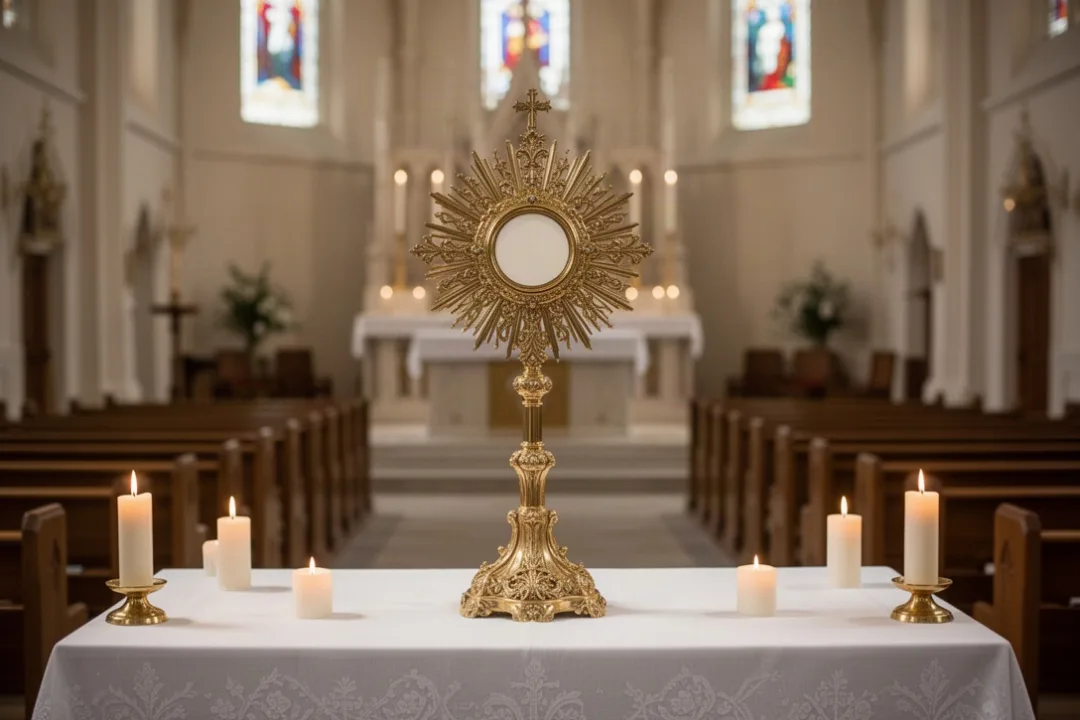
If you have entered a Catholic church and seen a large gold object with rays surrounding a small white circle, you may have wondered what it is. That object is usually a monstrance, also called an ostensorium, and it is designed to display the consecrated Eucharistic host for public prayer and adoration.
The host in the center is not merely a symbol or decoration. Catholics believe that, after the consecration at Mass, the bread becomes the Body of Christ. The monstrance gives the faithful a visible way to focus their worship on the Eucharist during a period called Eucharistic exposition.
Short answer: A Catholic monstrance is a sacred vessel used to display a consecrated host outside Mass, especially during Eucharistic adoration and Benediction.
What a monstrance is and why Catholic churches use it
The word monstrance comes from a Latin term meaning “to show” or “to display.” Its purpose is practical and devotional: it allows the consecrated host to be seen while it remains protected inside a suitable holder.
A monstrance normally has a broad base, a central stem, and a glass opening called a luna or lunette. The consecrated host is placed in this opening, often surrounded by a sunburst of metal rays. The rays commonly represent Christ as the light of the world, although the exact design can carry different artistic meanings.
Catholic teaching holds that Christ is truly present in the Eucharist under the appearances of bread and wine. Because of this belief, Catholics treat a consecrated host with profound reverence. The monstrance is honored because it contains the Eucharist, but it is not itself worshiped.
Churches may use a monstrance for several related practices:
Eucharistic adoration: a period when people pray in the presence of the exposed host.
Benediction: a liturgical blessing given with the exposed Eucharist.
Eucharistic processions: a public procession in which the Blessed Sacrament is carried through a church or, under appropriate circumstances, outside it.
Special prayer periods: such as a parish holy hour, a Corpus Christi observance, or prayer before a major feast.
How a monstrance is used during Eucharistic adoration
Eucharistic adoration begins when the consecrated host is placed in the monstrance and exposed for prayer. The priest, deacon, or another person authorized according to the Church’s liturgical norms prepares the altar and places the host in the vessel. The exact form varies by parish and by the length of the exposition.
Once the host is exposed, people may sit or kneel in prayer. Some parishes provide a scheduled hour of silence, while others include Scripture readings, hymns, a rosary, or periods of guided meditation. The central focus remains the real presence of Christ, not the design of the vessel or the atmosphere of the room.
A typical period of adoration may follow these steps:
Preparation of the altar: The sanctuary is arranged with the monstrance, candles, and any required liturgical furnishings.
Exposure of the Blessed Sacrament: The consecrated host is placed inside the luna and set in the monstrance.
Prayer and silence: Visitors remain in the church for personal or communal prayer.
Optional liturgical prayer: The parish may include hymns, readings, a homily, or a rosary.
Reposition or Benediction: The host is either returned to the tabernacle or used for a blessing before being returned.
Adoration is not a second Mass, and the monstrance does not replace the celebration of the Eucharist. It extends prayerful attention to the Eucharist outside the Mass itself. Many Catholics use the time to pray silently, read the Gospels, ask for guidance, express gratitude, or simply remain attentive in God’s presence.
What to do when you visit a church with a monstrance
You do not need to be an expert to enter a period of Eucharistic adoration. A respectful, quiet presence is enough. If you are unfamiliar with Catholic customs, watch what others do or ask a parish volunteer for guidance.
These practical steps can help:
Enter quietly and silence your phone before approaching the seating area.
Genuflect or bow respectfully toward the tabernacle or exposed Eucharist, following local custom.
Take a seat or kneel wherever the parish permits, leaving accessible places available for others.
Pray in the way you can, using silence, Scripture, a rosary, written prayers, or simple conversation with God.
Keep movement and conversation to a minimum, especially during a scheduled silent hour.
Follow parish directions about photography, candles, children, and when to leave.
Visitors who are not Catholic may sit quietly and observe. You are not expected to receive Communion during adoration, and you should not touch the monstrance or the host. If the parish has a scheduled closing rite, remain seated or stand with the congregation according to the instructions given.
Respectful practice: Never attempt to move, open, touch, or photograph the exposed host without permission. The Eucharist and its sacred vessels are handled according to Catholic liturgical rules.
What the parts of a Catholic monstrance mean
Monstrances vary considerably. Some are simple and modern; others are elaborate works of metalwork decorated with jewels, enamel, symbols, or images of saints. Their construction usually includes several recognizable parts.
The base and stem
The base gives the monstrance stability when it stands on the altar. It may be circular, oval, cross-shaped, or decorated with Christian imagery. The stem rises from the base and often includes a rounded section called the node, which gives the person carrying the vessel a secure place to hold it.
Because a monstrance containing the Eucharist can be tall and heavy, its base must be carefully balanced. In larger processions, the vessel may require deliberate handling by a priest or deacon and may be protected from sudden movement or contact.
The central luna
The luna is the small holder that surrounds and supports the consecrated host. It is usually fitted within the central opening of the monstrance and may be made of gold, silver, or another precious material. The host is placed inside it so that the host can be seen without being directly handled.
The luna is removable. When the Eucharistic exposition ends, the host remains in the luna as it is taken from the monstrance and returned to the tabernacle or transferred according to the parish’s liturgical practice. This protects the host and limits unnecessary handling.
The rays and surrounding ornament
Many monstrances have rays spreading around the luna. These rays can suggest the sun and point to Christ as a source of divine light. Some designs include a cross at the top, angels, vines, wheat, grapes, or other Eucharistic symbols.
Wheat and grapes may refer to the bread and wine used in the Eucharist. A cross centers the vessel on Christ’s sacrifice, while angels can express the heavenly worship associated with the Eucharist. These meanings are common, but the details depend on the church’s tradition, the artist, and the age of the object.
How a monstrance differs from other Catholic vessels
Several Catholic vessels may appear similar to someone visiting a church for the first time. Their purposes are different, and recognizing those differences makes the layout of a Catholic sanctuary easier to understand.
Monstrance: Displays a consecrated host for adoration, Benediction, or procession.
Tabernacle: A locked container where consecrated hosts are reserved, normally for Communion and prayer.
Ciborium: A covered vessel used to hold consecrated hosts, especially for distribution at Communion and reservation in the tabernacle.
Chalice: A cup used for the consecrated wine during Mass.
Pyx: A small container used to carry the Eucharist, particularly to people who are sick or unable to attend Mass.
Reliquary: A container for a relic of a saint or another sacred object; it may resemble a monstrance but does not normally contain the Eucharistic host.
The most important distinction is between display and reservation. The monstrance is made for visible exposition, while the tabernacle is made to safeguard the Eucharist when it is not being displayed. A ciborium holds multiple hosts and is generally associated with Communion rather than public exposition.
What Catholics believe about the host in the monstrance
At Mass, Catholics believe that the bread and wine become the Body and Blood of Christ through the Eucharistic Prayer and consecration. The appearances of bread and wine remain, but the substance is understood to have changed. Catholic theology calls this change transubstantiation.
For that reason, adoration before a monstrance is directed to Christ present in the Eucharist. A person may kneel as an act of worship, make the Sign of the Cross, or pray in silence. These gestures are not directed toward gold, glass, or artistic craftsmanship; they express reverence for the person Catholics believe is present in the sacrament.
The practice is connected to the broader life of the Church. The Eucharist is celebrated in the Mass, received in Holy Communion, reserved for the sick and dying, and adored outside Mass. Each practice has its own setting, but all are related to Catholic belief in Christ’s sacramental presence.
Scripture references often used in Catholic teaching about the Eucharist include John 6, the accounts of the Last Supper in the Synoptic Gospels, and Paul’s discussion of the Lord’s Supper in 1 Corinthians 10–11. Rather than treating these passages as decorative language, Catholics read them as part of the biblical foundation for Eucharistic faith and practice.
The sunburst shape is one of the most recognizable features of a monstrance. It commonly represents the radiance of Christ and the way divine light reaches the world. The design also draws attention to the small host at the center, making the Eucharist the visual focus.
Not every monstrance has rays. Some have a Gothic tower form, a cross, a circular frame, or a more restrained contemporary design. The Church does not require one artistic style. A suitable monstrance must be dignified, stable, and appropriate for protecting and displaying the Blessed Sacrament.
Materials can include gold, silver, gilded metal, wood, enamel, and precious or semiprecious stones. The value of the materials is not meant to suggest that God needs expensive objects. Instead, the use of beautiful materials reflects the honor Catholics wish to give to the Eucharist and the care taken with sacred worship.
What happens during Benediction with a monstrance
Benediction of the Blessed Sacrament is a liturgical service in which a priest or deacon blesses the people with the exposed Eucharist. The service often includes hymns, Scripture, prayers, silence, and incense, although the exact form varies.
During the blessing itself, the minister generally covers his shoulders and hands with a humeral veil before taking the monstrance. The veil is a sign of reverence and also means that the minister’s hands are not presented as personally giving the blessing. The blessing is understood to come from Christ in the Eucharist.
Those attending may kneel during Benediction, but local instructions take priority. People who cannot kneel may remain seated or stand respectfully. The rite is not a performance, and visitors do not need to imitate every gesture perfectly to participate with respect.
Afterward, the host is removed from the monstrance and returned to the tabernacle. The congregation may sing a closing hymn or remain briefly in prayer. If the parish has no formal Benediction, the period of exposition may simply end with reposition of the Eucharist.
How churches care for and store a monstrance
A monstrance is a sacred vessel, but it is also a delicate object that requires practical care. Staff or clergy typically store it securely when it is not in use, protecting it from theft, tarnishing, scratches, and accidental damage. Valuable historic monstrances may require conservation by specialists familiar with religious artifacts.
Cleaning should be appropriate to the material and finish. Abrasive products can damage plating, decorative stones, lacquer, or older metalwork. A parish should not assume that a household metal polish is safe, especially when the vessel has historical or artistic significance.
Before exposition, the church must also prepare the surrounding space. The altar should be stable, candles should be placed safely, and the monstrance should not be positioned where it could be knocked over by clothing, children, pets, or passing equipment. A parish may use a protective case or locked sacristy storage between services.
Historic or especially ornate pieces may have an important local story. A monstrance could have been donated by a parish family, commissioned for a church dedication, or preserved from an older church building. Those details should be verified through parish records or a qualified curator rather than guessed from the object’s appearance.
Common misunderstandings about the monstrance
The monstrance is not a decorative centerpiece
Although a monstrance may be beautiful, it is not placed on the altar merely to improve the church’s appearance. Its primary purpose is to display the consecrated host. The decoration serves the sacred function rather than replacing it.
The object itself is not the Eucharist
Catholic worship is directed to Christ present in the Eucharist, not to the metal vessel. If the host is removed, the monstrance remains a sacred object used for worship, but it no longer contains the Eucharist at that moment.
Adoration does not mean receiving Communion
During adoration, the host is exposed for prayer and is not distributed to visitors. Holy Communion is received during Mass or another approved liturgical setting. A person should never take the host from the monstrance or attempt to receive it directly.
There is no single required prayer for sitting before the Blessed Sacrament. You can read a passage from the Gospels, pray silently, use a devotional book, or remain still. Quiet attention and respect are appropriate even when you are learning about Catholic practice.
How to spend an hour before the Blessed Sacrament
A scheduled holy hour can feel long if you have never attended one, but it does not require constant activity. The time can be divided into simple periods that allow prayer to develop naturally.
Begin with stillness: Spend several minutes becoming quiet and aware of where you are.
Offer an intention: Pray for a family member, a difficult situation, the parish, or a personal need.
Read a short Gospel passage: Consider what the passage reveals about Christ and how it relates to your life.
Pray with gratitude: Name the gifts, people, and opportunities for which you are thankful.
Allow silent prayer: You do not need to fill every minute with words.
Close with a familiar prayer: The Lord’s Prayer, a psalm, or another prayer may help you end the hour attentively.
If your attention wanders, gently return to the presence of the Eucharist. Some people find it helpful to keep a small notebook nearby, while others prefer complete silence. The purpose is not to achieve a particular emotional experience but to pray with reverence and honesty.
When a monstrance may be seen outside a church building
Some Catholic communities hold Eucharistic processions, especially on the solemnity associated with the Body and Blood of Christ or during other significant parish observances. In a procession, the monstrance is carried by a priest or deacon, often under a canopy and accompanied by candles, hymns, and people in prayer.
Processions are public acts of faith, but they are organized according to Church regulations and local permissions. Routes, traffic arrangements, weather plans, and the handling of the Eucharist all require careful preparation. A monstrance should not be carried casually or used as a prop for an event.
You may also see a monstrance in a diocesan museum, church display, sacristy, or historical exhibit when it is not being used for exposition. In that setting, it may be shown as an example of religious art or parish history. If it is on display without a host, it should not be mistaken for an active period of Eucharistic adoration.
Questions to ask if you are unsure at a parish
Practices can differ in small ways from one Catholic church to another. If you are uncertain, a parish staff member, usher, sacristan, or priest can explain what is happening without assuming that you already know the customs.
Is the church open for silent adoration, or is a service about to begin?
Where should visitors sit or kneel?
Is photography permitted?
When will Benediction or reposition take place?
Are children welcome, and are there any special instructions?
Who should I contact if I want to arrange a prayer intention or visit?
A brief question is more respectful than guessing, particularly when the Eucharist is exposed. The parish may also have a printed schedule explaining adoration hours, confession times, devotional prayers, and closing rites.
When you see a monstrance in a Catholic church, the central point is simple: it is a vessel that displays the consecrated host so Catholics can pray before the Eucharist outside the celebration of Mass. Its form, history, and craftsmanship may be meaningful, but its purpose is rooted in faith in Christ’s presence and in the reverent care given to the Blessed Sacrament.
Frequently asked questions
Can anyone enter a Catholic church during Eucharistic adoration?
Usually, visitors are welcome to enter quietly, including people who are not Catholic. You do not need to receive Communion or know Catholic prayers. Follow posted parish instructions, avoid interrupting the prayer of others, and ask a volunteer if you are unsure where to sit or when the service will end.
Should I kneel the entire time when a monstrance is exposed?
No. Kneeling is a common gesture of reverence, but you may sit, stand, or change position as needed. People with health, mobility, or caregiving needs should not feel pressured to kneel continuously. Quiet attention and respect matter more than maintaining one particular posture.
Can a layperson carry or touch a monstrance?
Handling a monstrance depends on the circumstances and the Church’s liturgical norms. A layperson may have a role in preparing or assisting with certain aspects of exposition when properly authorized, but visitors should never touch or move it on their own. Ask the priest or parish sacristan about local practice.
Is every gold object with rays in a church a monstrance?
No. A ray-shaped vessel may be a monstrance, but some similar objects are reliquaries or decorative pieces. The presence of a consecrated host and the context of Eucharistic exposition identify its use. If you cannot tell, ask a parish representative rather than touching or opening the object.











Leave a Reply