Have you ever wondered why a humble Spanish friar is remembered around the world for his love of the Eucharist? Paschal Baylon was a sixteenth-century Franciscan lay brother whose life joined ordinary work with intense prayer. He served as a shepherd, cook, porter, gardener, and doorkeeper, yet his deep devotion made him one of the best-known saints associated with the Blessed Sacrament.
Paschal was born in 1540 in Torrehermosa, Spain, and died in 1592 at Villarreal. He entered the Alcantarine branch of the Franciscan Order as a lay brother, not as a priest, and became known for humility, kindness, physical endurance, and a remarkable love of Christ present in the Eucharist. The Catholic Church canonized him in 1690, and his feast is celebrated on May 17.
At a glance: St. Paschal Baylon was a Spanish Franciscan lay brother, born in 1540 and canonized in 1690. He is especially associated with Eucharistic devotion and is recognized as a patron of Eucharistic congresses and works.
Who Paschal Baylon was and why Catholics remember him
Paschal Baylon was not famous because he held a position of authority or produced a large body of writing. His reputation grew from the consistency of his daily life. He performed simple duties carefully, prayed whenever he could, welcomed people who came to the friary, and showed particular reverence toward the Eucharist.
The word “Baylon” is connected with his family name and is commonly included when referring to him. In Spanish, he is often called San Pascual Bailón. The name “Paschal” also has a Christian association with Passover and Easter, although his surname distinguishes him from the broader religious meaning of the word.
Paschal belonged to a period when Catholic religious life in Spain was being renewed. The sixteenth century included the Protestant Reformation, Catholic reform efforts, and strong movements toward stricter observance in several religious orders. The Franciscan reform associated with St. Peter of Alcantara emphasized poverty, simplicity, prayer, and disciplined community life. Paschal found a home in that tradition.
His story appeals to many people because it does not depend on public success. He was not a bishop, theologian, or political leader. He was a lay religious brother whose work often happened behind the scenes. For Catholics, his life suggests that holiness can be expressed through patience, service, prayer, and faithfulness in tasks that receive little recognition.
Paschal Baylon’s childhood and years as a shepherd
Paschal was born on May 16, 1540, in Torrehermosa, a small town in the Kingdom of Aragon. His parents, Martín Baylon and Isabel Jubera, were associated with modest rural life. He grew up in a working family and was introduced early to the demands of labor, responsibility, and religious practice.
As a boy and young man, Paschal worked as a shepherd. Shepherding required long hours outdoors, care for animals, alertness to danger, and patience with repetitive tasks. It also gave him stretches of solitude. According to his traditional biography, he used that quiet time for prayer and spiritual reflection.
His work as a shepherd shaped the way people later understood his spirituality. He did not separate prayer from ordinary responsibilities. The fields became a place where he could pray, but he still had to watch the flock, protect it, and complete the work entrusted to him. His example reflects a practical form of devotion: prayer accompanied by responsibility.
Traditional accounts also describe Paschal as a child with a strong devotion to the Eucharist. Because he was not a priest and could not celebrate Mass, his desire to be near the Blessed Sacrament was understood as a sign of a special calling. Stories about his early years often present him as unusually serious about prayer, though they also emphasize his obedience and willingness to work.
Several accounts connect Paschal with an incident involving a wealthy landowner who wanted him to become an heir. Paschal declined because he believed he was called to religious life. Stories from this period should be read as traditional hagiography rather than as a modern biography with complete documentary detail. Their central point is clear: he preferred a life of poverty and service to financial security.
His decision to join the Franciscan Order
Paschal was drawn to the Alcantarine Franciscans, a branch of the Order of Friars Minor that followed a strict interpretation of Franciscan poverty and discipline. He first approached the friars at an earlier stage of his life, but tradition says he was encouraged to wait. After continuing his work and discerning his vocation, he entered the order as a lay brother in 1564.
Entering as a lay brother meant that Paschal did not pursue priestly ordination. Religious communities needed many forms of service, including cooking, cleaning, gardening, caring for the sick, receiving visitors, collecting provisions, and maintaining the friary. Paschal embraced these responsibilities rather than treating them as secondary to spiritual life.
His vocation reflected the Franciscan ideal that humility and poverty are not merely private attitudes. They affect how a person works, uses possessions, relates to authority, and treats people who cannot offer status or advantage in return. Paschal’s duties placed him in contact with friars, travelers, poor people, and strangers, allowing his character to be seen in practical situations.
He served in several Franciscan houses, including communities in the Spanish regions of Valencia and Murcia. His assignments varied, but the pattern remained similar: he worked diligently, accepted inconvenience, prayed with concentration, and tried to respond to others with charity. Reports of his holiness grew among the people who encountered him in daily life.
His daily work as a lay brother
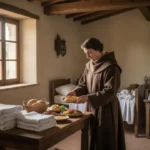
Paschal Baylon’s religious life was grounded in tasks that many people might overlook. He worked as a cook, gardener, porter, and doorkeeper. These roles required physical effort and frequent interruptions. A doorkeeper, for example, had to welcome visitors, respond to requests, and remain available rather than retreating into uninterrupted private prayer.
His example is useful because it presents service as a spiritual discipline. Preparing food, tending a garden, carrying supplies, or helping a traveler can become an act of love when performed with care. Paschal did not need an exceptional setting to practice faithfulness. He treated the work immediately before him as an opportunity for obedience and generosity.
People who knew him remembered his kindness toward the poor. He was also associated with a gentle manner in community life. Traditional biographies describe him as patient when criticized and willing to accept humble assignments. These qualities mattered because strict religious observance without charity can become harsh. Paschal’s devotion was remembered as demanding of himself but compassionate toward others.
He is also said to have had a special concern for people who came to the friary seeking help. As porter, he could not simply ignore the needs at the door. His work required discernment: he had to follow community rules while responding humanely to visitors. That combination of discipline and mercy is an important part of his legacy.
As a cook: he served the community through ordinary household work.
As a gardener: he accepted physical labor and routine responsibility.
As a porter: he welcomed visitors and encountered people in need.
As a lay brother: he showed that religious holiness is not limited to ordained ministry.
Why the Eucharist was central to his spirituality
The strongest theme in the life of Paschal Baylon is his devotion to the Holy Eucharist. Catholic teaching holds that, in the Eucharist, Christ is truly present under the appearances of bread and wine. Paschal’s prayer, work, and desire to attend Mass were shaped by this belief.
Because he was a lay brother, Paschal could not preside at Mass. His love for the Eucharist therefore had a distinctive form. He attended Mass when his duties allowed, prayed before the tabernacle, and encouraged reverence toward the sacrament. His devotion was not based on holding a liturgical office. It came from faith in Christ’s presence.
Traditional stories describe Paschal spending time in prayer before the Blessed Sacrament and showing unusual joy or concentration during Eucharistic worship. Some accounts also attribute miraculous signs to him. The Church’s recognition of a saint includes the judgment that the person lived with heroic virtue and, in canonization processes, the examination of reported miracles. Individual stories should still be approached with care, especially when details differ among biographies.
Paschal’s Eucharistic devotion also had a theological dimension. The Eucharist is not simply a private object of comfort. It is connected with the Mass, Christ’s sacrifice, communion among believers, and service to others. A person who receives Communion is called to live with greater charity. Paschal’s care for the poor and his humble service gave practical expression to that connection.
Practical meaning: Paschal Baylon’s Eucharistic devotion was more than time spent in prayer before the tabernacle. It also appeared in how he worked, welcomed people, accepted inconvenience, and treated ordinary duties as service to God and neighbor.
Paschal Baylon and Eucharistic congresses
Paschal Baylon is widely recognized as a patron of Eucharistic congresses and works. A Eucharistic congress is a gathering devoted to teaching, worship, prayer, processions, and reflection centered on the Eucharist. Such events bring together clergy and laypeople to express faith in Christ’s presence and to consider how Eucharistic life should shape Christian service.
His association with these gatherings makes sense because his life joined Eucharistic prayer with practical charity. He represents the person who approaches the sacrament with reverence and then returns to the work of caring for others. That balance helps prevent two misunderstandings: treating worship as detached from daily conduct, or treating service as disconnected from prayer.
The title of patron does not mean that Paschal invented Eucharistic congresses or led a formal movement during his lifetime. The organized congress tradition developed later. His patronage comes from the way his life and reputation express a particular spiritual focus: faith in the Eucharist, love for the Church, and humble service.
People involved in parish worship, catechesis, adoration, sacramental preparation, or Eucharistic events may find his example especially relevant. He encourages careful preparation, reverent celebration, and a willingness to serve without seeking attention. His story also reminds communities that the success of a religious gathering is not measured only by attendance or ceremony, but by the charity it produces.
The journey to canonization
Paschal died on May 17, 1592, at the Franciscan friary in Villarreal, in the region of Valencia. Traditional accounts say that he died while the community was celebrating Mass. Whether every detail in later retellings can be confirmed, his death was followed by strong local devotion and reports of favors received through his intercession.
He was beatified by Pope Paul V in 1618 and canonized by Pope Alexander VIII in 1690. Canonization recognized his holiness for the universal Church. This process did not make him important because he had performed public leadership. Instead, it affirmed a life marked by faith, humility, disciplined religious practice, and love of the Eucharist.
After his canonization, devotion to Paschal spread beyond Spain. Franciscan communities promoted his example, and Catholics invoked him in connection with the Blessed Sacrament. His name became especially familiar in places where Eucharistic adoration, congresses, and public Eucharistic devotion held a strong role.
The title “Seraph of the Eucharist” is sometimes associated with Paschal in devotional writing. This expression refers to the intensity of his love for the Eucharist, not to an official claim that he belonged to the angelic order called seraphim. Like other devotional titles, it summarizes how generations of believers understood his spiritual character.
What Paschal Baylon’s symbols represent
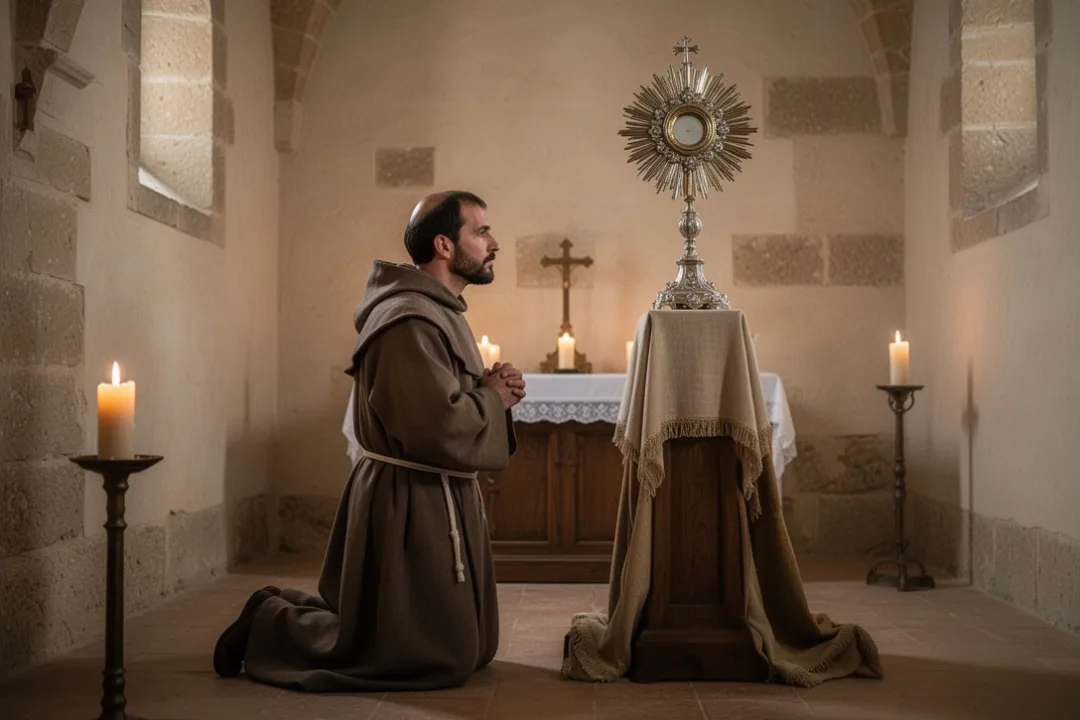
Religious art often portrays Paschal in the brown habit of a Franciscan friar. He may be shown kneeling before the monstrance, the vessel used to display the consecrated host during Eucharistic adoration. This image immediately identifies the central devotion associated with him.
Other artistic details may include a shepherd’s staff, sheep, a kitchen implement, or a book of prayer. These symbols connect different stages of his life: his childhood work as a shepherd, his service as a lay brother, and his commitment to prayer. Not every image includes all of these elements, and local traditions may emphasize one aspect over another.
A monstrance in an image of Paschal does not suggest that he was a priest. It points to his devotion to the sacrament. The staff or sheep recalls the years before religious life and the way ordinary work prepared him for a vocation centered on care, attentiveness, and responsibility.
Franciscan habit: poverty, fraternity, and service.
Monstrance: faith in Christ’s real presence in the Eucharist.
Sheep or shepherd’s staff: his early work and patient care.
Prayer book: disciplined reflection and devotion.
Kitchen or garden tools: holiness expressed through practical labor.
Common mistakes when learning about Paschal Baylon
Paschal’s story is often told in short devotional summaries, which can blur historical details. Keeping a few distinctions in mind makes it easier to understand him accurately and respectfully.
Do not call him a priest: Paschal was a lay brother and was not ordained.
Do not reduce him to a visionary: reports of mystical experiences are part of his traditional biography, but his documented importance also rests on humility, service, and Eucharistic faith.
Do not treat every legend as a verified fact: saintly biographies often preserve devotional stories that vary in detail.
Do not separate prayer from charity: his Eucharistic devotion was reflected in service to the poor and in ordinary work.
Do not confuse his patronage with historical leadership: he is linked with Eucharistic congresses because of his spiritual example, even though the congress movement developed after his lifetime.
Do not assume simple work means a simple vocation: his daily assignments required discipline, endurance, obedience, and care for other people.
Ways to honor Paschal Baylon today
You do not need to belong to a religious order to learn from Paschal’s example. His spirituality can be applied through ordinary acts of worship and service. The most faithful response is not to imitate every external feature of a sixteenth-century friar, but to practice the virtues that shaped his life.
Attend Mass with attention: prepare beforehand, listen to the readings, and participate thoughtfully in the Eucharistic celebration.
Spend quiet time in prayer: if your parish offers adoration, use that time for reverence rather than treating it as a rushed obligation.
Serve without seeking credit: volunteer for a practical task that helps your parish, household, or community function well.
Notice people at the margins: respond with dignity to visitors, older adults, people who are poor, and anyone who may feel unwelcome.
Connect worship with conduct: ask whether your prayer is leading to patience, forgiveness, honesty, and generosity.
Read his life critically and prayerfully: distinguish historical information from later devotional storytelling while appreciating the spiritual lesson.
Families and parish groups can remember him on May 17 by learning about his life, attending Mass, praying before the Blessed Sacrament, or preparing a meal for someone in need. A simple act of hospitality fits his example particularly well because he spent much of his religious life serving people through ordinary household and community duties.
Many people struggle to find time for prayer because work, caregiving, household responsibilities, and interruptions fill the day. Paschal’s life does not promise that duties will become easy or that every task will feel spiritually inspiring. It offers a different idea: faithfulness can grow inside the schedule you already have.
A shepherd watching animals, a friar preparing food, and a porter answering the door all had practical responsibilities that could not simply be ignored. Paschal’s example suggests that prayer need not always replace work. Sometimes prayer changes the manner in which work is done, making a person more patient, attentive, and willing to serve.
His life also challenges the assumption that visible achievement is the main measure of value. He became known because people recognized holiness in a person who held no prestigious office. His legacy gives dignity to hidden labor: washing dishes, preparing meals, caring for a home, tending a garden, answering requests, and helping people who may never publicly express gratitude.
For Christians, the Eucharist is both a source of grace and a call to communion. Paschal Baylon’s particular contribution is the clear connection he makes between reverence before the altar and humility after leaving it. His devotion asks a practical question: how does your worship affect the way you treat the next person you meet?
Paschal Baylon’s lasting place in Catholic devotion
Paschal Baylon remains significant because his life brings together several forms of Christian practice that can sometimes be separated. He was deeply devoted to the Eucharist, committed to Franciscan poverty, attentive to the poor, and willing to perform uncelebrated work. His holiness was expressed through both prayer and action.
His story is also a reminder that the Church’s saints come from many backgrounds. Some were scholars, missionaries, rulers, martyrs, or founders. Paschal was a lay brother and worker. His path shows that a person can serve the Church profoundly without preaching publicly, writing books, or holding authority.
When Catholics invoke Paschal Baylon, they often ask for help in developing reverence for the Eucharist and generosity in service. His feast day, May 17, provides an opportunity to remember a man whose life began in rural labor and ended in a Franciscan community, leaving behind a reputation for prayerful humility.
His legacy can be expressed in a simple pattern: approach God with reverence, accept your responsibilities with patience, welcome people with kindness, and let worship shape the way you serve. That pattern explains why Paschal Baylon continues to be honored centuries after his death.
Frequently asked questions
Was Paschal Baylon a priest?
No. Paschal Baylon was a Franciscan lay brother, not an ordained priest. He entered religious life as a member of the Alcantarine Franciscans and served the community through cooking, gardening, doorkeeping, and other practical duties. His strong devotion to the Eucharist is especially notable because it came from a lay religious vocation rather than from celebrating Mass.
When is St. Paschal Baylon’s feast day?
St. Paschal Baylon’s feast day is May 17. The date is associated with the anniversary of his death in 1592. Parishes and Franciscan communities may mark the day with Mass, Eucharistic adoration, prayer, charitable service, or teaching about his devotion to the Blessed Sacrament.
What is Paschal Baylon the patron saint of?
Paschal Baylon is especially known as a patron of Eucharistic congresses and works. He is connected with these gatherings because of his extraordinary devotion to the Eucharist and his belief that Eucharistic faith should lead to humble, charitable service. He is not primarily known as the patron of a specific profession.
Where did Paschal Baylon live?
Paschal was born in Torrehermosa, Spain, and spent his early years working as a shepherd. After joining the Franciscan Order, he served in friaries in parts of Spain, particularly in the Valencia region. He died at the Franciscan friary in Villarreal, where his remains are associated with the Basilica of St. Paschal.












Leave a Reply