Saint André Bessette was a Canadian religious brother, doorkeeper, and healer known for his extraordinary compassion toward the sick. Born Alfred Bessette in Quebec in 1845, he spent much of his life serving at Notre Dame College in Montreal and encouraging people to pray to Saint Joseph.
He did not claim to possess healing power himself. Instead, Brother André directed visitors toward faith, prayer, and Saint Joseph’s intercession. He was canonized by Pope Benedict XVI on October 17, 2010, becoming one of Canada’s best-known Catholic saints and the first saint of the Congregation of Holy Cross.
Who Saint André Bessette was and why he became famous
Saint André Bessette was born Alfred Bessette on August 9, 1845, in Saint-Grégoire-d’Iberville, Quebec. He grew up in a large French Canadian family during a period when many rural families depended on physical labor, farming, and close parish communities. His parents, Isaac Bessette and Clothilde Foisy, raised their children in the Catholic faith.
Alfred’s childhood was marked by loss. His father died in a work accident when Alfred was still young, and his mother died several years later. By the time he was about twelve, Alfred had become an orphan. Relatives cared for him, but his education was limited, and poor health made it difficult for him to follow a stable trade.
As a young man, he worked at many different jobs. He tried farming, factory work, shoemaking, baking, and other forms of manual labor. He also traveled to the United States for a time, joining other French Canadian workers who sought employment in New England’s mills. None of these occupations became his lasting vocation.
His life changed when he returned to Quebec and became acquainted with the Congregation of Holy Cross. In 1870, he entered the congregation as a religious brother. He took the religious name Brother André, likely in honor of the congregation’s founder, Father André Provençal.
Brother André was assigned to Notre Dame College in Montreal, where he served for decades as a porter. His duties were ordinary: greeting visitors, answering the door, delivering messages, caring for the grounds, and helping with small tasks around the school. The position placed him near people who needed practical help and spiritual comfort.
His reputation spread because he listened patiently to the sick and troubled. Visitors began asking him to pray for them, and many later reported improvement in their health. Brother André consistently rejected the idea that he was a miracle worker. He pointed instead to God’s care, prayer, and the intercession of Saint Joseph.
A useful distinction: Brother André’s ministry was not based on presenting himself as a faith healer. He urged people to pray, seek appropriate medical care, and place their trust in God rather than in his personal abilities.
How Brother André served the sick and discouraged
People came to Brother André with a wide range of concerns. Some had chronic illnesses, physical disabilities, or serious diagnoses. Others were grieving, anxious, lonely, or facing family problems. He welcomed them with the same basic approach: listen carefully, pray with them, and encourage confidence in Saint Joseph.
His service was especially striking because he held no prestigious position within the church. He was not a priest, physician, professor, or public official. He was a humble brother with limited formal education. His influence grew through personal contact and the trust of people who believed that he treated their suffering with dignity.
Brother André often recommended rubbing the affected area with oil associated with a lamp burning before a statue of Saint Joseph. This practice became part of the popular devotion surrounding him. The oil itself was not presented as a medical treatment, and Brother André did not describe it as having independent supernatural power.
Accounts of his ministry describe a man who could be direct as well as gentle. He encouraged people not to remain passive in the face of illness. Prayer, for him, did not eliminate responsibility. A person could ask for divine help while also consulting doctors, following treatment, and making sensible decisions.
His concern extended beyond physical healing. Brother André understood that many visitors needed reassurance, forgiveness, or a renewed sense of hope. Someone who arrived frightened might leave with a simple task: pray, return to the sacraments, reconcile with a family member, or continue treatment with patience.
Several features made his approach memorable:
He welcomed ordinary people. Visitors did not need social status, education, or influence to receive his attention.
He focused on Saint Joseph. Brother André saw Joseph as a quiet protector who served faithfully without seeking recognition.
He avoided self-promotion. He repeatedly redirected praise away from himself.
He combined prayer with practical action. Spiritual encouragement did not replace medical care or personal responsibility.
He remained close to suffering. He did not treat illness as a problem that could be explained away easily.
Brother André’s ministry also reflected a Catholic understanding of intercession. Catholics ask saints to pray for them, not because saints replace God, but because the saints are believed to share in God’s life and continue to pray for the church. In Brother André’s case, devotion to Saint Joseph became the central expression of that trust.
The stories surrounding his ministry include many reports of cures. Some were informal accounts from individuals who believed they had received help. Others were examined more carefully by church authorities during the process leading to beatification and canonization. The Catholic Church distinguishes between personal testimony, medical evidence, and officially recognized miracles.
That distinction matters. A person may sincerely believe that prayer helped during an illness, but an officially recognized miracle requires a formal investigation. The church examines medical records, the diagnosis, the treatment, the timing of the recovery, and whether the improvement can be explained by known medical causes.
Why Saint Joseph was central to his spiritual life
Brother André’s devotion to Saint Joseph was not a minor personal preference. It shaped his prayers, his advice to visitors, and the major religious project associated with his name. He regarded Joseph as a model of humility, labor, protection, and quiet obedience.
In the Gospels, Joseph is portrayed as the husband of Mary and the foster father of Jesus. He does not speak in the biblical accounts, yet his actions protect his family and respond faithfully to God’s direction. Brother André found meaning in that hidden form of service. Joseph represented a person who worked without applause and cared for others without demanding recognition.
Brother André encouraged people to place their needs under Saint Joseph’s care. This devotion appealed to workers, families, immigrants, the sick, and people who felt overlooked. It also reflected Brother André’s own experience as a man whose life was built around small duties rather than public authority.
Saint Joseph’s importance in Brother André’s ministry can be seen in several practices:
Praying before an image or statue of Saint Joseph.
Asking for help with illness, family needs, work, and protection.
Using oil associated with a lamp burning before Saint Joseph’s image as a devotional reminder.
Visiting or supporting a chapel dedicated to Saint Joseph.
Imitating Joseph’s patience, reliability, and hidden service.
His devotion was also connected to the growth of a shrine on Mount Royal. Brother André began with a small roadside chapel in 1904 after receiving permission to build a modest place of prayer. The chapel was dedicated to Saint Joseph and soon attracted more visitors than the small structure could accommodate.
As the number of pilgrims increased, supporters expanded the site. A larger crypt church was built, followed by the monumental basilica now known as Saint Joseph’s Oratory of Mount Royal. Brother André did not live to see the entire basilica completed, but his ministry provided the spiritual foundation for the shrine.
For visitors and pilgrims: Saint Joseph’s Oratory is more than a monument connected with Brother André. It remains a place of prayer, liturgy, education, art, and remembrance, with Brother André’s life preserved as part of its religious history.
How Saint Joseph’s Oratory became his lasting legacy
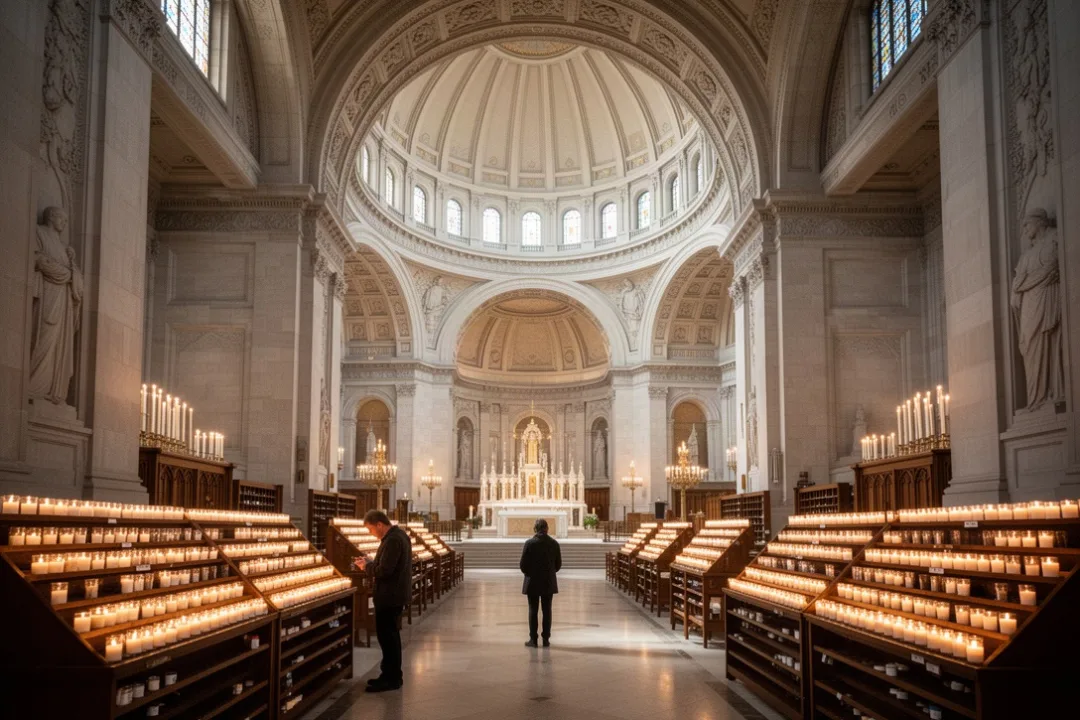
Saint Joseph’s Oratory stands on Mount Royal in Montreal and is one of the most recognizable Catholic pilgrimage sites in Canada. Its origins are closely linked to Brother André’s encounters with visitors at Notre Dame College. He believed that a larger place of prayer could help people deepen their devotion to Saint Joseph.
The original chapel was intentionally modest. Brother André’s vision was not based on personal grandeur. He wanted a place where people could pray, ask for Saint Joseph’s intercession, and find spiritual support. As reports of favors and cures spread, the small chapel became inadequate for the crowds.
Construction proceeded in stages. The crypt church opened before the great basilica was finished, allowing worship and pilgrimages to continue while the larger structure developed. The basilica’s enormous dome and elevated position eventually made the oratory a defining feature of Montreal’s skyline.
Brother André remained associated with the site even as it grew. His personality was very different from the scale of the buildings linked to his ministry. He was known for simplicity, personal prayer, and a willingness to meet people individually. The contrast between the humble doorkeeper and the imposing basilica helps explain why many visitors continue to feel connected to him.
The oratory contains several features connected with his memory and devotion:
Brother André’s tomb, where visitors can pray and pay their respects.
The original chapel, which recalls the modest beginning of the shrine.
The votive chapel, associated with thousands of candles offered in prayer.
Ex-votos and crutches, displayed as signs of gratitude by people who believed they received healing or help.
The basilica and dome, which welcome pilgrims, tourists, and worshipers from many backgrounds.
The crutches and other objects at the oratory should be understood as expressions of personal testimony, not as automatic proof of every reported cure. They show that visitors attributed important changes in their lives to prayer and Saint Joseph’s intercession. The church’s formal recognition of miracles follows a separate process.
Brother André’s legacy also continued through the Congregation of Holy Cross. The congregation helped preserve his memory, promote his spirituality, and serve communities through education and pastoral work. His example is particularly meaningful within a religious tradition that values humble service in schools, parishes, missions, and institutions.
What the Catholic Church recognizes about his miracles
The Catholic Church beatified Brother André in 1982 and canonized him in 2010. These stages required more than popular devotion. Church authorities examined his life, reputation for holiness, writings and testimony about his ministry, and reported healings associated with his intercession.
For canonization, the church recognized two miracles attributed to Brother André’s intercession after his beatification. The cases involved people who experienced serious medical conditions and unexpected recoveries. As with other canonization investigations, the medical evidence was examined by qualified professionals before theological authorities and the pope approved the findings.
A miracle in the canonization process is not simply an event that seems surprising. Investigators look for a recovery that is medically unexplained or not adequately accounted for by treatment and natural causes. They also examine whether the person or those praying for the person specifically sought the intercession of the candidate for sainthood.
The church’s standards do not mean that every prayer must result in physical healing. Brother André himself did not promise cures. His ministry made room for many outcomes: recovery, endurance, reconciliation, peace, acceptance, or the strength to continue through a difficult illness.
That point is central to a responsible understanding of his life. Presenting him as someone who guaranteed healing would distort his message. He directed attention away from himself and toward a relationship with God expressed through prayer, sacraments, community, and care for the sick.
People who pray through Saint André Bessette today may approach him in several ways:
Name the need honestly. Pray for a person, illness, family situation, or personal burden without pretending that fear does not exist.
Ask for Saint Joseph’s intercession. Connect the prayer with the quiet protection and faithful service associated with Joseph.
Remain open to more than one answer. Healing may be physical, emotional, spiritual, or relational.
Use appropriate practical help. Medical treatment, counseling, pastoral guidance, and support from loved ones can all belong alongside prayer.
Give thanks without making promises for others. A personal experience of grace should not become pressure placed on someone else.
His canonization also affirmed that holiness can grow through an apparently small vocation. Brother André did not lead armies, write major theological works, or hold a high office. He opened a door, listened to visitors, prayed, and repeated acts of service over many years.
When Saint André Bessette is remembered and how to honor him
Saint André Bessette died on January 6, 1937. His funeral drew wide attention, reflecting the strong devotion that had developed during his lifetime. He was buried at the oratory connected with his ministry, and his tomb remains a place where people pray.
His liturgical feast is celebrated on January 6. Depending on the local calendar and the observance of Epiphany, the date may be marked differently in particular dioceses or communities. Catholic calendars can vary, so parish listings provide the most precise local information.
Honoring Saint André does not require traveling to Montreal. A person can remember him through acts that reflect the central themes of his life:
Pray for someone who is sick, isolated, or discouraged.
Ask Saint Joseph to protect a family or guide a difficult decision.
Visit a sick person without trying to offer easy explanations.
Support a hospital, hospice, parish ministry, or charitable organization.
Perform a humble task that benefits others but receives little attention.
Seek medical or professional help when illness or distress requires it.
A short prayer inspired by his spirituality might ask God to give a suffering person strength and peace through the intercession of Saint Joseph and Saint André Bessette. The wording can be personal. What matters is not a special formula but the attitude of trust, compassion, and willingness to serve.
His story also offers a meaningful perspective on vocation. A vocation does not always appear as a dramatic calling. Sometimes it takes shape through repeated responsibilities: welcoming people, caring for a building, encouraging the discouraged, and remaining faithful when the work seems ordinary.
That is why Saint André Bessette continues to matter beyond accounts of healing. His life joins compassion, prayer, humility, and practical service. For many people, his example is a reminder that a person can make a lasting spiritual difference through patient attention to those who arrive at the door needing help.
Frequently asked questions
Was Saint André Bessette a priest?
No. He was a religious brother in the Congregation of Holy Cross, not an ordained priest. At Notre Dame College in Montreal, he served primarily as a porter and performed other practical duties. His lack of clerical status did not prevent him from becoming a widely trusted spiritual adviser to people who sought his prayers and encouragement.
Where is Saint André Bessette buried?
Saint André Bessette is buried at Saint Joseph’s Oratory of Mount Royal in Montreal, Quebec. His tomb is located within the oratory complex and has become a place of prayer for pilgrims. The site also preserves the small chapel associated with the beginning of his devotion to Saint Joseph.
What is Saint André Bessette the patron saint of?
He is especially associated with the sick, people seeking healing, caregivers, and those who serve in humble or overlooked roles. He is also closely connected with Saint Joseph’s Oratory and devotion to Saint Joseph. Because official patronage can vary by community, local Catholic calendars may describe his associations differently.
Can people pray to Saint André Bessette for healing?
Yes. Catholics may ask Saint André Bessette to intercede for someone who is ill or facing another serious difficulty. Such prayer does not replace diagnosis, treatment, or professional care. His own example emphasized trust in God, attention to suffering, and practical help rather than a guarantee that every illness would be physically cured.











Leave a Reply