Kateri Tekakwitha: Her life, faith, and lasting legacy
Kateri Tekakwitha: Her life, faith, and lasting legacy
If you have heard the name Kateri Tekakwitha and wondered why she is remembered, the short answer is that she was a seventeenth-century Mohawk woman whose Christian faith became central to her life despite illness, family opposition, and social pressure. The Catholic Church canonized her in 2012, making her the first Native American saint recognized by the church.
Kateri’s story is more than a list of religious milestones. It brings together Indigenous identity, colonial-era mission activity, personal conviction, family loss, and a disciplined spiritual life. Understanding her requires respect for both her Catholic devotion and the Mohawk community and culture in which she was born.
Kateri Tekakwitha was born in 1656 in the Mohawk Valley, in what is now New York State. Her father was Mohawk, and her mother was Algonquin and had become Christian before her marriage. Kateri’s birth name was Tekakwitha; after her baptism, she received the Christian name Catherine, rendered in Mohawk as Kateri.
She lived during a period of intense conflict and change in northeastern North America. Mohawk communities faced warfare, disease, political pressure, and the growing influence of European colonial powers and Christian missionaries. Her life unfolded within those realities rather than apart from them.
Kateri is often called the “Lily of the Mohawks”, a devotional title that reflects her reputation for purity, prayer, and steadfastness. Some Catholics also refer to her as Saint Kateri or Kateri Tekakwitha, Virgin. These names point to her religious importance, but they do not replace her identity as a Mohawk woman.
What happened to Kateri during her childhood
When Kateri was about four years old, a smallpox epidemic killed her parents and her younger brother. Kateri survived the disease, but it left facial scarring and weakened eyesight. She was then raised by relatives, including her aunt and uncle, in the Mohawk community of Caughnawaga, near the present-day site of Fonda, New York.
The loss of her immediate family shaped her early life, although surviving records cannot tell us every detail of her childhood. Smallpox also affected many other members of her community. The disease should be understood as part of the devastating epidemics that accompanied the broader upheaval of Indigenous life during European colonization.
As a young person, Kateri learned the responsibilities expected within her community. She took part in ordinary work such as preparing food, making clothing, and helping with household tasks. Accounts of her life later emphasized her reserved nature and her interest in Christian teaching, but she should not be imagined as detached from Mohawk family and community life.
A useful historical distinction: Much of what is known about Kateri comes from missionary accounts written after her death. Those records preserve valuable information but also reflect the language and priorities of European Catholic observers. Her story is best approached with both appreciation and historical care.
How Kateri became Christian
Kateri encountered Catholic Christianity through Jesuit missionaries who worked among Indigenous communities in the region. Her mother’s earlier connection to Christianity may also have influenced her familiarity with the faith. Kateri was baptized in 1676 at the age of about twenty, receiving the name Catherine.
Her decision to become Christian was not simply a private spiritual preference. Baptism affected her relationships and position within the community. Some relatives and neighbors opposed her conversion, and she experienced pressure to follow customary expectations concerning work, marriage, and community participation.
Mission records describe her as choosing not to marry and remaining committed to a life of prayer. That choice was unusual in her circumstances, but it was not necessarily a rejection of Mohawk identity. Kateri’s religious commitments developed as she responded to Christian teaching while continuing to live within an Indigenous community.
Because accounts of her conversion were written by missionaries, descriptions of her motives can sometimes sound overly simple. A careful reading recognizes both her personal agency and the unequal colonial setting in which missionaries and Indigenous communities interacted. Calling her a Christian saint does not require overlooking the historical forces surrounding her.
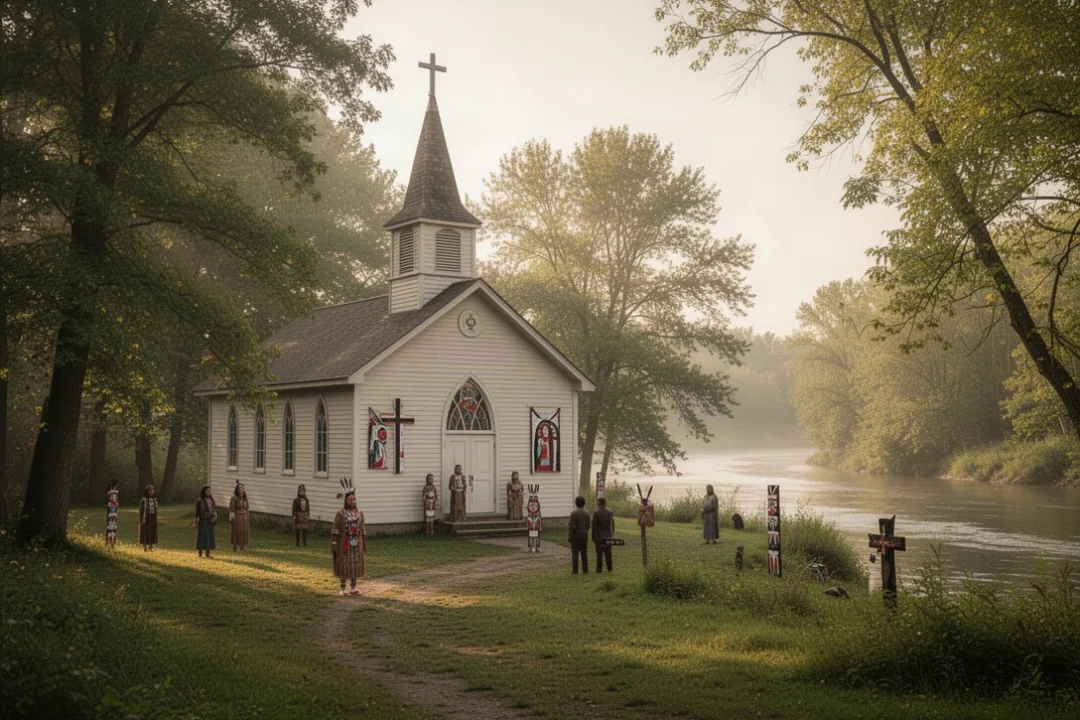
In 1677, Kateri moved north to the Catholic mission community at Kahnawake, near present-day Montreal, Quebec. The community was associated with Mohawk Catholics and offered a setting in which she could practice her faith with fewer of the pressures she had faced at home.
At Kahnawake, she joined a community sometimes called the Mission of Saint Francis Xavier. There she took part in Catholic worship, received religious instruction, and lived among other Mohawk Christians. The move was significant because it connected her to a wider Indigenous Catholic community rather than placing her faith entirely within a European framework.
Kahnawake also became the place where the final years of her life unfolded. She worked, prayed, fasted, and participated in communal religious practices. The surviving accounts portray her as deeply devoted, although some reports may emphasize extraordinary self-denial in ways that reflect the devotional writing of her period.
What Kateri’s religious life involved
Kateri’s spirituality centered on prayer, participation in the sacraments, care for others, and personal discipline. She attended Mass, received Communion when permitted by the customs of her time, and spent periods in prayer and reflection. Her devotion was expressed through regular practices rather than through public leadership or political authority.
She also joined other women in acts of service. Accounts describe her helping care for sick people and participating in communal work. These details matter because they show that her religious life was not only inward or solitary. Her faith was practiced through relationships, responsibilities, and service within the Kahnawake community.
Some biographies highlight fasting, bodily penance, and other forms of self-denial. These practices were part of Catholic devotional culture in the seventeenth century, but modern readers should avoid treating physical suffering as a requirement for holiness. Kateri’s significance does not depend on copying every practice attributed to her.
Her spirituality is often described through themes of perseverance, purity of intention, and care for creation. The last theme has become especially prominent in modern Catholic devotion. It connects her image with the natural world and with Indigenous traditions of attentiveness to land, although those connections should be expressed respectfully rather than used to make broad claims about all Indigenous peoples.
When Kateri Tekakwitha died
Kateri died on April 17, 1680, at Kahnawake. She was about twenty-four years old. Her short life, marked by childhood disease, bereavement, conversion, social pressure, and religious commitment, contributed to the strong memory that developed around her after death.
According to Catholic tradition, witnesses reported that the appearance of her face changed after her death, with the smallpox scars no longer visible. This account became part of her devotional story. As with other historical claims preserved in religious biographies, readers may distinguish between documented testimony, spiritual tradition, and the church’s later judgment about her sanctity.
Kateri was buried at Kahnawake, where her tomb remains an important place of pilgrimage. People visit to pray, honor her memory, and connect with the Indigenous Catholic history of the community. Kahnawake is not merely a backdrop to her story; it is a living Mohawk community with its own identity, history, and contemporary concerns.
How the Catholic Church recognized Kateri
After Kateri’s death, devotion to her spread among Catholics, especially Indigenous Catholics in North America. The process toward official recognition took centuries. She was declared Venerable in 1943 and beatified by Pope John Paul II in 1980.
For canonization, the Catholic Church requires evidence of a miracle attributed to a candidate’s intercession after beatification, except in certain special cases. In Kateri’s cause, the church approved a healing involving a young Native American boy who had suffered a serious bacterial infection. The details of the case were reviewed through the church’s formal process before her canonization.
Pope Benedict XVI canonized Kateri on October 21, 2012, in Rome. Her canonization placed her among the saints officially recognized for veneration throughout the Catholic Church. The event held particular meaning for Indigenous Catholics in the United States and Canada, who had long honored her as a spiritual ancestor and model of faith.
Her canonization does not mean that every detail in older biographies has the same historical certainty. It means the Catholic Church recognizes her as a saint and presents her life as an example of Christian holiness. Historical study and religious devotion can coexist when each is clear about its methods and limits.
What Kateri represents to Indigenous Catholics
Kateri’s importance to Indigenous Catholics is both spiritual and cultural. She was an Indigenous woman who lived within an Indigenous community, spoke an Indigenous language, and practiced Catholicism in a setting where European and Indigenous worlds were in constant contact. Her life shows that Indigenous Catholics are not recent participants in church history.
At the same time, her image has sometimes been used in ways that flatten Indigenous diversity. Kateri was Mohawk, and her mother had Algonquin ancestry; she was not a symbolic representative of every Native nation. Different Indigenous communities have distinct languages, histories, traditions, and relationships with Christianity.
Her story also raises difficult questions about missionization and colonialism. Catholic missions sometimes offered education, community, and religious belonging, while missionary activity also took place within systems that pressured Indigenous people to change cultural practices. A respectful account can honor Kateri’s faith without presenting colonization as harmless or treating conversion as proof that Indigenous cultures were deficient.
For many people, Kateri represents faith expressed through Indigenous identity, not faith achieved by abandoning it. Her legacy can encourage Catholics to listen to Native communities, learn local history, and recognize Indigenous leadership rather than using her only as an inspirational figure from the past.
Why Kateri is associated with nature and the environment
Kateri is widely honored as a patron saint of the environment and ecology. This association grew especially in modern Catholic devotion, where her connection with the land, forests, water, and Indigenous life became part of how people remembered her.
The association does not mean that Kateri left behind a modern environmental program. She lived in a society whose daily survival depended closely on land, seasonal work, plants, animals, and water. Modern people may draw ecological meaning from her life, but they should avoid placing contemporary terminology directly into her seventeenth-century experience.
Her patronage can be a starting point for practical responsibility. Someone honoring Kateri might pray for wisdom about caring for creation, learn about local Native nations, support habitat protection, reduce waste, or participate in community service. These actions are more meaningful when they include attention to the people most affected by environmental damage.
How to honor Kateri respectfully
You do not need to know every detail of Kateri’s biography to honor her thoughtfully. Begin by treating her as a real person rather than a decorative religious symbol. Learn about her Mohawk background, the history of Kahnawake, and the continuing presence of Indigenous communities.
Use her full name, Kateri Tekakwitha, and describe her as Mohawk rather than using vague terms such as “Indian saint.”
Learn about the Mohawk Nation and the Kanien’kehá:ka communities connected with her history.
Read Catholic biographies alongside Indigenous perspectives and reliable historical resources.
Pray for the protection of creation while also taking a practical step to care for land, water, or vulnerable neighbors.
Support Indigenous-led organizations when giving money or volunteering.
Visit a shrine or church connected with Kateri respectfully, following local guidance about photography, prayer, and public behavior.
Churches, schools, and families may also observe her feast day with prayer, Scripture readings, educational programs, or service projects. A good observance makes room for both devotion and learning. It should not turn Indigenous culture into costumes, generic crafts, or a backdrop for a religious celebration.
Common mistakes when learning about Kateri Tekakwitha
Many short biographies leave out context or repeat devotional language as though it were fully established history. These mistakes can unintentionally distort Kateri’s life and the experiences of the people around her.
Calling her the first Indigenous Catholic. Indigenous people encountered and practiced Christianity before Kateri, and many Indigenous Catholics lived alongside her. She is recognized as the first Native American saint canonized by the Catholic Church, not the first Indigenous Christian.
Describing her as simply “American.” Kateri lived before the United States existed. Calling her Mohawk and placing her in the seventeenth-century northeastern woodlands is more accurate.
Separating her faith from her community. Her life was shaped by family, Mohawk society, Kahnawake, and other Indigenous Catholics. She was not an isolated figure who existed only in relation to missionaries.
Repeating every legend as verified fact. Some stories come from devotional biographies and later tradition. Presenting them as tradition preserves their religious meaning without overstating historical certainty.
Using her to erase colonial violence. Kateri’s conversion and sainthood do not make the history of missions, disease, warfare, and cultural pressure simple or harmless.
Assuming all Native nations share her traditions. Kateri’s Mohawk identity should be named specifically, and other Indigenous communities should not be treated as interchangeable.
Respectful language matters: “Native American” is common in the United States, while “Indigenous” is also widely used. Follow the terminology preferred by the community or source you are discussing, and use “Mohawk” or “Kanien’kehá:ka” when referring specifically to Kateri’s people.
How Catholics may pray with Kateri’s example
Kateri’s life can shape prayer without turning her into a replacement for God or a source of magical protection. Catholics traditionally ask saints to pray with them and for them. A person might bring concerns about illness, grief, family conflict, religious conviction, or the care of creation to prayer while asking for Kateri’s intercession.
Prayer inspired by Kateri can focus on a few concrete themes: courage when your convictions are misunderstood, compassion for people who are sick or isolated, faithfulness in ordinary responsibilities, and humility before the natural world. These themes connect more closely with the known pattern of her life than a vague appeal to success or personal achievement.
You may use an approved Catholic prayer to Saint Kateri, pray the Rosary, attend Mass on her feast day, or speak to God in your own words. Churches and Catholic organizations may offer different devotions. If a prayer includes historical claims that seem exaggerated, you can still retain its central purpose while consulting a reliable source about the underlying biography.
When Kateri Tekakwitha’s feast day is observed
In the United States, Kateri Tekakwitha’s feast day is observed on July 14. The date may differ in local calendars or communities, so a parish, diocese, or Catholic calendar is the best guide for a particular celebration.
Her feast day gives communities an opportunity to remember her life, pray for Indigenous peoples, and reflect on stewardship of creation. It can also be a time to examine whether a celebration truly respects the living communities connected to her story.
A thoughtful observance might include a biography written by a reputable historian, a presentation about Mohawk history, a service project chosen with Indigenous or environmental partners, or a prayer that acknowledges the complicated history of Christian missions. The emphasis should be on learning and respect rather than turning Kateri into a generic symbol.
What Kateri’s legacy means today
Kateri Tekakwitha remains significant because her story cannot be reduced to one category. She was a Mohawk woman, a survivor of epidemic disease, an orphan, a Christian convert, a member of a Catholic Indigenous community, and a young person who made serious choices about how to live. Each part of her identity helps explain why her memory has endured.
For Catholics, she offers an example of committed faith shaped by hardship and community. For Indigenous Catholics, she is a recognized saint whose life affirms a long Indigenous presence within Catholic history. For others, she raises questions about cultural identity, religious freedom, historical memory, and the responsibilities involved in telling another community’s story.
The most responsible way to remember Kateri is to hold these dimensions together. Honor her devotion, name her Mohawk identity, acknowledge the limits of the historical record, and learn about the living communities connected with her. Her legacy becomes deeper when admiration leads to respect, accurate history, and care for people and creation.
Frequently asked questions
Is Kateri Tekakwitha a Catholic saint?
Yes. Pope Benedict XVI canonized Kateri Tekakwitha on October 21, 2012. The Catholic Church recognizes her as a saint and observes her feast day in the United States on July 14. She is commonly described as the first Native American saint canonized by the Catholic Church.
What nationality was Kateri Tekakwitha?
Kateri was Mohawk, an Indigenous people of northeastern North America. She was born in the Mohawk Valley, in an area now associated with New York State, before the United States existed. Her mother was Algonquin, so descriptions of her family background should include both her Mohawk and Algonquin connections.
What is Kateri Tekakwitha the patron saint of?
Kateri is widely honored as a patron saint of the environment and ecology. She is also associated with Indigenous Catholics, nature, and people seeking strength in their faith. These associations developed through Catholic devotion and modern interpretation of her life rather than from a modern environmental program she personally wrote or organized.
Where can people visit Kateri Tekakwitha’s tomb?
Kateri’s tomb is at Kahnawake, a Mohawk community near Montreal, Quebec. The site is connected with the Saint Francis Xavier Mission and remains a place of prayer and pilgrimage. Visitors should check current local guidance before traveling and treat the community, religious site, and surrounding cultural setting with respect.














Leave a Reply