Elizabeth of Hungary: Life, faith, and lasting legacy
Elizabeth of Hungary: Life, faith, and lasting legacy
Elizabeth of Hungary was a thirteenth-century princess, wife, widow, and Christian saint known for turning royal privilege toward the care of people living in poverty. After her husband’s death, she gave away much of her wealth, helped establish a hospital in Marburg, and personally served the sick.
She was born in 1207 and died in 1231 at about 24 years old. The Catholic Church canonized her in 1235, and her feast day is observed on November 17. Her life is remembered not because she rejected responsibility, but because she used her position, resources, and influence to practice disciplined compassion.
Elizabeth was the daughter of King Andrew II of Hungary and Queen Gertrude of Merania. She belonged to the European ruling class, yet the surviving accounts of her life emphasize her concern for people who had little social or economic power. Her spirituality was shaped by prayer, fasting, generosity, and a strong personal identification with Christ’s suffering.
She spent much of her childhood and young adulthood at the court of Thuringia in central Germany. There she married Louis IV, Landgrave of Thuringia, and became a landgravine. The marriage produced three children, but it ended suddenly when Louis died while preparing to join a crusade in 1227.
Elizabeth then faced pressure to return to a conventional aristocratic life or enter another marriage. Instead, she chose a life of religious dedication and service. With support from spiritual advisers, she settled in Marburg, where she founded a hospital and cared for vulnerable people herself.
The central idea: Elizabeth’s holiness was expressed through practical action. She did not only donate money; she visited, fed, nursed, and accompanied people who were sick, poor, or abandoned.
Elizabeth of Hungary’s life in chronological steps
Birth and royal family: Elizabeth was born in 1207 into the Hungarian royal family and raised within the political world of medieval Europe.
Move to Thuringia: As a child, she was sent to the court of Thuringia because of a planned dynastic marriage.
Marriage to Louis: She married Louis IV and became landgravine, sharing the responsibilities of a powerful noble household.
Growing commitment to service: During her marriage, she used court resources to support people in need and deepened her life of prayer.
Widowhood: Louis died in 1227 before reaching the Holy Land, leaving Elizabeth a young widow with three children.
Renunciation of court life: She gave up much of her wealth and political security, choosing a simpler religious life in Marburg.
Hospital ministry: She helped establish a hospital dedicated to Saint Francis and served patients directly.
Death and canonization: Elizabeth died in 1231 and was canonized only a few years later, an unusually rapid recognition of her sanctity.
Elizabeth’s childhood and royal background
Elizabeth was born into a family whose decisions affected kingdoms, alliances, and church politics. Her father, Andrew II, ruled Hungary, while her mother, Gertrude, came from a prominent German noble family. Elizabeth’s birth connected her to a network of European dynasties rather than to an ordinary private household.
Her childhood was shaped by a political marriage agreement. When she was still very young, she was sent to the court of Hermann I, Landgrave of Thuringia. The arrangement was intended to strengthen the relationship between the Hungarian and Thuringian ruling families. Such marriages were common among medieval monarchs and often involved children who had little control over the plans made for them.
Life at court gave Elizabeth access to education, worship, ceremony, and luxury. It also placed her in a setting where charity could be organized on a large scale. Accounts of her youth describe a child unusually serious about prayer and almsgiving, although the details were recorded by people who wanted to present her as a model of holiness.
Her mother was murdered in 1213 during a political uprising in Hungary. Elizabeth was still a child, and the event added personal grief to an already demanding public life. It is difficult to separate later devotional storytelling from firmly documented details, but her biography consistently presents loss as a major influence on her spiritual outlook.
Her marriage to Louis of Thuringia
Elizabeth married Louis IV in 1221, when she was about 14. The marriage was both a family alliance and, according to the accounts surrounding her life, a deeply affectionate partnership. Louis became landgrave after the death of his father, and Elizabeth assumed the public duties expected of a noblewoman in his territory.
As landgravine, Elizabeth was responsible for more than private charity. She participated in the management of a large household, received visitors, supported religious institutions, and helped distribute resources during difficult periods. Her position gave her the ability to reach people beyond her immediate circle, but it also required her to live within the structures of medieval rank and authority.
Stories about Elizabeth often describe her bringing food to poor people despite objections from relatives or officials. One famous tradition says that when she was confronted while carrying bread under her cloak, the bread had become roses. This is known as the rose miracle. It is a beloved symbol of her generosity, but historians generally treat it as a later devotional tradition rather than a fact that can be independently confirmed.
Her marriage did not mean that she abandoned the expectations of court life. Instead, she tried to combine her public role with intense religious practice. She reportedly wore simple clothing at times, limited personal luxuries, and arranged regular assistance for people in need. These choices sometimes created tension because medieval courts depended on displays of wealth and status.
How Elizabeth practiced charity during her marriage
Elizabeth’s charity included both organized relief and personal contact. She supported distributions of food, clothing, and money, especially when poor families faced hunger or illness. She also visited people who were sick, an activity that could expose a wealthy person to discomfort, infection, and social disapproval.
Her approach differed from charity that remained distant. Medieval rulers commonly gave alms as part of religious duty and public leadership. Elizabeth’s reputation rests especially on her willingness to move toward suffering rather than only sending servants or issuing payments.
Food assistance: She helped provide food for people who could not support themselves.
Care for the sick: She visited patients and offered hands-on service.
Support for children: Accounts connect her charitable work with the care of children and families in distress.
Personal simplicity: She tried to reduce her own consumption so more resources could be shared.
Religious motivation: Her service was grounded in prayer and in the Christian command to care for the poor.
These practices should be understood within the limits of the thirteenth century. Elizabeth could not create modern hospitals, public benefits, or universal health care. Her work took place through a household, a church network, and a charitable institution supported by patrons and donations.
What happened after Louis died
Louis died in 1227 while traveling toward the crusade that Emperor Frederick II had organized. Elizabeth was about 20 years old and had three children. His death left her in a vulnerable position because her authority depended partly on her marriage and because relatives had interests in controlling the landgrave’s government and property.
Elizabeth’s decision after Louis’s death became one of the defining moments of her life. She resisted arrangements that would have returned her to a wealthy court existence or required another marriage. She negotiated for the freedom to live according to her religious commitments, though the exact details of these negotiations are not fully clear in every surviving account.
Some biographies describe her taking a vow of celibacy at Louis’s tomb. Whether every detail of that story is historically secure, the larger point is clear: Elizabeth chose not to treat widowhood as a temporary stage before another aristocratic marriage. She wanted her future to center on service and devotion.
Her children were placed under the protection of relatives and dynastic guardians. That separation was painful and remains one of the most difficult parts of her story. It also shows that Elizabeth’s choices had real consequences. Her religious vocation did not remove her responsibilities as a mother; it forced her to make decisions within a political system that gave noble families control over children and inheritance.
A useful historical distinction: Elizabeth’s later reputation includes dramatic stories of renunciation, but the broad evidence supports a more precise picture: she deliberately reduced her access to wealth and power, secured some independence, and devoted her remaining resources to religious charity.
Why Marburg became central to her legacy
After leaving the Thuringian court, Elizabeth settled in Marburg. There she used money connected with her widow’s rights to establish a hospital. The hospital was dedicated to Saint Francis of Assisi, whose example of poverty and service strongly influenced religious life in the period.
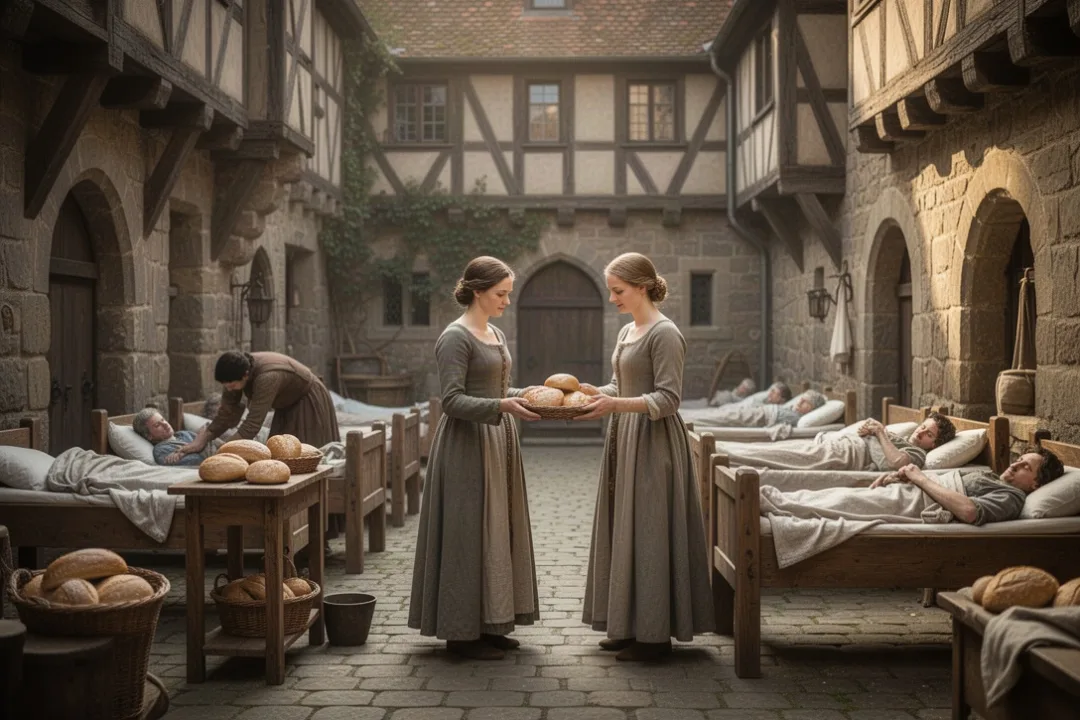
Elizabeth did not simply act as a benefactor. She worked among the patients and adopted the demanding role of a servant. Accounts describe her feeding people, washing them, tending wounds, and helping those who had been rejected by ordinary social networks. These details explain why her image became closely linked with nursing and charitable care.
Her hospital served a practical purpose in a world where illness, disability, childbirth complications, hunger, and injury could quickly destroy a family’s stability. It also reflected a growing medieval movement toward organized religious care. Hospitals at this time were not equivalent to modern medical centers; they offered shelter, food, prayer, and basic nursing as well as whatever treatment was available.
Elizabeth’s connection with Marburg continued after her death. The city became an important destination for people honoring her, and a church was built over her tomb. Her relics, liturgical commemoration, and charitable example helped make Marburg one of the main places associated with her memory.
Elizabeth’s connection with Saint Francis and religious life
Elizabeth lived during the expansion of the Franciscan movement, which emphasized poverty, humility, preaching, and service. She was not a Franciscan friar, but Franciscan spirituality influenced her choices. She wanted a religious life that was active, disciplined, and close to people who suffered.
She was also associated with a group of women living under religious guidance at Marburg. Later writers sometimes describe this as a formal entrance into the Franciscan Third Order. The exact institutional details are debated because medieval religious categories did not always match later definitions, but her connection to Franciscan ideals is well established.
Her spirituality was not based only on emotional sympathy. It included demanding practices such as fasting, confession, prayer, and obedience to a spiritual director. Some of these practices may appear severe to modern readers. They reflect the penitential culture of medieval Christianity, in which self-denial was understood as a way to discipline desire and unite oneself with Christ.
At the same time, Elizabeth’s religious life was not escapism. She remained concerned with food, shelter, cleanliness, illness, and the dignity of individual patients. Her legacy joins contemplative devotion with concrete service, a combination that has shaped how churches and charitable organizations remember her.
What the rose miracle means
The rose miracle is the best-known story associated with Elizabeth. In its familiar form, she is carrying bread to poor people, and someone questions what she is hiding. When she opens her cloak, the bread has become roses. The story is often shown in religious art and has made roses a lasting symbol of her charity.
Whether or not the event happened historically, the legend expresses several ideas about her reputation. It presents care for the poor as something worthy of protection, suggests that hidden generosity matters, and connects ordinary food with beauty. The miracle also reflects the medieval tendency to communicate a saint’s character through memorable symbolic stories.
It is best to describe the account as a traditional legend rather than as a documented event. Doing so does not make it meaningless. Religious traditions often preserve values through images and narratives, while historians separately evaluate what can be established from contemporary or near-contemporary evidence.
Elizabeth’s final years and death
Elizabeth’s years at Marburg were brief. She died on November 17, 1231, probably from illness or physical exhaustion, though the precise medical cause is not certain. She had spent the final period of her life serving patients and maintaining a demanding religious routine.
Reports of miracles began to circulate after her death. Her reputation spread quickly through religious communities, noble networks, and people who had encountered her charitable work. Within a few years, Pope Gregory IX canonized her in 1235. The speed of the process reflects the strength of local devotion, the testimony gathered about her life, and the support of powerful people connected to her family and region.
Her canonization also showed how medieval Christianity could recognize sanctity in a laywoman who had held political status. Elizabeth was not known primarily as a theologian, abbess, or martyr. Her public identity rested on service to the poor, personal sacrifice, and the practical use of wealth for people in need.
How Elizabeth of Hungary is honored today
Elizabeth is honored as a saint in the Catholic Church and is also remembered in other Christian traditions. Her feast day, November 17, provides an annual occasion to celebrate her life and to connect prayer with charitable action. Churches, hospitals, schools, religious communities, and charitable organizations have been named for her.
She is especially associated with people who serve others through nursing, social work, hospitals, and organized relief. Her patronage may vary by country and tradition, but common associations include charitable organizations, hospitals, nurses, widows, brides, the homeless, and people experiencing poverty.
Artists often portray her as a young noblewoman wearing a crown or richly colored clothing, with bread, roses, a pitcher, or people receiving aid. These symbols bring together the two sides of her identity: she was both a member of royalty and a servant of the poor.
Crown: Her royal birth and position as landgravine.
Bread: Her practical care for hungry people.
Roses: The traditional miracle associated with secret charity.
Hospital or sick person: Her service to patients in Marburg.
Simple clothing: Her renunciation of luxury after widowhood.
What Elizabeth’s example can mean for charitable work
Elizabeth’s story is often reduced to a simple message about kindness, but it offers a more demanding model. She used her position to create access to food and care, accepted personal inconvenience, and treated people on the margins as worthy of direct attention. Her example suggests that charity involves both resources and relationships.
Her life also raises questions about power. A medieval princess could distribute wealth because she had wealth to distribute, while most poor people had no comparable freedom. Remembering Elizabeth responsibly means honoring her generosity without ignoring the unequal social system in which it took place.
Modern readers can apply her example in practical ways without copying every medieval practice. A person may support a reliable food pantry, volunteer in a hospital-approved program, assist a shelter, give to emergency relief, or learn how local organizations protect vulnerable people. The central principle is to combine compassion with informed and consistent action.
Elizabeth also challenges the idea that service must be public to matter. Much of the charity associated with her was personal and local. She did not need modern publicity, a large institution, or a formal professional title to make a difference. Her influence grew because the people around her remembered how she treated those who were often ignored.
Questions to ask when studying Elizabeth of Hungary
Reliable study of Elizabeth requires attention to both history and devotion. Her earliest biographies were written to support her canonization and to communicate her holiness. They preserve valuable information, but they also include miracles, dramatic speeches, and idealized scenes that should be read as religious literature as well as biography.
When a source tells a striking story, ask whether it is describing a documented event, a longstanding local tradition, or a symbolic account. This approach allows you to appreciate the meaning of the tradition without presenting every detail as certain fact.
Separate firm dates from approximate details: Her birth, death, marriage, and canonization are broadly established, while some personal episodes are less certain.
Consider the source’s purpose: A canonization biography aims to show holiness and may organize events to highlight virtues.
Place her choices in context: Medieval marriage, inheritance, hospitals, and religious orders operated differently from their modern counterparts.
Notice her institutional work: Her hospital and charitable network were as significant as the miracle stories.
Keep the human cost visible: Her children, widowhood, political vulnerability, and physical demands of service were part of her real life.
Elizabeth of Hungary remains compelling because her life joins circumstances that are often kept separate: privilege and poverty, motherhood and religious dedication, public authority and personal humility. Her legacy is not simply that she gave something away. It is that she treated care for suffering people as a serious responsibility, even when doing so challenged the expectations attached to her rank.
Frequently asked questions
Was Elizabeth of Hungary a queen?
No. Elizabeth was born a princess of Hungary, but she became landgravine of Thuringia through her marriage to Louis IV. “Elizabeth of Hungary” refers to her family origin, not to a reign as queen. Her royal background gave her wealth and influence, but her public title in adulthood was connected to Thuringia.
Why is Elizabeth of Hungary associated with roses?
A traditional story says that bread she carried to poor people changed into roses when she was questioned about it. The account is called the rose miracle and appears frequently in religious art. It is best understood as a devotional tradition symbolizing generosity, rather than as an event historians can firmly verify.
What did Elizabeth of Hungary do in Marburg?
Elizabeth helped establish a hospital in Marburg and served its patients directly. She provided practical care to people who were sick, poor, or socially isolated. Her work included nursing and personal assistance, not merely financial sponsorship. The hospital became one of the strongest foundations of her reputation for Christian charity.
When is Saint Elizabeth of Hungary’s feast day?
Saint Elizabeth of Hungary’s feast day is November 17, the date associated with her death in 1231. Churches and charitable groups may mark the day with worship, educational programs, food drives, or service projects. Customs vary by country and denomination, but charitable action reflects the focus of her life.















Leave a Reply