St. Frances of Rome: Life, Feast Day, and Patronage
St. Frances of Rome: Life, Feast Day, and Patronage
St. Frances of Rome was a fifteenth-century Italian saint known for combining family life, charitable service, and deep prayer. Born in Rome in 1384, she married Lorenzo Ponziano, raised children, cared for the sick and poor during epidemics, and later helped establish a community of women religious.
Her feast day is March 9. She is especially associated with widows, motorists, Rome, and people seeking help in times of illness or hardship. Catholic tradition also remembers her for visions and for the angel said to have accompanied her throughout much of her life.
St. Frances of Rome, also called Francesca Romana, lived during a period of political conflict, disease, poverty, and division within the Church. Her story is distinctive because she did not enter a monastery as a young woman. Instead, she pursued holiness while fulfilling the responsibilities of a wife, mother, householder, and servant of people in need.
She was born into a noble Roman family and grew up with a strong desire for a religious life. Her parents arranged her marriage to Lorenzo Ponziano, a member of another prominent Roman family. Frances accepted the marriage, even though her personal hopes had been directed toward a convent.
Her life shows a recurring Christian theme: a vocation can unfold through circumstances that differ from a person’s original plans. Frances did not abandon prayer or charity when she married. She brought those commitments into her household and used her position and resources to serve others.
At a glance: St. Frances of Rome was a married laywoman, mother, widow, charitable worker, and founder of the Oblates of Tor de’ Specchi. Her life is often cited as an example of sanctity practiced in ordinary family and civic responsibilities.
Why St. Frances of Rome is remembered
Frances is remembered less for a single dramatic event than for the consistency of her service. She prayed regularly, managed a large household, distributed food and clothing, visited the sick, and responded to crises affecting Rome. Her charitable work became especially visible when disease and war placed severe pressure on the city.
She also had an unusual spiritual life marked by visions, mystical experiences, and the reported presence of a guardian angel. These accounts form part of her traditional biography, but her reputation for holiness rests equally on practical love: feeding hungry people, nursing the sick, and giving away possessions when others had greater need.
Her example mattered because it challenged the assumption that serious religious commitment belonged only to clergy or cloistered women. Frances remained closely involved with her family while developing a disciplined life of prayer and service.
St. Frances of Rome’s life by major stages
Birth and formation: Frances was born in Rome in 1384 and raised in a noble Christian household.
Marriage and family: She married Lorenzo Ponziano and shared the responsibilities of family life, household management, and public hardship.
Service during crises: She turned family resources toward people suffering from hunger, sickness, war, and poverty.
Spiritual growth: Her prayer life deepened through fasting, meditation, confession, and reported visions.
Formation of a religious community: She gathered women who wanted to serve God while remaining connected to their homes and charitable work.
Widowhood and final years: After Lorenzo’s death, Frances devoted herself more fully to the community she had helped establish.
Death and canonization: She died in Rome in 1440 and was canonized by Pope Paul V in 1608.
Her childhood and arranged marriage
Frances was born into a wealthy Roman family at a time when marriage among noble households often involved family strategy as well as personal relationships. As a young woman, she reportedly wanted to become a nun. Her parents, however, arranged her marriage to Lorenzo Ponziano.
According to her traditional biography, Frances initially struggled with the idea of marriage. Her spiritual adviser helped her recognize that she could pursue a holy life within the vocation her circumstances had placed before her. She married Lorenzo while still young and became part of a household with significant responsibilities.
The marriage was not presented in later accounts as an obstacle to her faith. Lorenzo respected her religious commitment, and Frances remained faithful to her family duties. Their relationship illustrates how medieval women of noble families often balanced domestic obligations with religious devotion and charitable patronage.
Family responsibilities and personal loss
Frances and Lorenzo had children, although disease and other hardships affected the family. One of their children died during an epidemic, and the family also endured the disruption caused by war and political instability. Such losses shaped Frances’s compassion for other families facing grief.
She did not treat charity as an occasional donation. She organized care, gave away household goods, and helped make family property available to people in distress. Traditional accounts say that she and her sister-in-law, Vannozza, went through Rome helping the poor and sick.
Frances’s household became a place where practical decisions and spiritual priorities met. She managed resources carefully, but she also recognized that possessions had a moral purpose. Her generosity reportedly became so extensive that members of the household sometimes questioned whether enough remained for the family.
Her answer, as conveyed through the tradition surrounding her life, was that goods should not be protected for comfort while neighbors lacked necessities. This principle did not lead her to neglect her family. Rather, she sought a disciplined form of stewardship in which family needs and the needs of the poor were considered together.
Rome experienced repeated outbreaks of disease during Frances’s lifetime. Medical care was limited, and the sick could be abandoned because families feared infection or lacked food and medicine. Frances responded by visiting those who were ill and helping create practical support for people who had no one else to assist them.
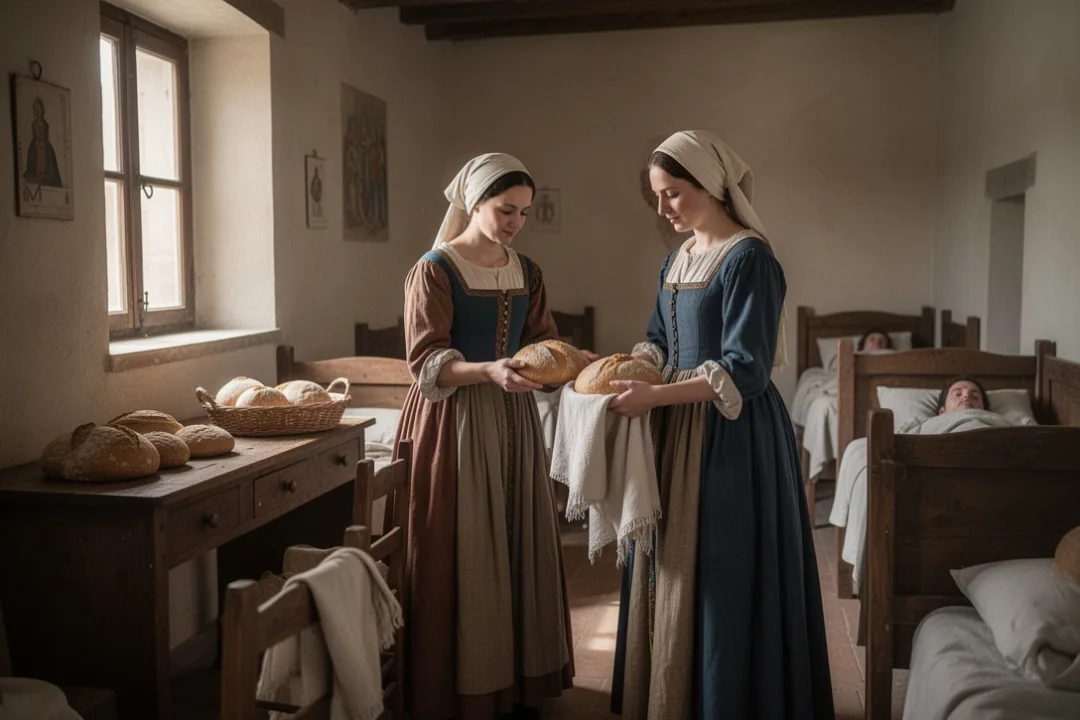
She is traditionally associated with caring for patients at the Hospital of Santo Spirito in Sassia, one of Rome’s historic hospitals. Accounts of her service describe nursing, distributing supplies, and supporting institutions that cared for the poor. Her charitable work extended beyond individual acts to organized relief.
War also affected Roman neighborhoods and noble families. Political struggles could lead to displacement, property loss, and hunger. Frances used what influence and resources she had to protect vulnerable people and to support those whose circumstances had deteriorated.
Food: She helped distribute provisions to people facing hunger.
Clothing: Household garments and other goods were given to people who lacked basic necessities.
Nursing: She visited and cared for sick people despite the risks involved.
Institutional support: She worked with hospitals and charitable efforts rather than relying only on private donations.
Spiritual care: She accompanied suffering people with prayer and personal attention.
A useful way to understand her charity: Frances combined personal compassion with organized service. She did not merely feel sympathy for the poor; she changed how money, food, clothing, time, and household labor were used.
Her prayer life and reported angelic companion
St. Frances of Rome is closely associated with visions and mystical experiences. Traditional accounts say that she had a special relationship with an angel who appeared to her and remained near her. Artistic representations often show Frances with an angel standing beside her.
The angel is usually understood as a sign of God’s guidance and protection rather than as the central purpose of her spirituality. Frances’s accounts of visions were connected with prayer, moral discernment, suffering, and the needs of the people around her.
Descriptions of her spiritual practices include meditation on Christ’s life, regular prayer, fasting, confession, and acts of humility. Her mystical experiences did not remove her from daily duties. She continued to handle practical matters, care for dependents, and respond to emergencies.
For Catholics, private visions do not carry the same authority as public revelation contained in the Christian faith. They may encourage devotion, but they are evaluated in relation to sound teaching, humility, and the fruits of a person’s life. In Frances’s case, her reported visions were remembered alongside concrete service and moral discipline.
The founding of the Oblates of Tor de’ Specchi
Frances gathered a group of women who wanted to dedicate themselves to God and charitable service without becoming enclosed nuns. This group developed into the Oblates of Tor de’ Specchi, also known as the Oblates of Mary.
The community was formally established in Rome in the fifteenth century. Its members were associated with service to the poor and sick, prayer, and a form of religious commitment adapted to women who were not entering a traditional cloister. The community took its name from Tor de’ Specchi, a site in Rome where the women lived and served.
The Oblates’ identity reflects Frances’s own experience. She understood that women could live a serious spiritual vocation while remaining attentive to charitable responsibilities and the needs of the city. Her foundation gave structure to a way of life that joined prayer, community, and service.
Frances became a widow after Lorenzo died. In her later years, she was able to devote more of her time to the Oblates. She entered their community and served as its leader, although the group’s origins lay in the years when she was still married and managing family responsibilities.
What happened after her death
Frances died in Rome in 1440. Her reputation for holiness continued to grow, particularly among the people who had witnessed her charity and among the women connected with the Oblates. She was buried in the church now known as Santa Francesca Romana, located in the Roman Forum.
The formal process leading to her canonization took place over many years. Pope Paul V canonized her in 1608, making her recognized throughout the Catholic Church as a saint. Her body is venerated at Santa Francesca Romana, where her memory remains connected with both the city of Rome and the community she founded.
The church’s location is significant. Frances lived during a period when Rome’s ancient spaces, churches, hospitals, noble homes, and poor neighborhoods formed the setting for her work. Her devotion is therefore tied not only to an individual biography but also to the religious and civic history of Rome.
When St. Frances of Rome’s feast day is celebrated
The feast of St. Frances of Rome is celebrated on March 9. The date falls near the anniversary of her death and gives the Church an annual opportunity to remember her witness.
Parishes and religious communities may mark the feast with Mass, prayers, readings about her life, or acts of charity. Some people use the day to pray for widows, families, caregivers, hospital workers, people facing illness, and those who travel by car.
A personal observance does not need to be elaborate. You might attend Mass, read about her service in Rome, make a donation to a local food pantry, visit someone who is sick, or ask for wisdom in balancing family obligations with concern for people in need.
Why she is the patron saint of motorists
St. Frances of Rome is widely honored as the patron saint of motorists. The connection comes from the traditional account that her guardian angel traveled before her and illuminated the road with a small light, helping her avoid danger as she moved through Rome at night.
Modern devotion applies this image to people who drive or travel. The patronage does not promise immunity from accidents, and it should never replace safe driving. Instead, it expresses a prayer for prudence, protection, attention, and responsibility toward everyone sharing the road.
Pray briefly before a long journey or daily commute.
Check your vehicle before traveling, especially tires, lights, and fuel.
Do not drive while impaired, dangerously tired, or distracted.
Leave enough time to travel without speeding or aggressive driving.
Remember pedestrians, cyclists, passengers, and other drivers as people deserving care.
Some motorists keep a medal or prayer card associated with St. Frances of Rome in their vehicle. The object can serve as a reminder to drive patiently and attentively, but it should not be treated as a guarantee of safety.
Other patronages connected with St. Frances of Rome
In addition to motorists, Frances is associated with widows and the city of Rome. Her experience as a married woman, mother, caregiver, and widow gives her particular meaning for people who carry family responsibilities through loss.
She is also invoked by people affected by illness and by those who care for the sick. These associations arise from her service during epidemics and her willingness to enter places where suffering was intense. Her example can be meaningful for nurses, caregivers, hospital staff, and family members providing long-term care.
Different devotional traditions may describe her patronages somewhat differently. The most consistent associations are Rome, widows, and motorists, while her charitable work naturally connects her with the sick, the poor, and people facing difficult family circumstances.
What St. Frances of Rome teaches about family and faith
Frances’s life challenges a narrow definition of religious devotion. She did not have to choose between caring about God and taking responsibility for a household. Her prayer was expressed through cooking, organizing supplies, nursing the sick, managing property, and making difficult decisions about resources.
That does not mean every family responsibility is automatically easy or holy. Frances’s example includes discipline, sacrifice, and discernment. She appears to have treated ordinary duties as places where love could be practiced rather than as interruptions to her spiritual life.
Her story may be especially helpful to people who cannot withdraw from work, parenting, caregiving, or community obligations. It suggests that a life of prayer can be woven into demanding routines, provided that spiritual priorities shape how time, money, and attention are used.
What her example teaches about charitable service
Frances did not reduce poverty to a problem solved by private goodwill alone. She supported hospitals, organized assistance, and used social access to reach people who were suffering. Her service included direct contact with people whom others might avoid because of disease or poverty.
Her example offers several practical principles for charitable work:
See people personally: Assistance begins with attention to real needs rather than assumptions.
Use available resources: Wealth, time, influence, professional skills, and household goods can all support service.
Work with others: Sustainable care often depends on hospitals, churches, community groups, and trained workers.
Accept limits: Helping others requires prudence, especially when illness, exhaustion, or family obligations are involved.
Protect dignity: Charity should treat people as neighbors and participants, not merely as problems.
For a person inspired by Frances, a suitable response might be consistent rather than dramatic: volunteering monthly, supporting a local shelter, checking on an isolated neighbor, donating needed medical supplies, or helping a caregiver obtain a break.
How to pray with St. Frances of Rome
Prayer through a saint is understood in Catholic practice as asking that saint to intercede with God. Devotion to Frances can focus on the needs most closely connected with her life: family responsibilities, widowhood, illness, travel, charitable service, and discernment.
A simple prayer can name the situation plainly. Ask for prudence in decisions, patience in family relationships, courage when serving the sick, and protection for travelers. You can also ask for the grace to recognize what you have to share and to use it responsibly.
Many people combine prayer with a concrete act. After asking for help, you might call someone who is grieving, drive more carefully, prepare food for a neighbor, or give time to a local organization. This reflects Frances’s connection between contemplation and action.
“Saint Frances of Rome, pray for us as we care for our families, serve those in need, and travel in safety.”
There is no required formula for private prayer. The value lies in honest attention to God, openness to correction, and a willingness to put love into practice. Frances’s own life suggests that prayer becomes credible when it affects the way people are treated.
Where to learn more about her in Rome
The principal place associated with St. Frances of Rome is Santa Francesca Romana in the Roman Forum. The church preserves her memory and is connected with her burial and later devotion. Visitors should check current opening hours and worship schedules before planning a visit, since access to churches and archaeological areas can vary.
Tor de’ Specchi is also important because it is linked to the community she founded. The site has a longstanding connection with the Oblates and with the continuation of Frances’s religious and charitable mission.
When viewing images of Frances, look for recurring symbols: an angel at her side, a small lantern or light, and clothing associated with a noble Roman woman or religious founder. These symbols point to guidance, service, and her distinctive vocation as a married woman who became a leader of a religious community.
How to observe her feast day in a practical way
March 9 can be observed through worship, study, service, or a combination of the three. The most fitting activity depends on your circumstances. A small act done with care is consistent with Frances’s emphasis on meeting actual needs.
Pray for a specific need: Choose a family member, patient, caregiver, widow, or traveler.
Practice safe travel: Put away your phone, plan extra time, and drive with patience.
Serve someone directly: Bring a meal, make a phone call, or offer practical help.
Support organized care: Give to a hospital, food pantry, shelter, or caregiving ministry.
Examine your resources: Consider whether your time or possessions could meet a neighbor’s need.
Learn her story: Read about the Oblates of Tor de’ Specchi and her work in Rome.
For families, the feast can become a conversation about using possessions responsibly, showing care to sick relatives, and treating travel as a responsibility shared with others. For a parish or school, it can inspire a service project connected with food insecurity, visiting the elderly, or supporting caregivers.
Why St. Frances of Rome remains relevant
Frances lived centuries ago, but the pressures she faced remain recognizable: family obligations, grief, public crisis, unequal access to resources, illness, and the challenge of turning beliefs into action. Her response was not to separate spiritual life from practical life.
Her legacy is especially relevant for people who serve without public recognition. Parents, spouses, widows, nurses, household caregivers, volunteers, and community organizers can see in her a model of faith expressed through steady responsibility.
St. Frances of Rome is remembered because she joined prayer with service, family life with religious commitment, and personal compassion with organized charity. Her feast day offers a chance to ask not only for protection and intercession, but also for the wisdom to use ordinary duties as opportunities to care for others.
Frequently asked questions
Is St. Frances of Rome the same person as St. Francis of Assisi?
No. St. Frances of Rome and St. Francis of Assisi were different saints. Frances was a Roman wife, mother, widow, charitable worker, and founder of the Oblates of Tor de’ Specchi. Francis of Assisi was an Italian friar who founded the Franciscan movement. Their names sound similar in English, but their lives, communities, and feast days are distinct.
What is St. Frances of Rome’s feast day?
Her feast day is March 9. Catholics may observe it through Mass, private prayer, charitable service, or a request for protection during travel. The date recalls her death and provides an annual opportunity to remember her work among the poor and sick, her family responsibilities, and the community of women associated with her mission.
Why do people pray to St. Frances of Rome before driving?
She is traditionally regarded as the patron saint of motorists because accounts of her life describe an angel lighting her way during nighttime travel. People ask for her intercession before driving as a reminder of protection, prudence, and responsibility. Prayer does not replace seat belts, alert driving, vehicle maintenance, or obeying traffic laws.
What religious community did St. Frances of Rome found?
She helped establish the Oblates of Tor de’ Specchi, also called the Oblates of Mary. The community brought women together for prayer and charitable service without following the pattern of a traditional enclosed convent. Its mission reflected Frances’s own combination of spiritual dedication, care for the poor, and practical service in Rome.















Leave a Reply