Saint Raymond most often refers to Saint Raymond of Peñafort, a 13th-century Dominican priest, canon lawyer, and missionary whose feast day is January 7. Several other Catholic saints also bear the name Raymond, especially Saint Raymond Nonnatus, whose feast is August 31.
If you are looking for a patron saint, prayer, biography, or feast-day information, the distinction matters. Raymond of Peñafort is associated with canon law, confessors, lawyers, and church governance, while Raymond Nonnatus is connected with childbirth, expectant mothers, and people facing difficult pregnancies.
The name Raymond appears among several saints and blessed people, but two figures are especially well known. Their lives took place in medieval Spain, yet their ministries were very different: one served the Church through law and preaching, while the other devoted himself to the redemption of Christian captives.
Saint Raymond of Peñafort: Dominican friar, priest, scholar, confessor, and patron of canon lawyers. His feast day is January 7.
Saint Raymond Nonnatus: Mercedarian religious and captive redeemer, traditionally invoked for childbirth and unborn children. His feast day is August 31.
Saint Raymond of Fitero: Cistercian abbot associated with the foundation of the military Order of Calatrava. His feast is generally observed on April 15.
When a church, school, parish, medal, or prayer card simply says “Saint Raymond,” the surrounding details usually identify the intended person. A reference to lawyers, confession, Dominican spirituality, or canon law points toward Raymond of Peñafort. A reference to mothers, infants, pregnancy, or ransom ministry usually points toward Raymond Nonnatus.
Quick identification: Saint Raymond of Peñafort is celebrated on January 7, while Saint Raymond Nonnatus is celebrated on August 31. Checking the feast date is often the fastest way to identify the right saint.
Saint Raymond of Peñafort’s life and ministry
Raymond of Peñafort was born around 1175 near Barcelona in Catalonia, in what is now Spain. He received an advanced education and became known for his ability in philosophy, theology, and law. His intellectual gifts were not separated from pastoral responsibility: he used them to help priests, confessors, bishops, and ordinary Christians address difficult moral and legal questions.
Raymond taught law at the University of Bologna, one of the leading centers of legal study in medieval Europe. During this period, he gained a reputation as a careful scholar. He later returned to the Iberian Peninsula, joined the Order of Preachers, commonly called the Dominicans, and was ordained a priest.
His Dominican vocation shaped the rest of his life. The order emphasized preaching, theological study, community life, and service to the Church. Raymond brought his legal training into that mission, helping people understand how Christian teaching applied to confession, penance, marriage, church discipline, and public responsibilities.
Raymond eventually served as confessor to Pope Gregory IX. In that role, he was asked to organize and edit a major collection of papal legal documents. The resulting compilation, commonly known as the Decretals of Gregory IX, became an influential reference work in the development of medieval canon law.
His own best-known legal work was the Summa de casibus poenitentiae, or “Summary of Cases of Penance.” It was written as a practical guide for confessors. Rather than treating confession as a purely technical process, Raymond considered how priests should form consciences, judge responsibility, assign penances, and help penitents return to a faithful Christian life.
The work became influential because it connected moral theology with real pastoral situations. Confessors faced questions involving contracts, restitution, marriage, business practices, violence, promises, and social obligations. Raymond’s writing aimed to give them a disciplined way to respond without reducing every case to a simple formula.
Raymond was elected master general of the Dominican Order in 1238. He served for only a short time before resigning in 1240, but the position reflected the respect he had earned among his fellow religious. After leaving office, he returned to Barcelona and spent many years preaching, teaching, hearing confessions, and supporting missionary activity.
Raymond of Peñafort is remembered not merely as a legal scholar but as someone who believed that knowledge should serve mercy and truth. Canon law, in his understanding, was not simply a collection of penalties and procedures. It helped the Church order its communal life, protect the sacraments, correct wrongdoing, and guide people toward reconciliation.
His example is especially relevant to people whose work involves judgment or responsibility. Lawyers, judges, canonists, priests, teachers, administrators, and counselors may see in him a model of careful reasoning joined to ethical concern. He shows that expertise becomes more useful when it is directed toward the good of people rather than personal status.
Raymond also supported efforts to prepare missionaries for work among Muslims and Jews in the medieval Mediterranean world. He encouraged the study of languages, including Arabic, so that Christian preaching could be carried out with greater understanding. This aspect of his ministry reflects the Dominican commitment to serious study as preparation for preaching.
Tradition connects Raymond with the conversion of people in Muslim-ruled territories, including the work of Saint Peter Nolasco and the Mercedarian movement. Some popular accounts describe Raymond as helping shape missionary plans or supporting the foundation associated with the Order of the Blessed Virgin Mary of Mercy. The historical details are complex, so it is best to describe his role as an important supporter and adviser rather than assign every later tradition to him as a documented event.
His ministry also included preaching in Catalonia and Mallorca. He lived during a period of political, religious, and cultural change in the western Mediterranean. Like other medieval missionaries, Raymond worked within the assumptions and conflicts of his time, and his story should be understood in that historical setting rather than separated from it.
Raymond died in Barcelona in 1275, at roughly one hundred years of age according to traditional accounts. The exact details of his early life are not equally certain, but his long association with Dominican preaching, canon law, and pastoral care is well established. He was canonized by Pope Clement VIII in 1601.
Saint Raymond of Peñafort’s feast day and symbols
The Catholic Church celebrates Saint Raymond of Peñafort on January 7. The date falls shortly after Christmas and Epiphany, when the liturgical calendar turns attention toward Christ’s manifestation and the Church’s mission. A parish honoring Raymond may celebrate with Mass, preaching, a novena, a blessing for legal professionals, or a gathering connected with Dominican spirituality.
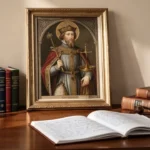
Art commonly portrays Raymond in the white habit and black mantle of a Dominican. He may hold a book representing his legal and theological writings, or be shown with symbols of priestly ministry such as a cross. Some images depict him traveling by sea or riding on a cloak across the water, a legendary scene associated with his attempted journey from Mallorca to Barcelona.
The story behind that image says that Raymond objected to a decision by King James I of Aragon to keep a sinful relationship. When the king refused to allow Raymond to leave Mallorca, Raymond is said to have spread his Dominican cloak on the sea, fastened it to his staff, and crossed the water. The account is part of his devotional tradition and should be treated as a miraculous legend, not as an ordinary historical travel record.
His most established symbols are more closely tied to his actual ministry. A book points to his work in canon law and moral theology. A Dominican habit recalls his religious vocation. A scene of preaching or hearing confession reflects the pastoral service that occupied much of his life.
Book or legal text: his scholarship and influence on canon law.
Dominican habit: his membership in the Order of Preachers.
Cross or preaching gesture: his priestly and missionary ministry.
Sea crossing on a cloak: a traditional miracle associated with his life.
Confessional setting: his concern for penance, conscience, and reconciliation.
The feast day can be a useful occasion to pray for integrity in public and professional life. Someone may ask Raymond’s intercession before a difficult legal decision, a moral dilemma, an examination, or an important conversation involving justice and responsibility. His example points toward patience, accurate judgment, humility, and compassion.
Saint Raymond Nonnatus is a different saint from Raymond of Peñafort. His name, “Nonnatus,” means “not born” or “not born by ordinary delivery,” referring to the tradition that he was delivered by an emergency surgical procedure after his mother had died. Because of this story, he became associated with childbirth, pregnancy, mothers, infants, and unborn children.
Raymond Nonnatus was born in Portell in Catalonia around the beginning of the 13th century. He joined the Order of the Blessed Virgin Mary of Mercy, also called the Mercedarians. The order’s mission included redeeming Christians held captive in Muslim territories, sometimes by collecting money for ransom and sometimes by offering members of the order in exchange for captives.
According to tradition, Raymond traveled to North Africa to negotiate the release of prisoners. When funds ran out, he offered himself as a hostage. While captive, he continued to encourage fellow Christians and preach to others. Accounts of his suffering include imprisonment, hunger, and harsh treatment, although specific details belong partly to devotional tradition.
Stories about his captivity say that his captors pierced or locked his lips to prevent him from preaching. These accounts explain why some images show him with a padlock or a sealed mouth. The symbol represents his determination to witness to his faith under persecution, not a general recommendation to remain silent in ordinary circumstances.
Saint Raymond Nonnatus is commemorated on August 31. People may pray through his intercession for a safe delivery, protection during pregnancy, strength after pregnancy loss, or courage in situations involving medical uncertainty. His patronage is also sought by midwives, obstetric professionals, and people concerned for the welfare of unborn children.
Some devotional practices use a medal, novena, candle, or prayer card bearing his image. These objects are reminders of prayer rather than guarantees of a particular medical result. Anyone facing pregnancy complications should seek prompt care from qualified medical professionals while also turning to prayer according to personal faith.
Medical care comes first: Prayer to Saint Raymond Nonnatus can accompany medical treatment and emotional support, but it should never replace prenatal care, emergency evaluation, or advice from a licensed health professional.
Saint Raymond of Fitero and other namesakes
Saint Raymond of Fitero is another historical figure who may be intended by the name Saint Raymond. He was a Cistercian monk and abbot connected with the defense of the fortress of Calatrava in Castile. His support helped lead to the development of the Order of Calatrava, a military religious order that played a role in medieval Iberian history.
Raymond of Fitero’s life belongs to a period when religious communities were involved not only in prayer and agricultural work but also in the military defense of Christian territories. Modern readers may find that combination unfamiliar, yet it formed part of the political and religious structure of medieval Spain. His commemoration is generally associated with April 15.
There are also blessed and venerable figures named Raymond, as well as saints whose names appear in different languages or forms. A parish may use “Raymond,” “Ramon,” or another regional form. A family devotion may preserve a particular Raymond through a baptismal name, local shrine, religious order, or inherited prayer tradition.
If you need to identify a saint shown in an image, begin with the surrounding clues. Look at the feast date, clothing, objects, location, and stated patronage. A Dominican holding a book is likely Raymond of Peñafort; a religious captive with a lock or chains may be Raymond Nonnatus; a Cistercian connected with a fortress may be Raymond of Fitero.
Check the date printed on the card, calendar, or church bulletin.
Identify the religious habit: Dominican black and white differs from Cistercian white.
Look for objects such as a book, chains, a lock, a cross, or a fortress.
Read the stated patronage, especially if it mentions lawyers, childbirth, captives, or military orders.
Ask the parish, religious community, or publisher if the image remains uncertain.
How to pray with Saint Raymond
There is no single required prayer for every saint named Raymond. The most useful approach is to address God directly and ask for the saint’s intercession and example. You can name the specific need, such as wisdom in a legal matter, strength during pregnancy, reconciliation after wrongdoing, or courage while facing injustice.
A short prayer to Saint Raymond of Peñafort might ask God to give you honesty in judgment, patience in disagreement, and concern for the people affected by your decisions. You could also ask for help in examining your conscience, repairing harm, and seeking forgiveness. These requests reflect the central themes of Raymond’s priestly and legal ministry.
A prayer to Saint Raymond Nonnatus may ask for protection and steadiness during pregnancy, support for medical caregivers, comfort after loss, or strength for people held captive or deprived of freedom. The prayer can acknowledge fear without pretending that difficult circumstances are simple or certain.
A personal prayer may follow this pattern:
Begin by addressing God with reverence and trust.
Name the saint and the quality you seek to imitate.
Describe your need honestly and specifically.
Ask for wisdom, courage, healing, justice, or peace according to the situation.
End by entrusting the outcome to God and remaining open to practical help.
People also honor Saint Raymond through the Our Father, Hail Mary, and Glory Be, the Rosary, a novena, Scripture reading, confession, or participation in Mass. Devotion is strongest when it leads to concrete action. A prayer for justice may call you to tell the truth; a prayer for reconciliation may require an apology; a prayer for a safe birth should be accompanied by appropriate medical care.
Raymond of Peñafort offers a particularly useful example for anyone handling rules, evidence, authority, or confidential information. He suggests that technical skill should be accompanied by humility and concern for conscience. Raymond Nonnatus offers a different witness: faithful service can include sacrifice, endurance, and solidarity with people who are vulnerable or deprived of freedom.
Choosing between these saints does not require certainty about every historical detail. Start with the need that brought you to the name. If the concern is law, moral judgment, confession, or Dominican study, Raymond of Peñafort is the natural choice. If it concerns pregnancy, childbirth, infants, or captivity, Raymond Nonnatus is usually the appropriate patron.
Frequently asked questions
Is Saint Raymond the patron saint of lawyers?
Yes. Saint Raymond of Peñafort is widely recognized as a patron of canon lawyers and is also honored by people working in legal professions. His connection comes from his teaching, pastoral writing, and role in organizing an important collection of medieval Church law. His example emphasizes ethical judgment, careful study, justice, and concern for the people affected by legal decisions.
What is Saint Raymond’s feast day?
The answer depends on which Saint Raymond you mean. Saint Raymond of Peñafort is celebrated on January 7. Saint Raymond Nonnatus is celebrated on August 31, and Saint Raymond of Fitero is generally associated with April 15. The saint’s title, image, or patronage can help identify the correct feast.
Why is Saint Raymond Nonnatus connected with childbirth?
His title, “Nonnatus,” refers to the tradition that he was delivered by an emergency surgical procedure after his mother died. This story led to his association with childbirth, expectant mothers, infants, and unborn children. People may ask his intercession during pregnancy or after loss, while continuing to rely on qualified medical care.
What does Saint Raymond of Peñafort hold in religious artwork?
He is often shown wearing a Dominican habit and holding a book, which represents his work as a canon lawyer, theologian, and pastoral writer. Some images portray him crossing the sea on his cloak, a traditional miracle story associated with his life. A cross or preaching gesture may also symbolize his priestly ministry.














Leave a Reply