If you are looking for a patron saint for a law office, a bar exam, or a difficult case, the short answer is St. Thomas More. He is widely recognized as the patron saint of lawyers, along with statesmen and politicians. His life connects legal skill with conscience, public service, and the responsibility to speak truthfully under pressure.
St. Thomas More is not the only saint associated with the legal profession. St. Ivo of Kermartin, a medieval French priest, judge, and lawyer, is also honored as a patron of lawyers. In some legal and Catholic communities, St. Ivo may be the more traditional choice, especially because he practiced law and served as a judge while caring for people who could not afford representation.
Why St. Thomas More is the patron saint of lawyers
Thomas More was born in London in 1478 and became one of England’s most respected lawyers and public officials. He trained in law, served as a member of Parliament, became a judge, and eventually held the office of Lord Chancellor of England. His career placed him close to the center of political power, but his reputation rested partly on his fairness, learning, and concern for the law.
More’s legal work was shaped by the belief that law should serve justice rather than personal advantage. He was known for taking legal obligations seriously and for treating the law as more than a collection of technical rules. For lawyers, his example raises a practical question: How should professional skill be used when a client’s interests, political pressure, and moral responsibility pull in different directions?
That question became decisive during the reign of King Henry VIII. More disagreed with the king’s effort to reject papal authority and establish the king as the supreme head of the Church in England. More did not lead a public campaign against the king, but he refused to give the required approval. His silence and refusal to swear the oath were treated as disobedience.
More was imprisoned, tried, and executed in 1535. He was canonized by the Catholic Church in 1935. His death is remembered not simply as the death of a political opponent, but as the witness of a lawyer and public servant who would not use his office or words to affirm what he believed was wrong.
The central reason for More’s patronage: St. Thomas More represents the lawyer whose professional abilities remain accountable to conscience, truth, justice, and the proper limits of political power.
His story does not suggest that every legal disagreement is a matter of martyrdom. Most legal work involves negotiation, research, procedure, interpretation, and careful advocacy. More’s example is especially relevant when a lawyer is asked to compromise a fundamental principle, misrepresent facts, misuse authority, or place loyalty to a person above a duty to justice.
Who St. Thomas More was as a lawyer and public servant
More’s legal career developed gradually. He studied at Oxford and later trained in the law, eventually becoming a successful practitioner. He worked in professional and public roles that required careful judgment, including service as a legal adviser and judge. His career showed that faith and legal professionalism were not separate parts of life for him.
He also wrote widely and maintained friendships with scholars, church leaders, and political figures. His education and writing made him a major intellectual figure, but his public reputation was not based only on books. He was valued as someone who could analyze complicated disputes, understand competing claims, and make decisions with attention to both law and fairness.
As Lord Chancellor, More handled important matters of state and law. The office required him to work within a political system dominated by the king. His position demonstrates why he remains relevant to lawyers: legal professionals often work inside institutions they did not create and must balance duties to clients, courts, employers, agencies, and the public.
More’s career also included tensions that should not be simplified. Historical figures can be admired for particular virtues while still being understood in the context of their time. His record as a public official included actions against religious dissenters, and modern readers may find parts of that history troubling. Recognizing this complexity does not erase his importance; it encourages a more honest understanding of what his patronage means.
The strongest lesson is not that More was flawless. It is that professional success does not remove moral responsibility. A lawyer may hold a prestigious position, represent powerful clients, or enjoy the confidence of political leaders and still need to answer to principles beyond career advancement.
What happened during More’s conflict with Henry VIII
Henry VIII wanted his marriage to Catherine of Aragon declared invalid and sought a different relationship with the authority of the Catholic Church. When the pope did not grant the annulment the king wanted, Henry moved toward a settlement in which the English crown claimed supreme authority over the Church in England.
More’s position was cautious rather than theatrical. He resigned as Lord Chancellor in 1532 and largely avoided public attacks on the king. He did not want to provoke conflict, yet he could not affirm the changes required of him. His approach shows that silence can sometimes be a deliberate act of conscience, especially when public speech may create confusion or danger.
Eventually, More was required to take an oath recognizing the king’s authority in religious matters. He refused because he believed the oath contradicted his duties and convictions. After imprisonment and trial, he was convicted of treason. He was executed on July 6, 1535.
For lawyers, the episode highlights several professional pressures:
Confidentiality and careful speech: A lawyer may need to protect lawful confidences and avoid making statements that distort a client’s position or the facts.
Independence from power: Legal judgment should not automatically follow the wishes of a government official, wealthy client, senior partner, or influential organization.
Respect for lawful process: Conscience does not excuse careless procedure, but lawful procedure cannot make dishonesty or coercion morally sound.
Responsibility for formal acts: Signing, filing, advising, and swearing an oath can carry consequences beyond the immediate task.
His final recorded words are often remembered in connection with his faith and his relationship with the king. The larger point is more useful than any single quotation: More sought to remain respectful toward people in authority without pretending that authority could control his conscience.
How St. Ivo became another patron of lawyers
St. Ivo of Kermartin was born in Brittany, in what is now France, around the middle of the 13th century. He studied law and canon law and later became a priest. He is remembered for combining legal knowledge, judicial service, pastoral care, and concern for the poor.
St. Ivo practiced as a lawyer before serving as an official in the Church’s legal administration. He later became a parish priest. Accounts of his life emphasize his willingness to help people who lacked money or social influence, including widows, orphans, and people who could not easily defend their interests.
His association with lawyers comes directly from this work. Unlike a patron chosen mainly because of martyrdom or public office, St. Ivo is closely connected to the everyday legal vocation: listening to disputes, understanding rules, advising clients, deciding cases, and ensuring that vulnerable people are not ignored.
St. Ivo is often called the advocate of the poor. That title reflects the tradition that he offered legal assistance without seeking payment from people who could not afford it. It does not mean that every historical detail in later accounts can be verified equally. It does express the enduring image of a lawyer who viewed legal service as a form of responsibility rather than merely a business transaction.
He is also associated with judges and canon lawyers. His feast day is commonly observed on May 19. The familiar image of St. Ivo may show him in clerical clothing, sometimes with legal documents or other symbols of his profession, reflecting his combined roles as priest and legal professional.
Choosing between the two: St. Thomas More is the best-known answer in the United States and many English-speaking settings. St. Ivo may be the more fitting choice when the focus is legal aid, judging, canon law, or service to clients who lack financial resources.
The two saints offer different but complementary models. More is associated with conscience in public life and resistance to improper pressure. Ivo is associated with competence in legal service and special concern for people who are easily overlooked.
What these patron saints mean for legal ethics
Calling someone a patron saint does not mean that the saint performs legal work for a person or guarantees a favorable verdict. In Catholic practice, a patron saint is a heavenly intercessor and a model whose life can help people reflect on their own responsibilities. Lawyers may ask for a saint’s intercession while also taking the concrete steps that competent legal work requires.
For a lawyer, devotion to St. Thomas More or St. Ivo can support a professional examination of conscience. The question is not simply, “Can I win this matter?” It may also be, “Am I serving this client honestly, protecting the legal process, and treating other people with dignity?”
Several areas of legal ethics connect naturally with the examples of these saints:
Truthfulness: A lawyer should not knowingly mislead a court, opposing counsel, a client, or a third party.
Competence: Good intentions do not replace legal knowledge, preparation, or the need to seek help in unfamiliar areas of law.
Conflicts of interest: Personal gain, family relationships, political pressure, or business interests should not quietly control professional judgment.
Access to justice: St. Ivo’s example encourages attention to people who cannot easily pay for counsel or understand the legal system.
Professional independence: Lawyers need enough independence to give candid advice, including advice a client or supervisor may not want to hear.
Respect for opponents and courts: Strong advocacy does not require personal hostility, humiliation, or abuse of procedure.
These principles apply across practice areas. A criminal defense lawyer may need to protect a client’s rights while acknowledging the limits of the evidence. A family lawyer may need to reduce unnecessary conflict when children are affected. A corporate lawyer may need to explain risks plainly rather than allowing a client to assume that a preferred result is guaranteed.
A lawyer in government service faces related questions. Public authority can be lawful and still be exercised unfairly. More’s example encourages public lawyers to distinguish between the wishes of a political superior and the actual requirements of law. Ivo’s example asks whether legal systems are serving real people, including those who have little money or influence.
How a lawyer might use a patron saint in daily practice
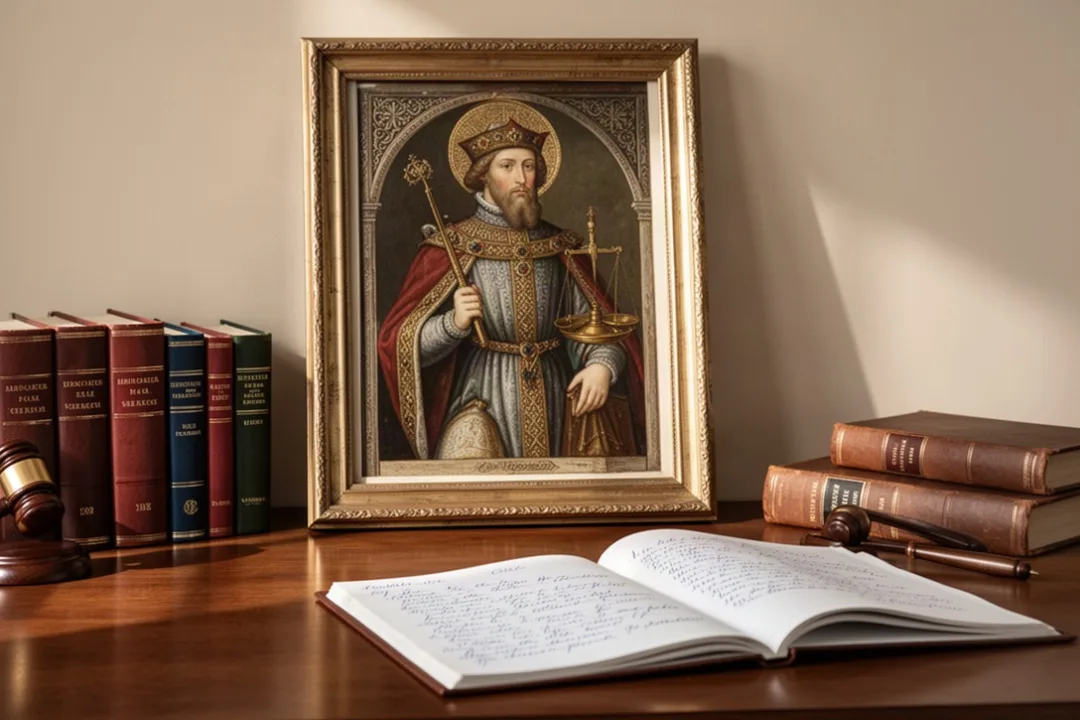
Some lawyers keep an image, medal, prayer card, or small statue of a patron saint in a private office space. Others mark a feast day, attend Mass, ask for prayers before a difficult hearing, or make a donation to a legal-aid organization. These practices are personal and need not be visible to clients or colleagues.
A simple routine can connect devotion with professional conduct:
Before a significant decision, pause to identify the legal duty, the client’s legitimate interest, and the risk of misleading or harming others.
Ask for wisdom and courage, particularly when a client, supervisor, or public official is applying improper pressure.
Check the practical details, including deadlines, evidence, authority, conflicts, and the limits of your advice.
Consider access to justice, such as a reasonable fee arrangement, a referral, pro bono assistance, or a clear explanation of available options.
Review the result honestly, learning from mistakes instead of protecting pride or reputation at the expense of accuracy.
Prayer does not replace legal research, preparation, or compliance with professional rules. Instead, it can remind a lawyer that technical ability is meant to serve a larger purpose. The most meaningful tribute to these saints is often not a symbol on a desk but a habit of honest advice, careful preparation, and respectful advocacy.
Which patron saint should a lawyer choose?
If you want the most widely recognized patron for the legal profession, choose St. Thomas More. His life speaks especially clearly to lawyers who work in government, public policy, constitutional law, or any setting where professional independence and conscience may be tested.
If your work centers on legal aid, judging, church law, or direct service to people with limited resources, St. Ivo of Kermartin may be the more natural patron. His example places legal knowledge at the service of people who might otherwise be unable to obtain a fair hearing.
You do not necessarily have to choose only one. Many Catholics regard both saints as meaningful intercessors because they emphasize different dimensions of the profession. More encourages fidelity to conscience when power demands agreement; Ivo encourages generosity, fairness, and practical service to those in need.
The choice can also reflect a particular stage of a legal career. A law student facing examinations might look to More for discipline and moral clarity. A new associate learning to advise clients might look to Ivo for patience and fairness. A judge might reflect on both: More’s independence and Ivo’s responsibility to the people who come before the court.
For a law firm, bar association, or legal organization, honoring one of these saints can be paired with a concrete commitment. That might include supporting a legal-aid clinic, offering pro bono hours, mentoring students, improving client communication, or reviewing office practices that make representation inaccessible.
In that sense, the question “Who is the patron saint of lawyers?” has a clear answer but a broader purpose. St. Thomas More is the most commonly named patron, and St. Ivo is an important additional patron with a direct connection to legal advocacy and care for the poor. Both invite lawyers to see the profession as a public trust, not only as a way to earn a living.
Ways to honor St. Thomas More or St. Ivo
A lawyer or law student can honor these saints through ordinary professional choices. The practice does not need to be elaborate, expensive, or public. What matters is that the action reflects the values associated with the saint being honored.
Attend Mass or another service on the saint’s feast day, if that fits your religious practice.
Read a reliable biography to understand the saint’s life in its historical setting.
Ask for intercession before an important hearing, negotiation, or ethical decision.
Support a legal-aid program, public defender organization, or other group serving people with limited resources.
Offer pro bono assistance when your professional rules, time, and competence allow it.
Keep a small prayer card or image in a private place as a reminder of professional duties.
Discuss legal ethics with students or colleagues using the saints’ lives as starting points.
For someone seeking a patron for a new practice, a law school group, or a courtroom, St. Thomas More provides a well-known symbol of integrity under pressure. St. Ivo provides a strong symbol of accessible justice and compassionate legal service. Either choice can be meaningful when it leads to conduct that benefits clients, courts, and the wider community.
Frequently asked questions
Is St. Thomas More officially the patron saint of lawyers?
Yes. St. Thomas More is widely recognized in the Catholic tradition as a patron of lawyers, along with statesmen and politicians. His legal career, public service, and refusal to violate his conscience during a conflict with King Henry VIII explain the association. St. Ivo of Kermartin is also traditionally honored as a patron of lawyers and judges.
What is St. Ivo the patron saint of?
St. Ivo is especially associated with lawyers, judges, and canon lawyers. He is also remembered for helping people who were poor or unable to pay for legal representation. His reputation as an advocate for the vulnerable makes him a fitting patron for legal-aid attorneys, public-interest lawyers, and professionals concerned with access to justice.
When is the feast day of St. Thomas More?
The Catholic Church observes St. Thomas More’s feast day on June 22, together with St. John Fisher. St. Thomas More was executed on July 6, 1535, but his liturgical feast is celebrated in June. St. Ivo’s feast day is generally observed on May 19.
Can a non-Catholic lawyer choose St. Thomas More as a patron?
A person does not need to work in a Catholic legal setting to find meaning in More’s example. Non-Catholic lawyers may respect his commitment to conscience, public service, and professional integrity without adopting Catholic devotional practices. Someone seeking a patron saint in the formal religious sense would normally consider the customs of their own tradition.















Leave a Reply