Orthodox saint of the day: how to find today’s commemoration
Orthodox saint of the day: how to find today’s commemoration
The Orthodox saint of the day is the saint or group of saints commemorated by the Church on a particular calendar date.
Orthodox Christians follow a liturgical calendar that remembers the lives, deaths, miracles, teachings, and witness of holy people throughout the year. A daily entry may honor a martyr, bishop, monk, nun, missionary, prophet, apostle, or an entire group of Christians who suffered together. Some days also commemorate a major event in the life of Christ or the Virgin Mary rather than focusing mainly on one saint.
The most useful answer to “Who is the Orthodox saint of the day?” depends on the date, the Orthodox jurisdiction, and the calendar style being used. A Greek, Antiochian, Romanian, Serbian, Russian, or Orthodox Church in America calendar may list the same central feast while differing in the secondary commemorations or in the date observed.
For an accurate daily answer: check the calendar published by your own Orthodox parish, diocese, or jurisdiction. Online lists can be helpful, but local calendars provide the best guide for services, fasting, and name-day observance.
The daily commemoration is not simply a historical birthday list. It places a holy person within the Church’s rhythm of prayer and asks believers to remember how that person responded to Christ in particular circumstances. A saint may have lived in the first century or in recent times, but the commemoration presents that life as spiritually relevant now.
Orthodox Christianity does not understand sainthood as personal perfection in the ordinary sense. Saints are people who received God’s grace and were transformed through faith, repentance, love, prayer, sacrifice, and service. Their stories include different personalities and vocations, yet they point toward the same goal: union with God and faithful participation in the life of the Church.
Many daily calendar entries come from the Synaxarion, a collection of accounts about saints and feasts. The word refers to a gathering or collection, and in practice it can mean the set of commemorations appointed for a given day. A parish may hear a portion of these accounts during Matins, after the dismissal, or through a sermon or bulletin.
A calendar may list several names on one date. One saint may be identified as the principal commemoration, while others are remembered as secondary saints. The list can also include a feast of the Lord, a feast of the Theotokos, the finding or translation of relics, or an icon associated with a particular place.
Martyrs are remembered for remaining faithful despite persecution and death.
Confessors suffered for the faith without necessarily being killed.
Hierarchs are bishops known for teaching, pastoral care, or defending Orthodox doctrine.
Venerable saints often include monks and nuns who pursued prayer and ascetic discipline.
Righteous saints may include married people, parents, rulers, workers, and others who lived holy lives in the world.
Apostles, evangelists, and missionaries are honored for preaching and spreading the Christian faith.
The title attached to a saint’s name gives useful context. “Great-martyr,” “unmercenary,” “fool-for-Christ,” “stylite,” and “wonderworker” are not decorative labels. They describe something about the saint’s life, service, suffering, or spiritual reputation. Reading those titles carefully can help you understand why the person is remembered.
Why Orthodox calendars can show different saints on the same date
The main reason for date differences is the use of two calendar systems. Some Orthodox churches use the Revised Julian calendar or the Gregorian calendar for fixed feasts, while others continue to use the Julian calendar. The difference affects fixed dates, although the calculation of Pascha and related movable feasts follows the Orthodox tradition and is not simply converted like an ordinary civil date.
For a reader using the civil calendar in the United States, a fixed feast listed under a Julian-calendar date may appear on a different civil date from the same feast in a Revised Julian calendar. That does not necessarily mean the churches disagree about the saint. They may be observing the same commemoration according to different calendar practices.
Jurisdictions can also arrange their calendars differently. A saint may be especially prominent in one local tradition because of a connection to a region, monastery, parish, or national Church. Another calendar may include the same person in a longer list but give greater attention to a different saint.
There is also a difference between a liturgical calendar and a general list of saints. A liturgical calendar tells you what the Church commemorates on a date and may identify the hymns, readings, fasting rule, or services. A general list might contain many saints associated with that date without showing which commemoration has priority in worship.
When two calendars appear to conflict, compare the following details before assuming that one is incorrect:
Check whether both calendars use the same civil date.
Look for a note identifying the calendar style or jurisdiction.
See whether one list is naming the principal feast while the other gives all commemorations.
Confirm the spelling and form of the saint’s name, since transliteration varies.
Ask your parish which calendar governs its services and fasting guidance.
Names may look different even when they refer to the same saint. For example, a Greek name may be rendered differently in English, Russian, Romanian, Arabic, or Serbian. Search results can therefore become confusing if you rely only on spelling. The saint’s title, feast date, place of origin, and associated monastery often provide a more reliable identification.
How to find the Orthodox saint of the day reliably
Start with your parish or diocesan website. Many parishes publish a daily calendar, a monthly calendar, or a link to the calendar of their governing jurisdiction. This source is usually the best choice because it matches the services you can actually attend and the pastoral guidance you receive.
Established Orthodox jurisdictions and monasteries also publish calendars. Look for a calendar that clearly states whose calendar it follows, whether the date is civil or ecclesiastical, and whether it includes the daily fasting rule. A website that gives only a name without identifying its source may be less useful for serious study.
Printed church calendars remain valuable as well. They often include saints, feast days, fasting instructions, Scripture readings, and major services in one place. A printed calendar can be especially useful for households that want a visible reminder of the Church year rather than a quick daily search.
When looking up a date online, use a specific search phrase such as “Orthodox calendar [month] [day]” together with the name of your jurisdiction. You can also search for the saint’s name plus “Orthodox feast day,” but verify the result against an official or parish source.
A dependable daily entry normally provides more than a name. It may include:
the saint’s full name and title;
the date and calendar system;
a short account of the saint’s life;
the major feast or feasts of the day;
the appointed fasting guidance;
the Scripture readings and service information;
the saint’s troparion or kontakion, when available.
Some websites use “today” according to the server’s location rather than your own time zone. Near midnight, the displayed date can be different from the date where you live. If the result matters for attending a service, observing a fast, or celebrating a name day, check the calendar date directly rather than relying on a homepage label.
Do not treat a search snippet as the whole calendar. A search engine may display one prominent saint while leaving out the principal feast, the local calendar distinction, or the other commemorations appointed for that day.
How to use the daily saint in prayer and worship
Learning the saint’s name is only the beginning. The daily commemoration can become a simple pattern for prayer: read a brief account, identify one virtue or struggle, and ask God for help in applying that example to your own circumstances. The point is not to imitate every external detail of a saint’s life. A hermit’s practice, for example, cannot be copied literally by someone caring for children or working full time.
Begin by reading the saint’s life from a trustworthy Orthodox source. Pay attention to the historical setting and to the saint’s relationship with the Church. Short online biographies sometimes compress legends, local traditions, and documented history into a few sentences. A longer account may explain what is known, what is traditionally reported, and why the saint is honored.
Then read the saint’s liturgical hymn if one is available. The troparion often identifies the central spiritual quality associated with the saint, while the kontakion may present the saint’s witness in poetic form. These hymns are not merely summaries; they are prayers that interpret the saint’s life through the Church’s worship.
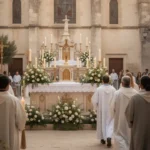
Attending the Divine Liturgy or another service is the fullest way to observe a major feast. The service places the saint’s memory alongside the Eucharist, the readings, the hymns, and the prayers of the whole Church. If a feast falls on a weekday and you cannot attend, you can still mark it by reading the day’s commemoration and offering a brief prayer.
A practical home observance might include these steps:
Identify the saint and confirm the calendar date with a reliable source.
Read a short biography without rushing through unfamiliar names or places.
Look up the day’s Gospel or Epistle reading if your parish provides it.
Pray for the saint’s intercession and for the needs of your family, parish, and community.
Choose one concrete quality to practice, such as patience, generosity, courage, or repentance.
Mark a major feast by attending services, speaking with your priest, or sharing a suitable meal.
Orthodox Christians ask saints to pray for them because the saints are alive in Christ and remain members of the Church. This does not replace prayer to God. Instead, it reflects the Orthodox understanding of the Church as a communion that includes the faithful on earth and those who have entered the presence of God.
The saint of the day can also guide intercession. On the commemoration of a physician saint, you might pray for patients and medical workers. On the feast of a missionary, you might pray for people who preach, teach, translate, or serve across cultures. On the day of a martyr, you might remember Christians and other people facing persecution or violence.
How name days relate to the saint of the day
In many Orthodox cultures, a person’s name day is connected to the saint whose name they received at baptism or whose protection their family chose. The name day is often treated as a spiritual celebration, sometimes with church attendance, a family meal, hospitality, and greetings for the person commemorating the saint.
Name-day customs vary widely. Some families celebrate on the feast of the saint for whom a person was named. Others observe the nearest or most prominent saint with that name, especially when several saints share it. A person may also have a baptismal name that differs from the name used in daily life, so the parish priest is the right person to ask about the local custom.
The civil birthday and the name day have different meanings. A birthday marks the beginning of a person’s earthly life. A name day points to a relationship with a patron saint and invites the person to remember the Christian calling associated with that name. Neither celebration needs to be treated as a competition or as a measure of spiritual achievement.
If you are unsure which saint is connected with your name, do not rely on an automatic name-day website alone. Ask your family, parish priest, or godparent, and check how your jurisdiction handles names that have multiple forms. Transliteration and language can create several English spellings for one traditional name.
A respectful name-day greeting can be simple: wish the person many years, ask for the saint’s prayers, or mention a virtue associated with the saint. The celebration can include ordinary hospitality, but the religious meaning remains central: the saint is remembered as a model and intercessor, not as a replacement for the person’s own relationship with God.
What to read and remember about a daily saint
Not every calendar entry provides a long biography, and not every saint’s life can be understood from a few dramatic details. Some saints are remembered through a single event, a short hymn, or a local tradition. Others have extensive writings, historical records, monasteries, relics, or pilgrimage sites associated with them.
When reading, ask several careful questions. What did this person believe? What pressures did the saint face? How did the saint respond to other people? What kind of prayer, service, repentance, or courage appears in the account? These questions keep the focus on Christian life rather than on unusual stories alone.
It is also wise to distinguish veneration from worship. Orthodox Christians worship God alone. They venerate saints by honoring them as faithful servants of God, asking for their prayers, keeping their feasts, and respecting their icons and relics. This distinction is basic to Orthodox teaching about the saints.
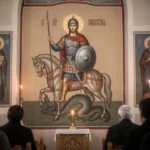
Icons show the saint within the light of God’s Kingdom rather than serving as ordinary portraits. If you keep an icon of the day’s saint at home, you can place it where you pray, light a candle where that is customary and safe, or simply pause before it and remember the saint’s witness. The outward practice should support prayer rather than become an object of superstition.
Some daily commemorations are joyful, while others recall martyrdom, death, exile, or suffering. The Church does not present suffering as good in itself. It remembers the faith, love, and hope with which a saint endured suffering, while continuing to pray for peace, healing, justice, and protection for those who are in danger.
The calendar therefore offers more than a new name every morning. It gives you a year-round pattern of Christian memory. Saints from different centuries, countries, languages, and walks of life appear together in worship, reminding the Church that holiness can take many forms while remaining centered on Christ.
For a daily practice that is manageable, choose a consistent source, spend a few minutes with the commemoration, and let the saint’s example shape one action. Attend the feast when you can, follow your parish’s guidance on fasting, and ask questions when calendar dates or name-day customs are unclear. That approach keeps the Orthodox saint of the day connected to prayer, worship, and real life.
Frequently asked questions
Is there only one Orthodox saint of the day?
Usually not. Orthodox calendars commonly list a principal commemoration along with several other saints, feasts, apostles, martyrs, or events. A website may highlight one name for convenience, but the complete liturgical calendar can contain many entries. Your parish calendar can show which commemoration receives the greatest attention in local worship.
Why does the Orthodox saint of the day change between websites?
Different websites may follow different jurisdictions, calendar systems, or levels of detail. One may use the Revised Julian calendar, while another uses the Julian calendar for fixed feasts. Some pages list only the major saint; others include every commemoration. Check the source, date system, and jurisdiction before comparing results.
How do I find my Orthodox name day?
First identify the saint connected with your baptismal or Christian name. Then ask your parish priest, family, or godparent which feast date your tradition observes. Several saints may share a name, and different languages may use different forms. Local customs determine whether one particular saint is treated as your patron.
Can I pray to the Orthodox saint of the day at home?
Yes. You can read the saint’s life, use the day’s troparion when available, and ask the saint to pray for you and others. You may also attend a service or observe the feast according to your parish’s practice. Orthodox prayer remains directed to God, while saints are honored as faithful members of the Church who intercede.










Leave a Reply