You may be searching for today’s readings because Mass is coming up, you want to begin a daily Bible habit, or you heard a passage and would like to read it in context. The quickest answer is to use a reliable Catholic daily-Mass source, confirm the date and liturgical celebration, then read the passages slowly rather than treating them as disconnected quotations.
The readings assigned for a particular day usually include an Old Testament or Acts reading, a psalm, a New Testament reading, and a Gospel. The exact selection depends on the liturgical calendar, the season, the saint or feast being celebrated, and whether the day is a Sunday, weekday, solemnity, or special occasion.
In a Catholic setting, “today’s readings” most often refers to the Scripture proclaimed at the daily Mass. A weekday may have a first reading, a responsorial psalm, an optional or prescribed Gospel acclamation, and a Gospel. Sundays and major feast days normally have more readings, including a second reading from the New Testament.
The phrase can also mean something broader: a personal Bible-reading plan, the readings used by a particular Christian denomination, or the passages assigned by a parish bulletin. Those options do not always match. If you are attending a specific church, the safest choice is to check that church’s bulletin or its official website.
For Catholic readings in the United States, you can generally find the correct selections through the United States Conference of Catholic Bishops, your diocesan website, a parish bulletin, or a reputable daily-Mass resource. Some websites display the full text, while others list references and provide a brief reflection.
Check the celebration before reading. Two churches in the same city may use different readings if one is celebrating a patronal feast, dedication, wedding, funeral, or another approved liturgy.
How the Catholic liturgical calendar determines the readings
The Catholic Church organizes its public worship around the liturgical year, not the January-to-December calendar alone. The major seasons are Advent, Christmas, Lent, the Easter season, and Ordinary Time. Each season gives the readings a different emphasis, so a passage is easier to understand when you know where it falls in that larger pattern.
Advent often directs attention toward hope, preparation, the prophets, and the coming of Christ. Christmas readings focus on the incarnation and the identity of Jesus. Lent emphasizes conversion, covenant, repentance, and preparation for baptism and Easter. During the Easter season, Acts and the Gospel accounts highlight the risen Christ, the mission of the apostles, and the work of the Holy Spirit.
Ordinary Time is not a period when nothing significant happens. The term refers to numbered weeks, and the readings commonly develop a sustained Gospel narrative. Depending on the year and the calendar, you may hear a Gospel read in a fairly continuous sequence, with first readings chosen to illuminate or complement it.
Why Sundays and weekdays use different cycles
Sunday Mass readings follow a three-year cycle traditionally identified as Years A, B, and C. The Gospel selections in each year give particular attention to Matthew, Mark, or Luke, while John appears prominently at certain seasons and on major celebrations. The Sunday cycle helps the congregation hear a broad selection of Scripture over time.
Weekday readings follow a separate two-year pattern, often identified as Year I and Year II. The cycle changes according to the liturgical year. A weekday reading may therefore differ from the passage heard on the previous Sunday, even if both are part of the same season.
Feasts and solemnities can take priority over the ordinary weekday sequence. When that happens, the readings are chosen for the saint, mystery, or event being celebrated. This is why searching only by the date may not be enough; you also need to verify the liturgical rank of the day.
Where to find accurate readings for today
A search result can lead you to several versions of the same passage, but not every page is equally reliable. Start with a source connected to a bishop’s conference, diocese, parish, religious community, or established Catholic publisher. Look for the date, liturgical season, celebration name, and reading references on the page.
Official Catholic sources: These are useful for confirming the assigned references and the U.S. calendar.
Your parish bulletin: This may reflect a local feast, a special liturgy, or a different Mass from the one you plan to attend.
Diocesan websites: These can be particularly helpful when a local patronal feast or diocesan celebration changes the usual schedule.
Printed missals: A daily or annual missal is practical when you want to pray without a phone or computer.
Prayer and Bible apps: These may provide reminders, audio readings, reflections, and bookmarking, but check that the calendar is set to your location.
Be careful with pages that combine several traditions without identifying them clearly. A general Bible app may show a reading plan rather than the Catholic Mass readings. A website based in another country may use a different calendar, language edition, or local observance.
The liturgical date can also be affected by your time zone. A reading displayed after midnight may belong to the new calendar date even though you are preparing for an evening Mass celebrated as part of the previous day’s observance. For a Sunday vigil, parish information is usually more useful than a generic date search.
What each part of the daily Mass readings does
The readings are arranged as a liturgical act, not simply as a list of Bible passages. Each part has its own role, and noticing that role can help you read with greater attention.
The first reading connects faith with Israel and the early Church
On most weekdays, the first reading comes from the Old Testament. It may describe creation, the history of Israel, the wisdom tradition, the prophets, or the experience of exile and restoration. During the Easter season, the first reading often comes from Acts of the Apostles, showing how the early Christian community responded to the resurrection.
Ask what situation the passage addresses. Is the speaker offering a warning, recalling a promise, leading a prayer, or interpreting a crisis? A short historical note can prevent a common error: treating an ancient passage as though it were written directly to a modern audience without a particular setting.
The responsorial psalm gives the assembly a prayerful response
The psalm is not merely an intermission between readings. It allows the congregation to answer the first reading with praise, sorrow, trust, thanksgiving, or a plea for help. The repeated response gives the assembly a simple way to participate, even when the language of the first reading is unfamiliar.
When praying at home, read the psalm twice. The first reading helps you hear its overall movement; the second lets you notice the repeated response and the emotion beneath the images. You do not need to force the psalm into a cheerful mood. Some psalms express grief, fear, anger, or confusion while still turning toward God.
The second reading often develops Christian life and belief
On Sundays and major celebrations, the second reading usually comes from an apostolic letter or another New Testament book. It may address a community’s divisions, explain the meaning of Christ’s death and resurrection, describe Christian freedom, or offer practical guidance about love, worship, suffering, and hope.
Letters can be difficult because a passage may begin or end in the middle of an argument. Read a few verses before and after the assigned section when possible. Look for the central problem, the author’s main claim, and the response being asked of the community.
The Gospel presents the central proclamation of the liturgy
The Gospel receives a distinctive place in the Mass because it proclaims the words and works of Jesus. The surrounding acclamations and gestures express reverence, but the meaning is not limited to the ceremony. The Gospel invites you to notice how Jesus sees people, responds to conflict, calls disciples, heals, teaches, and reveals the kingdom of God.
Rather than searching immediately for a personal slogan, first ask what happens in the passage. Who is present? What changes? What question remains unresolved? This approach respects the text before applying it to your own circumstances.
How to understand today’s readings together
The readings do not always tell one continuous story. Sometimes the connection is direct: a prophecy is read alongside its fulfillment, or an Old Testament image reappears in the Gospel. At other times, the readings share a theme such as mercy, covenant, wisdom, discipleship, judgment, or trust.
Begin by identifying one repeated word or idea. Then ask whether the readings develop it in the same way. For example, one passage may portray faith as patient waiting, while another shows faith through action. The relationship may be a contrast, a development, or a shared response to a human need.
Historical context matters, but it should serve prayer rather than replace it. Learn enough to understand the setting, audience, and genre. A prophetic warning, a wisdom saying, a parable, a hymn, and a letter should not all be read as if they use language in the same way.
Pay attention to who is speaking and who is being addressed. A statement made by a character in a biblical story is not automatically a direct command to every reader. The Church reads Scripture within the whole canon, the tradition of faith, and the worship of the community.
“Your word is a lamp for my feet.” — Psalm 119:105
This reference expresses a useful attitude toward daily readings: Scripture may offer enough light for the next faithful step without answering every question at once. Read patiently, and allow the passage to remain challenging where the text itself is challenging.
A practical routine for praying with today’s readings
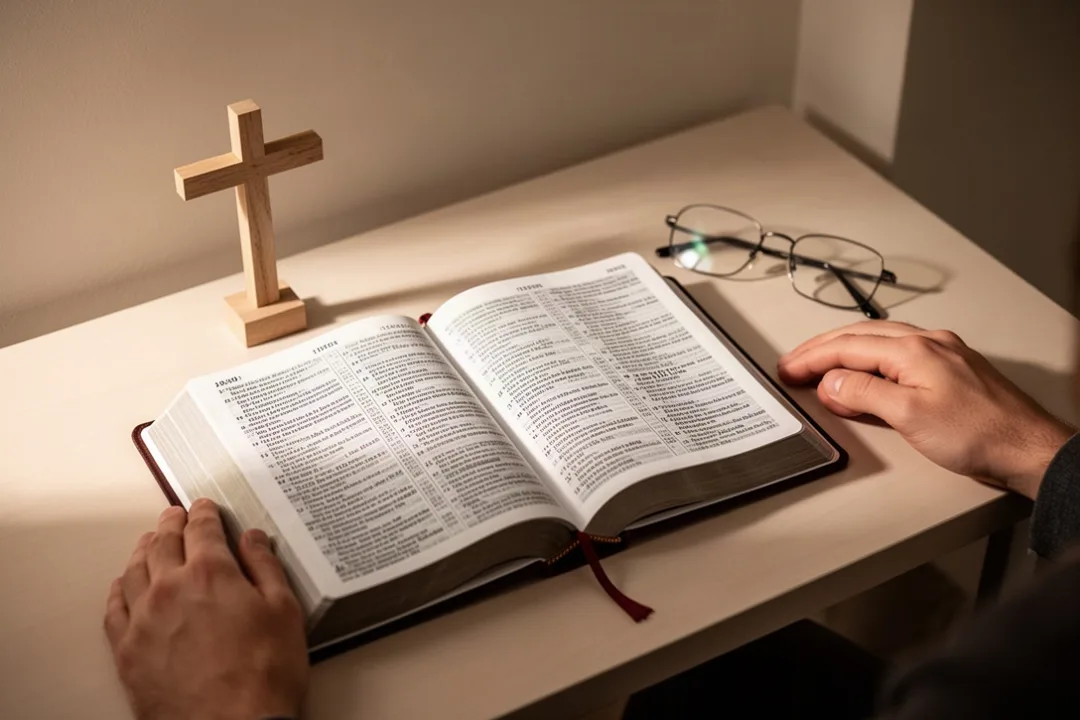
You do not need a long study session to pray with the daily readings. A consistent 10- to 15-minute routine can be more fruitful than occasionally attempting several chapters without attention. Choose a time when you can be quiet, even if the routine happens on a commute, during a lunch break, or before bed.
Confirm the date and celebration. Make sure you are reading the correct weekday, Sunday, feast, or local observance.
Read every assigned passage once. Notice the overall movement without stopping to solve every difficulty.
Read the Gospel again. Observe one action, question, command, or response that stands out.
Compare the readings. Identify one connection, contrast, or repeated theme.
Pray in your own words. Speak honestly about what the passages bring to mind.
Choose one response. Let the reading shape a concrete act of patience, honesty, mercy, attention, or service.
A short journal entry can make the practice more personal. Write the date, one phrase in your own words, one question, and one response. Avoid copying a verse as though the copied words alone were the reflection; explain what you think the passage is asking you to see or do.
If a passage is troubling, do not rush to a conclusion. Mark it, consult a trustworthy commentary, and compare it with related passages. Prayerful reading includes humility, patience, and willingness to learn, especially when a text does not fit your first interpretation.
Try the “one connection, one prayer, one response” method. Name one link among the readings, turn it into a brief prayer, and select one specific way to live that prayer today.
Common mistakes when searching for daily readings
Most problems with daily readings are easy to prevent. The issue is usually not the Bible itself but an incorrect date, a mismatched calendar, or a reading taken out of context.
Using yesterday’s page: This can happen when a browser keeps an old tab open. Check the date and celebration each time.
Confusing a reading plan with Mass readings: A devotional plan may assign chapters that are not proclaimed at Mass.
Ignoring local celebrations: A parish feast, dedication, or special liturgy can replace the ordinary weekday readings.
Reading only the Gospel: The Gospel is central, but the first reading and psalm often deepen its themes.
Taking one line out of context: Read the surrounding paragraph and identify the speaker before drawing a conclusion.
Assuming every translation is identical: Wording varies among approved translations and languages, while the reference remains the same.
Treating a reflection as the meaning of the passage: A reflection may be helpful, but it is an interpretation rather than the biblical text itself.
Trying to solve every question immediately: Mark difficult points and return to them with a commentary or guidance from a priest, deacon, or qualified teacher.
Another common mistake is expecting every reading to provide an immediate personal message. Some passages first teach you about God, a community, a historical crisis, or the consequences of human choices. Personal application is strongest when it grows from what the passage actually says.
How to read difficult passages responsibly
Some daily readings include violence, harsh judgment, complex family relationships, or laws from a very different historical setting. Avoid reducing these passages to a single sentence. Ask how the selection fits its book, its audience, and the broader movement of Scripture.
Genre is a helpful starting point. Poetry uses images and parallel lines; narrative reports actions without approving everything every character does; wisdom literature often presents general patterns rather than guarantees; apocalyptic writing uses vivid symbols. Recognizing the form changes how you interpret the words.
It can also help to distinguish description from instruction. A biblical story may describe betrayal, war, or injustice without presenting that behavior as a model. Likewise, a passage addressed to a particular ancient community may require careful interpretation before it can be applied to a modern situation.
Use sources that explain context without treating Scripture as a collection of isolated sayings. A Catholic study Bible, parish formation resource, diocesan commentary, or guidance from a knowledgeable clergy member can help. When a question involves serious moral, pastoral, or emotional consequences, seek personal pastoral advice rather than relying on a quick search result.
How families and groups can use today’s readings
Families do not need to conduct a formal Bible study every day. One person can read the Gospel aloud, and each participant can name one detail they noticed. Younger children may respond better to a question about a character’s choice or feeling than to an abstract theological question.
For a small group, distribute the readings in advance and agree on a simple structure. Begin with silence, read the passages, allow each person to share one observation, and then discuss one question. Keep interpretation connected to the text rather than allowing the conversation to become a general debate about current events.
What does this passage reveal about God, Jesus, or the people involved?
What human need, conflict, or hope appears in the reading?
Where do the first reading, psalm, second reading, and Gospel meet?
What part of the passage is difficult to understand or accept?
What response would be faithful and specific rather than merely abstract?
Listening is part of group prayer. A person may notice a detail that others missed, while another may have a question that prevents the group from making an overly quick interpretation. The goal is not to produce the cleverest comment but to read attentively and respond faithfully.
How daily readings can become a lasting habit
Choose a reliable source and keep it in one predictable place. If you use a printed missal, leave it near your prayer space. If you use an app, enable only the reminders that genuinely help; too many notifications can turn the practice into something you dismiss automatically.
Link the reading to an existing habit, such as morning coffee, a daily train ride, or the time before dinner. Start with a manageable commitment: reading the Gospel each day, or reading all the assigned passages three times a week. A routine that survives busy days is more valuable than an ideal plan that lasts only a week.
When you miss a day, simply begin with the current readings. You do not need to catch up on every passage before returning. The liturgical calendar offers a continuing rhythm, and the purpose of daily prayer is not to create a burden of unfinished tasks.
Over time, keep track of themes that recur. You may notice that a passage heard in Lent sounds different when remembered during Easter, or that a psalm expresses a prayer you have encountered in several circumstances. This kind of recollection helps Scripture become part of your language for worship, discernment, and ordinary life.
When today’s readings do not match what you hear at church
If the online page differs from the readings proclaimed at Mass, first check the date, time zone, and country. Then confirm whether the parish is celebrating a feast, a votive Mass, a funeral, a wedding, a confirmation, or another special liturgy. The parish’s printed or digital bulletin normally gives the most relevant information for that service.
Differences may also come from the lectionary edition or from a shortened option permitted for a particular celebration. A missal may show several choices while the celebrant selects one approved set. This does not necessarily mean that the parish or website is wrong.
For a serious question, compare the reading reference rather than only the wording. Different approved translations can sound noticeably different, but the biblical book and chapter-and-verse reference will show whether you are looking at the same passage.
Reading today’s assigned passages is a simple way to share in the Church’s prayer beyond the walls of a parish. The practice becomes more meaningful when you verify the celebration, attend to the readings as a whole, and let prayer lead to a specific response.
Frequently asked questions
Are today’s readings the same in every Catholic church?
Not always. The regular lectionary creates a common pattern, but a parish may celebrate a local patron, dedication, funeral, wedding, or another special liturgy. National calendars and approved translation editions can also differ. Check the bulletin or website of the church you plan to attend when you need the exact readings for a particular Mass.
Should I read the Bible passages before or after attending Mass?
Either works. Reading beforehand helps you listen for familiar words and follow the proclamation. Reading afterward gives you time to revisit a phrase that stood out during worship. Many people find that reading the Gospel before Mass and reviewing all the readings later creates a useful balance between preparation and reflection.
What should I do if I do not understand today’s Gospel?
Read the surrounding verses, identify the people and situation, and consider the passage’s literary form. Then consult a trustworthy Catholic commentary, study Bible, priest, deacon, or trained catechist. Write down the question instead of forcing an immediate answer. Some passages become clearer through repeated reading and comparison with related biblical texts.
Can I use today’s readings for personal prayer even if I am not attending Mass?
Yes. The readings can provide a structured way to pray with Scripture at home, while traveling, or during a quiet break. Read them slowly, notice a shared theme, and respond in your own words. If you are preparing for a specific service, use the parish’s information to confirm that your prayer matches the celebration.









Leave a Reply