St Maximilian Kolbe gave his life for a fellow prisoner at Auschwitz, turning an act of Christian charity into one of the most remembered martyrdoms of the 20th century.
St Maximilian Maria Kolbe was a Polish Conventual Franciscan friar, priest, publisher, missionary, and martyr. He was born Raymond Kolbe on January 8, 1894, in Zduńska Wola, Poland, and received the religious name Maximilian when he entered the Franciscans.
His life combined intense devotion to the Virgin Mary with practical work. He founded the Militia of the Immaculata, established large religious communities, published Catholic newspapers and magazines, and served as a missionary in Japan. His story is not only about his death in a concentration camp; it is also about how he understood faith as something to be practiced through prayer, communication, service, and courage.
Kolbe died at Auschwitz on August 14, 1941. Pope John Paul II canonized him as a saint on October 10, 1982, recognizing him as a martyr of charity. His feast day is August 14, the day before the Catholic Church celebrates the Assumption of the Blessed Virgin Mary.
The central fact: When a prisoner was selected to die in retaliation for an escape, Kolbe stepped forward and offered to take his place because the condemned man had a wife and children.
St Maximilian Kolbe’s life in major stages
1894: Raymond Kolbe was born in central Poland.
1907: He entered the Franciscan seminary in Lviv with his brother Francis.
1910: He began his novitiate and took the religious name Maximilian.
1912–1919: He studied in Rome, earned doctorates in philosophy and theology, and was ordained a priest in 1918.
1917: He and several other friars founded the Militia of the Immaculata.
1922: He began publishing the magazine Rycerz Niepokalanej, or The Knight of the Immaculate.
1927: He founded Niepokalanów, a major Franciscan center near Warsaw.
1930–1936: He served as a missionary in Japan and established a friary and publishing apostolate in Nagasaki.
1939–1941: After Nazi occupation and arrest, he continued serving prisoners and fellow friars when possible.
1941: He died at Auschwitz after volunteering to take another prisoner’s place.
1982: Pope John Paul II canonized him as a saint.
How Kolbe’s devotion to Mary shaped his work
Kolbe’s spirituality centered on the Immaculate Virgin Mary. In Catholic teaching, the Immaculate Conception refers to Mary being preserved from original sin from the beginning of her life. Kolbe saw Mary as a model of complete openness to God and as someone who leads Christians toward Jesus rather than away from him.
His Marian devotion was active rather than merely sentimental. He believed that Christians should place their talents, decisions, and daily work at God’s service through Mary’s intercession. That conviction influenced his preaching, publications, missionary work, and approach to community life.
Kolbe used the title “Immaculate” frequently because it expressed the mission of the organization he founded. The Militia of the Immaculata was intended to encourage people to seek conversion, deepen their Christian faith, and bring others closer to Christ through Mary’s example.
For Kolbe, Marian consecration did not mean withdrawing from ordinary responsibilities. It meant allowing prayer to shape concrete choices. His printing presses, educational projects, international missions, and care for prisoners all grew from the same spiritual purpose.
What the Militia of the Immaculata meant
The Militia of the Immaculata began in Rome in 1917, when Kolbe and fellow friars formed a movement devoted to Mary and evangelization. Its members sought personal holiness and aimed to help others encounter the Christian faith.
The movement was not a military organization in the ordinary sense. “Militia” described disciplined spiritual commitment: prayer, conversion, service, and a willingness to defend human dignity and Christian truth through peaceful means.
Members traditionally made Mary central to their spiritual life and sought to live with greater consistency. The movement’s practical emphasis can be expressed through several commitments:
Personal conversion: examining one’s life and turning away from sin.
Prayer: asking for God’s grace and Mary’s intercession.
Evangelization: sharing Christian truth through words and example.
Service: responding to the needs of other people.
Perseverance: remaining faithful during hardship rather than treating faith as an occasional interest.
Kolbe did not regard apostolic work as the responsibility of priests alone. He wanted laypeople and religious communities to use their gifts responsibly. In that respect, the Militia of the Immaculata anticipated forms of organized Catholic evangelization that combined personal devotion with public communication.
Why Kolbe used newspapers, radio, and technology
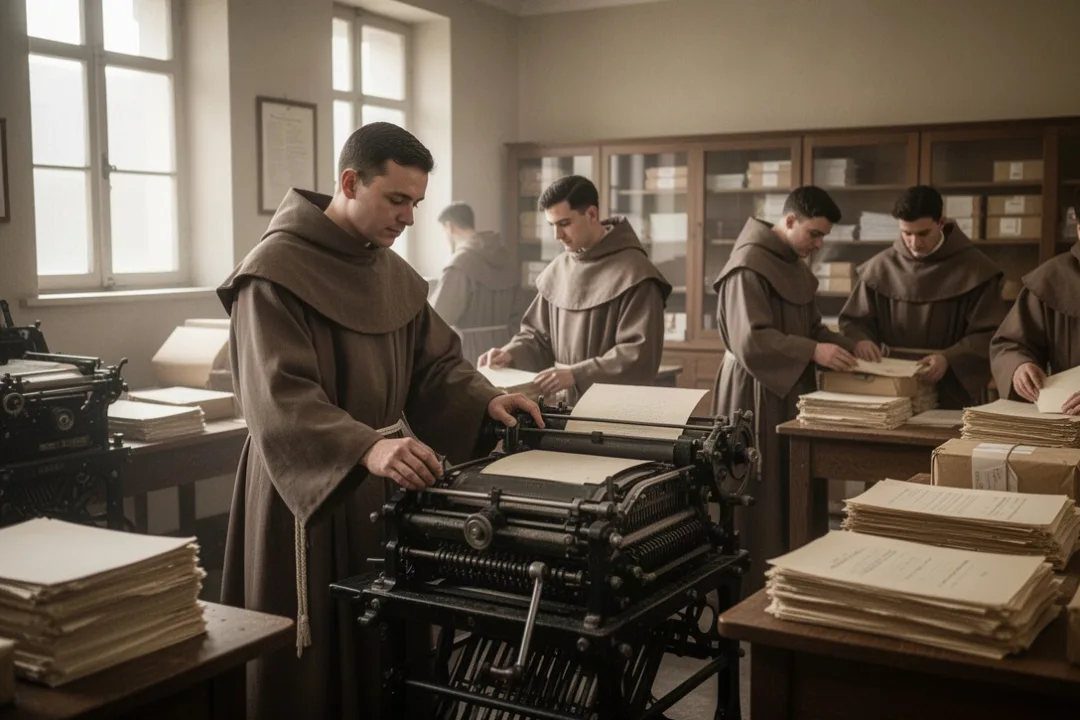
Kolbe understood that the tools of communication could influence public life for good or for harm. He therefore treated printing and mass communication as instruments of evangelization. His publications addressed Catholic doctrine, moral questions, current events, and practical religious life.
At Niepokalanów, the friars developed a substantial publishing operation. The community produced religious periodicals and reached a broad readership. Kolbe’s approach was unusual for some religious leaders of his period because he took modern media seriously without assuming that technology was automatically either virtuous or dangerous.
His principle was simple: a tool should be judged by the purpose it serves. Printing presses, photography, radio, and other technologies could spread confusion, but they could also communicate truth, strengthen families, and help people think about faith.
That lesson remains relevant for anyone who communicates publicly. Kolbe’s example suggests that Christian communication should be:
Truthful: avoiding exaggeration, manipulation, and deliberate falsehood.
Clear: presenting ideas in language ordinary people can understand.
Responsible: considering how messages affect vulnerable people and communities.
Constructive: correcting error without treating opponents as less than human.
Connected to action: allowing communication to lead toward service rather than mere argument.
For this reason, Kolbe is often remembered by Catholic communicators, journalists, publishers, and evangelists. His legacy is not a command to use every available platform. It is a challenge to use communication with integrity and a genuine concern for the people receiving it.
What Niepokalanów was and why it mattered
In 1927, Kolbe founded Niepokalanów, sometimes translated as the “City of the Immaculate.” It became a large Franciscan religious community near Warsaw and served as a center for prayer, formation, publishing, and charitable work.
Niepokalanów reflected Kolbe’s belief that spiritual life and organized work could support each other. The friars followed a disciplined schedule of prayer, study, manual labor, and apostolic activity. The community’s success depended not simply on Kolbe’s energy, but on cooperation among many friars with different responsibilities.
The settlement also demonstrated his interest in serving people at scale. Instead of limiting religious work to individual conversations, Kolbe used a community and its resources to produce publications, train workers, and respond to public needs.
His leadership had both strengths and limitations. He was energetic, demanding, and willing to pursue ambitious projects, but he also lived in a period marked by strong religious, political, and cultural conflicts. Reading his life responsibly means appreciating his heroic virtues while recognizing that his historical setting was more complicated than a simple success story.
Kolbe’s mission in Japan
Kolbe traveled to Japan in 1930 with several fellow friars. In Nagasaki, they established a friary called Mugenzai no Sono, commonly translated as the Garden of the Immaculate, and began publishing a Japanese-language Catholic magazine.
The mission faced language barriers, financial difficulties, cultural differences, and the challenge of presenting Christianity in a country where Catholics were a minority. Kolbe’s work there showed that his interest in media was not limited to Poland. He believed publications could support personal evangelization and provide accessible religious instruction.
The friary later became known for surviving the atomic bombing of Nagasaki in 1945 because of its location on the opposite side of a mountain from much of the destruction. That survival occurred after Kolbe had returned to Poland and should not be presented as something he personally witnessed or caused.
His Japanese mission also reveals a practical side of his spirituality. He did not simply ask people to adopt a foreign religious culture. He worked through local language and local circumstances, seeking forms of communication that people could actually receive.
What happened to Kolbe under Nazi occupation
Germany invaded Poland in September 1939, beginning the Second World War in Europe. Nazi authorities arrested Kolbe and other friars more than once. He was eventually arrested again in February 1941, partly because of the publishing and charitable activity connected with Niepokalanów.
Kolbe had helped people who were suffering under occupation, including Jewish refugees. Such assistance placed religious communities under serious danger. After his arrest, he was first held at Pawiak prison in Warsaw and then transported to Auschwitz in May 1941.
At Auschwitz, prisoners experienced forced labor, starvation, disease, violence, and systematic dehumanization. Kolbe was assigned prisoner number 16670. Accounts of his time in the camp describe him continuing to pray and encourage others despite brutal conditions.
His actions should be understood within the wider history of Nazi persecution. Auschwitz was not simply a difficult prison. It was part of a system of concentration camps and mass murder. Kolbe’s death took place inside that system, which targeted people for racial, political, religious, and other reasons.
How Kolbe took another prisoner’s place
In late July 1941, a prisoner escaped from the camp. In retaliation, the guards selected ten prisoners to die in a starvation bunker. One of those chosen, Franciszek Gajowniczek, cried out that he had a wife and children.
Kolbe then stepped forward and offered to die in his place. He was not the prisoner’s relative, and the two men had not formed a long friendship. The act was a deliberate choice to protect another human being who was facing death.
The guards accepted the substitution. Kolbe and the other selected prisoners were confined without food or water. Witnesses later reported that Kolbe helped lead prayer and singing during the ordeal. After about two weeks, he was still alive, so camp authorities killed him with a lethal injection on August 14, 1941.
Read the story accurately: Kolbe did not escape death or defeat the camp by force. His freedom consisted in choosing an act of love under conditions designed to strip prisoners of every form of human agency.
Gajowniczek survived the camp and later spoke publicly about Kolbe’s sacrifice. He lived for many years after the war. His testimony helped preserve the memory of the event, while Kolbe’s death became a powerful example of self-giving love.
Why the Church calls Kolbe a martyr of charity
Kolbe is formally honored as a martyr of charity, a phrase that highlights the motive of his death. He was already a prisoner because of Nazi persecution, but the specific act that led to his death was his decision to offer himself for another prisoner.
Many Christian martyrs die because they refuse to deny their faith. Kolbe’s case also involves that kind of fidelity, but his canonization emphasized the concrete act of taking another person’s place. His death is therefore associated with the Christian command to love one’s neighbor, including when love demands costly self-sacrifice.
His example should not be used to pressure people into reckless behavior or to suggest that every person must imitate his exact decision. Christian moral teaching distinguishes between freely chosen sacrifice and situations involving coercion, abuse, or preventable danger.
The enduring question is not simply, “Would you die exactly as Kolbe did?” A more practical question is, “How do you protect another person’s dignity when fear, pressure, or hostility makes that difficult?” That can involve defending someone who is being mistreated, sharing scarce resources, visiting prisoners, supporting a grieving family, or refusing to participate in dehumanizing speech.
What Catholics can learn from St Maximilian Kolbe
Kolbe’s life offers several connected lessons rather than one isolated moral. His sacrifice at Auschwitz matters most when viewed alongside the habits that prepared him to act: prayer, discipline, community life, intellectual work, concern for the vulnerable, and a strong sense of responsibility.
Courage can be cultivated: heroic action often grows from repeated, ordinary choices to be faithful.
Prayer should lead to service: devotion becomes credible when it changes how people treat others.
Communication carries moral weight: words can clarify truth, spread hatred, or defend the vulnerable.
Human dignity does not depend on power: prisoners remained persons even when the camp treated them as objects.
Hope can exist under oppression: hope does not deny suffering; it refuses to let suffering define the whole meaning of a human life.
Community matters: people are better able to endure hardship when they pray, work, and care for one another.
These lessons apply beyond explicitly religious settings. A teacher, editor, caregiver, employer, volunteer, or family member can practice Kolbe’s ideals by protecting truth and treating vulnerable people with respect.
St Maximilian Kolbe’s patronage and feast day
Kolbe is especially associated with prisoners, journalists, families, the pro-life movement, and people struggling with addiction. Patronage customs may vary among Catholic communities, so lists sometimes differ. His connection with prisoners is the clearest and most directly grounded in his imprisonment and death at Auschwitz.
The Church celebrates his feast on August 14. This date invites reflection on both his martyrdom and his Marian spirituality, since it falls immediately before the Solemnity of the Assumption of the Blessed Virgin Mary.
Parishes and schools may commemorate him through Mass, prayer services, educational programs, visits to prisons, charity projects, or discussions about moral courage. A meaningful observance should connect his memory to concrete concern for people who are imprisoned, persecuted, isolated, or treated as disposable.
How to pray with Kolbe’s example
You do not need to recreate the circumstances of his martyrdom to pray with his example. Begin by naming a person or group whose dignity is being ignored. This might be a prisoner, refugee, victim of war, person with an addiction, unborn child, elderly neighbor, or family under severe strain.
Then ask for the virtues Kolbe practiced: courage without hatred, compassion without condescension, discipline without pride, and faith that leads to responsible action. A short period of silence can help you notice whether fear or indifference is preventing you from serving someone.
A practical prayer routine might include these steps:
Read a brief account of Kolbe’s life or the Gospel passages about sacrificial love.
Pray for people who are imprisoned, persecuted, or separated from their families.
Ask Mary to help you respond to others with patience and courage.
Identify one concrete act of mercy you can complete within the next few days.
Review the action afterward and consider what it revealed about your habits and priorities.
For Catholics, this prayer can be joined to Mass, confession, Eucharistic adoration, the Rosary, or a Marian devotion. For other Christians and for readers outside the Christian tradition, Kolbe’s example can still be considered as a historical witness to conscience, solidarity, and the defense of human dignity.
How to remember Kolbe without simplifying his story
It is easy to reduce Kolbe to one dramatic sentence: a priest died at Auschwitz in another man’s place. That sentence is true, but it leaves out the years of preparation, the publishing work, the missionary experience, the suffering of other prisoners, and the political system that made the camp possible.
A fuller remembrance keeps several truths together. Kolbe was a man of prayer and action, a Catholic religious and a public communicator, a missionary and a prisoner, a victim of Nazi persecution and a person who freely chose to protect another prisoner.
His memory should also encourage serious historical awareness. Auschwitz was a site of organized terror and mass murder, not merely the setting for an inspiring personal story. Honoring Kolbe means remembering both his individual courage and the countless people who suffered and died under Nazi rule.
For many people, St Maximilian Kolbe remains a model because he made love concrete when the cost was extreme. His life asks you to consider how faith, conscience, and responsibility can shape your choices before a crisis arrives—and how one act of solidarity can affirm the humanity of another person even in a place built to destroy it.
Frequently asked questions about St Maximilian Kolbe
What was St Maximilian Kolbe’s birth name?
He was born Raymond Kolbe in 1894. When he entered the Conventual Franciscan order, he received the religious name Maximilian. Later, he became widely known as Maximilian Maria Kolbe because of his profound devotion to the Virgin Mary.
Who was the prisoner Kolbe saved?
Kolbe took the place of Franciszek Gajowniczek, a Polish army sergeant and fellow Auschwitz prisoner. Gajowniczek had been selected for death after an escape and protested that he had a wife and children. He survived Auschwitz and later helped tell the story of Kolbe’s decision.
Is St Maximilian Kolbe the patron saint of prisoners?
Yes. His imprisonment and death at Auschwitz give him a particularly strong connection with prisoners and people who suffer under unjust confinement. Catholic communities also associate him with journalists, families, people with addiction, and pro-life causes, although patronage lists can vary.
When is St Maximilian Kolbe’s feast day?
His feast day is August 14. The date commemorates the day he died in Auschwitz in 1941. It occurs immediately before the Catholic celebration of the Assumption of the Blessed Virgin Mary, which reflects the close connection between Kolbe’s spiritual life and his devotion to Mary.
Frequently asked questions
What was St Maximilian Kolbe’s birth name?
He was born Raymond Kolbe in 1894. When he entered the Conventual Franciscan order, he received the religious name Maximilian. Later, he became widely known as Maximilian Maria Kolbe because of his profound devotion to the Virgin Mary.
Who was the prisoner Kolbe saved?
Kolbe took the place of Franciszek Gajowniczek, a Polish army sergeant and fellow Auschwitz prisoner. Gajowniczek had been selected for death after an escape and protested that he had a wife and children. He survived Auschwitz and later helped tell the story of Kolbe’s decision.
Is St Maximilian Kolbe the patron saint of prisoners?
Yes. His imprisonment and death at Auschwitz give him a particularly strong connection with prisoners and people who suffer under unjust confinement. Catholic communities also associate him with journalists, families, people with addiction, and pro-life causes, although patronage lists can vary.
When is St Maximilian Kolbe’s feast day?
His feast day is August 14. The date commemorates the day he died in Auschwitz in 1941. It occurs immediately before the Catholic celebration of the Assumption of the Blessed Virgin Mary, which reflects the close connection between Kolbe’s spiritual life and his devotion to Mary.









Leave a Reply