S. Teresa usually refers to Saint Teresa of Ávila, the Spanish Carmelite nun, reformer, mystic, and writer whose teaching on prayer still guides Christians around the world.
The abbreviation “S. Teresa” commonly stands for Saint Teresa, but it can refer to more than one woman honored by the Catholic Church. The most frequent reference is Teresa of Ávila, also called Saint Teresa of Jesus. She lived in sixteenth-century Spain and became one of Christianity’s most influential teachers of contemplative prayer.
Other well-known saints named Teresa include Teresa of Calcutta, known for serving people living in poverty, and Thérèse of Lisieux, whose “little way” emphasizes trust, humility, and ordinary acts of love. The name may also appear in church names, place names, schools, parishes, and devotional materials.
When a prayer book, religious image, or Catholic website uses “S. Teresa” without another name, the surrounding context usually identifies the person. References to interior prayer, the Carmelite order, the Interior Castle, or spiritual autobiography generally point to Teresa of Ávila.
Quick identification: Teresa of Ávila is the Teresa associated with mystical prayer and Carmelite reform; Teresa of Calcutta is associated with missionary service to the poor; Thérèse of Lisieux is associated with the little way of spiritual childhood.
Teresa of Ávila’s life in its historical setting
Teresa Sánchez de Cepeda y Ahumada was born in Ávila, Spain, in 1515. She grew up in a religiously serious household and developed an early interest in the lives of saints, prayer, and the possibility of giving her life completely to God. Her family’s faith was shaped by the Catholic culture of Spain during a period of major religious change.
As a young woman, Teresa entered the Carmelite monastery of the Incarnation in Ávila. Religious life gave her a structured setting for prayer, but she later described years of inner struggle, illness, distraction, and inconsistent devotion. Her experience became central to her teaching: spiritual growth does not require a perfect emotional life, but it does require honesty, patience, and a steady return to prayer.
During the sixteenth century, the Catholic Church was responding to the Protestant Reformation and undertaking significant internal reform. Spanish religious communities were examining discipline, education, preaching, and personal devotion. Teresa’s reform work took place within this wider movement, but her contribution was distinctive because she joined practical organization with a deeply personal understanding of prayer.
How to understand S. Teresa step by step
Teresa’s life and writings can seem demanding if they are approached only as accounts of extraordinary mystical experiences. A clearer way to read her is to follow the basic progression of her thought.
Begin with her identity. Teresa was a Carmelite nun, a writer, a reformer, and a woman who treated prayer as a real relationship with God.
Place her experiences in context. Her visions and mystical language belong to a specific Catholic and Carmelite tradition, not to a general formula that every believer must reproduce.
Focus on her definition of prayer. For Teresa, prayer is not primarily a technique. It is a loving relationship marked by attention, honesty, and friendship.
Notice the balance between contemplation and action. She founded communities, traveled extensively, wrote books, handled money, negotiated with church officials, and made difficult decisions.
Read her writings gradually. Her works combine personal stories, spiritual instruction, humor, warnings, and theological reflection. Short sections are often easier to absorb than a complete book read quickly.
Apply the practical lesson. A regular period of quiet prayer, a truthful examination of motives, and a willingness to serve others reflect Teresa’s spirituality more faithfully than chasing unusual experiences.
This approach keeps Teresa’s spirituality grounded. She did not present holiness as an escape from ordinary responsibilities. Instead, she taught that love of God must become visible in patience, humility, courage, and service.
What Teresa taught about prayer
Teresa’s most quoted description of prayer presents it as spending time with someone we know loves us. The idea is simple but demanding. Prayer is not only the recitation of words or the search for a particular feeling; it is an act of relationship in which you bring your real self before God.
Her teaching gives permission for prayer to include distraction, dryness, uncertainty, and weakness. She did not believe that a person had to create a perfect interior mood before beginning. Instead, she encouraged people to return patiently to God, using a simple thought, a sacred image, a passage from the Gospels, or silent attention.
Teresa valued mental prayer, meaning prayer that involves the mind and heart rather than only spoken formulas. She often reflected on Christ’s humanity, especially his suffering, compassion, and presence. For her, contemplation was not an abstract exercise detached from Christian belief. It involved growing in love for Christ and becoming more receptive to God’s action.
Her advice can be translated into a practical pattern:
Set aside a regular time and a reasonably quiet place.
Recognize that you are turning toward God, not performing for an audience.
Use a short passage from Scripture or a clear image of Christ to gather your attention.
Speak honestly about what is happening within you.
Remain for the time you have chosen, even if the experience feels ordinary.
End by carrying one concrete intention into the rest of the day.
Teresa did not measure prayer by emotional intensity. A quiet period that seems uneventful may still be spiritually fruitful. Likewise, a powerful experience is not automatically proof of maturity. She repeatedly directed readers toward humility, discernment, obedience, and love of neighbor as signs of authentic growth.
Practical reminder: Teresa’s method is not a demand to produce mystical feelings. It is an invitation to show up faithfully, pay attention, and let prayer shape the way you treat other people.
The Life of Teresa of Jesus is both an autobiography and a work of spiritual instruction. Teresa recounts her childhood, entrance into religious life, illnesses, struggles, prayer, and mystical experiences. She writes with unusual directness, sometimes presenting herself critically and sometimes defending her experience against readers who might misunderstand it.
The book is valuable because it shows that her spiritual life developed over time. Teresa does not describe a smooth rise from devotion to perfection. She presents delays, fear, divided motives, resistance, and renewed commitment. Her honesty makes the work approachable, although her descriptions of visions and ecstasies require historical and theological context.
The Way of Perfection
The Way of Perfection was written for the nuns of the reformed Carmelite communities Teresa established. It discusses prayer, community life, humility, detachment, mutual charity, and the Lord’s Prayer. The book is practical because Teresa understood that a community cannot sustain deep prayer if its members are consumed by rivalry, resentment, status, or constant distraction.
Her advice is directed to a particular religious community, but several principles apply more broadly. She stresses freedom from excessive dependence on possessions, respect for one another, honest self-knowledge, and a willingness to forgive. Prayer, in her view, should produce a more generous and less self-centered person.
The Interior Castle
The Interior Castle is Teresa’s best-known spiritual work. She imagines the soul as a castle with many rooms or “mansions,” moving inward toward deeper union with God. The image does not describe a rigid ladder that every person must climb in exactly the same order. It is a symbolic way to discuss conversion, prayer, temptation, grace, and transformation.
The outer rooms represent a person who is beginning to turn seriously toward God but remains distracted or entangled in unhealthy patterns. As the soul moves inward, Teresa describes increasing freedom, recollection, suffering, love, and receptivity. The central dwelling represents union with God, not self-importance or spiritual achievement.
The castle image also makes a psychological point: people often live far from their deepest identity. Teresa encourages readers to move inward rather than remain scattered among possessions, reputation, fear, and competing desires. Her language is mystical, but the invitation is accessible: pay attention to the interior life and allow truth to challenge the habits that keep you divided.
Foundations and letters
Teresa’s book known as The Book of the Foundations describes the establishment of her reformed Carmelite monasteries. It reveals her administrative ability and her awareness of practical realities. Travel, buildings, finances, health, community disagreements, and church permissions all affected the work.
Her surviving letters add another dimension. They show Teresa responding to ordinary problems with intelligence and spiritual perspective. She could be firm, strategic, affectionate, and sharply observant. Together, the letters and foundations demonstrate that mysticism did not make her impractical; it gave her a framework for acting with purpose amid uncertainty.
Why Teresa reformed the Carmelite order
Teresa believed that Carmelite religious life needed a more focused commitment to prayer, simplicity, and community discipline. The monasteries of her time faced social and institutional pressures, and some communities had become relatively comfortable compared with the strict ideals of earlier religious life.
Her reform sought smaller communities in which the nuns could support one another in prayer and live with greater simplicity. The first reformed foundation, dedicated to Saint Joseph, opened in Ávila in 1562. Teresa’s work eventually expanded, despite opposition, financial difficulties, illness, and the logistical problems of traveling across Spain.
Teresa did not reform the Carmelites by acting alone. She worked with supporters, church leaders, benefactors, and fellow religious men and women. Saint John of the Cross became an important collaborator in the reform of the Carmelite friars. Together, the reformed communities became known as the Discalced Carmelites, a name referring symbolically to a simpler, more austere form of religious life.
Her reform was not based on contempt for everyone outside her group. Teresa’s goal was to form communities whose daily life would sustain prayer and mutual charity. She understood that external structures influence interior freedom: crowded schedules, status competition, and excessive material comfort can make sustained attention difficult.
Teresa’s mystical experiences and the need for discernment
Teresa described visions, locutions, ecstasy, and other unusual experiences in her writings. These accounts are among the reason she is called a mystic, but they should not be treated as the entire meaning of her life. Teresa herself was cautious about extraordinary experiences and sought guidance from confessors and theologians.
She recognized that strong inner experiences can be misunderstood. A person may confuse imagination with revelation, emotional intensity with holiness, or private certainty with unquestionable authority. Teresa’s response was not to dismiss spiritual experience, but to test it through humility, obedience, lasting moral change, and the fruits of love.
Her approach offers a useful safeguard for modern readers. Spiritual experiences do not excuse harmful behavior, contempt for others, refusal of wise counsel, or disregard for mental and physical health. A responsible reading of Teresa includes respect for pastoral guidance and, when needed, professional medical or psychological care.
Teresa’s own standards are demanding: authentic prayer should make a person more patient, truthful, courageous, and charitable. If a supposed spiritual insight produces pride, cruelty, manipulation, or isolation, it deserves serious questioning.
Teresa’s understanding of suffering and weakness
Illness shaped much of Teresa’s life. She experienced prolonged physical suffering and periods of serious weakness, and her writing frequently connects bodily limitation with dependence on God. She did not romanticize every form of pain, nor did she suggest that people should refuse appropriate treatment.
Instead, she recognized that weakness can expose the limits of self-reliance. Her spirituality makes room for frustration and discouragement while still encouraging perseverance. Teresa’s account of growth is not a promise that prayer will remove every hardship. It is a claim that hardship can become a place where patience, compassion, and trust are gradually formed.
This perspective can be useful without becoming simplistic. Suffering should not be used to blame people for their circumstances or to pressure them into tolerating abuse. Teresa’s emphasis on courage and truth does not support passivity in the face of injustice. Her life included difficult decisions, clear boundaries, and persistent efforts to protect the communities entrusted to her.
How Teresa balanced contemplation with action
Teresa is sometimes portrayed as though she belonged only to the world of private devotion. Her biography shows something different. She founded monasteries, traveled long distances, negotiated permissions, managed correspondence, handled financial questions, and dealt with disagreements among religious authorities.
Her spirituality joined deep interior attention to practical responsibility. She did not see activity as automatically valuable simply because it was busy. Nor did she treat withdrawal from activity as automatically holy. The question was whether a person’s actions flowed from love, wisdom, and a rightly ordered purpose.
This balance appears in her famous practical outlook: prayer should change the way a person lives with other people. Teresa valued quiet, but she also valued work. She valued solitude, but she also valued community. She valued mystical union, but she judged spiritual maturity by the quality of a person’s love.
Contemplation gives space for attention, self-knowledge, and receptivity.
Action tests whether prayer has become patience, courage, and service.
Community reveals habits that solitude may hide.
Humility keeps spiritual language from becoming self-promotion.
Discernment helps separate genuine growth from temporary emotion.
Teresa as a woman writer and church teacher
Teresa wrote in a period when women’s religious authority was limited and closely examined. She was aware that her gender could lead some readers to dismiss or distrust her. Her works often use humility and self-criticism, partly as a spiritual style and partly as a way to speak within the expectations of her culture.
At the same time, she displayed remarkable confidence in the value of her experience and teaching. She communicated with church officials, defended the reform, and continued writing when the process was difficult. Her prose is personal and vivid, mixing theological insight with domestic images and observations about human behavior.
In 1970, Pope Paul VI declared Teresa of Ávila a Doctor of the Church. This title recognizes the enduring importance of her teaching for the wider Catholic Church. She was the first woman to receive the title, followed soon afterward by Catherine of Siena. The recognition reflects the theological substance of Teresa’s work, not only her reputation as a mystic.
Teresa’s feast day, symbols, and patronage
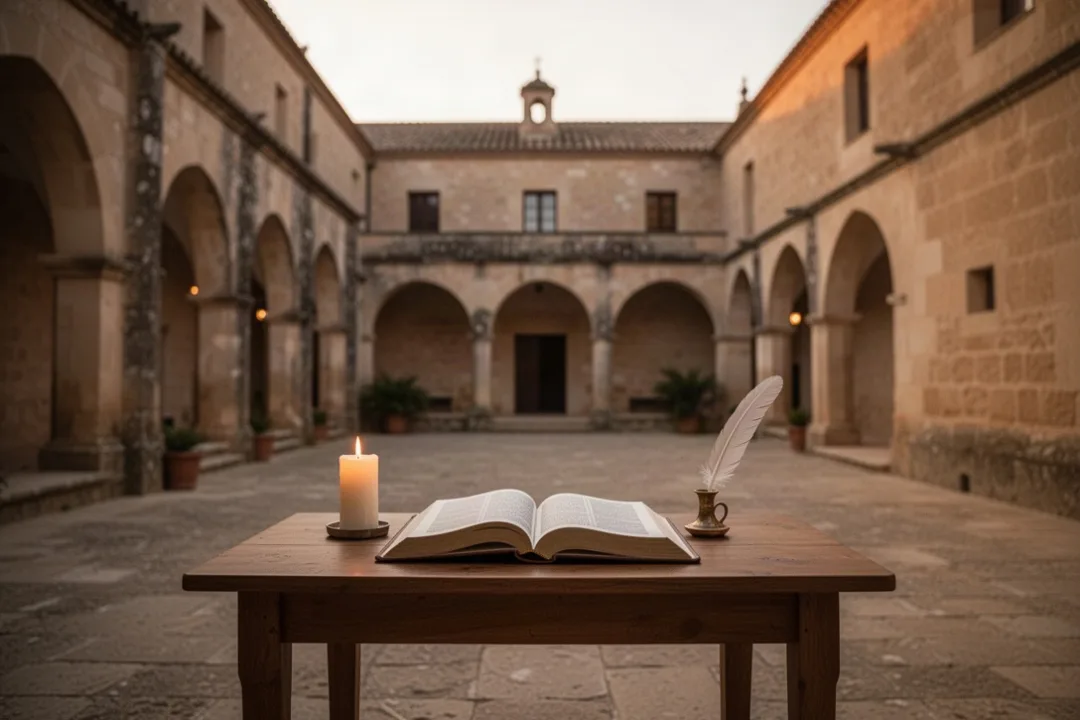
Teresa of Ávila is celebrated in the Catholic Church on October 15. Religious art often depicts her wearing the habit of a Carmelite nun and holding a book, a quill, or symbols associated with mystical prayer. These details point to her roles as writer, teacher, reformer, and contemplative.
She is associated with writers, spiritual teachers, and people seeking deeper prayer. She is also recognized as a patron of the Spanish Catholic Church and connected with places and institutions shaped by the Carmelite tradition. Local customs vary, so a parish or community may honor her with a feast, prayer service, lecture, or reading from her works.
Her title Teresa of Jesus reflects the Carmelite custom of taking a religious name, while “of Ávila” identifies the city most closely associated with her life and reform. “Saint Teresa of Ávila” and “Saint Teresa of Jesus” refer to the same person.
How to begin reading S. Teresa today
Readers often find Teresa’s language both beautiful and unfamiliar. Her works were written for specific communities and use theological terms, images, and assumptions that may require patience. A short introduction, study guide, or annotated edition can clarify the historical setting without replacing the power of her own voice.
A practical reading sequence begins with selected chapters from The Life of Teresa of Jesus, followed by portions of The Way of Perfection and then The Interior Castle. Reading a few pages at a time helps you notice her movement between personal story, prayer instruction, and theological reflection.
What does Teresa say prayer changes in a person’s daily conduct?
How does she describe distraction and spiritual dryness?
What does she identify as evidence of genuine growth?
Where does she balance personal experience with the need for discernment?
How do community life and service appear alongside private prayer?
It is also useful to distinguish Teresa’s teaching from popular quotations attributed to her online. Short sayings are frequently circulated without a reliable source or with wording altered over time. When a quotation matters, check a recognized edition of her works or a reputable Catholic reference.
What S. Teresa can mean for ordinary prayer
Teresa’s lasting appeal comes partly from the fact that she does not require a person to have an unusual personality or an uninterrupted devotional life. She knew what it meant to be distracted, discouraged, ill, uncertain, and pulled in several directions. Her central invitation remains accessible: turn toward God honestly and return when you wander.
For one person, that may mean ten quiet minutes in the morning. For another, it may mean praying while recovering from illness, caring for a family member, or trying to respond to conflict without resentment. Teresa’s spirituality does not erase responsibilities; it asks you to bring those responsibilities into a deeper relationship with God.
Her example also challenges a narrow understanding of holiness. A holy person need not appear constantly serene or detached from practical concerns. Teresa was decisive, energetic, perceptive, and sometimes frustrated. Her growth involved learning to place those qualities at the service of love.
The most reliable way to honor S. Teresa is therefore not to imitate the surface details of her sixteenth-century life. It is to practice the qualities at the center of her witness: faithful prayer, honest self-knowledge, humility, courage, discernment, and active charity.
How Teresa of Ávila differs from other famous Teresas
Knowing the distinctions among famous saints named Teresa prevents confusion when searching for prayers, biographies, or feast-day materials. Teresa of Ávila belongs to the sixteenth century and is primarily associated with Carmelite reform and contemplative prayer. Her symbol is often a book because of her extensive spiritual writing.
Teresa of Calcutta, born Anjezë Gonxhe Bojaxhiu, founded the Missionaries of Charity and became known internationally for serving people who were poor, sick, dying, or abandoned. Her spirituality emphasizes concrete mercy and service, though she also experienced a profound interior struggle that appears in accounts of her life.
Thérèse of Lisieux lived in France in the late nineteenth century and entered the Carmelite monastery at a young age. Her “little way” teaches confidence in God through small acts of love, humility, and trust. Although she and Teresa of Ávila belong to the Carmelite tradition, their historical settings and spiritual emphases differ.
All three are important, but a search for “S. Teresa” should be refined with a full name when accuracy matters. Use Teresa of Ávila for the mystic and reformer, Teresa of Calcutta for the missionary founder, and Thérèse of Lisieux for the Carmelite teacher of the little way.
Frequently asked questions
Is S. Teresa the same person as Teresa of Calcutta?
Not necessarily. “S. Teresa” is a shortened form of “Saint Teresa” and may refer to several saints. In spiritual writing, it most often means Teresa of Ávila, especially when the subject is the Interior Castle or contemplative prayer. Teresa of Calcutta is identified by her work with the Missionaries of Charity and service to people experiencing poverty.
What is Saint Teresa of Ávila best known for?
She is best known for teaching about prayer, reforming the Carmelite order, and writing The Life of Teresa of Jesus, The Way of Perfection, and The Interior Castle. Her understanding of prayer as friendship with God has made her a major influence on Christian spirituality. She was declared a Doctor of the Church in 1970.
What prayer did Saint Teresa of Ávila recommend?
Teresa encouraged mental prayer: a quiet, attentive turning of the mind and heart toward God. She often recommended reflecting on Christ and speaking honestly rather than relying only on memorized words. Her approach does not require mystical experiences. Faithful attention, patience through distraction, humility, and growth in love matter more than unusual feelings.
When is Saint Teresa of Ávila’s feast day?
The Catholic Church celebrates Saint Teresa of Ávila on October 15. Churches and Carmelite communities may mark the day with Mass, prayer, readings, or educational events. The date honors Teresa of Ávila, not every saint named Teresa, since different saints have their own feast days and liturgical calendars.














Leave a Reply