Teresa of Ávila: life, writings, and spiritual legacy
Teresa of Ávila: life, writings, and spiritual legacy
Teresa of Ávila was a sixteenth-century Spanish Carmelite nun, mystic, writer, and reformer who reshaped Christian teaching about prayer. She founded reformed Carmelite communities, wrote influential works such as The Interior Castle, and became the first woman named a Doctor of the Catholic Church.
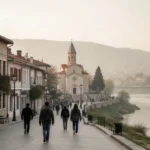
Born Teresa Sánchez de Cepeda y Ahumada in Ávila, Spain, in 1515, she lived during a period of religious change, political tension, and strict expectations for women. Her writings describe prayer as a gradual friendship with God, grounded not in impressive religious experiences but in humility, love, self-knowledge, and perseverance.
Teresa belonged to the Carmelite Order, a religious community whose members seek God through prayer, community life, and service. She entered the Carmelite convent of the Incarnation in Ávila as a young woman and spent much of her early religious life within its established customs.
Over time, Teresa became convinced that Carmelite life needed a more demanding focus on solitude, poverty, silence, and sustained prayer. She did not reject the Church or the Carmelite tradition. Instead, she believed the order could recover a simpler way of living that would give its members greater freedom to seek God.
Her importance rests on several connected achievements:
She gave a detailed, practical account of Christian prayer and spiritual growth.
She established communities associated with the Discalced Carmelites, meaning “barefoot Carmelites,” who followed a stricter form of the rule.
She wrote openly about mystical experiences while submitting her views to the judgment of Church authorities.
She created an enduring model of female religious leadership in a society where women had limited public authority.
She produced major works of Spanish prose that remain important in both religious and literary studies.
Teresa was canonized in 1622, along with several other major Catholic saints. In 1970, Pope Paul VI declared her a Doctor of the Church. This title recognizes exceptional importance in teaching and does not mean that she held an academic doctorate. It reflects the lasting value of her spiritual and theological insight.
At the heart of Teresa’s teaching: prayer is a relationship that develops through honest attention, love, and repeated practice. Her descriptions of mystical prayer belong within that larger path rather than replacing ordinary faithfulness.
Teresa’s childhood, conversion, and Carmelite vocation
Teresa was born into a prosperous Castilian family. Her father, Alonso Sánchez de Cepeda, valued reading and owned a substantial collection of books. Her mother encouraged devotion to Mary and the saints. Teresa later remembered being deeply affected by stories of martyrdom, sainthood, and eternal life.
As a child, she and her brother Rodrigo reportedly imagined leaving home to seek martyrdom among Muslims. When that plan failed, they created a small retreat in the family garden. These early stories, preserved in her autobiography, reveal an intense imagination and an early desire to make faith concrete rather than merely ceremonial.
Her mother died while Teresa was still young. Teresa later described turning to the Virgin Mary as a spiritual mother. During adolescence, she also became interested in clothing, conversation, and the social world around her. She did not present her younger self as consistently devout. That candor is one reason her autobiography feels unusually personal for its period.
Teresa entered the Carmelite convent in 1535, against her father’s initial wishes. She chose religious life partly because she feared the uncertainty of marriage and partly because she wanted to dedicate herself to God. After entering, she made her profession and began the demanding routine of prayer, work, fasting, community obligations, and religious observance.
Her health became fragile during the early years of her religious life. She experienced serious illness and periods of physical suffering, and these difficulties influenced her understanding of patience and dependence. Her recovery did not immediately produce a stable spiritual life. Teresa later described years in which she struggled to maintain prayer consistently.
For a long period, Teresa felt divided between prayer and distraction. She believed prayer was essential, yet she was embarrassed by her difficulty remaining faithful to it. Her eventual change did not come from discovering a special technique. It came through returning repeatedly to prayer and becoming more honest about the resistance she encountered.
Scripture and Christian devotion gave her language for repentance, mercy, and love.
Books about prayer helped her understand contemplation as a disciplined practice.
Confessors and theological advisers helped her test her experiences rather than accepting every interior impression as divine.
Friendships with other religious women gave her practical support and opportunities for leadership.
Personal illness taught her that spiritual growth could not be separated from the body’s limitations.
Teresa’s account of conversion is therefore not a simple story of a sinful person becoming perfect. It is a story of gradual integration. She learned to bring her fears, ambitions, weaknesses, and desires into a more honest relationship with God.
What Teresa taught about prayer and mystical experience
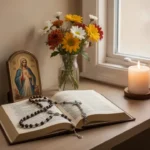
Teresa defined prayer in relational terms. In The Book of Her Life, she described prayer as spending time with someone known to love you. The wording varies across translations, but the central idea is clear: prayer begins with relationship, not performance.
For her, mental prayer involved using the mind and heart to become present to God. A person might reflect on the life of Christ, consider a Gospel scene, examine personal conduct, or simply remain quietly attentive. Teresa did not insist that everyone pray in exactly the same manner.
She also resisted the idea that successful prayer must feel peaceful. A person can pray faithfully while experiencing dryness, distraction, fear, or emotional emptiness. Teresa treated these periods as possible stages of growth, although she did not romanticize suffering or advise people to ignore psychological or physical needs.
The stages represented by the Interior Castle
Teresa’s best-known image is the interior castle. She imagined the soul as a castle made of many rooms, with God dwelling at its center. The movement through the rooms represents increasing self-knowledge, freedom from disordered attachments, love of neighbor, and deeper union with God.
The castle is not a map with strict steps that every person must follow on a fixed schedule. It is a symbolic framework for describing different forms of prayer and spiritual maturity. Teresa emphasizes that the goal is not spiritual status or unusual experiences. The purpose is transformation into a person who loves more steadily and acts more faithfully.
The earlier rooms involve awakening to God while still carrying strong habits of distraction and self-protection. As the person advances, prayer may become more focused and receptive. Later rooms describe forms of contemplation and union that Teresa presents as gifts rather than achievements.
Teresa repeatedly connects mystical prayer with practical evidence. Someone who claims deep union with God but becomes cruel, proud, dishonest, or careless toward others has misunderstood the purpose of prayer. Love of neighbor is one of her most reliable tests of spiritual progress.
How Teresa understood visions and contemplation
Teresa reported experiences that included visions, interior speech, rapture, and a profound awareness of God’s presence. She also worried about being deceived or misunderstood. Her caution is significant: she did not simply declare every extraordinary experience authentic because it felt powerful.
She sought guidance from priests, theologians, and other trusted advisers. Some authorities were suspicious of her experiences, especially during a period when Church leaders were alert to false visions and theological error. Teresa accepted examination and tried to describe her experiences with precision while acknowledging the limits of language.
Her descriptions of mystical prayer are grounded in humility and discernment. She argued that genuine spiritual growth produces greater patience, obedience, courage, and love. Extraordinary experiences, by contrast, are not proof of holiness by themselves.
Teresa also recognized that prayer can be affected by illness, exhaustion, temperament, and emotional strain. Her writing does not provide modern psychological categories, but it shows an unusual awareness that the person praying is embodied and vulnerable. This makes her advice useful even for readers who do not share her religious assumptions about mystical experience.
How Teresa reformed the Carmelite order
By the middle of the sixteenth century, Teresa believed that the Carmelite convent in Ávila was too large and socially open for the kind of quiet, disciplined prayer she wanted to foster. She envisioned small communities in which nuns could live with fewer possessions, less social pressure, and more time for prayer and mutual care.
Her first reformed convent, St. Joseph’s in Ávila, opened in 1562. Establishing it required persistence, financial support, legal permission, and the backing of influential people. Teresa faced opposition from some members of the existing Carmelite structure and from people who considered her plans impractical or disruptive.
The new communities followed a stricter rule of life. Teresa emphasized:
A small household in which members could know and support one another.
A simpler material lifestyle and careful use of community resources.
Regular periods of silence and recollection.
Manual work and shared responsibilities.
Strong friendships shaped by charity rather than rivalry.
Time for both communal worship and personal prayer.
Her reform was not an escape from human relationships. Teresa knew that enclosed communities could become tense, competitive, or emotionally difficult. For that reason, she placed great weight on common sense, humorless self-deception avoidance, patience, and kindness—though she often expressed these qualities in her own lively and direct style.
Teresa eventually founded numerous communities across Spain. Travel was physically demanding, and she often journeyed in uncomfortable conditions, dealing with poor roads, illness, weather, administrative disputes, and limited funds. Her leadership required more than mystical insight. It demanded negotiation, financial planning, recruitment, correspondence, and the ability to make decisions under pressure.
Her reform also involved men. Teresa worked with John of the Cross, a younger Carmelite friar who shared her interest in a stricter form of religious life. He helped establish reformed communities for men, while Teresa directed the development of the women’s communities. Together, their work helped form the Discalced Carmelite branch of the order.
The partnership was not always easy. John experienced imprisonment and opposition within the Carmelite order, and Teresa faced continuing scrutiny. Their shared reform therefore emerged through conflict as well as cooperation. Teresa’s achievement was not the creation of an idealized institution free from disagreement. It was the creation of a durable spiritual movement capable of surviving those disagreements.
Teresa’s major books and literary legacy
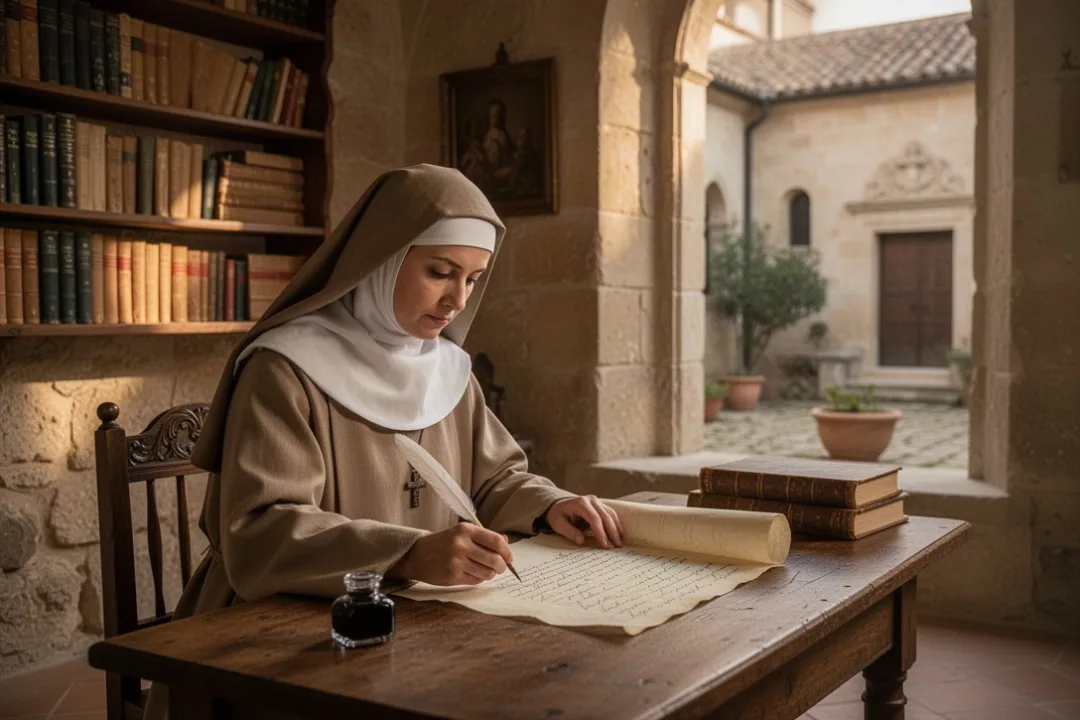
Teresa wrote primarily for practical religious purposes, but her work became important literature. She wrote in Spanish with a direct, personal voice, often combining careful theological explanation with vivid images and everyday examples. Her style can move quickly from a description of deep contemplation to advice about household management or community behavior.
The Book of Her Life
The Book of Her Life is part autobiography, part spiritual testimony, and part defense of Teresa’s prayer. She recounts her childhood, entry into religious life, illnesses, struggles, mystical experiences, and reforming mission. The book was examined by Church authorities, and its form reflects the risks Teresa faced in writing about unusual spiritual experiences.
Readers often value the work because Teresa does not portray herself as effortlessly holy. She describes hesitation, inconsistency, fear, vanity, and confusion alongside grace. Her self-portrait is neither casual confession nor polished legend; it is an attempt to understand how a complicated life can become a place of spiritual change.
The Way of Perfection
The Way of Perfection was written for the nuns in Teresa’s reformed communities. It offers guidance on prayer, community life, humility, detachment, and the Lord’s Prayer. Teresa repeatedly connects the quality of a convent’s prayer with the way its members treat one another.
She warns against gossip, status-seeking, resentment, and excessive concern with possessions. Her advice is directed toward enclosed religious communities, yet much of it addresses ordinary human problems: comparison, conflict, fear of criticism, and the desire to control other people.
The Interior Castle
The Interior Castle, written near the end of Teresa’s life, develops the image of the soul as a castle with seven groups of rooms, often called mansions. Each stage describes a different relationship between prayer, self-knowledge, temptation, grace, and love.
The later mansions describe intense forms of union with God, but Teresa remains practical even there. She argues that spiritual maturity becomes visible through service and endurance. A person who has received great insight should become more available to others, not more self-important.
Teresa also left letters, short works, poems, and accounts of her foundations. Her correspondence shows her handling travel plans, money, buildings, personnel, health, and disputes. These documents complicate the stereotype of Teresa as someone detached from practical life.
Her writings show that contemplation and administration were not opposites. She could discuss an experience of prayer and then address food supplies, a sick nun, a building project, or a disagreement with an official. That combination is central to her legacy: spiritual depth did not remove her from responsibility.
Teresa’s final years, sainthood, and continuing influence
Teresa continued traveling and founding communities despite declining health. She died in 1582 at the Carmelite foundation in Alba de Tormes, Spain. Her body was buried there, and the site remains associated with her memory and devotion.
Her reputation grew after her death. She was beatified in the seventeenth century and canonized in 1622. Her feast is observed on October 15. In 1970, her appointment as a Doctor of the Church formally recognized her importance as a teacher for the universal Catholic Church.
Teresa’s influence extends beyond Catholic monasteries. Her books are read by Christians from different traditions, scholars of mysticism, literary historians, and people interested in contemplative practice. Readers may approach her as a saint, a spiritual director, a Spanish author, a reformer, or a remarkably candid observer of the human mind.
Her continuing relevance comes from several qualities:
She treats prayer as a relationship that can withstand distraction and doubt.
She values self-knowledge without encouraging obsessive self-analysis.
She tests spiritual claims by their effects on character and relationships.
She combines contemplation with work, leadership, and responsibility.
She acknowledges that progress is uneven and that weakness does not make prayer pointless.
Teresa is sometimes reduced to a collection of extraordinary visions or to a single famous line about God being found among ordinary tasks. A fuller reading presents someone more demanding and more human. She asks readers to become truthful about their inner lives, patient with gradual growth, attentive to other people, and willing to let prayer change their conduct.
For someone beginning with Teresa, The Book of Her Life provides the clearest personal context, The Way of Perfection shows her advice about community and prayer, and The Interior Castle offers her most developed spiritual image. Reading a modern translation with explanatory notes can help clarify historical references and differences between editions.
Frequently asked questions
Was Teresa of Ávila a Catholic saint?
Yes. Teresa was canonized in 1622 and is honored as a saint in the Catholic Church. Her feast day is October 15. She was also named a Doctor of the Church in 1970, a title given to saints whose teaching has particular importance for Christian doctrine and spiritual life.
What is Teresa of Ávila best known for?
She is best known for her writings on prayer, especially The Interior Castle, and for reforming Carmelite religious life. Her teaching presents prayer as a relationship with God and emphasizes that authentic spiritual growth should produce humility, courage, love, and better treatment of other people.
Did Teresa of Ávila really experience visions?
Teresa reported visions and other extraordinary forms of prayer, but she approached them cautiously. She sought advice from confessors and theologians and worried about possible misunderstanding or deception. She taught that unusual experiences were not proof of holiness; their value had to be judged by the lasting fruits of a person’s character and conduct.
What should I read first by Teresa of Ávila?
The Book of Her Life is a useful starting point because it introduces Teresa’s childhood, religious vocation, struggles, prayer, and mystical experiences. The Way of Perfection is more practical, while The Interior Castle offers her most structured account of spiritual development. A reliable modern translation with notes can make the historical setting easier to follow.











Leave a Reply