Mother Teresa was born in Skopje, a city that was part of the Ottoman Empire in 1910 and is now the capital of North Macedonia. She was born Anjezë Gonxhe Bojaxhiu to a family of Albanian background.
Her birthplace, family heritage, religious formation, and public identity are sometimes described differently, which can make the simple question “Where was Mother Teresa from?” confusing. Geographically, she was born in Skopje. By ancestry, she was Albanian. By vocation and much of her adult life, she was closely associated with India, especially Kolkata.
Mother Teresa was born in Skopje, now in North Macedonia
Mother Teresa was born on August 26, 1910, in Skopje. At that time, the city belonged to the Ottoman Empire, a large multinational empire that included much of southeastern Europe, the Middle East, and North Africa. Skopje was not yet part of a country called North Macedonia because that modern state did not exist.
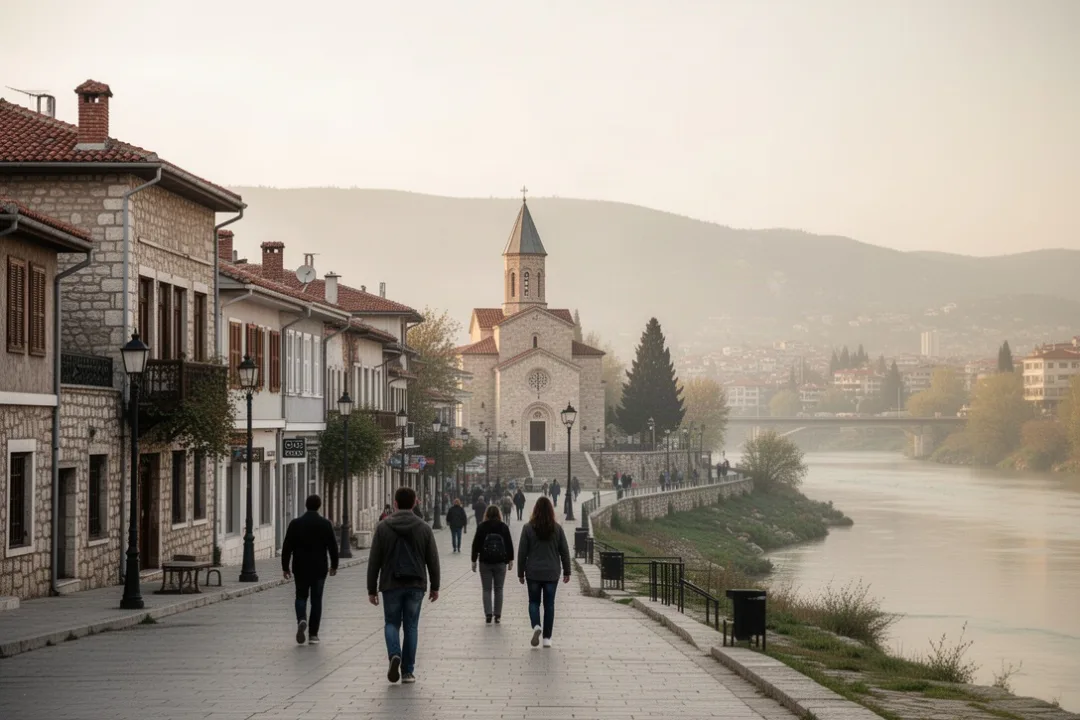
Today, Skopje is the capital of North Macedonia, a country in the Balkans. The city lies along the Vardar River and has long been influenced by different ethnic, linguistic, and religious communities. Its historical setting is one reason modern descriptions of Mother Teresa’s birthplace can sound different even when they refer to the same location.
Some accounts say she was born in the Ottoman Empire. Others describe her birthplace as Macedonia, although the political borders and official names of the region changed after her birth. Modern references usually identify Skopje as being in North Macedonia, which is the clearest answer for readers asking where the city is located today.
The short answer: Mother Teresa was born in Skopje, now the capital of North Macedonia. She came from an Albanian family and later made India her home.
Her birth name was Anjezë Gonxhe Bojaxhiu. “Anjezë” is commonly rendered in English as Agnes, while “Gonxhe” is an Albanian name associated with a flower bud. After joining the Sisters of Loreto, she became known as Sister Mary Teresa and eventually as Mother Teresa.
Her date of birth is often listed as August 26, 1910. She regarded September 5, the day she was baptized, as the more significant date for religious purposes. That distinction explains why some descriptions mention a different date when discussing her early life, but it does not change her birthplace.
Her family was Albanian, even though she was born in Skopje
Mother Teresa’s parents, Nikola Bojaxhiu and Dranafile Bernai, were Albanian Catholics. Her family belonged to the Albanian-speaking Catholic community in the region. This background shaped her language, household traditions, and sense of cultural identity during her childhood.
Calling her Albanian refers primarily to her family heritage, not to the modern citizenship she held at birth. National borders in the Balkans changed significantly during her lifetime, so a person could have Albanian ancestry while being born in a city governed by an empire or a different state.
Her father was involved in business and local public affairs. He died when Mother Teresa was still a child, after which her mother played a major role in raising the family. The household’s Catholic faith and concern for people who were poor influenced Mother Teresa’s later decision to enter religious life.
Her family lived in a setting where several communities existed alongside one another. Albanians, Slavs, Turks, Vlachs, Roma, Jews, and other groups had historical connections to the wider region. Skopje’s mixed history means that birthplace and ancestry should be treated as related but separate facts.
It is therefore accurate to describe Mother Teresa in several ways at once:
She was born in Skopje, a city now located in North Macedonia.
She was born into an Albanian Catholic family.
She was raised in the Balkan region of southeastern Europe.
She later lived most of her adult life in India.
She became widely known as a Catholic religious sister who served people in Kolkata and other parts of the world.
These descriptions do not contradict one another. Each answers a different version of the question. “Where was she born?” points to Skopje. “What was her heritage?” points to her Albanian family. “Where did she do her best-known work?” points mainly to India.
She left the Balkans and began religious life in Ireland
Mother Teresa did not spend her entire life in Skopje. At age 18, she left home to join the Sisters of Loreto, an order of Catholic women religious. Her decision took her away from the Balkans and began a life that would eventually connect her with several countries.
She traveled to Ireland in 1928 and entered the Loreto community in Rathfarnham, near Dublin. There she learned English, a language needed for the order’s work in India. After this period of training, she traveled to India in 1929.
Leaving Skopje did not mean that her family background became irrelevant. She continued to use her religious name, Teresa, and her early experiences remained part of the story people told about her. However, her education, work, and relationships increasingly centered on India rather than southeastern Europe.
Her move also helps explain why answers based only on her later fame can be misleading. Mother Teresa became internationally recognized through her work in India, but she was not born there. She arrived as a young woman in a religious order and spent the rest of her career connected to Indian communities.
India became the center of Mother Teresa’s life and work
After arriving in India, Mother Teresa trained in Darjeeling and later taught at St. Mary’s School in Kolkata, then commonly called Calcutta. She spent years teaching and eventually became the school’s principal. Kolkata became the city most strongly associated with her public ministry.
In 1946, she described experiencing a call to work directly among people who were poor and suffering. She later left the Loreto school environment and began serving people in Kolkata’s neighborhoods. In 1950, the Missionaries of Charity received official recognition as a religious congregation in the Catholic Church.
The congregation established homes and care centers for people who were dying, abandoned, sick, or otherwise in need. Its work later expanded beyond India into other countries. Mother Teresa’s service brought international attention, and she received the Nobel Peace Prize in 1979.
Although she was born in Europe, she became strongly identified with Kolkata and India. She held Indian citizenship and was honored in India for her humanitarian work. Her public life, religious organization, and final years were all closely linked to the country.
Mother Teresa died in Kolkata on September 5, 1997. She was given a state funeral in India, reflecting the importance of her work and public reputation there. She was later canonized by the Catholic Church in 2016 and is formally known within the church as Saint Teresa of Calcutta.
Why she is called Teresa of Calcutta: The name refers to the city where she carried out much of her ministry, not to her birthplace. She was born in Skopje but became associated with Calcutta, now officially known as Kolkata.
Her connection to India was not merely a matter of residence. She worked with Indian communities, operated institutions there, spoke publicly about poverty and compassion, and built an organization whose main base was in Kolkata. That is why people sometimes describe her as an Indian humanitarian, even though she was born in Europe.
Why descriptions of her nationality and birthplace differ
Several historical changes make Mother Teresa’s origins easy to oversimplify. The first is that Skopje changed political settings during her lifetime. In 1910, it was within the Ottoman Empire. After the Balkan Wars, the region came under Serbian rule and later became part of Yugoslavia. Today, Skopje is in North Macedonia.
The second issue is that ethnicity and nationality are not identical. Mother Teresa’s family was Albanian, but she was born in a city outside the borders of the modern Republic of Albania. A person can have one ethnic heritage, be born in another political territory, and later become a citizen of a different country.
The third issue is her religious and professional identity. She became a Catholic nun, worked in India, and founded an organization with an international mission. As her fame grew, people used different labels to emphasize her birthplace, ancestry, citizenship, or service.
The following wording is precise in different contexts:
“Mother Teresa was born in Skopje.” This answers the birthplace question directly.
“She was born in what is now North Macedonia.” This gives the modern geographic location.
“She came from an Albanian Catholic family.” This describes her heritage and religious background.
“She became an Indian citizen and worked primarily in Kolkata.” This describes her adult public identity.
“She was a Catholic nun from the Balkans who became famous in India.” This combines the major parts of her life without treating them as the same thing.
It can be inaccurate to say simply that she was “from India” if the question concerns her birth or family origin. It can also be incomplete to say only that she was “from Macedonia,” because that may leave out her Albanian heritage and her lifelong connection to India.
A careful answer recognizes that Mother Teresa’s story crossed borders. Her birthplace was in southeastern Europe, her family identity was Albanian, her religious training began in Ireland, and her most influential work took place in India.
A timeline that separates birthplace, heritage, and home
A brief timeline makes the different parts of her background easier to understand:
1910: Anjezë Gonxhe Bojaxhiu was born in Skopje, then part of the Ottoman Empire.
Childhood: She grew up in a Catholic Albanian family in Skopje.
1928: She left home and joined the Sisters of Loreto in Ireland.
1929: She traveled to India and began her religious life there.
1930s and 1940s: She taught at a Loreto school in Kolkata and later became its principal.
1940s onward: She began a ministry serving people who were poor, sick, dying, or abandoned.
1950: The Missionaries of Charity received formal recognition.
1979: She received the Nobel Peace Prize for her humanitarian work.
1997: She died in Kolkata, India.
2016: The Catholic Church canonized her as Saint Teresa of Calcutta.
This timeline shows why one geographic label cannot capture her entire life. Skopje explains where she began; India explains where she served; and Calcutta explains the city most closely associated with her name.
How to answer “Where was Mother Teresa from?” accurately
If someone asks the question in a general conversation, the clearest response is: “Mother Teresa was born in Skopje, now in North Macedonia, to an Albanian Catholic family. She later moved to India, where she became famous for her work in Kolkata.”
That sentence provides the essential facts without forcing her life into a single national category. It identifies her birthplace, modern geography, ancestry, and adult home in a natural order.
If the question is specifically about her country of birth, use historical context rather than assigning a modern country without explanation. She was born before North Macedonia became an independent state, so “born in Skopje, then in the Ottoman Empire” is historically more exact.
If the question concerns her cultural background, mention her Albanian parents and Albanian Catholic upbringing. If it concerns her career**, mention India and Kolkata. These answers are all valid as long as they respond to the particular meaning of “from.”
Mother Teresa’s origins are best understood as a combination of place, family, faith, and later service. She began life in Skopje, carried an Albanian heritage, entered religious life through Ireland, and found her defining mission in India.
Frequently asked questions
Was Mother Teresa born in Albania?
No. Mother Teresa was born in Skopje, which is now in North Macedonia. Her parents were Albanian, so she had Albanian ancestry, but her birthplace was not within the borders of modern Albania. Her family belonged to the Albanian Catholic community in the Balkans.
Was Mother Teresa Indian?
Mother Teresa was not born in India, but she became an Indian citizen and spent most of her adult life there. She arrived in 1929 as a member of the Sisters of Loreto and later founded the Missionaries of Charity in Kolkata. India became the main setting for her religious and humanitarian work.
What was Mother Teresa’s real name?
Her birth name was Anjezë Gonxhe Bojaxhiu. She later took the religious name Teresa when she joined the Sisters of Loreto. She became widely known as Mother Teresa, and the Catholic Church later called her Saint Teresa of Calcutta.
Why is Mother Teresa associated with Calcutta?
Calcutta, now officially Kolkata, was the main city where Mother Teresa taught, served people experiencing poverty, and founded the Missionaries of Charity. Her work there made the city central to her public identity, even though she had been born in Skopje and spent part of her early religious formation in Ireland.










Leave a Reply