When you hear the name Saint Teresa of Calcutta, you may wonder how one nun became known around the world—or whether her reputation rests mainly on charity, Catholic spirituality, or both. The answer is that her life joined direct service to people in poverty with an intense religious vocation. She organized homes for people who were sick, dying, abandoned, or without shelter, while urging others to treat every person as worthy of dignity.
Born Anjezë Gonxhe Bojaxhiu, she became a Catholic religious sister in India and later founded the Missionaries of Charity. Her work attracted volunteers, donations, political attention, praise, and criticism. The clearest way to understand her is to look at the choices she made, the spiritual convictions behind them, the organization she built, and the questions her legacy still raises.
Who Saint Teresa of Calcutta was before her public ministry
Saint Teresa was born on August 26, 1910, in Skopje, then part of the Ottoman Empire. Her family was Albanian and Catholic. She was baptized the following day and grew up in a household where prayer, parish life, and concern for people in need were taken seriously.
Her father died when she was young, leaving her mother, Dranafile, to raise the children. Accounts of Teresa’s early life commonly emphasize her mother’s hospitality and charitable habits. The family welcomed people who were poor or in difficulty, and this helped shape Teresa’s understanding that faith should produce practical care, not remain only a private belief.
At age 18, she left home to join the Sisters of Loreto, an Irish community that ran schools in India. She traveled first to Ireland, learned English, and entered religious formation. In 1929, she arrived in India, where she would spend the rest of her life.
How teaching in Calcutta led Teresa toward a different calling
Teresa initially served as a teacher and later became principal at St. Mary’s School in Calcutta, a school for girls from relatively comfortable families. She valued education and remained connected to the Loreto community for many years. Her work as a teacher was not a brief stop before her “real” vocation; it was a substantial part of her religious life.
Her direction changed after what she described as a profound spiritual experience during a train journey in September 1946. She believed Christ was calling her to leave the convent school and work among people living in severe poverty. She later referred to this as a “call within a call”.
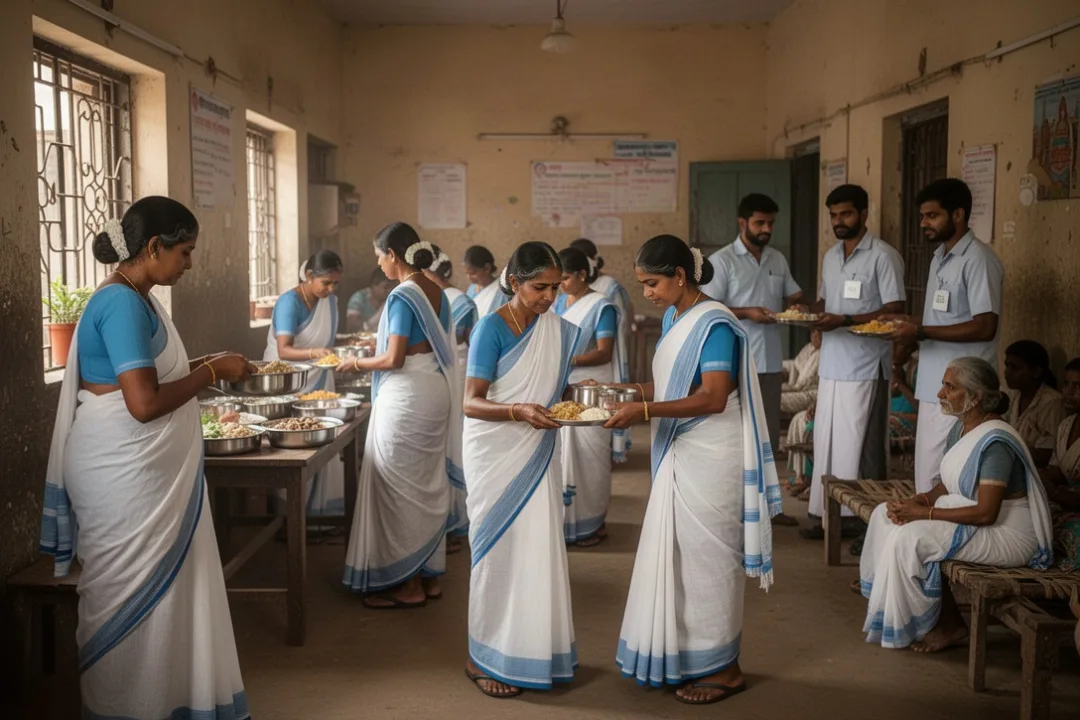
Obtaining permission took time. She left the Loreto convent in 1948, received training in basic nursing, and began living and working in the streets and neighborhoods of Calcutta. She wore a simple white sari with a blue border, a style that became closely associated with her ministry.
The central change: Teresa did not abandon religious life when she left the school. She sought a different form of it—one that placed her community directly among people who were poor, sick, dying, or excluded.
What the Missionaries of Charity set out to do
Teresa gathered a small group of women who wanted to share her way of life. In 1950, the Missionaries of Charity received recognition as a religious congregation from the Archdiocese of Calcutta. The sisters committed themselves to serving “the poorest of the poor,” a phrase that described people facing abandonment as well as material deprivation.
The congregation’s work expanded beyond one city. Its communities eventually served in many countries and established homes for several groups, including:
People who were dying and had no family or safe place to receive care.
Children without stable homes, including children who had been abandoned.
People with leprosy, a disease often accompanied by social isolation and stigma.
People living with HIV/AIDS and others rejected by their communities.
Women facing homelessness, crisis pregnancies, or abandonment.
The sisters’ approach was intentionally personal. They fed people, washed them, helped them receive medical attention, provided shelter, and stayed with those who were dying. Their facilities were not designed to replace hospitals or offer every kind of specialized treatment. They were often intended to provide basic care and human presence where no other support was available.
Teresa also encouraged lay volunteers to serve alongside the sisters. Her influence therefore extended beyond the official congregation. People who never took religious vows could still participate through local projects, donations, medical assistance, childcare, or direct work with vulnerable communities.
Why Saint Teresa connected service with human dignity
For Teresa, charity was not simply a method for reducing poverty. It was a religious response to the worth of each human person. She believed that people who were dying, disabled, homeless, or rejected should not be treated as burdens or problems to remove from public view.
That conviction explains the strong emphasis on small acts. Giving food mattered, but so did listening, touching a neglected person with care, or helping someone die surrounded by kindness rather than alone. Her ministry often focused on people whom institutions had failed to reach.
Her Catholic beliefs shaped the language she used to describe this work. She saw service as an expression of love for Christ and taught that the person in need should be approached with reverence. This spiritual framework does not require every reader to share her theology to understand the practical principle: care becomes more humane when it recognizes the person before the condition.
Teresa’s model also differed from many modern approaches to social change. She was not primarily a policy advocate, economist, or political organizer. She usually emphasized personal service, voluntary simplicity, prayer, and local action rather than structural analysis of poverty. Supporters saw this as a strength because she acted quickly and personally. Critics argued that personal charity alone cannot address the systems that create poverty.
Major milestones in Saint Teresa’s life and recognition
Teresa’s public reputation grew as reports of the congregation’s work spread. Her life included several major milestones:
1928–1929: She entered the Sisters of Loreto and traveled to India.
1937: She made her final religious vows and took the name Teresa, associated with Saint Thérèse of Lisieux and Saint Teresa of Ávila.
1946: She experienced the call that led her toward ministry among people living in poverty.
1950: The Missionaries of Charity received ecclesiastical recognition in Calcutta.
1965: The congregation received recognition as a pontifical institute, allowing it to expand under the authority of the Holy See.
1979: She received the Nobel Peace Prize for her work on behalf of suffering people.
1980: She received the Bharat Ratna, India’s highest civilian honor.
September 5, 1997: She died in Calcutta at age 87.
2003: Pope John Paul II beatified her.
September 4, 2016: Pope Francis canonized her as Saint Teresa of Calcutta.
The Nobel Peace Prize made her one of the most recognizable humanitarian figures of the late 20th century. She used the attention to speak about poverty, peace, abortion, and the responsibility of wealthy societies toward people in need. Her public statements reflected traditional Catholic teaching, which sometimes placed her at odds with political leaders and sections of the public.
What canonization means in Saint Teresa’s case
In the Catholic Church, canonization is a formal declaration that a deceased person is a saint and may be publicly honored throughout the universal Church. It does not mean that the person was flawless or that every decision made during life must be imitated. It means the Church recognizes the person as a model of Christian holiness and believes the person is with God.
Before canonization, the Church examines a candidate’s life, writings, reputation for holiness, and reported miracles. Teresa was beatified in 2003 after the Church accepted the healing of Monica Besra, an Indian woman whose recovery was attributed to Teresa’s intercession. A second healing, involving Brazilian man Marcilio Haddad Andrino, was accepted before Teresa’s canonization in 2016.
Canonization is therefore different from a historical award or a public popularity poll. It belongs to the Church’s spiritual and legal process. Catholics may ask a saint to pray for them, but they do not worship the saint; worship is directed to God.
What Saint Teresa’s spirituality emphasized
Teresa’s spirituality centered on prayer, Eucharistic devotion, humility, and service. She encouraged her sisters to build their work around daily prayer rather than treating prayer as an optional activity after charitable duties were complete. For her, the two belonged together.
She also spoke often about love expressed through ordinary actions. Her famous phrase about doing “small things with great love” is frequently quoted in summaries of her teaching. The point was not that small actions are automatically sufficient, but that faithful care requires attention, patience, and consistency even when the work is unseen.
Her private writings, released after her death, revealed long periods of spiritual darkness and a sense of God’s absence. These writings surprised people who had assumed that her public confidence meant she constantly felt spiritual consolation. Instead, they showed a distinction between faithful commitment and emotional certainty.
That tension matters when interpreting her life. Teresa continued to pray and serve even while describing inner loneliness and doubt. Some readers see this as evidence of spiritual endurance. Others find her writings difficult because they complicate the simple image of a woman who was always joyful and certain.
Practical ways to learn from her example—and common mistakes to avoid
You do not have to copy Teresa’s religious vocation to apply the practical lessons of her work. A useful approach is to combine compassion with informed action. Consider these options:
Start with a specific need: Volunteer at a shelter, food pantry, hospice program, or community health organization rather than treating “helping people” as an abstract goal.
Ask what respectful help looks like: Listen to the people receiving services and avoid assuming that outsiders know every solution.
Offer reliable support: Regular volunteering or recurring donations are often more useful than occasional bursts of attention.
Protect dignity: Do not photograph, publicize, or tell someone’s story without appropriate consent.
Learn the limits of your role: Refer medical, legal, mental health, and domestic violence concerns to qualified professionals.
Pair charity with civic responsibility: Direct service can be combined with support for policies and organizations that address housing, health care, wages, and discrimination.
Several common mistakes can distort Teresa’s example:
Reducing her to a slogan: Her service involved difficult institutions, demanding routines, and a defined Catholic discipline.
Assuming poverty is spiritually desirable: Teresa served poor people; she did not argue that preventable suffering should be preserved.
Confusing basic care with complete medical treatment: Homes for the dying and abandoned had different purposes from modern hospitals.
Ignoring criticism: Her reputation includes serious questions about facility conditions, medical practices, fundraising, and relationships with powerful donors.
Using her name to avoid professional standards: Compassion should not replace trained care, informed consent, safety procedures, or financial accountability.
A balanced lesson: Compassionate service is strongest when it combines personal presence with competent care, transparent leadership, respect for consent, and attention to the causes of poverty.
Why Saint Teresa has been criticized
Teresa’s global reputation has never been free from controversy. Journalists, academics, former volunteers, and critics have questioned the quality of care in some Missionaries of Charity facilities, the organization’s financial transparency, its relationships with wealthy or politically controversial donors, and the way suffering was described in some of Teresa’s public statements.
Some critics argued that certain homes offered too little medical treatment or did not meet standards expected in professional health-care settings. Supporters responded that the homes often served people who had nowhere else to go and were not intended to function as full hospitals. The reality could vary by location and period, so broad claims about every facility should be treated cautiously.
Her language about suffering has also drawn criticism. Teresa sometimes spoke of suffering as an opportunity to share in Christ’s Passion or to encounter divine love. Critics feared that such language could romanticize poverty or make avoidable pain appear acceptable. Supporters interpreted it as an attempt to affirm the dignity of people who were already suffering, not as an argument for causing or prolonging suffering.
Her political and social positions created another source of debate. She opposed abortion and contraception in line with Catholic teaching, and she sometimes accepted awards or donations from people whose politics were controversial. Admirers saw these choices as evidence that she served people across social and ideological boundaries. Critics wanted greater distance from donors or stronger public attention to structural injustice.
Taking these criticisms seriously does not require dismissing the people who benefited from her work. It does require separating admiration from unquestioning praise. A person can acknowledge Teresa’s extraordinary ability to mobilize care while also asking whether particular practices were safe, transparent, or adequate.
How Saint Teresa’s legacy continues after her death
The Missionaries of Charity continue to operate homes and communities in many parts of the world. Their members maintain a distinctive religious life based on prayer, community, simplicity, and service to people in severe need. The congregation’s visibility remains closely tied to Teresa, although its daily work depends on many sisters, employees, volunteers, and local partners.
Her legacy has also influenced people outside the Catholic Church. Some are drawn to her willingness to work with people others avoided. Others appreciate her focus on small, consistent acts of mercy. Humanitarian groups, hospice workers, nurses, teachers, and volunteers may recognize parts of her approach without adopting her religious beliefs.
At the same time, modern service organizations often place greater emphasis on trauma-informed care, patient rights, evidence-based medicine, safeguarding, financial reporting, and community-led solutions. These standards can complement Teresa’s concern for personal dignity. They also provide necessary tests for any charitable organization, including one with a revered founder.
Her public image has changed over time because access to her private writings and criticism has made the story more complicated. The saint who once appeared in simplified photographs and short quotations is now understood as a religious founder with strong convictions, substantial achievements, human limitations, and a contested institutional legacy.
What Saint Teresa of Calcutta can mean to readers today
For Catholics, Teresa may represent a model of holiness expressed through radical service and fidelity to a religious calling. Her canonization invites believers to see care for the vulnerable as a direct part of Christian discipleship rather than a secondary activity.
For other readers, her life can be considered as an example of how one person’s clear mission can build a worldwide network. Her methods invite useful questions: Who is being overlooked? What kind of help is actually wanted? How can service protect dignity? And how should compassion be measured alongside competence and accountability?
Those questions keep her legacy relevant without turning her into either a flawless hero or a figure defined only by criticism. Saint Teresa of Calcutta became famous because she brought attention to people living at the margins. Her lasting challenge is to ensure that attention leads to respectful, effective, and accountable care.
Frequently asked questions
What was Saint Teresa of Calcutta’s real name?
Her birth name was Anjezë Gonxhe Bojaxhiu. She was born into an Albanian Catholic family in Skopje in 1910. When she entered the Sisters of Loreto, she took the religious name Teresa, associated with Saint Thérèse of Lisieux and Saint Teresa of Ávila. She later became widely known as Mother Teresa and, after canonization, Saint Teresa of Calcutta.
Why did Mother Teresa become a saint?
The Catholic Church recognized her for a life devoted to prayer and service among people who were poor, sick, dying, or abandoned. Her sainthood also involved the Church’s formal process of examining her life and accepting two reported healings attributed to her intercession. She was canonized by Pope Francis on September 4, 2016.
Did Saint Teresa of Calcutta work only in India?
No. She began her ministry in Calcutta, now generally called Kolkata, but the Missionaries of Charity later established communities and services in many countries. The congregation’s work has included homes for people who are dying, children without stable care, people with serious illnesses, and others experiencing homelessness or social exclusion.
What are the main criticisms of Saint Teresa?
Critics have questioned conditions and medical practices in some homes, the congregation’s financial transparency, its relationships with controversial donors, and Teresa’s descriptions of suffering. Supporters emphasize that the homes served people who often had nowhere else to go and were not intended to be full hospitals. Her legacy is best considered with both achievements and documented concerns in view.















Leave a Reply