Is Mother Teresa a saint? Her canonization explained
Is Mother Teresa a saint? Her canonization explained
Yes. Mother Teresa is a saint in the Catholic Church. She was formally canonized as Saint Teresa of Calcutta by Pope Francis on September 4, 2016, in Vatican City. Her liturgical feast day is September 5, the anniversary of her death.
Her canonization recognized a life devoted to people who were poor, sick, dying, and abandoned. The decision followed the Catholic Church’s usual investigation, including examination of her life, writings, reputation for holiness, and two reported healings attributed to her intercession.
Mother Teresa was born Anjezë Gonxhe Bojaxhiu in 1910 in Skopje, then part of the Ottoman Empire and now the capital of North Macedonia. She became a Catholic religious sister, founded the Missionaries of Charity, and spent much of her public life serving in India.
After canonization, the Church refers to her as Saint Teresa of Calcutta. The name connects her holiness with the city formerly known as Calcutta, where she established the Missionaries of Charity’s first home and carried out much of her ministry.
People still commonly call her Mother Teresa, the name she used as a religious sister and the name by which she became known internationally. “Mother” refers to her role within her religious community, not to biological motherhood.
Direct answer: Mother Teresa is officially recognized as a saint by the Catholic Church. Her canonization took place on September 4, 2016, after the Church approved two miracles connected with her intercession.
How Mother Teresa became a Catholic saint
Catholic canonization is a formal process rather than a simple public vote or honorary title. The Church studies whether a person demonstrated lasting Christian virtue, whether people regarded the person as holy, and whether alleged miracles meet strict medical and theological standards.
The process can take many years, although there is no single required waiting period in every case. Mother Teresa’s cause moved unusually quickly because of her worldwide reputation, the large amount of available documentation, and the extensive religious community that continued her work.
Her life was investigated. Church officials examined her biography, letters, writings, witness testimony, ministry, and reputation for holiness.
She was declared a Servant of God. This is the first formal stage after a diocese opens a canonization cause.
She was named Venerable. This meant the Church judged that she had practiced Christian virtues to an exceptional degree.
She was beatified. Pope John Paul II beatified her in 2003 after the Church recognized one miracle attributed to her intercession.
She was canonized. Pope Francis declared her a saint in 2016 after a second approved miracle.
These stages do not mean that the Church claims a saint was flawless in every personal decision. Instead, canonization is a judgment that the person lived with heroic virtue, remained faithful to the Christian life, and may be publicly honored and asked to pray for believers.
When Mother Teresa was canonized
Mother Teresa was canonized on September 4, 2016. Pope Francis presided over the ceremony in St. Peter’s Square, where large crowds gathered for the Mass. The ceremony formally entered her into the Church’s calendar of saints.
Her canonization occurred almost two decades after her death on September 5, 1997. The date was significant because her feast day is observed on the anniversary of her death, a common practice for saints.
The ceremony was not the moment when the Church first began calling her holy. Many Catholics had already regarded her as a model of charity during her lifetime. Canonization gave that devotion an official status and permitted her public veneration throughout the Catholic Church.
There is a difference between veneration and worship in Catholic theology. Catholics worship God alone. They honor saints as examples of faith and ask them to pray for them, while believing that God is the source of holiness and miracles.
Why the Church recognized Mother Teresa’s work
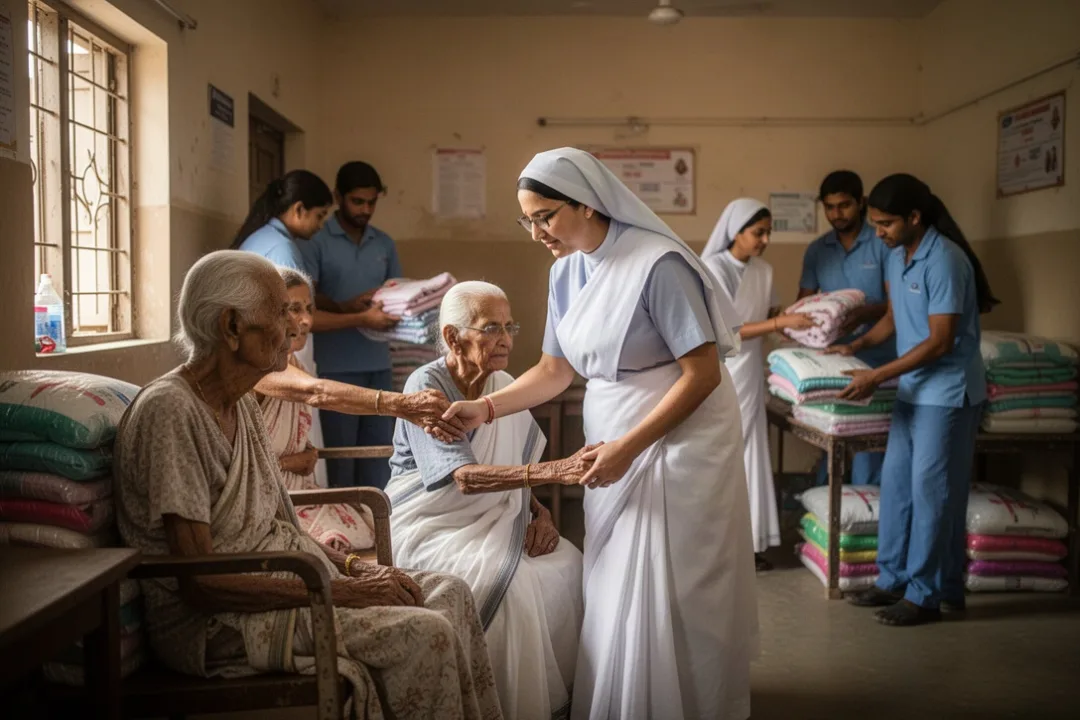
Mother Teresa founded the Missionaries of Charity in Calcutta in 1950. The order focused on serving people who had little support, including those experiencing extreme poverty, serious illness, homelessness, and abandonment.
Her work became especially associated with homes for people who were dying and with care for individuals affected by conditions such as leprosy. The Missionaries of Charity also operated children’s homes, shelters, clinics, and other services in different countries.
Her ministry was built around a distinctive idea: every human person has dignity, including people whom society may overlook. She often described service to suffering people as service to Christ, a belief that shaped the order’s prayer, discipline, and daily work.
Personal presence: Sisters and volunteers cared for people directly rather than treating poverty as an abstract social problem.
Simple living: The Missionaries of Charity adopted a demanding lifestyle centered on prayer, community, and service.
Global expansion: The order eventually established communities and charitable work in many parts of the world.
Attention to the abandoned: Her work emphasized people without family support, stable housing, or access to ordinary care.
The Catholic Church did not canonize her simply because she was famous or because she founded a large organization. The formal judgment focused on her faith, charity, perseverance, and religious commitment as expressed through decades of service.
What “heroic virtue” means in her case
In a canonization investigation, heroic virtue does not mean that a person never felt fear, sadness, doubt, frustration, or exhaustion. It means that the person consistently responded to life’s demands through virtues such as faith, hope, charity, prudence, justice, temperance, and courage.
Mother Teresa’s supporters point to her willingness to serve people with severe needs, her acceptance of an austere religious life, and her persistence when the work was physically and emotionally difficult. They also point to her ability to inspire others to serve.
Her public life included travel, speaking engagements, fundraising, and meetings with political and religious leaders. Those activities supported the expansion of the Missionaries of Charity, but her central identity remained that of a religious sister committed to prayer and direct service.
The Church’s evaluation also considered her private spiritual life. Her letters revealed long periods of spiritual darkness and a felt absence of God. Church officials did not treat those experiences as proof that she lacked faith. Instead, they interpreted her continued prayer and service during those periods as part of her perseverance.
The two miracles connected with her canonization
For a person who was not a martyr, Catholic canonization normally requires the recognition of two miracles that occurred through the person’s intercession. In simple terms, someone must have prayed for the candidate’s help, an extraordinary recovery must have followed, and the Church must conclude that the recovery cannot be adequately explained by natural causes.
The first recognized miracle involved Monica Besra, an Indian woman who reported being healed of a serious abdominal condition after prayers to Mother Teresa. The case was examined during the process that led to beatification in 2003.
Some doctors and observers disputed whether the healing should be attributed to a miracle, arguing that medical treatment may have explained Besra’s recovery. The Church nevertheless accepted the case after its own medical, theological, and ecclesiastical review.
The second recognized miracle involved Marcilio Haddad Andrino, a Brazilian man who was reported to have recovered from severe brain infections and multiple brain abscesses after prayers to Mother Teresa. Church authorities concluded that the recovery was medically unexplained and connected to her intercession.
The Church’s process for alleged miracles includes several levels of review. It is not enough for a person to improve after prayer. Investigators consider the diagnosis, the treatment received, the speed and completeness of the recovery, the medical evidence, and whether the person’s condition returned.
Medical review: Doctors examine whether science can explain the recovery.
Theological review: Specialists consider whether the event can reasonably be linked to the candidate’s intercession.
Church approval: The pope authorizes recognition of the miracle and allows the canonization process to proceed.
Important distinction: A canonized saint is not considered the source of a miracle. Catholic teaching attributes miracles to God and understands the saint as someone who prayed or interceded for the person who was healed.
Why she is called Saint Teresa of Calcutta
Mother Teresa joined the Sisters of Loreto and took the religious name Sister Mary Teresa, later commonly known as Mother Teresa. The name Teresa honored Saint Thérèse of Lisieux, a French Carmelite nun known for her “little way” of spiritual trust and ordinary acts of love.
She later founded the Missionaries of Charity after what she described as a call to leave her convent teaching position and work among Calcutta’s poorest residents. The Church recognizes the congregation as a religious institute dedicated to serving people in need.
“Of Calcutta” distinguishes her from other saints named Teresa, especially Saint Teresa of Ávila and Saint Thérèse of Lisieux. It also identifies the city most closely associated with her work, even though the Missionaries of Charity later served people in countries around the world.
What critics say about Mother Teresa
Mother Teresa’s canonization did not end debate about her work. Critics have questioned the quality of medical care in some homes, the use of donations, her relationships with wealthy or controversial public figures, and statements she made about suffering, contraception, abortion, and poverty.
Some critics argued that people in her facilities did not always receive the same medical treatment available in modern hospitals. Others questioned whether her emphasis on accepting suffering could discourage efforts to remove the causes of poverty and illness.
Supporters respond that her facilities were often intended to provide care for people who had nowhere else to go, particularly those rejected by families or institutions. They also emphasize that the Missionaries of Charity were never designed to replace public health systems or provide every form of specialized medical treatment.
Questions about financial transparency have also remained part of public discussion. Her organization received donations from individuals and institutions with different reputations, and commentators have disagreed about the level of scrutiny applied to those gifts and how funds were managed.
These criticisms do not change the fact of her canonization. They do show why official sainthood is not the same as universal agreement. Catholics may honor her as a saint while still examining particular decisions, statements, or institutional practices critically.
Did Mother Teresa doubt God?
Yes, her private letters describe long stretches of spiritual dryness, loneliness, and a sense that God was absent. These writings became widely known after her death, when portions of her correspondence were published in connection with accounts of her life.
At first, some readers were surprised because her public image emphasized confidence and devotion. In Catholic spiritual tradition, however, a person may continue believing and praying while experiencing no emotional sense of God’s presence.
Her doubts did not lead the Church to reject her cause. Church officials interpreted her continued service, prayer, and fidelity as evidence that she remained committed even when religious consolation was absent.
That interpretation does not require every reader to view her spiritual experience in exactly the same way. It does mean that Catholic sainthood does not require constant emotional certainty. The Church can regard endurance through doubt as part of a person’s witness.
How Catholics honor Saint Teresa of Calcutta
Catholics may ask Saint Teresa of Calcutta to intercede for people who are poor, sick, dying, lonely, or ignored. They may also celebrate her feast day, read about her life, support charitable work, or imitate her attention to people in immediate need.
Her example is often applied to ordinary situations rather than only to large charitable projects. A person might visit someone who is isolated, help a neighbor obtain practical support, volunteer at a shelter, or treat a sick person with patience and respect.
Honoring her does not require joining the Missionaries of Charity or reproducing the order’s strict lifestyle. The broader lesson many Catholics draw from her example is that service begins with seeing the person in front of you and responding with dignity.
Pray for guidance: Ask for the patience and courage to respond to suffering constructively.
Offer practical help: Food, transportation, companionship, or help with paperwork may matter more than general sympathy.
Support reliable organizations: Research a charity’s programs, finances, and safeguarding practices before donating.
Protect dignity: Help without humiliating, exploiting, or treating a person as a project.
How sainthood differs from being a good person
Many people live generous and morally serious lives without becoming canonized saints. Canonization is a specific Catholic process, and only a small number of people receive that formal recognition compared with the number who may be regarded as holy by family members, communities, or other religious traditions.
For Catholics, sainthood ultimately means sharing in eternal life with God. Canonized saints are people the Church proposes as trustworthy examples and publicly honors. The canonization process offers a disciplined way to investigate a person’s life, but it does not attempt to list every holy person who has ever lived.
Mother Teresa’s status therefore has two dimensions. She is officially a Catholic saint, and she is also a widely known historical figure whose methods and public statements remain open to discussion.
Those dimensions can be held together without confusion. Recognizing her canonization answers the religious question. Evaluating the effectiveness, ethics, and limitations of her work answers a different historical and social question.
What Mother Teresa’s sainthood means outside Catholicism
People from other Christian traditions and other religions may admire Mother Teresa’s service without accepting Catholic teachings about canonization or asking saints for intercession. In that setting, “saint” may be used informally to describe someone viewed as exceptionally compassionate or self-sacrificing.
The Catholic meaning is narrower and more official. It refers to a person whom the Church has formally declared to be in heaven and has authorized the faithful to honor publicly.
So the answer depends slightly on the context. In everyday speech, people may call Mother Teresa a saint because of her charitable work. In Catholic terms, she is Saint Teresa of Calcutta because Pope Francis formally canonized her.
Where her legacy stands today
The Missionaries of Charity continue the work associated with Mother Teresa, with sisters and other workers serving vulnerable people in different countries. Their communities generally combine prayer, communal religious life, and direct service.
Her legacy has also influenced conversations about poverty, end-of-life care, homelessness, volunteer service, and the dignity of neglected people. Admirers see her as a model of personal compassion. Critics use her work to raise questions about charity, accountability, medical standards, and the relationship between short-term relief and long-term social change.
Both responses help explain why she remains significant. She was not only a religious figure but also an internationally recognized organizer, speaker, and symbol whose choices affected how many people understood poverty and service.
For the Catholic Church, the formal answer is settled: Mother Teresa is Saint Teresa of Calcutta. The continuing discussion concerns how best to understand her work, how to evaluate its weaknesses, and how to serve vulnerable people with both compassion and responsible care.
Frequently asked questions
Was Mother Teresa canonized by the Catholic Church?
Yes. Pope Francis canonized her on September 4, 2016, during a Mass in St. Peter’s Square. The Church officially recognized her as Saint Teresa of Calcutta after reviewing her life and approving two miracles attributed to her intercession. Her feast day is September 5, the anniversary of her death in 1997.
What miracles were attributed to Mother Teresa?
The first involved Monica Besra, an Indian woman whose recovery from a serious abdominal condition was accepted during Mother Teresa’s beatification process. The second involved Marcilio Haddad Andrino of Brazil, who recovered from severe brain conditions. Church authorities concluded that both recoveries lacked a sufficient medical explanation and followed prayers asking for Mother Teresa’s intercession.
Why do some people criticize Mother Teresa?
Critics have questioned medical conditions in some facilities, financial transparency, relationships with controversial donors, and her views on suffering and social issues. Supporters say her homes served people who had nowhere else to go and were not intended to replace modern hospitals. Canonization recognizes her holiness in Catholic teaching but does not require every person to approve of every decision or institution connected with her.
Can non-Catholics consider Mother Teresa a saint?
Yes, if they use “saint” as a term for someone they regard as exceptionally compassionate or devoted to serving others. However, the formal Catholic meaning is specific: the Church has canonized her, permits public veneration, and teaches that she is in heaven. Other religious traditions are not required to accept Catholic canonization or beliefs about intercession.














Leave a Reply