Mother Teresa was 87 years old when she died. She died on September 5, 1997, in Calcutta, India, now commonly called Kolkata. Her generally accepted birth date was August 26, 1910, so she had lived 87 years and 10 days.
Her birth name was Anjezë Gonxhe Bojaxhiu. She became widely known as Mother Teresa after joining religious life and later founding the Missionaries of Charity. Her age at death is straightforward, but the dates surrounding her early life, religious vocation, and public work help explain the long path that led to her international recognition.
The usual calculation uses August 26, 1910, as Mother Teresa’s date of birth and September 5, 1997, as her date of death. Because her 87th birthday had already occurred 10 days before she died, she was 87 rather than 86 or 88.
Her death occurred shortly after her 87th birthday. Put another way, she was in the 88th year of her life, but she had completed 87 years. This distinction sometimes causes confusion when people describe someone as being “in their 88th year,” but the ordinary answer to the question is that Mother Teresa died at age 87.
Birth: August 26, 1910
Death: September 5, 1997
Age at death: 87
Time between her birthday and death: 10 days
Mother Teresa was born in Skopje, a city that was part of the Ottoman Empire at the time. Skopje is now the capital of North Macedonia. Her family was Albanian, and her upbringing took place within a Catholic community in the Balkans.
Direct answer: Mother Teresa died at age 87 on September 5, 1997. Her commonly recognized birth date was August 26, 1910.
Mother Teresa’s early years before she became famous
Mother Teresa grew up as Gonxhe Bojaxhiu, the youngest child in her family. The name Gonxhe is often translated as “bud” or “flower bud.” Her father died when she was young, and her mother played a major role in shaping the family’s religious life and concern for people who were poor.
As a teenager, she became interested in missionary work. Accounts of her life describe her developing a strong desire to serve outside her home region, particularly through the Catholic religious missions operating in India. At that point, she was still known by her birth name and had not yet begun the work that would make her one of the best-known religious figures of the 20th century.
She left home as a young woman and joined the Sisters of Loreto, an Irish branch of the Institute of the Blessed Virgin Mary. After entering religious life, she traveled to Ireland to begin her training. She later went to India, where she spent many years teaching before changing the direction of her work.
In 1928, when she left home to pursue religious life, she was 18 years old. She took her first religious vows several years later and eventually adopted the name Teresa, honoring Saint Thérèse of Lisieux and Saint Teresa of Ávila. The name became the one by which millions of people would know her.
She arrived in India in 1929 and began teaching at a school in Darjeeling. She later worked at St. Mary’s School in Calcutta, where she taught geography and became principal. Her early career was therefore connected with education, not yet with the street ministry and hospice work that later defined her public image.
How old Mother Teresa was at major points in her life
Looking at Mother Teresa’s age during major stages makes the timeline easier to understand. She was in her late teens when she entered religious life, in her 20s when she began teaching in India, and in her late 30s when she started the work that developed into the Missionaries of Charity.
Age 18: She left home to pursue religious life.
Age 19: She arrived in India and began her religious training and teaching career.
Age 36: During a train journey in 1946, she experienced what she described as a call to serve people living in extreme poverty.
Age 38: She received permission to leave her teaching community and begin working directly among poor people in Calcutta.
Age 40: The Missionaries of Charity received formal recognition as a religious congregation in 1950.
Age 59: She received the Nobel Peace Prize in 1979.
Age 87: She died in 1997.
The year 1946 was especially significant. While traveling by train from Calcutta to Darjeeling, Mother Teresa said she felt called to leave her school-based work and serve people who were suffering in the city. She later referred to this experience as a decisive turning point, although several more years passed before she could make the change formally.
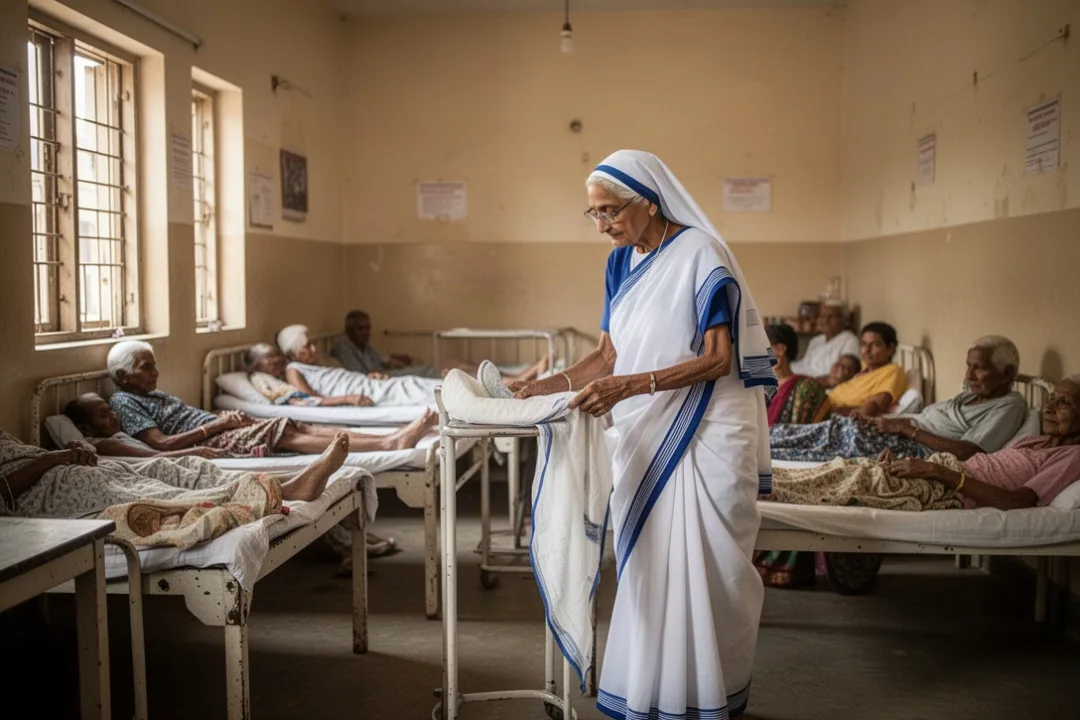
In 1948, at about 38 years old, she left the Loreto community and began working in Calcutta’s neighborhoods. She learned basic medical skills and opened an informal school for children who had little access to education. Her clothing also changed: she became associated with a simple white sari with a blue border, a practical and recognizable sign of her ministry.
Two years later, the Catholic Church formally recognized the Missionaries of Charity. The congregation’s purpose was to care for people whom Mother Teresa believed were often overlooked, including people who were sick, dying, homeless, or abandoned. Its work gradually expanded beyond Calcutta to other parts of India and then to countries around the world.
What Mother Teresa did during her later decades
Mother Teresa spent the second half of her life building and representing the Missionaries of Charity. The group operated homes for people who were dying, shelters for children, services for homeless people, and other forms of aid. Its exact activities varied by location, but the central emphasis was direct personal care for people in severe need.
One of the best-known facilities associated with her work was Nirmal Hriday, often translated as “Pure Heart,” a home for people who were dying in Calcutta. The facility became a symbol of her approach: people who had been abandoned or lacked medical support could receive food, basic care, companionship, and a place to die with dignity.
Her work attracted increasing attention during the 1960s and 1970s. She traveled extensively, established new Missionaries of Charity communities, and met political and religious leaders. Media coverage helped make her a global figure, while the sisters and volunteers associated with her organization continued local work away from public attention.
At 59 years old, she received the Nobel Peace Prize in 1979. The award recognized her humanitarian work and brought even more international attention to her beliefs and organization. She used the occasion to focus public attention on poverty, abandonment, and the dignity of people who were seriously ill or dying.
Mother Teresa also received many other honors during her lifetime. Among them was the Presidential Medal of Freedom, awarded by the United States in 1985. Such honors made her one of the most recognizable humanitarian figures of her generation, although her work and methods were also examined and criticized by some journalists, medical professionals, and social commentators.
Her public reputation was not based only on age or longevity. It came from the contrast between her simple personal lifestyle and the worldwide scale of the organization she led. By the time she was in her 70s and 80s, the Missionaries of Charity had communities in numerous countries, while she continued to speak publicly about compassion, poverty, faith, and care for vulnerable people.
Mother Teresa’s health and final years
Mother Teresa experienced serious health problems during her final decade. She suffered from heart-related illness and was hospitalized more than once. Despite these difficulties, she continued to guide the Missionaries of Charity for as long as her health allowed.
Her physical condition became more fragile after the Nobel Prize years. She experienced cardiac problems in the late 1980s and early 1990s, and her public appearances became less frequent. The organization’s leadership increasingly depended on other members, although Mother Teresa remained its central spiritual and public figure.
In March 1997, she stepped down as superior general of the Missionaries of Charity. She was then 86 years old. Sister Nirmala Joshi succeeded her in that role, allowing the congregation to continue its work while Mother Teresa’s health was declining.
Mother Teresa died on September 5, 1997, at the Missionaries of Charity’s motherhouse in Calcutta. She was 87 years old. Her death came less than two months before the death of Diana, Princess of Wales, and the two events occurred during a period of intense international media attention, although they were unrelated.
The Indian government gave Mother Teresa a state funeral. This reflected the unusual place she held in public life: she was a Catholic nun born in the Balkans, but she had spent most of her adult life in India and had become closely associated with Calcutta and the country’s humanitarian work.
Why Mother Teresa is also called Saint Teresa of Calcutta
Mother Teresa was not called a saint during her lifetime in the official Catholic sense. After her death, the Catholic Church began the formal process of examining her life, writings, reported miracles, and reputation for holiness. That process led first to her beatification and later to her canonization.
She was beatified in 2003, six years after her death. Beatification allowed her to be called Blessed Teresa of Calcutta within the Catholic Church. The process then continued as church authorities reviewed another reported miracle attributed to her intercession.
In 2016, Pope Francis canonized her as Saint Teresa of Calcutta. The canonization took place 19 years after her death, when she would have been 106 if she had lived. The new title did not change her age at death: she remained 87 when she died in 1997.
The title “Mother Teresa” remains widely used because it was the name associated with her public ministry. “Saint Teresa of Calcutta” is the name used in the Catholic Church after her canonization. Both refer to the same person, but they belong to different stages of how she has been remembered.
Her legacy includes both admiration and debate. Supporters praise her dedication to people who were dying, her willingness to live simply, and the international growth of the Missionaries of Charity. Critics have questioned the quality of care in some facilities, the organization’s approach to suffering, and its relationships with controversial donors and institutions.
Those debates do not change the basic historical answer. Mother Teresa died at 87, having spent nearly seven decades in religious life and nearly half a century leading or inspiring the Missionaries of Charity. Her age is one small fact within a life that began in Skopje, unfolded mainly in India, and became internationally influential during the final decades of the 20th century.
Frequently asked questions
What was Mother Teresa’s real name?
Mother Teresa was born Anjezë Gonxhe Bojaxhiu. “Gonxhe” was her given name, while Anjezë is commonly rendered as Agnes in English. She adopted the religious name Teresa after joining the Sisters of Loreto, and she later became known publicly as Mother Teresa through her work in India.
When was Mother Teresa born?
Mother Teresa’s generally accepted birth date is August 26, 1910. She was born in Skopje, which was part of the Ottoman Empire at the time and is now in North Macedonia. Her baptism took place the following day, August 27, which can sometimes create confusion about the date listed in biographical records.
Where did Mother Teresa die?
Mother Teresa died at the Missionaries of Charity’s motherhouse in Calcutta, India, on September 5, 1997. Calcutta is now officially called Kolkata. She had spent most of her adult life in India and was closely associated with the city because much of her ministry began and developed there.
What illness did Mother Teresa have before she died?
Mother Teresa experienced significant heart problems during her later years and was hospitalized several times. Her health gradually weakened, particularly during the 1990s. She stepped down as head of the Missionaries of Charity in March 1997, several months before she died at age 87.













Leave a Reply