When you hear the name Lawrence of Brindisi, you may wonder whether he was mainly a preacher, a theologian, or a church leader. The answer is that he was all three, along with a biblical scholar, missionary, diplomat, and Capuchin friar whose work crossed religious, political, and military settings.
Born Giulio Cesare Russo in Brindisi, Italy, in 1559, he entered the Capuchin branch of the Franciscan Order and took the religious name Lorenzo, or Lawrence. He became known for his command of Scripture and languages, his direct preaching, and his ability to serve the Church in difficult circumstances. The Catholic Church canonized him in 1881 and declared him a Doctor of the Church in 1959.
The short answer: Lawrence of Brindisi was a Capuchin Franciscan priest and major Catholic preacher of the late sixteenth and early seventeenth centuries. His biblical learning, defense of Catholic teaching, pastoral work, and diplomatic service explain his lasting reputation.
Lawrence lived during a period of intense religious and political conflict. The Protestant Reformation had changed the religious map of Europe, Catholic leaders were implementing reforms associated with the Council of Trent, and the Ottoman Empire remained a major military power. In that setting, Lawrence combined scholarship with practical ministry.
His work did not fit a single category. He preached to ordinary parishioners, taught and governed within the Capuchin order, studied the Bible in its original languages, advised church and political leaders, and accompanied Christian forces as a chaplain. His life shows how early modern Catholic reform depended on both public teaching and disciplined religious life.
Lawrence is especially remembered for his Marian devotion, his preaching on Christ and the Eucharist, and his extensive use of the Old and New Testaments. His writings are not a short devotional manual but a substantial body of sermons, biblical explanations, and theological works.
A short account of Lawrence of Brindisi’s life
Lawrence was born on July 22, 1559, in Brindisi, a port city in the Kingdom of Naples. His family gave him the name Giulio Cesare Russo. After losing his father while still young, he received care and education that helped prepare him for religious life.
He joined the Capuchins in Verona as a teenager and received the name Brother Lawrence of Brindisi. The Capuchins were a reform movement within the Franciscan tradition that emphasized poverty, prayer, preaching, and a simple way of life. Lawrence was ordained a priest after completing his formation and then pursued serious study in theology and Scripture.
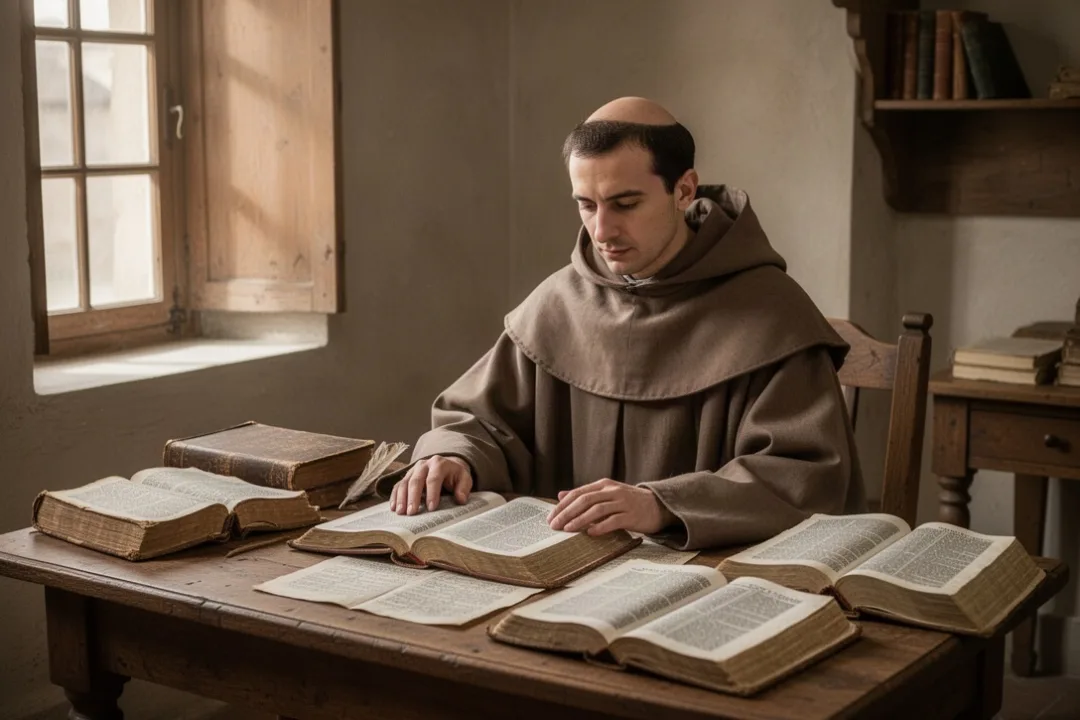
His education included Latin, Greek, and Hebrew, as well as the theological traditions needed for Catholic preaching. He also gained familiarity with several European languages, which supported his ministry across different regions. His learning was not merely academic. He used it to explain Christian doctrine, respond to religious controversy, and connect biblical passages with the spiritual life.
Lawrence held several responsibilities within the Capuchin order, including leadership as minister general. He also worked to establish and strengthen Capuchin communities in parts of Europe. His assignments took him beyond Italy to places such as Austria, Germany, Bohemia, and other territories affected by religious division.
In 1601, he served as a chaplain and spiritual adviser with the imperial forces during a campaign against the Ottoman army near Székesfehérvár in Hungary. Accounts of the campaign describe him encouraging the troops while carrying a crucifix. His role was religious and pastoral, although later stories sometimes portray the episode in highly dramatic terms.
Later in life, Lawrence was sent on diplomatic missions. He traveled to the court of King Philip III of Spain and was involved in efforts connected with the rulers of Naples. He died in Lisbon on July 22, 1619, while carrying out a diplomatic assignment. His remains were eventually associated with the Poor Clare monastery at Villafranca del Bierzo in Spain.
The main stages of Lawrence of Brindisi’s vocation
Lawrence’s life can be understood through several connected stages. Each one helps explain how his reputation developed.
Formation in the Capuchin tradition: He embraced Franciscan poverty, prayer, community life, and service to the Church.
Study of Scripture and theology: He developed the learning that later distinguished his preaching and writing.
Preaching and pastoral ministry: He addressed communities in Italy and across Europe, often explaining Catholic doctrine through the Bible.
Leadership within the order: He helped guide Capuchin communities and support their expansion and discipline.
Service during conflict: He encouraged Christian soldiers and ministered to them as a chaplain.
Diplomatic work: He represented Catholic interests and sought practical solutions in politically unstable settings.
Recognition as a Doctor of the Church: His theological and biblical writings led to formal recognition of his enduring teaching value.
These stages were not separate careers. Lawrence understood preaching, scholarship, leadership, and diplomacy as forms of Christian service. His intellectual work gave depth to his preaching, while his prayer and religious discipline shaped the way he approached public responsibilities.
How Lawrence of Brindisi used Scripture in his preaching
Lawrence is one of the most biblically grounded preachers in the Catholic tradition. He read Scripture in Latin and in the original biblical languages available to him, especially Hebrew and Greek. This allowed him to pay close attention to words, grammar, images, and connections between different passages.
His preaching often moved through several layers of meaning. He explained the literal sense of a passage, connected it with Catholic doctrine, and then drew out its spiritual application. He commonly linked the Old Testament with the New Testament, seeing Christ as the fulfillment of the biblical story while also treating the earlier texts as meaningful in their own right.
That approach mattered during the religious controversies of his era. Arguments about authority, grace, the sacraments, the Church, and Christian belief frequently depended on competing interpretations of Scripture. Lawrence responded not by treating the Bible as a collection of isolated proof texts, but by presenting it as a unified account of God’s work.
His method included several practical habits:
He paid attention to the original wording and historical setting of biblical passages.
He compared related passages instead of relying on a single verse.
He connected biblical teaching with the sacraments and the life of the Church.
He used Scripture to call listeners toward repentance, faith, charity, and perseverance.
He allowed doctrine and spiritual application to support each other rather than treating them as unrelated subjects.
For modern readers, Lawrence’s example suggests that biblical study and prayer do not need to compete. He treated serious learning as a way of serving faith. At the same time, he believed that knowledge without conversion was incomplete.
What Lawrence of Brindisi taught about Christ and Christian life
Christ stands at the center of Lawrence’s preaching. His sermons repeatedly return to the Incarnation, the Passion, the Resurrection, and the Eucharist. He presents Christian life as a response to Christ’s love, not merely as obedience to an external code.
His theology of the Eucharist emphasizes the real presence of Christ and the sacrament’s power to unite believers with him. He also connects Eucharistic devotion with moral transformation. A person who receives Christ should grow in charity, humility, patience, and willingness to serve others.
Lawrence’s writing also gives a major place to the Virgin Mary. His Marian theology reflects the Catholic devotion of his time, presenting Mary as the mother of Christ, an example of faithful discipleship, and a figure closely associated with the mystery of salvation. His devotion to Mary was not meant to replace attention to Christ; it was meant to lead believers toward him.
Several themes recur throughout his work:
Conversion: Christian faith requires a continuing turning of the heart toward God.
Charity: Love of God must appear in concrete concern for other people.
Prayer: Interior prayer gives strength for demanding responsibilities.
Humility: Learning, authority, and success should not become occasions for self-importance.
Perseverance: Faithfulness matters when circumstances are confusing, hostile, or exhausting.
Church life: Doctrine and sacramental practice belong together rather than existing as separate parts of Christianity.
Lawrence of Brindisi as a Capuchin Franciscan
To understand Lawrence, it helps to understand the Capuchin identity he embraced. The Capuchins sought a strict and visible return to key elements of Franciscan life: poverty, simplicity, penitence, communal prayer, and preaching. Their friars were known for a plain style of dress and life, along with a strong presence among ordinary people.
Lawrence’s learning did not distance him from this tradition. He remained a religious friar who valued discipline and simplicity. His scholarship served the order’s mission, especially its preaching ministry. This combination of intellectual ability and humble religious observance became one of the defining features of his reputation.
He also accepted responsibilities that required organization and authority. As a superior, he had to guide communities, address practical needs, and maintain the order’s identity while it expanded. His example suggests that Franciscan humility does not mean refusing leadership. It means exercising authority as service rather than personal advancement.
A useful distinction: Lawrence’s reputation for learning should not be separated from his religious discipline. He was not simply a scholar who happened to belong to an order; his study, preaching, and leadership were shaped by Capuchin prayer and poverty.
His role in Catholic reform after the Council of Trent
The Council of Trent, which met in the sixteenth century, addressed Catholic doctrine, clerical formation, preaching, sacramental practice, and church discipline. Lawrence belonged to the generation that helped put those reforms into practice. He lived at a time when Catholic renewal required more than official decrees. It needed educated preachers, serious clergy, stronger religious communities, and accessible instruction for ordinary believers.
Lawrence contributed in each of these areas. His sermons explained Catholic beliefs in a period when many people encountered competing religious claims. His work in the Capuchin order supported the formation of friars who could preach and minister effectively. His biblical expertise gave his teaching authority in debates where Scripture was central.
His approach to controversy was firm, but it was also grounded in a detailed knowledge of the opposing arguments. He did not treat theological disagreement as a reason to avoid learning. Instead, he studied languages, texts, and positions carefully so that Catholic teaching could be presented with precision.
That historical setting also explains why his writings can feel dense to modern readers. They were created for a world in which sermons, disputations, biblical commentary, and theological argument were major tools of religious education. A reader approaching Lawrence today may need patience, background information, and a reliable translation.
Lawrence of Brindisi and the campaign in Hungary
Lawrence’s service during the 1601 campaign against the Ottoman forces is one of the best-known episodes of his life. He went with the Christian army as a priest and chaplain, offering spiritual support to soldiers. Accounts describe him preaching courage, hearing confessions, celebrating Mass, and urging the troops to remain faithful.
His presence should be understood within the religious and political culture of early modern Europe. Military campaigns were often described in religious terms, and chaplains could have significant influence over morale. Lawrence’s mission was not simply to encourage victory. He was expected to provide pastoral care in a setting marked by fear, death, violence, and moral danger.
Later biographies emphasize that he carried a crucifix and placed himself near the front during the fighting. Such accounts contributed to his image as a fearless spiritual leader. They should be read alongside the broader purpose of his role: caring for soldiers, urging ethical conduct, and reminding them of religious duties during war.
This episode does not make Lawrence a military strategist. His importance lies in the way he brought his priestly vocation into an extreme environment. The event also reveals a tension modern readers may notice: Lawrence’s life combined deep commitment to Christian ideals with service in a period when religious identity and warfare were closely connected.
His diplomatic missions and public responsibilities
Lawrence was not limited to preaching from a pulpit. Church and political leaders recognized his ability to communicate, negotiate, and represent religious interests. He served as an adviser and envoy in matters involving Catholic rulers and contested territories.
His diplomatic work required qualities different from those needed for academic study. He had to listen carefully, understand political motives, speak to people with different priorities, and seek outcomes that supported the Church without reducing every issue to a simple slogan. His assignments show that early modern religious leaders often worked within complicated networks of government, war, dynastic power, and church authority.
At the same time, diplomacy exposed him to the limits of political solutions. Christian unity and church reform could not be achieved only through agreements between rulers. Lawrence continued to emphasize conversion, prayer, teaching, and moral renewal. For him, public action had to be supported by spiritual change.
Lawrence’s writings and major areas of study
Lawrence left a substantial written legacy. His works include sermons, biblical commentaries, Marian writings, theological discussions, and material connected with preaching. Some texts focus on the Eucharist, while others explore Christian doctrine or passages from the Bible.
His work on Genesis is especially associated with his biblical scholarship. He also wrote extensively on the Virgin Mary and produced sermons for liturgical and doctrinal occasions. The exact organization and availability of his works can vary by edition and language, so readers often encounter him through selected translations rather than a single standard volume.
When reading Lawrence, watch for these characteristics:
Extensive biblical cross-references: He frequently builds an argument by connecting many passages.
Christ-centered interpretation: Old Testament themes are often related to Christ and the Christian mystery.
Doctrinal purpose: His sermons defend and explain Catholic teaching.
Spiritual application: Theological discussion usually leads toward prayer, repentance, or virtuous living.
Rhetorical intensity: His preaching style can be forceful, devotional, and highly structured.
His writings are valuable not only for theology but also for understanding Catholic intellectual culture after Trent. They reveal how a learned preacher used Scripture, tradition, liturgy, and pastoral exhortation together.
Why the Catholic Church calls him a Doctor of the Church
The title Doctor of the Church recognizes a saint whose teaching has lasting importance for Christians. It does not mean that the person was a physician, nor does it mean that every sentence in the person’s writings is treated as a formal definition of doctrine. The title points to the enduring value of the person’s theological contribution.
Lawrence was declared a Doctor of the Church by Pope John XXIII in 1959. His recognition rests especially on the depth of his biblical interpretation, the breadth of his theological writing, and the way his teaching serves Catholic faith and Christian practice.
His title as a Doctor is particularly fitting because he joined several forms of knowledge. He knew Scripture, theology, languages, preaching, religious discipline, and pastoral leadership. His work demonstrates how Christian teaching can be intellectually serious while remaining directed toward worship and changed behavior.
For a reader studying the Doctors of the Church, Lawrence offers a useful contrast with figures whose main work was philosophical or systematic. His distinctive strength is the integration of biblical scholarship and preaching. He was a learned interpreter who wanted people to pray, repent, receive the sacraments, and live with greater charity.
What modern readers can learn from Lawrence of Brindisi
Lawrence lived in circumstances very different from those of the United States today, and some aspects of his era require historical distance. Still, several features of his life remain relevant for anyone interested in faith, education, or public service.
First, he shows that serious study can strengthen practical ministry. Lawrence did not see scholarship as a retreat from people. He studied so that he could preach more accurately, answer difficult questions, and serve communities facing confusion.
Second, he demonstrates the value of communicating across settings. He addressed friars, parishioners, soldiers, rulers, and church officials. His message had to be adapted to each audience without losing its central convictions.
Third, his life raises a useful question about leadership: do authority and humility have to conflict? Lawrence’s example says they do not, provided leadership remains focused on responsibility rather than status.
Finally, he reminds readers that religious conviction can involve both contemplation and action. Prayer, study, preaching, administration, diplomacy, and care for people in danger all belonged to his vocation.
How to study Lawrence of Brindisi today
If you want to learn more about Lawrence, begin with a reliable biography or an introduction to the Capuchin Franciscans. His writings can be demanding when read without context, especially because they assume familiarity with the Bible, Catholic doctrine, and debates of the sixteenth century.
Start with his historical setting. Learn about the Council of Trent, the Reformation, the Capuchin reform, and the Ottoman-Habsburg conflict.
Read a selected sermon. Notice how Lawrence moves from a biblical passage to doctrine and then to practical spiritual advice.
Compare translations when possible. Technical terms and biblical references may be handled differently in English editions.
Study his use of Scripture. Keep a Bible nearby and look up the references rather than reading them as isolated quotations.
Connect the writings with his life. Ask how his Capuchin vocation, leadership, and diplomatic work shape the themes he emphasizes.
Use church-approved resources for devotional interpretation. Historical explanation and personal prayer can complement one another without being confused.
A good first reading might focus on one theme, such as the Eucharist, Mary, preaching, or Christian perseverance. Trying to absorb all of Lawrence’s biblical references at once can obscure the main argument. Short sections read slowly are usually more helpful than rushing through a long collection of sermons.
Lawrence of Brindisi’s feast day and patronage
Lawrence’s liturgical memorial is generally celebrated on July 21. His death occurred on July 22, but the liturgical calendar places his memorial on July 21. He is especially associated with the Capuchin Franciscans, Catholic preachers, theologians, and students of Scripture.
Different sources may describe his patronage in slightly different ways, depending on whether they emphasize his formal recognition, his religious order, or popular devotion. He is not primarily known because of a single occupation or miraculous object. His enduring identity comes from his teaching, preaching, religious life, and service during a turbulent period.
People who turn to Lawrence in prayer often ask for help with faithful teaching, clear communication, perseverance in difficult duties, and the disciplined study of Scripture. Those themes arise naturally from the way he lived rather than from a narrow list of popular associations.
Remembering Lawrence as a teacher and servant
Lawrence of Brindisi remains significant because he refused to separate knowledge from holiness or public work from prayer. He studied the Bible deeply, preached with conviction, led a demanding religious community, supported people in wartime, and served as a diplomat when church and political interests collided.
His life also benefits from a balanced reading. He was a product of the late Renaissance and the Catholic Reformation, so his language and assumptions belong to that era. Yet his central example remains clear: learn carefully, speak truthfully, serve humbly, and allow faith to shape practical responsibilities.
That combination explains why the Church remembers him not only as a historical Capuchin friar but as a Doctor whose teaching continues to invite serious study. Lawrence’s legacy is found in the meeting point between Scripture and preaching, contemplation and action, learning and service.
Frequently asked questions
Was Lawrence of Brindisi a Franciscan?
Yes. He belonged to the Capuchin branch of the Franciscan family, formally known as the Order of Friars Minor Capuchin. He embraced their emphasis on poverty, prayer, preaching, and close community life. His Franciscan identity remained central even when he served as a scholar, religious superior, chaplain, or diplomatic envoy.
When did Lawrence of Brindisi become a Doctor of the Church?
Pope John XXIII declared Lawrence of Brindisi a Doctor of the Church in 1959. The designation recognizes the lasting value of his theological and biblical teaching. His extensive sermons and writings, especially his scriptural interpretation and explanations of Catholic doctrine, were central to that recognition.
What is Lawrence of Brindisi the patron saint of?
Lawrence is particularly associated with Capuchin Franciscans, preachers, theologians, and people devoted to biblical study. He is also remembered by those seeking guidance in teaching, spiritual perseverance, and religious service. Patronage lists can vary among sources, so his strongest associations come from his documented work and vocation.
Did Lawrence of Brindisi write books?
Yes. He produced sermons, biblical commentaries, theological works, Marian writings, and material concerning the Eucharist and Catholic doctrine. His collected works are extensive, and many modern readers encounter them through selected translations. Because his style assumes knowledge of Scripture and early modern theology, an introductory biography can make his writings easier to approach.












Leave a Reply