Have you come across the name Saint Laurence and wondered whether it refers to a biblical figure, a Roman martyr, or a church named in his honor? In most Christian contexts, the name means Laurence of Rome, a third-century deacon remembered for serving the poor and dying for his faith. His feast day is celebrated on August 10.
Laurence is also spelled Lawrence, especially in English-speaking countries. The two forms generally refer to the same saint when people are discussing the Roman deacon. His story combines well-established historical details with later traditions, so understanding the difference helps you appreciate both the history and the devotion surrounding him.
Saint Laurence lived during the third century, when Christianity was still a minority faith in the Roman Empire. He served as a deacon in Rome under Pope Sixtus II. A deacon assisted the bishop or pope with worship, administration, and practical service, including the care of people who were poor, sick, imprisoned, or otherwise vulnerable.
Laurence was not primarily known as a scholar, bishop, or political leader. His reputation grew from a role that was both spiritual and practical: he helped manage the church’s resources and distribute assistance to those in need. That connection between Christian worship and concrete charity remains central to the way churches remember him.
Ancient Christian accounts place his death during the persecution of Emperor Valerian. In 257 and 258, imperial authorities took measures against Christian clergy and church gatherings. Pope Sixtus II was arrested and executed in August 258, traditionally on August 6. Laurence was killed a few days later, on August 10.
The basic outline of his life is widely accepted in Christian tradition: he was a Roman deacon, he served under Sixtus II, and he died as a martyr during the Valerian persecution. Details about his birthplace, age, education, and personal life are not securely known. Later accounts focus less on biography and more on the meaning of his service and death.
Name note: “Saint Laurence” and “Saint Lawrence” usually refer to the same Roman martyr. “Laurence” follows the Latin-influenced form, while “Lawrence” is the more familiar English spelling in many places.
Laurence’s office also explains why he became associated with the treasures of the Church. In the third century, those treasures were not simply objects kept for display. Church property supported worship and helped provide food, shelter, burial assistance, and other forms of care for people with few resources.
His example is therefore broader than the story of a courageous death. It presents leadership as stewardship: a person entrusted with resources should use them responsibly, especially for people who are suffering. That interpretation has made Laurence meaningful to parish workers, charitable organizations, deacons, and people who serve behind the scenes.
What happened during Saint Laurence’s martyrdom
The most familiar account of Laurence’s martyrdom appears in later Christian tradition. According to the story, Roman authorities demanded that he hand over the Church’s wealth. Laurence asked for a short period of time, gathered the poor and suffering people whom the church supported, and presented them to the authorities as the Church’s true treasure.
This episode has a clear moral point. People, not gold or silver, are the Church’s greatest treasure. Laurence’s answer challenges any religious community that measures its success by property, decoration, or financial reserves while ignoring people in need. Even readers who treat the scene as a devotional tradition rather than a precisely documented event can understand the principle it expresses.
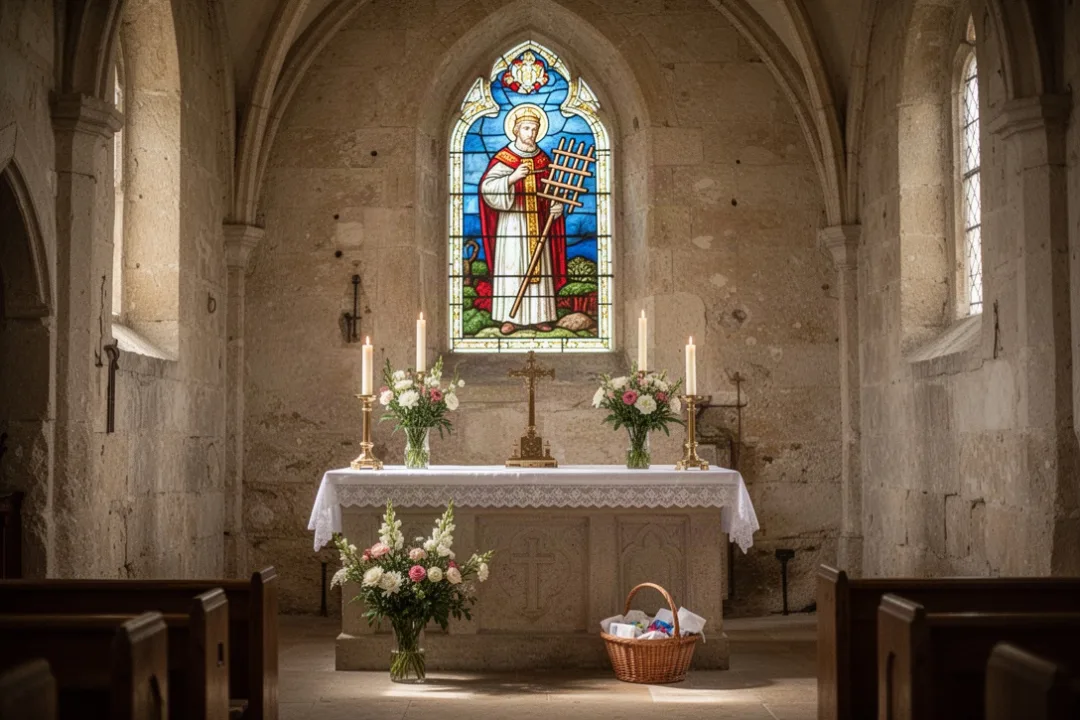
The story then says that Laurence was tortured and killed on a gridiron over a fire. Because of this tradition, he is frequently pictured holding a gridiron or standing beside one. The object became his most recognizable symbol in Christian art.
Some versions of the story include dramatic remarks attributed to Laurence during the torture. These details belong to the later tradition and should not be treated as secure transcripts of his final moments. Early martyr stories often developed through retelling, and their purpose was to strengthen faith and honor courage rather than provide modern courtroom-style documentation.
The gridiron account was already influential in late antique Christian memory, but historians recognize that the exact manner of Laurence’s death is not established with the same certainty as the fact of his execution. A careful description can hold both points together: Laurence was certainly remembered as a martyr, while the most vivid details of his death come through tradition.
His death is connected with the wider persecution of Christian clergy under Valerian. The Roman government viewed Christian assemblies and leadership with suspicion, and attacks on clergy disrupted the organization of local churches. The execution of a pope and a leading deacon shows that the persecution targeted not only private believers but also the structures that supported Christian communities.
Laurence’s story gained particular force because he appears to have remained responsible for the church’s work after Sixtus was arrested. The tradition portrays him as someone who could have focused on self-preservation but instead continued serving the people entrusted to him. That is why his martyrdom is often presented as an extension of his ministry rather than as an isolated heroic act.
Laurence’s enduring image is the servant who recognizes human need as a sacred responsibility.
The word martyr means a witness, especially one who remains faithful despite persecution or death. For Christians, Laurence’s martyrdom represents fidelity under pressure. It does not glorify suffering for its own sake. Rather, it remembers a person who refused to abandon his commitments when authorities threatened him.
His witness also raises practical questions for modern communities. How are religious resources used? Who receives help? Are vulnerable people treated as recipients of charity alone, or as persons with dignity and a rightful place within the community? The old story of the “treasures of the Church” continues to speak because those questions have not disappeared.
Why Saint Laurence’s feast day is August 10
The feast of Saint Laurence is observed on August 10, the traditional anniversary of his martyrdom. In the Christian calendar, a saint’s feast commonly remembers the day of death as the saint’s entrance into eternal life. The date is therefore connected to his death during the persecution of Valerian, not to a known birthday.
August 10 is marked in Catholic communities and in other Christian traditions that honor the Roman martyrs. Churches dedicated to Laurence may celebrate with a special liturgy, a procession, a charitable collection, or a community gathering. Local customs vary considerably, so a parish feast might look solemn, festive, or strongly focused on service.
People named Laurence or Lawrence may observe the day as a name day. Some families attend worship, light a candle, visit a church named for the saint, or perform an act of charity. Others simply use the day to learn more about the person whose name they carry.
Several customs and natural observations have become associated with August 10. In parts of Europe, the date has long been linked with the Perseid meteor shower, whose annual activity occurs around the same period. Popular language has sometimes described the meteors as the saint’s tears or sparks. That is a cultural association, not part of the historical evidence about Laurence himself.
The feast can also be a useful occasion for communities to examine their own service programs. Because Laurence was a deacon responsible for practical care, a celebration in his honor may include attention to food banks, shelters, emergency assistance, or support for people who are isolated. Such activities connect the feast to the central theme of his life rather than treating it as a name on a calendar.
Attend a service: Visit a parish or chapel dedicated to Saint Laurence or Saint Lawrence.
Support direct care: Donate food, money, or time to an organization serving people in need.
Learn local history: Explore why a church, school, hospital, or neighborhood bears his name.
Pray for servants: Remember deacons, caregivers, social workers, and volunteers who assist people in difficult circumstances.
In art and liturgy, the feast often emphasizes Laurence’s identity as a deacon and martyr. Liturgical readings may focus on faithful service, generosity, or courage under persecution. The precise readings depend on the tradition and calendar being followed, but the broad message is consistent: worship should lead to care for people.
What Saint Laurence symbolizes in Christian art and devotion
Artists usually identify Saint Laurence through a small group of symbols. The most common is the gridiron, representing the traditional account of his execution. He may also wear a deacon’s dalmatic, a distinctive liturgical garment that identifies his ministry.
Other images show him holding a purse, a book, or a vessel. These objects can point to the administration of church resources, the care of the poor, or his service at the altar. In some works, Laurence stands beside people in need, making the connection between his office and charitable responsibility clear.
When a church contains a statue or painting of a deacon holding a gridiron, the figure may be Saint Laurence. The setting can provide additional clues. A Roman context, a martyr’s palm, and scenes of serving the poor all support that identification, although no single symbol proves it in every case.
The palm branch is another common symbol. In Christian art, a martyr’s palm represents victory through faithful endurance. It does not mean that the person sought death. Instead, it indicates that the Church remembers the martyr as remaining faithful despite violence.
Laurence is often named as a patron of cooks and chefs, a connection influenced by the gridiron tradition and the fact that fire became part of his visual identity. He is also associated in various local traditions with librarians, archivists, students, and people who work with books or records, although patronage lists can differ by country and institution.
Some professions claim Laurence because of an imaginative link to the traditional story, while others connect him to the deacon’s administrative work. These associations should be understood as devotional customs rather than official job descriptions. A patron saint offers a model of prayer and character; the relationship does not depend on a historical claim that Laurence personally practiced every occupation linked to him.
His name appears in many places because churches have been dedicated to him for centuries. A Saint Laurence church may reflect an early Christian dedication, a medieval foundation, a local devotion, or the influence of a religious order. The building’s date and region can reveal which aspects of his story mattered most to its founders.
When visiting a church named for Laurence, look for details such as:
A figure dressed as a deacon rather than as a bishop or priest.
A gridiron, fire, or palm branch held as an identifying emblem.
Images of poor people, food distribution, or church treasures.
An inscription using “Laurence,” “Lawrence,” or the Latin form “Laurentius.”
A feast-day notice connected with August 10.
These features can turn a familiar church interior into a readable account of local religious history. They also show how a short life, known through limited evidence, became a lasting visual language of service and courage.
How Saint Laurence’s legacy connects with service today
The most useful way to honor Saint Laurence is not to repeat every dramatic detail of his legend but to take seriously the value he placed on people who needed help. His story asks religious communities to treat charity as a central responsibility, not as an optional activity after worship or administration are complete.
That principle can be applied at both personal and institutional levels. An individual might volunteer regularly, help a neighbor with practical needs, or contribute to a local relief effort. A parish or nonprofit might review whether its budget, facilities, and volunteer time are reaching people who are most vulnerable.
Laurence’s example is especially relevant to people whose work is rarely visible. Deacons, caseworkers, caregivers, kitchen staff, reception volunteers, and administrators often make compassionate service possible without receiving public recognition. The saint’s own role reminds Christians that faithful ministry can involve organizing resources, listening carefully, and showing up consistently.
His story also offers a standard for responsible stewardship. The question is not simply how much an institution owns, but how those resources are used. Buildings, funds, equipment, and collections can support meaningful care when they are directed toward human flourishing rather than treated as ends in themselves.
A practical way to mark his feast: Choose one specific need in your community, learn what help is actually useful, and offer support through a trusted organization or direct service.
For families, August 10 can become a day for discussing the difference between generosity and display. Children can learn that a church’s “treasure” includes the people it protects, welcomes, and serves. Adults can use the occasion to review charitable giving, volunteer commitments, or the way they respond to someone facing hardship.
For cooks and food-service workers, the association with Laurence can carry a particularly concrete meaning. Preparing food is often a form of care, whether it happens in a home, a restaurant, a shelter, or a community kitchen. Sharing a meal with someone who is hungry reflects the same basic conviction that made Laurence’s story endure: material resources matter most when they help people live with dignity.
His legacy also cautions against romanticizing persecution. Laurence’s courage is remembered because he faced unjust violence, but Christian teaching does not require people to seek danger or ignore wise efforts to protect life. Faithful service may involve courage, yet it can also involve careful planning, cooperation, advocacy, and patient daily work.
When the historical record is limited, devotion can still be meaningful if it remains honest. You can honor the established facts about Laurence—his service as a Roman deacon, his connection with Pope Sixtus II, and his martyrdom under Valerian—while recognizing that the gridiron and treasure stories come through later tradition. That balance respects both history and faith.
Saint Laurence remains memorable because his life joins two qualities that are sometimes separated: compassion for people in need and courage under pressure. His feast day, symbols, and legends all return to that connection. The person remembered on August 10 is not simply a martyr with an unusual emblem, but a servant whose understanding of the Church’s wealth began with the people it was called to protect.
How Saint Laurence differs from other saints named Laurence
The name Laurence appears in the histories of more than one Christian saint. If a church record, family tradition, or local festival mentions “Saint Laurence,” the surrounding details can help identify which person is intended. The Roman martyr is the most widely recognized, but he is not the only possibility.
Saint Laurence of Canterbury was a different figure. He was a successor to Augustine of Canterbury and served as an early archbishop of Canterbury during the beginning of the Christian mission among the Anglo-Saxons. His feast is generally observed on February 2, not August 10.
Laurence of Canterbury is associated with the consolidation of the church in England and with efforts to maintain Christian leadership during a difficult period. He should not be confused with Laurence of Rome, even though both are often called simply Saint Laurence in local material.
There are also other saints and blessed people whose names appear as Laurence, Lawrence, or a related form in different languages. Local calendars may honor them on dates that do not match August 10. A church’s country, dedication date, feast day, and artwork can usually clarify which Laurence is being remembered.
Use these clues when identifying a reference:
August 10 and a gridiron: Usually Laurence of Rome.
February 2 and Canterbury: Usually Laurence of Canterbury.
A Roman deacon and martyr: Laurence of Rome.
An early English archbishop: Laurence of Canterbury.
A local feast with another date: Check the community’s calendar before assuming it refers to the Roman martyr.
The spelling can also create confusion. “Lawrence” is common in English, while “Laurence” may reflect older or regional usage. Latin sources generally use Laurentius. These variations do not by themselves identify a different person, so the feast day and biography are more reliable clues than spelling alone.
For most people searching for Saint Laurence, the intended figure is the Roman deacon whose feast falls on August 10. His story is remembered through the gridiron, the care of the poor, and the claim that a church’s true treasures are its people. Those themes explain why his name continues to appear in churches, calendars, artwork, and charitable traditions many centuries after his death.
Frequently asked questions
Is Saint Laurence the same person as Saint Lawrence?
Usually, yes. Laurence and Lawrence are English forms of the same name, related to the Latin Laurentius. When people mention the Roman deacon and martyr celebrated on August 10, either spelling may be used. A different saint may be intended only when the surrounding details point elsewhere, such as Laurence of Canterbury and his connection with early Christianity in England.
What is Saint Laurence the patron saint of?
Saint Laurence is commonly associated with cooks and chefs, partly because the traditional account of his martyrdom involves a gridiron and fire. He is also linked in some places with deacons, charitable workers, librarians, archivists, and people responsible for church resources. Patronage customs differ by region, so local calendars may list additional occupations.
Was Saint Laurence really killed on a gridiron?
Christian tradition says that Laurence was tortured and killed on a gridiron, and this is the symbol most often used to identify him in art. The fact that he was executed during the persecution under Emperor Valerian is more secure than the precise details of the torture. The gridiron story comes through early and later devotional accounts rather than modern historical documentation.
Why did Saint Laurence call poor people the Church’s treasures?
According to tradition, Roman authorities demanded the Church’s wealth, and Laurence presented the poor people supported by the church instead of presenting money or valuables. The episode teaches that people have greater value than property and that religious resources should serve human need. It remains a powerful image of stewardship, charity, and respect for human dignity.














Leave a Reply