Saint Martha: Her story, symbols, prayers, and feast day
Saint Martha: Her story, symbols, prayers, and feast day
Saint Martha is Martha of Bethany, the woman in the New Testament who welcomed Jesus into her home and whose brother Lazarus was raised from the dead. Christians often remember her for hospitality, practical service, faith, and friendship with Jesus, although the Gospels also show her bringing an honest complaint directly to him.
Her story appears mainly in Luke 10:38–42 and John 11, with another important scene in John 12. Martha is not simply a symbol of being busy. She is presented as a woman who serves, speaks candidly, grieves deeply, and makes a clear confession of faith.
Martha lived in Bethany, a village near Jerusalem, with her sister Mary and her brother Lazarus. The Gospel of John describes the three siblings as people Jesus loved, and their home appears to have been a familiar place of welcome during his ministry.
The New Testament does not provide a full biography of Martha. It gives several scenes instead, each revealing a different part of her character. She is active and responsible, but she is also reflective, emotionally honest, and capable of profound belief.
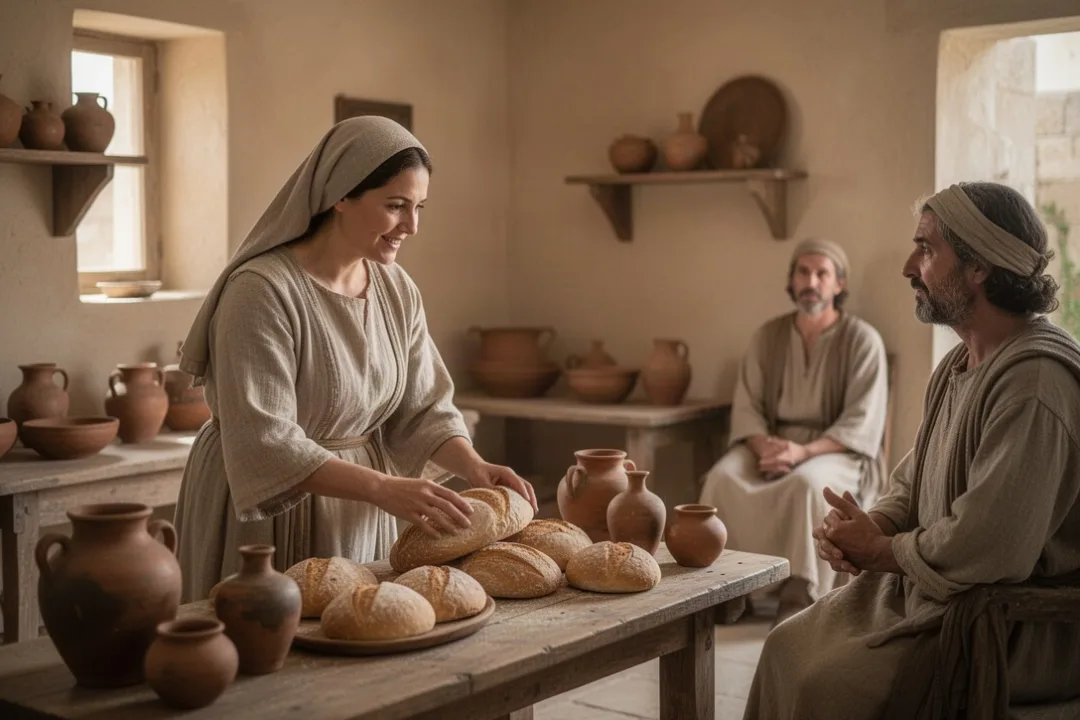
In Luke’s Gospel, Martha receives Jesus into her home while Mary sits at his feet listening to him. Martha becomes frustrated because she is carrying the work of serving alone. When she asks Jesus to tell Mary to help, he responds by drawing attention to Mary’s choice to listen rather than by condemning Martha’s hospitality.
That passage has often been reduced to a contrast between a “bad” busy person and a “good” contemplative person. The text supports a more careful reading. Martha’s service is not treated as worthless; rather, Jesus addresses the anxiety and distraction that have entered her service. Her work matters, but service can lose its peace when resentment takes over.
John 11 presents a different Martha. After Lazarus dies, Martha goes out to meet Jesus and tells him that her brother might not have died if Jesus had arrived sooner. Her words are direct, but they also show continued trust. She says that she still believes God will respond to Jesus.
Jesus then speaks with Martha about resurrection and life. When he asks whether she believes, Martha answers with a confession identifying him as the Messiah and the Son of God. This is one of the strongest statements of faith made by any individual in the Gospel narratives.
What the story of Saint Martha teaches
Martha’s story offers several lessons that remain meaningful for people who care for families, welcome guests, work in service occupations, or try to live faithfully amid ordinary responsibilities.
Service can be holy: Preparing food, caring for others, keeping a household running, and offering practical help can express love.
Honesty belongs in prayer: Martha does not hide her frustration or grief. She speaks plainly to Jesus.
Faith can exist alongside sorrow: Her belief does not prevent her from mourning Lazarus or asking why Jesus came late.
Attention matters: Jesus challenges the anxiety surrounding Martha’s work, not the value of every practical task.
People are more than one role: Martha is not only a hostess. She is also a disciple, sister, mourner, speaker, and believer.
These themes make Saint Martha especially meaningful to people who feel responsible for everyone else. Her example does not require you to choose between work and prayer in a simplistic way. It invites you to examine how you serve, what burdens you carry, and whether your responsibilities are leaving room for trust and attention.
A helpful way to remember Martha: She brings both her work and her worries to Jesus. Her faith is not presented as perfect calm; it is faith that continues to speak, question, and trust.
How to pray with Saint Martha’s example
There is no single required prayer for Saint Martha. You can use a traditional prayer, pray a novena, read the Gospel passages associated with her, or speak to God in your own words. The most useful approach is one that connects prayer with the real concern you are carrying.
Name the situation: Identify the person, responsibility, conflict, or fear that is occupying your attention.
Read a short passage: Consider Luke 10:38–42, John 11, or John 12:1–8. Paraphrase the scene in your own words rather than rushing through it.
Speak honestly: Tell God what feels unfair, exhausting, confusing, or painful, as Martha did.
Ask for a specific grace: You might ask for patience, wisdom, courage, healing, reconciliation, or the ability to serve without resentment.
Choose one practical action: Make a needed phone call, accept help, prepare a meal, set a boundary, or spend a quiet period listening.
End with trust: Entrust the outcome to God while remaining willing to do the next faithful thing.
A prayer to Saint Martha should not be treated as a guarantee that a particular outcome will occur. Christian devotion asks for her intercession, but it remains centered on God’s will, compassion, and wisdom. Prayer can also clarify what kind of help is needed from other people or from professional services.
For a brief prayer, you might say: Saint Martha, faithful friend of Jesus, help me serve with love, speak honestly about my burdens, and trust God in the middle of uncertainty. Pray for me and for the people I carry in my heart.
The three siblings are remembered together because their household provides a picture of friendship, family life, and discipleship. Martha appears as the one who welcomes and serves. Mary appears listening at Jesus’ feet and later anointing his feet with costly perfume. Lazarus becomes the brother whose death and return to life reveal Jesus’ power in John’s Gospel.
These roles should not be turned into rigid personality types. Scripture does not say that Martha always worked while Mary never worked, or that Lazarus had no active role. Each person appears in particular moments, and each moment highlights a different response to Jesus.
The siblings also demonstrate that closeness to Jesus does not remove ordinary family pain. They experience illness, death, disappointment, and the demands of hosting. Their home is not free from trouble. It becomes a place where grief and hope are brought into relationship with faith.
Martha’s interaction with Mary also deserves care. In Luke 10, Martha asks Jesus to intervene because she feels left alone with the service. Jesus addresses Martha directly, but the passage does not give permission to dismiss all domestic or caring work as inferior. A household still needs food, attention, and practical care. The deeper question is whether service flows from love or becomes controlled by anxiety and resentment.
What Martha says about faith and grief
John 11 gives Martha one of the clearest examples of faith expressed in the middle of grief. She meets Jesus before Lazarus is brought back to life, so her belief is not based on already seeing the desired result. She is mourning while still turning toward him.
Her first words are a complaint: if Jesus had arrived earlier, Lazarus might still be alive. This is not a polished religious statement. It is the language of someone who feels abandoned by the delay. Martha’s willingness to say it shows that prayer can include disappointment rather than requiring a performance of calmness.
Jesus does not answer her with a simple explanation of why Lazarus died. Instead, their conversation turns toward his identity and the promise of life. Martha responds by affirming who she believes Jesus to be. Her confession shows that faith is not the same as understanding every event.
For people facing illness or bereavement, Saint Martha can therefore be a companion in a very specific sense. She represents the person who says, “I believe,” while also admitting, “This hurts, and I do not understand why it happened.” That combination is not hypocrisy. It is a form of honest faith.
When grief is severe: Prayer and devotion can accompany mourning, but they should not replace medical care, grief counseling, crisis support, or practical help from trusted people.
Why Saint Martha is associated with hospitality and service
Martha’s association with hospitality comes directly from the Gospel scene in which she welcomes Jesus into her home and takes responsibility for serving. Over time, this made her a natural patron for people whose work involves food, lodging, household care, and practical welcome.
Her example is broader than domestic labor. Hospitality can mean making room for a guest, feeding someone who is hungry, helping a sick relative, organizing care, or creating a peaceful place for people who are vulnerable. These tasks are often overlooked because they happen quietly and repeatedly.
At the same time, Saint Martha’s story recognizes the cost of being the person who always handles the practical details. A devotion centered only on tireless work would miss the tension in Luke’s account. Martha needs not only appreciation for her service but also freedom from the anxiety that makes her feel alone.
If you identify with Martha, her story may encourage you to consider three questions:
What responsibilities genuinely belong to you, and which have gradually been placed on you by habit?
Where could you ask for assistance instead of silently building resentment?
Can you complete necessary work with greater attention, or do you need a period of rest before continuing?
These questions apply to paid workers as well as family caregivers. A person can serve others generously while still needing boundaries, rest, fair compensation, and shared responsibility.
Artists commonly portray Saint Martha with objects connected to her life and traditional patronage. The exact symbols vary by region and period, but several appear frequently.
A household key: This can represent her role as the woman who welcomes Jesus into her home and manages the household.
A ladle or serving vessel: This points to her practical work and association with cooks and hospitality.
A cross: This represents Christian faith and her confession of belief in Jesus.
A book: This may signify discipleship, Scripture, or her place among those who listened to Jesus.
A dragon or serpent: In later Western traditions, this refers to the Tarasque legend associated with Martha in Provence.
The dragon image does not come from the New Testament. It belongs to medieval tradition, especially stories connected with Tarascon in southern France. According to the legend, Martha helped tame or overcome a dangerous creature through prayer and faith. Different versions vary, and the story should be understood as a later devotional tradition rather than a biblical account.
When you see Martha holding a key or serving utensil, the image usually emphasizes her household role. When she holds a cross or book, the focus shifts toward her faith and discipleship. Art often combines these objects to show that practical work and spiritual commitment belong together.
Saint Martha’s feast day and related celebrations
In the Roman Catholic Church, Martha’s liturgical commemoration is celebrated on July 29. The Roman calendar now observes Saints Martha, Mary, and Lazarus together, reflecting the close relationship among the three siblings. Before that calendar revision, July 29 was commonly known as the feast of Saint Martha.
Other Christian communities may observe Martha differently or may place greater emphasis on the Gospel stories without maintaining a formal feast day. Orthodox, Anglican, Lutheran, and other traditions can have distinct calendars, names, and devotional customs. If you belong to a particular church, its calendar and local guidance are the best source for current practice.
Common ways to mark the day include reading the passages about Martha, attending worship, preparing a meal for someone who needs support, or praying for people who work in food service, caregiving, housekeeping, and hospitality.
A parish, school, or household might also use July 29 to recognize the unseen work that makes community life possible. The celebration is most faithful to Martha’s example when it combines prayer with concrete care for others.
Saint Martha and the Tarasque tradition
One of the best-known later traditions about Martha comes from Provence, particularly the town of Tarascon. Medieval accounts connect her with a creature called the Tarasque, described as a frightening monster that threatened local people.
In the legend, Martha approaches the creature with prayer and faith, and its power is overcome. The story helped establish Martha as a local patron and contributed to artistic depictions of her with a dragon-like creature. It also shaped religious celebrations and cultural traditions in the region.
Because the Tarasque story is not found in Scripture, it should be distinguished from the biblical material. The Gospel presents Martha through her relationship with Jesus, Mary, and Lazarus. The Provençal legend belongs to the later development of Christian folklore, pilgrimage, art, and local devotion.
People may still find symbolic meaning in the story. The creature can represent fear, violence, disorder, or a threat facing a community, while Martha’s courage represents the strength to confront danger through faith. That symbolism does not require treating the legend as a historical report.
Common misunderstandings about Saint Martha
Several popular explanations of Martha’s story are too narrow. Correcting them makes her example more useful and more faithful to the biblical passages.
Martha was not simply the “bad” sister
Jesus does not reject Martha as a person, and the Gospel does not say that practical service has no value. The concern is that she is anxious and troubled by many things while Mary is attending to Jesus. Martha remains a beloved member of the household and later makes a major confession of faith.
Mary and Martha are not only symbols of two personality types
It is common to label people as either “Martha” or “Mary,” meaning active or reflective. That comparison can be useful for self-examination, but it becomes misleading if it turns into a permanent classification. Most people need both attentive prayer and practical action.
Prayer to Martha is not a superstition or a guarantee
Christian intercession asks a saint to pray with and for the faithful. It does not make a saint an independent source of power, and it does not guarantee a particular answer. Claims that a specific prayer must produce a specific result go beyond the Gospel’s teaching.
The dragon belongs to tradition, not the Gospel
The Tarasque is a meaningful part of Martha’s later cultural history, but it is not part of the New Testament account. Keeping biblical material and later legend distinct allows both to be understood accurately.
Ways to honor Saint Martha in ordinary life
You do not need an elaborate ceremony to honor Martha. Her story points toward simple actions that combine welcome, attention, truthfulness, and faith.
Prepare and share a meal with someone who is isolated or grieving.
Thank a caregiver, housekeeper, cook, server, or hospitality worker for work that is often overlooked.
Read John 11 slowly and bring a personal disappointment into prayer.
Offer practical help instead of only promising to keep someone in your thoughts.
Make space for quiet listening before beginning another task.
Ask for help with a responsibility that has become unsustainable.
Pray for families experiencing illness, bereavement, or conflict.
These practices reflect the full picture of Martha. They honor work without worshiping busyness, and they make room for prayer without using spirituality to avoid necessary responsibilities.
What Saint Martha can mean for caregivers today
Caregivers may recognize themselves in Martha’s combination of love and fatigue. She knows what needs to be done, notices when others are not helping, and feels the pressure of carrying a situation. Her story gives language to a problem that remains familiar: caring for people can be meaningful while still being exhausting.
Her example does not tell caregivers to accept unlimited demands. A healthy response may include asking relatives to share tasks, arranging respite care, speaking with a doctor, contacting a social worker, or setting limits with someone who expects constant availability.
Saint Martha can also remind caregivers that their identity is larger than their duties. The person who prepares meals, manages medication, cleans a home, or coordinates appointments is not merely a function. That person also needs companionship, rest, spiritual nourishment, and the freedom to speak honestly about fear and frustration.
Her witness joins compassion with truth. She welcomes Jesus, confronts him with her pain, listens to his answer, and declares her faith. That pattern offers a grounded model for anyone trying to remain loving while facing responsibilities that cannot be solved quickly.
Frequently asked questions
Was Saint Martha a real person in the Bible?
Yes. Martha of Bethany appears in the Gospels of Luke and John. She is described as the sister of Mary and Lazarus and as someone who welcomed Jesus into her home. The Bible gives only selected scenes from her life rather than a complete biography, so later details about her should be distinguished from the New Testament accounts.
What is Saint Martha the patron saint of?
Saint Martha is commonly associated with cooks, homemakers, household workers, caregivers, and people involved in hospitality. These connections arise from the Gospel story in which she serves Jesus in her home. Patronage lists can differ by country and tradition, so local churches may emphasize different occupations or needs.
What Bible passage should I read about Saint Martha?
Luke 10:38–42 shows Martha welcoming Jesus and struggling with the demands of serving. John 11 tells of her meeting Jesus after Lazarus’s death and expressing a powerful confession of faith. John 12:1–8 places Martha serving during a meal at which Mary anoints Jesus.
When is Saint Martha’s feast day?
July 29 is the principal date associated with Saint Martha in the Roman Catholic calendar. The current Roman calendar commemorates Saints Martha, Mary, and Lazarus together. Other Christian denominations may use different calendars or observe Martha in another way, so check the calendar of your own church.













Leave a Reply