Saint Giles: life, feast day, symbols, and prayers
Saint Giles: life, feast day, symbols, and prayers
Saint Giles was a Christian hermit and abbot traditionally associated with southern France during the early medieval period. He is honored as one of the Fourteen Holy Helpers, and his feast day is celebrated on September 1.
People commonly ask Saint Giles for help with illness, disability, fear, and difficult circumstances. He is also linked with forests, hunters, nursing, and protection from plague. His story combines a small amount of historical information with later medieval tradition, so it helps to distinguish what is reasonably established from what comes from legend.
Who Saint Giles was and why Christians remember him
Saint Giles is usually described as a man from Greece who left ordinary society to seek a life of prayer and solitude. According to his traditional biography, he eventually lived as a hermit in the wilderness of southern Gaul, the region that later became part of France.
His reputation for holiness attracted people to him. Rather than remaining only a solitary religious figure, Giles is said to have founded or led a monastic community at Saint-Gilles-du-Gard, near the Rhône region. The town and its church became important destinations for pilgrims during the Middle Ages.
Much of the familiar account comes from medieval saints’ lives, especially stories that emphasize his compassion and humility. These accounts should be read as devotional tradition rather than as a modern biography with complete documentation.
At a glance: Saint Giles is traditionally remembered as a Greek-born hermit who became an abbot in southern France. His feast day is September 1, and his best-known symbol is a hind, or female deer.
A short historical context for Saint Giles
The earliest details about Giles are difficult to verify. There is no complete contemporary record that provides a secure account of his birth, education, or travels. Even so, his cult became established in the Middle Ages, and churches, hospitals, towns, and guilds adopted him as a patron.
The tradition places his religious life in the centuries when Christian monasticism was spreading through Europe. Hermits often withdrew into remote landscapes to pray, fast, and live with few possessions. Over time, their reputations could draw visitors, disciples, and benefactors, turning a solitary retreat into a religious settlement.
Saint Giles fits this pattern. His life represents the movement from private asceticism to community leadership. The traditional story also presents him as a protector of vulnerable people, particularly those facing physical or mental suffering.
The shrine at Saint-Gilles became connected with pilgrimage routes leading toward Spain. Travelers sought the saint’s intercession, especially when they were ill or undertaking a dangerous journey. This helps explain why his devotion spread well beyond the area where he supposedly lived.
Saint Giles’s story in traditional accounts
Several major episodes shape the way Saint Giles is remembered. They are not all equally historical, but together they explain his symbols, patronage, and place in Christian art.
He leaves ordinary life. Giles is said to have given away his possessions and chosen a life devoted to prayer and service.
He lives in the wilderness. His retreat among forests and caves connects him with solitude, wild places, and the discipline of the hermit.
A hind brings him food. A female deer is traditionally said to have visited him, becoming his most recognizable symbol.
A king protects or supports him. Later accounts connect Giles with a ruler who learned of his holiness and helped establish a religious community.
He becomes an abbot. Giles eventually guides other religious men, linking his name with Saint-Gilles-du-Gard.
He refuses worldly honors. His humility remains central to the devotional image of a saint who prefers prayer and service to prestige.
One famous legend says that hunters pursued the hind that had been coming to Giles. When an arrow struck the saint instead of the animal, the ruler learned that a holy man was living in the forest. In some versions, Giles was wounded in the hand or leg.
The story explains why the hind appears beside him in paintings and statues. It also reinforces the idea that Giles offered protection to creatures and people who could not protect themselves.
What the hind and other symbols of Saint Giles mean
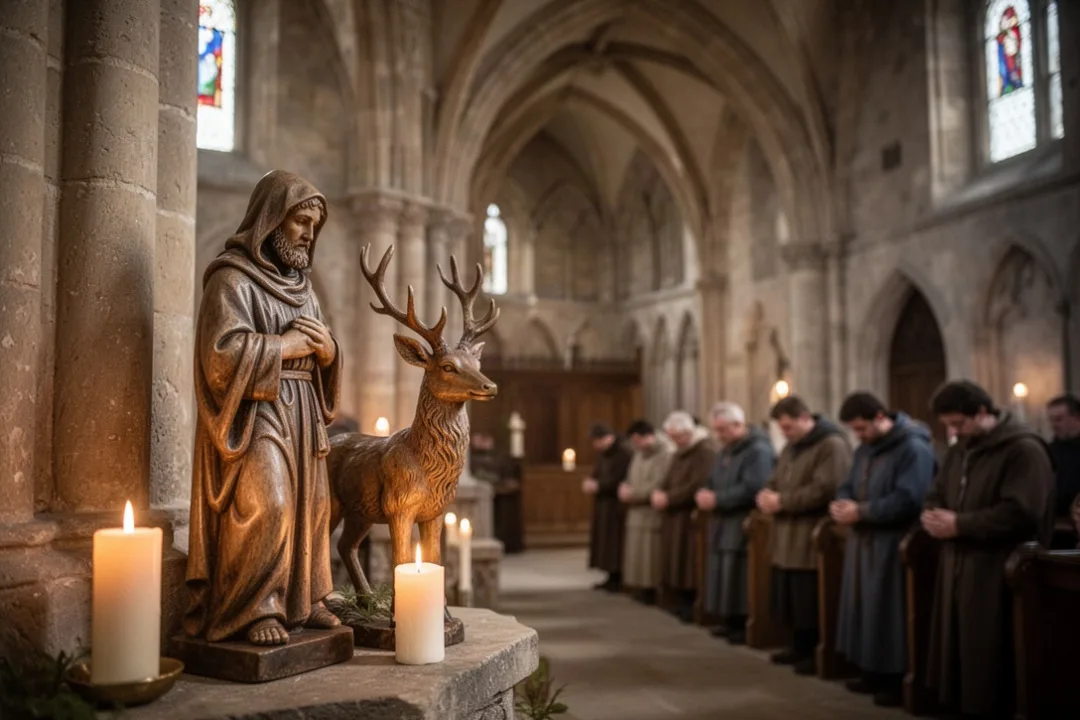
The hind is Saint Giles’s defining emblem. It usually appears as a deer standing near the saint, sometimes with a hunter or a forest in the background. The animal points to the legend of his wilderness life, but it can also suggest gentleness, dependence on God, and care for creation.
Artists may show Giles wearing a monk’s habit or an abbot’s clothing. A crozier, the staff carried by an abbot or bishop, indicates his leadership of a religious community. A book can represent prayer, teaching, or the wisdom associated with a holy life.
Another common feature is an arrow. It refers to the hunting story in which Giles is wounded while protecting the hind. Since his patronage later extended to people suffering from illness, the arrow can also remind viewers of bodily pain and the need for compassion.
Depending on the region and period, images may include a cave, forest, monastery, or pilgrim. These details help distinguish Giles from other saints whose images also feature animals or weapons.
Hind: the animal protected by Giles and his main identifying symbol.
Arrow: the weapon connected with his legendary injury.
Abbot’s staff: his authority as a monastic leader.
Monk’s habit: his life of prayer, discipline, and simplicity.
Forest or cave: his years as a hermit in the wilderness.
Book: prayer, spiritual instruction, or religious wisdom.
Why Saint Giles is a patron of illness and disability
Saint Giles is widely invoked for people living with physical disability, chronic illness, and conditions that affect the mind or nervous system. Older sources use terms for these conditions that are no longer appropriate, so modern explanations should use respectful, specific language instead.
His association with illness may come partly from the broader medieval practice of turning to particular saints for particular needs. It may also reflect the stories of his healing miracles and the reputation of his shrine as a place where suffering people sought help.
The exact list of conditions associated with him varies across countries and periods. He has been connected with epilepsy, mental illness, cancer, infertility, and plague, among other needs. These associations should be understood as devotional traditions, not as substitutes for medical diagnosis or treatment.
For many believers, asking Saint Giles for intercession means bringing a person’s fear, pain, or uncertainty into prayer. It can also mean asking for patience, wise care, and the strength to support someone who is sick.
Health reminder: Prayer and devotion may provide spiritual comfort, but they should accompany—not replace—qualified medical care, prescribed treatment, or emergency help.
Saint Giles as one of the Fourteen Holy Helpers
The Fourteen Holy Helpers are a group of saints whose intercession became especially popular in parts of medieval Europe. Devotion to them grew strongly in German-speaking regions, where people called on the group during serious illness, danger, and other crises.
Saint Giles belongs to this group because of his connection with disease, disability, and protection. The Helpers were not all chosen for one single reason, and their individual stories remained distinct. Their shared appeal came from the belief that each saint had particular experience or power of intercession in a specific kind of trouble.
The group is not identical in every local tradition, but it commonly includes saints such as Barbara, Blaise, Catherine of Alexandria, Christopher, Cyriacus, Denis, Erasmus, Eustace, George, Margaret, Pantaleon, and Vitus, along with Giles and Achatius.
Churches dedicated to the Fourteen Holy Helpers often display the saints together. In those settings, Giles can usually be recognized by the hind, the arrow, or the abbot’s staff.
Saint Giles’s patronage and the people who pray to him
Saint Giles has a wide range of patronages because his legends connect him with several kinds of vulnerability. He is especially associated with people who need protection, healing, or courage in circumstances they cannot control.
People with disabilities: Giles is invoked for strength, dignity, and support.
People with epilepsy or neurological illness: medieval devotion often connected him with disorders affecting the body and mind.
People with mental illness: he may be asked to intercede for healing, peace, and compassionate care.
Nursing and caregivers: his concern for the sick makes him a fitting patron for those who serve them.
Hunters and forest workers: the hind and wilderness legends explain this association.
People facing plague or contagious disease: he belongs to a tradition of saints invoked during epidemics.
People seeking protection from fear: his story emphasizes courage, retreat from violence, and trust in God.
Patronage does not mean that every Christian tradition assigns Giles exactly the same role. Local churches may emphasize healing, pilgrimage, animals, forests, or monastic life depending on their history.
Saint Giles’s feast day is September 1. It begins the month in the Western Christian calendar and has been observed for centuries. Local calendars may give him a different rank or include additional commemorations, but September 1 is the date most commonly associated with him.
A parish or religious community may mark the feast with Mass, a prayer service, a procession, or a celebration connected with a local church dedicated to the saint. In places where his shrine remains active, pilgrims may visit the church, light candles, or ask for prayers for the sick.
Some communities organize a blessing of animals or a service focused on care for creation because of the hind in Giles’s story. Such customs are local rather than universal, so the practices can differ substantially from one place to another.
You can observe the feast day privately by attending worship, reading about the saint’s life, praying for someone who is ill, or making a practical act of care. Helping a caregiver, visiting someone who is isolated, or supporting an organization serving people with disabilities can express the compassionate meaning associated with Giles.
How to pray with Saint Giles
Prayer to a saint is generally understood as asking that saint to intercede with God, not as treating the saint as a replacement for God. A prayer to Saint Giles can be formal or spontaneous, short or extended.
A simple prayer may name the person or situation that concerns you, ask for Saint Giles’s intercession, and place the outcome in God’s care. You can also pray for medical professionals, family members, caregivers, and anyone whose work brings comfort to the sick.
Settle into silence. Take a few moments to become attentive and calm.
Name the need. Speak plainly about illness, fear, disability, grief, or another concern.
Ask for intercession. Invite Saint Giles to pray with you and for the person involved.
Ask for practical help. Pray for wise decisions, good care, patience, and courage.
End with trust. Leave room for an answer that may come through people, treatment, or renewed strength rather than a dramatic cure.
For someone facing a medical crisis, a prayer can remain very direct: ask for protection, competent care, relief from suffering, and peace for everyone involved. There is no requirement to use complicated language or a long formula.
A person who cannot attend church may pray at home, in a hospital room, or while traveling. A candle, picture, medal, or statue of Saint Giles may help focus attention, but none of these objects is required.
A short prayer asking Saint Giles for intercession
Saint Giles, faithful servant of God, pray for people who are sick, disabled, frightened, or alone. Ask God to give them comfort, wise treatment, patient caregivers, and the strength needed for each day. Pray also for those who protect the vulnerable and care for the natural world. Amen.
This prayer can be adapted for a particular person. You might add their name, mention a specific illness, or ask for help with a decision about treatment and care.
Where Saint Giles is especially honored
The most important historic center associated with Giles is Saint-Gilles-du-Gard in France. Its church and former abbey became connected with pilgrimage and helped spread devotion to the saint across Europe.
Churches dedicated to Saint Giles can be found in many European countries, including regions of France, Belgium, Germany, Austria, England, and Central Europe. In English-speaking areas, his name may appear in forms such as Giles or Aegidius, the Latin form used in historical and ecclesiastical sources.
Place names can preserve his memory. A church, village, hospital, or chapel may bear his name even when local people no longer know the details of his legend. Historic buildings dedicated to him often contain medieval carvings or paintings showing the saint with his deer.
When visiting a church associated with Giles, look for the animal at his side. The presence of a hind is usually the clearest visual clue, especially when the saint is shown in the clothing of a hermit or abbot.
How Saint Giles appears in religious art
Artists often portray Saint Giles as a bearded man in a dark monastic habit, standing in a forest with a deer beside him. Some images show an arrow wound or a small mark indicating the injury from the hunting legend.
Medieval and Renaissance artists sometimes place him among other Holy Helpers. In a group image, his deer makes him easier to identify than his clothing, since several saints may be shown wearing similar robes or carrying books.
His image can carry more than one message. The hermit points to prayer and self-denial, the abbot points to responsibility for a community, and the hind points to mercy toward vulnerable life. Together, these symbols present holiness as both contemplation and active care.
Modern artwork may show Giles in a less dramatic way, with emphasis on accessibility, caregiving, disability, or environmental responsibility. Such interpretations can preserve the traditional meaning while speaking to present-day concerns.
What Saint Giles can mean for readers today
Saint Giles’s story has lasting value even for people who are still deciding what they believe about miracle stories. His life raises practical questions about how communities treat those who are sick, disabled, displaced, or dependent on others.
His traditional image does not present strength as independence alone. Giles is remembered as someone who received help from a creature, benefited from the support of a community, and later became responsible for others. That pattern can encourage a more honest view of human need.
The saint’s connection with the forest also offers a reminder that care can extend beyond human concerns. Protecting animals, preserving natural spaces, and treating vulnerable people with dignity all fit naturally with the themes found in his legends.
For Christians, Saint Giles may be a companion in prayer during illness or uncertainty. For visitors to historic churches, he offers a way to understand medieval pilgrimage, monastic culture, and the symbols used to communicate a saint’s identity.
Frequently asked questions
Was Saint Giles a real historical person?
Saint Giles is widely venerated as a historical Christian saint, but the surviving evidence about his life is limited. His biography was shaped by medieval legends written after the period in which he is traditionally believed to have lived. The existence of his cult, shrine, and churches is better documented than the precise details of his birth, travels, or miracles.
What is Saint Giles the patron saint of?
Saint Giles is especially associated with people living with disabilities, epilepsy, mental illness, and other serious health problems. He is also linked with nursing, caregivers, hunters, forests, animals, and protection during plague. Patronage can vary by country and local tradition, so churches may emphasize different parts of his story.
Why is Saint Giles shown with a deer?
A deer, specifically a hind, appears because of a traditional story about Giles living as a hermit in the forest. The animal supposedly visited him and was pursued by hunters. When Giles was wounded while protecting it, the story connected him permanently with the hind. The image also suggests gentleness, protection, and care for vulnerable creatures.
How can someone celebrate Saint Giles’s feast day?
Saint Giles’s feast day is September 1. You could attend a church service, pray for someone who is ill or disabled, learn about a local church named for him, or perform a practical act of care. Supporting caregivers, visiting someone who is isolated, and treating animals responsibly are meaningful ways to reflect the themes associated with his devotion.
















Leave a Reply