Saint Marina: story, feast day, prayers, and meaning
Saint Marina: story, feast day, prayers, and meaning
Are you searching for Saint Marina because you found her name on a prayer card, medal, church calendar, or family record? The name usually refers to Saint Marina of Antioch, a Christian martyr also widely known in the West as Saint Margaret the Virgin. Her story has been preserved through Eastern Orthodox, Eastern Catholic, and Western Christian traditions, although details differ between accounts.
Saint Marina is remembered for her courage, dedication to Christ, and endurance under persecution. Orthodox Christians commonly celebrate her feast on July 17, while Western Christians who call her Margaret traditionally observe her on July 20. Some people also use “Saint Marina” for a different holy woman, Marina the Monk, so identifying the tradition helps you find the right prayers and feast day.
According to traditional accounts, Marina was born in the ancient city of Antioch of Pisidia in Asia Minor. The stories place her life during the era of the Roman persecutions, when Christians could face imprisonment, torture, and execution for refusing to sacrifice to the Roman gods.
Marina is said to have been raised by a pagan father after the death or absence of her mother. A Christian nurse or foster mother introduced her to Christianity, and Marina embraced the faith while still young. When her father learned that she had become Christian, he rejected her. The account presents this family conflict as one of the first trials she faced.
As a young woman, Marina attracted the attention of a Roman official, often identified in tradition as the prefect or governor Olybrius. When she refused his proposal because she had committed herself to Christian life, he reportedly ordered her arrest. Her refusal was not simply a personal rejection; in the traditional story, it publicly revealed her Christian convictions.
Names can be confusing: Marina of Antioch and Margaret the Virgin are generally understood as the same saint in traditions that connect the Greek and Latin forms of her name. Marina is especially common in Eastern Christianity, while Margaret became the familiar Western name.
Why Saint Marina is also called Margaret
The connection between Marina and Margaret comes from the meanings and translations associated with their names. Marina is related to the Latin word for “of the sea,” while Margaret comes from a Greek word associated with a pearl. Over time, communities used different forms of the saint’s name, and translations helped establish separate names for the same martyr.
In Greek Christian tradition, she is commonly called Saint Marina the Great Martyr. In Latin and Western European tradition, she became Saint Margaret of Antioch. Medieval devotion spread her story widely, and she became one of the saints represented in the group known as the Fourteen Holy Helpers, a collection of saints invoked for particular needs.
Her name may therefore appear differently depending on where you encounter it:
Marina of Antioch: the name commonly used in Orthodox and some Eastern Christian traditions.
Marina the Great Martyr: a title emphasizing her witness and death for the faith.
Margaret the Virgin: the Western name often associated with the same saint.
Margaret of Antioch: the full name used in many Catholic and medieval sources.
A statue showing a young woman holding a cross, standing on a dragon, or carrying a small hammer may represent Marina, Margaret, or another local form of the same saint. Artistic details differ by region, so the inscription or church dedication is often the best clue.
What the traditional story says about her martyrdom
The traditional account describes Marina being brought before the Roman authorities after refusing to abandon Christianity. She was questioned and pressured to renounce her faith. When she would not comply, the story says she endured imprisonment, physical torture, and repeated attempts to force her submission.
One famous episode tells of Marina being confronted by a dragon while she was in prison. In some versions, the dragon swallows her, but she escapes by making the sign of the cross or using a cross-shaped object. In others, the dragon appears as a demonic vision that she defeats through prayer. This part of the story is generally read as symbolic religious imagery, showing the triumph of faith over evil, rather than as a modern historical report.
The dragon explains why Saint Marina is often pictured with one foot on a dragon or holding it by a chain. The image does not mean that she was celebrated for violence. It represents the defeat of temptation, fear, and spiritual oppression through steadfast faith.
After further punishment, Marina is said to have been sentenced to death. Her martyrdom is traditionally connected with the reign of the Roman emperor Diocletian, although the surviving accounts do not provide the kind of documentation modern historians would require to verify every detail.
Saint Marina’s story centers on a simple choice: remain faithful when pressure makes compromise seem easier.
What historians can and cannot establish
Saint Marina has been honored for many centuries, but the written accounts of her life are hagiographies rather than modern biographies. They were created to preserve a saint’s witness, encourage devotion, and communicate spiritual meaning. As a result, the accounts often include dramatic trials, visions, miracles, and symbolic episodes.
The broad tradition identifies Marina as a Christian virgin and martyr associated with Antioch of Pisidia. Beyond that, details such as her exact age, family circumstances, the sequence of tortures, and the precise date of her death are less certain. Different manuscripts and church traditions preserve different versions.
That distinction allows you to approach her story respectfully without treating every detail as equally documented. Christians who pray with her story often focus on her faithfulness, courage, purity of intention, and resistance to coercion. Historical uncertainty does not prevent the story from having religious importance, but it does call for careful language.
Some older retellings identify Marina with other female martyrs or blend separate traditions together. This is one reason a church calendar, icon inscription, or local parish dedication may be more useful than a general internet search when you need to know which Saint Marina is being honored.
Saint Marina’s feast days and church traditions
In many Eastern Orthodox churches, the feast of Saint Marina of Antioch falls on July 17. Liturgical services may include hymns, readings, processions, the blessing of bread or other local customs, and prayers asking for the saint’s intercession. The exact practice depends on the jurisdiction, parish, and local culture.
In Western Christianity, Saint Margaret of Antioch is traditionally associated with July 20. Her popularity grew strongly during the Middle Ages, when churches, guilds, and communities placed themselves under her patronage. Her image appeared in stained glass, manuscript art, sculptures, and devotional objects.
Some Eastern churches also commemorate other saints named Marina. Marina the Monk, sometimes called Marinos, has a different story and a different feast in traditions that honor her. She is associated with a monastery narrative in which she lived under a male identity and endured an accusation without revealing the truth about herself.
Before observing a feast day: check the calendar of your own church or parish. July 17 usually identifies Marina of Antioch in Eastern traditions, while July 20 usually identifies Margaret of Antioch in Western ones, but local calendars can vary.
What Saint Marina represents to believers
Saint Marina’s central spiritual theme is steadfastness under pressure. Her story portrays a young woman who refuses to surrender her beliefs even when obedience to authority, family expectations, or social pressure might have offered an easier path.
She is also associated with the dignity of a person whose conscience cannot be bought or forced. The traditional account does not describe her as powerful by worldly standards. Her strength comes from conviction, prayer, and willingness to accept consequences rather than deny what she believed.
For many people, Marina represents several connected qualities:
Courage: remaining faithful when fear and intimidation are present.
Integrity: keeping personal convictions consistent in public and private life.
Purity of purpose: refusing to treat faith as something that can be exchanged for comfort or status.
Protection: seeking spiritual help in situations involving danger, oppression, or serious temptation.
Hope: trusting that suffering does not have the final word.
Her example can also speak to people facing quieter forms of pressure. A person may not be threatened with imprisonment, yet still feel pushed to hide beliefs, accept mistreatment, betray a conscience, or remain silent about wrongdoing. Marina’s story encourages discernment and courage while leaving room for prudence and wise support.
Patronage lists are not identical across churches, countries, and devotional sources. Saint Marina or Margaret is often associated with pregnant women, childbirth, and difficult labor. This connection comes partly from the medieval tradition that she was invoked during childbirth and from a legend that she emerged safely from the dragon.
She is also invoked by people facing illness, danger, persecution, temptation, or severe personal trials. In areas where she is one of the Fourteen Holy Helpers, her intercession may be requested alongside that of other saints for urgent or difficult needs.
These associations do not mean that prayer replaces medical care, emergency help, counseling, or legal protection. A person in labor should contact qualified medical professionals, and anyone facing abuse or immediate danger should seek practical safety and appropriate assistance. Devotion can accompany responsible action; it should not delay it.
Some people also choose Marina as a patron for a child, parish, religious community, or family because her name has been handed down through generations. A patron saint may be honored through a name, feast-day observance, icon, medal, or regular prayer.
How people pray to Saint Marina
There is no single required prayer for Saint Marina across all Christian traditions. Orthodox services use formal hymns and prayers from the church’s liturgical tradition. Catholics and other Christians may use a novena, a prayer card, a personal petition, or a prayer asking Saint Margaret to intercede with God.
A simple prayer can mention the concern directly, ask for wisdom and protection, and remember Marina’s example. You might pray for courage before a difficult conversation, endurance during illness, safety for someone in danger, or strength for a family member facing pressure.
A respectful personal prayer could follow this pattern:
Address God first, recognizing that Christian saints are honored as intercessors, not as independent gods.
Remember Saint Marina’s witness and ask for help in imitating her courage and faithfulness.
Name your need clearly, without assuming that the outcome must occur in a particular way.
Ask for practical wisdom to take the right steps and accept help from trustworthy people.
End with gratitude and, if appropriate, a request for peace and perseverance.
People who prefer formal devotion may look for an approved prayer from their parish, diocese, monastery, or church jurisdiction. The wording of prayers can vary considerably, so a local source is more reliable than copying a prayer with an uncertain origin.
Common mistakes when identifying or honoring Saint Marina
Because several saints share similar names, a little care prevents confusion. The most common mistakes involve combining separate traditions or treating a devotional legend as a verified historical fact.
Assuming every Marina is the same saint: Marina of Antioch and Marina the Monk are different figures in traditions that honor both.
Using the wrong feast day: July 17 generally refers to Marina of Antioch in Eastern traditions; July 20 commonly refers to Margaret of Antioch in Western traditions.
Ignoring the Margaret connection: a church or medal labeled Margaret may still be honoring the saint known as Marina elsewhere.
Presenting legends as documented history: the dragon episode carries symbolic meaning, but its historicity is not established in the modern sense.
Expecting a saint to replace professional help: prayer can provide spiritual support, but emergencies require medical, legal, or safety assistance.
Choosing an icon without checking its inscription: similar images may represent different saints, especially in regions with several Marina traditions.
If you are buying a medal or commissioning an icon, give the artist the full name you intend to use: Marina of Antioch, Marina the Great Martyr, or Margaret of Antioch. Include the tradition or feast date when possible.
How Saint Marina appears in Christian art
Saint Marina is often depicted as a young woman in a long robe, holding a cross, palm branch, or martyr’s crown. The palm signifies martyrdom, while the crown represents victory through faithful endurance. Some icons show her with a small cross in her hand as a sign of her confession of Christ.
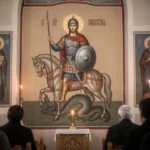
The most recognizable image shows Marina standing over or beside a dragon. In some Western paintings, she holds a hammer or chain and the dragon lies at her feet. In Eastern icons, the composition may be more formal, with the saint facing forward and the defeated creature placed below her.
These images are intended to teach through symbols. The dragon can represent evil, fear, persecution, or the destructive power of temptation. The saint’s calm posture often matters as much as the creature itself: the picture communicates that spiritual courage does not depend on physical strength.
When you see Marina represented with another saint, a bishop, or a group of martyrs, the surrounding figures may identify the local tradition. An icon’s style, inscription, and placement in a church can reveal more than the dragon symbol alone.
Ways to honor Saint Marina today
You do not need an elaborate ceremony to honor Saint Marina. A quiet observance can connect her feast to your own life and to the needs of other people. Churches may hold a liturgy or devotional service, while families may mark the day with prayer, a meal, or a visit to someone who is suffering.
Consider these practical forms of devotion:
Attend a service on her feast day if your church celebrates her.
Light a candle or spend a few minutes in silent prayer according to your tradition.
Read a reliable account of her life and discuss the difference between symbolism and historical evidence.
Pray for people facing persecution, coercion, illness, childbirth, or unsafe conditions.
Support a family member or neighbor who needs practical assistance.
Keep a saint card, icon, or medal as a reminder of courage and faithful living.
Honoring a martyr is not limited to admiring suffering. It also means protecting human dignity, resisting cruelty, telling the truth carefully, and helping people who are vulnerable. Marina’s story becomes meaningful when devotion leads to compassion and responsible action.
What Saint Marina’s story can mean for your own life
Saint Marina’s traditional story asks what you do when a meaningful conviction becomes inconvenient. Her example does not require dramatic gestures from everyone. Often, faithfulness appears in smaller decisions: refusing dishonesty, setting a safe boundary, speaking up for someone mistreated, or asking for help instead of pretending to be strong.
Her story also encourages patience with uncertainty. You can honor the saint while recognizing that some details come from devotional tradition rather than independently verified history. That balanced approach preserves both religious meaning and intellectual honesty.
If the name Marina belongs to someone in your family, the saint may offer a meaningful spiritual connection. You might celebrate the name day, learn about the local form of the devotion, or choose a prayer focused on courage, protection, and compassionate service.
Saint Marina remains memorable because her tradition joins personal integrity with hope. Whether you call her Marina of Antioch or Margaret of Antioch, she is honored as a Christian martyr whose witness encourages people to remain faithful, seek help in hardship, and treat courage as a daily practice rather than a heroic pose.
Frequently asked questions
Is Saint Marina the same person as Saint Margaret?
In most traditions that connect the two names, Saint Marina of Antioch and Saint Margaret of Antioch refer to the same virgin martyr. Marina is the name used more often in Eastern Christianity, while Margaret became standard in the Latin West. Some sources may use both names together, but you should check the church tradition and inscription connected with a particular icon or feast.
What day is Saint Marina’s feast day?
Saint Marina of Antioch is commonly celebrated on July 17 in Eastern Orthodox and related Eastern traditions. In Western Christianity, the same saint is generally known as Margaret of Antioch and is traditionally associated with July 20. Feast days can differ in local calendars, so your parish or church jurisdiction is the best authority for the date observed in your community.
What should I pray to Saint Marina for?
Devotees commonly ask Saint Marina’s intercession for courage, protection, endurance during hardship, and strength when facing pressure or temptation. She is also traditionally associated with pregnancy and childbirth. Prayer should accompany, not replace, medical care, emergency services, counseling, or protection from abuse. A local church can provide prayers appropriate to your denomination.
Why is Saint Marina shown with a dragon?
The dragon comes from a traditional story about Marina’s imprisonment and spiritual struggle. In some versions, she defeats or escapes a dragon through the sign of the cross; in others, the creature represents a demonic attack or vision. Christian art uses the dragon as a symbol of evil, fear, and temptation overcome through faith rather than as a claim that the event is historically verified.














Leave a Reply