Margaret of Antioch: Story, symbols, feast day, and legacy
Margaret of Antioch: Story, symbols, feast day, and legacy
Margaret of Antioch is a traditionally recognized Christian martyr whose story became one of the most popular saint legends of the Middle Ages. She is remembered especially for resisting persecution, surviving torture in the medieval account of her life, and defeating a dragon through the power of the cross.
Her historical details are uncertain, but her devotion has been lasting. In Western Christianity, Margaret became one of the Fourteen Holy Helpers and a patron saint associated with childbirth, pregnant women, nurses, and people facing difficult physical trials. Eastern Christians generally honor a related figure as Saint Marina the Great Martyr.
Who Margaret of Antioch was according to tradition
Margaret’s traditional life places her in Antioch, although ancient sources and later retellings do not always make clear which Antioch was intended. Some accounts connect her with Antioch in Pisidia, in present-day southwestern Turkey; others associate her with Antioch on the Orontes, a major city in ancient Syria. That uncertainty is one reason historians treat the story cautiously.
According to the medieval tradition, Margaret was the daughter of a pagan priest. She became a Christian in youth, sometimes after being instructed by a nurse or foster mother. Her father rejected her faith and expelled her from the household. She then worked as a shepherdess, a detail that helped later artists portray her with sheep or pastoral clothing.
A Roman official, often called Olybrius in Western versions of the story, noticed Margaret and wanted to marry her. Margaret refused because she had committed herself to Christianity. The official allegedly offered her social status and safety if she would renounce her faith. When she would not, he ordered her arrested and tortured.
The story belongs to the broad tradition of early Christian martyr narratives. These accounts often present a young believer confronting an authority figure, refusing to sacrifice or worship pagan gods, and remaining faithful through imprisonment and suffering. They were intended to strengthen Christian courage, although the literary form does not always provide the kind of evidence modern historians need to verify each event.
Historical caution: Margaret’s devotion is ancient and widespread, but the surviving narrative contains legendary elements and does not establish a securely documented biography. It is best to distinguish the saint’s long religious significance from claims that cannot be independently confirmed.
Margaret’s name may also appear as Marina. In Greek and Eastern Christian traditions, Saint Marina is celebrated as a great martyr, and many scholars and church traditions understand Marina and Margaret as the same or closely related figure. The differences in name, feast date, and storytelling developed as devotion traveled between languages and regions.
What happens in Margaret’s martyrdom story
The most familiar account describes Margaret as being brought before the governor after refusing his proposal and refusing to abandon Christianity. She is said to have been beaten, imprisoned, and subjected to several forms of torture. In each episode, the narrative emphasizes her steadfast faith rather than her physical strength.
One commonly repeated episode has Margaret thrown into a prison cell, where a dragon appears. The creature either swallows her or threatens to consume her. Margaret makes the sign of the cross, and the dragon is defeated. In some versions, she emerges from the creature’s body unharmed; in others, the dragon disappears or is destroyed when she confronts it with the cross.
The dragon episode is the source of one of Margaret’s most recognizable symbols. Medieval listeners often understood the monster as a visible image of Satan, persecution, temptation, or the forces that seek to destroy Christian faith. The detail that she is swallowed and emerges safely also led to associations with danger in pregnancy and childbirth.
Another version explains the dragon as a demonic apparition rather than a literal animal. The distinction matters because the story’s religious meaning does not depend on treating the scene as a zoological event. The dragon represents a hostile power that appears overwhelming but is defeated by Margaret’s trust in God and her use of the cross.
After surviving imprisonment and torture, Margaret is eventually condemned to death. The most common Western accounts say that she was beheaded. Her martyrdom is traditionally dated to the persecution of Christians under the Roman Empire, but the precise ruler and date vary among sources and should not be presented as certain.
Before her death, the story gives Margaret a prayer for people who remember her martyrdom. Medieval versions connect that prayer with protection from illness, danger, and the pains of childbirth. This helped explain why women in labor, midwives, and families expecting a child sought her intercession.
Why the dragon became Margaret’s defining symbol
Margaret’s dragon is not simply an illustration of an exciting legend. It communicates several themes at once: fear confronted, evil overcome, and a vulnerable person refusing to surrender her conscience. The image also distinguishes Margaret from many other virgin martyrs whose symbols include a sword, a palm branch, or an instrument of torture.
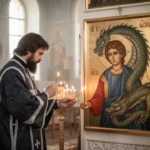
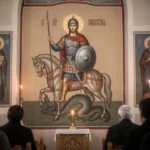
Artists often show Margaret standing beside the dragon, holding a cross, or emerging from its body. In some images, the dragon is small and subdued at her feet. In others, it is large enough to dominate the composition, making her calm posture and the cross especially important visual signs of spiritual authority.
What Margaret’s symbols and images mean
The most important symbol associated with Margaret is the dragon. It points to the central episode of her legend and identifies her at a glance. A cross, crucifix, or palm branch may appear with it, indicating her Christian faith and martyrdom.
A palm branch traditionally marks a martyr in Christian art. It does not mean that Margaret was killed with a palm or that the branch belongs to a specific event in her story. Instead, it represents victory through faith and the hope of eternal life after death.
Margaret may also be shown with a sword, reflecting the traditional account of her execution. In some artworks, the sword is prominent; in others, the dragon and cross are enough to identify her. A crown can signify virginity, martyrdom, or heavenly honor rather than earthly royalty.
She is sometimes portrayed as a young woman in a long robe, often with a veil or mantle. The clothing reflects her status as a virgin martyr in Christian art, not necessarily a historically documented costume. When she appears as a shepherdess, the image refers to the tradition that she tended sheep after being rejected by her father.
Margaret can be identified in a group of saints by looking for a combination of clues:
A dragon at her side or beneath her feet.
A cross held in her hand or used against the dragon.
A palm branch showing that she is remembered as a martyr.
A sword referring to her traditional execution.
Shepherdess imagery, including sheep or rural clothing.
Some medieval images show Margaret emerging from the dragon’s back or belly. These scenes can look startling to modern viewers, but they are designed to make the story unmistakable. The image expresses survival, divine protection, and the belief that evil cannot ultimately hold the faithful person captive.
Her imagery also appears in manuscripts, panel paintings, sculpture, stained glass, church portals, and devotional objects. In areas where the Fourteen Holy Helpers were especially honored, Margaret may stand beside saints invoked for plague, sudden death, headaches, epilepsy, storms, or other dangers. The group gave worshipers a set of intercessors for urgent and varied needs.
Why Margaret is associated with childbirth and protection
Margaret became strongly associated with pregnancy and childbirth because of the story in which the dragon swallows her and she escapes alive. Medieval Christians interpreted this dramatic image as a sign of protection for women facing the physical danger of labor. Her legend offered a saint who had endured confinement, pain, and a threat to bodily safety.
Women sometimes carried small devotional objects bearing Margaret’s image or words attributed to her prayer. These objects were used as requests for protection during labor, not as magical guarantees. Their meaning depended on prayer, trust, and the saint’s intercession within the believer’s understanding of Christian devotion.
Margaret’s patronage extended beyond childbirth. She was invoked by nurses, women who wanted children, people suffering from difficult illnesses, and those confronting fear or oppression. In certain regions, she was also connected with agriculture and rural life because of the shepherdess tradition.
Her role as a protector should be understood in the context of medieval religion, when childbirth was dangerous and medical care was limited. Families turned to saints as part of a broader religious response to uncertainty. Prayer to Margaret did not replace practical care from midwives or physicians; it accompanied the care available to the community.
People who pray with Margaret today may focus on several concerns:
Safety during pregnancy and delivery.
Strength during serious illness or physical suffering.
Courage when facing intimidation or injustice.
Protection for mothers, infants, nurses, and caregivers.
Perseverance when faith or conscience is challenged.
Her patronage also gives her story a personal dimension. Margaret is not remembered only as someone who defeated a monster in a legend. She represents a person whose choices carried a high cost, yet who refused to let another person’s power determine her beliefs or her identity.
For prayer and devotion: Margaret’s traditional role is intercessory. Those who honor her may ask for courage, protection, and care while also seeking appropriate medical, pastoral, and practical support.
Margaret’s feast day and place in Christian tradition
In the Western Christian calendar, Margaret of Antioch is traditionally commemorated on July 20. Her feast was widely celebrated in medieval Europe, and churches, chapels, guilds, and communities were dedicated to her. Local customs could add processions, prayers, votive offerings, or special observances.
In Eastern Christianity, Saint Marina the Great Martyr is commonly celebrated on July 17. The difference reflects the separate calendar traditions and the development of the saint’s name in Greek and other languages. It does not necessarily indicate two unrelated women.
Margaret was included among the Fourteen Holy Helpers, a group of saints who were especially invoked in medieval central Europe. The group was not identical in every place, but Margaret’s presence was widely recognized. She was often called upon for help during childbirth and other situations involving bodily danger.
Her feast once had a more prominent place in the Roman calendar than it does today. Following the calendar revision after the Second Vatican Council, Margaret’s feast was removed from the General Roman Calendar because the historical evidence for her life was considered too uncertain for a universal celebration. Her veneration was not forbidden, and she remains known in Catholic devotion and in the Roman Martyrology.
This distinction is useful. A saint’s removal from a universal calendar does not mean that the person is rejected as meaningless or that churches may not honor her. It indicates that a feast may be better observed locally or in communities with a particular connection to the devotion.
Margaret’s popularity continued because devotion is shaped not only by official calendars but also by local churches, family traditions, pilgrimage sites, works of art, and personal prayer. Her name remains common in Christian communities, and her image can still be found in churches and museums across Europe and beyond.
Margaret, Marina, and the question of historical identity
The relationship between Margaret and Marina is complex because saint traditions moved through different languages and regions. The Greek name Marina and the Latin name Margareta do not mean the same thing linguistically, but medieval transmission sometimes connected stories that shared a similar martyr profile.
Eastern accounts may give Marina a different family background, setting, or sequence of tortures. Western accounts developed their own narrative details, including the famous dragon episode. Shared themes do not prove that every version preserves the same historical record, but they help explain why the two names are often discussed together.
When researching Margaret, check whether a source is using a Western legend, an Eastern life of Marina, a medieval collection of saints’ lives, or a modern historical study. This prevents different versions from being blended into a single account without qualification.
How to understand Margaret of Antioch today
Margaret can be approached in several ways at once. Devout Christians may honor her as a martyr and intercessor. Historians may study the growth of her cult and the changing forms of her legend. Art historians may examine how the dragon, cross, and palm branch shaped visual storytelling.
Her story also shows how communities preserve meaning even when biography is difficult to verify. Medieval Christians found in Margaret a model of courage under pressure, while later generations connected her with the dangers faced by mothers and caregivers. The narrative changed in detail, but its central concerns remained recognizable.
A careful reading avoids two opposite mistakes. It does not dismiss Margaret’s importance simply because the surviving life contains legendary material. It also does not present every scene as a confirmed historical event. The most responsible approach holds together devotional significance, historical uncertainty, and the evidence of her enduring cultural impact.
Her legend may be especially meaningful to people who feel powerless before a threatening situation. Margaret is depicted as young, socially vulnerable, and opposed by an authority figure. Yet the story gives her moral clarity. She does not defeat the dragon through physical force; she confronts it through faith, the cross, and refusal to surrender.
For someone visiting a church or museum, Margaret’s image can be read through a simple sequence:
Identify the dragon as the sign of the central legend.
Look for the cross or palm branch to recognize her Christian identity.
Notice whether a sword, sheep, crown, or prison setting adds another part of her story.
Ask whether the artwork emphasizes martyrdom, protection, childbirth, or victory over evil.
Check the local church tradition, since Margaret’s feast and name may appear as Marina.
Margaret of Antioch remains memorable because her story combines a martyr’s courage with a protector’s compassion. The dragon gives her legend an unforgettable form, but the lasting subject is the strength to remain faithful when fear, authority, and suffering seem to control the future.
Frequently asked questions
Is Margaret of Antioch a historically verified person?
Margaret’s cult is old and influential, but the details of her life are not securely documented by surviving historical evidence. Her traditional biography contains features common in medieval martyr stories, including dramatic torture and a supernatural dragon encounter. Many Christians continue to honor her devotionally while recognizing that her legend should not be treated as a fully verified biography.
Are Margaret of Antioch and Saint Marina the same saint?
Many Christian traditions connect Margaret of Antioch with Saint Marina the Great Martyr, especially because their stories share major themes and similar devotional roles. The names and feast days differ between Western and Eastern traditions, however, and the surviving accounts are not identical. It is best to identify which tradition a particular source is presenting.
Why does Margaret appear with a dragon?
The dragon comes from the traditional account of her imprisonment, in which she confronts and survives a monstrous or demonic creature through the sign of the cross. In Christian art, the dragon represents evil, persecution, temptation, or overwhelming danger. It also helped establish Margaret’s association with protection during pregnancy and childbirth.
When is Saint Margaret of Antioch’s feast day?
Western Christian traditions traditionally observe Margaret’s feast on July 20. Eastern Christians commonly celebrate Saint Marina the Great Martyr on July 17. Local calendars may vary, and Margaret is not currently a universal feast on the Roman Catholic General Roman Calendar, although her devotion remains permitted and established.















Leave a Reply