Saint Margaret of Castello: Life, legacy, and feast day
Saint Margaret of Castello: Life, legacy, and feast day
Saint Margaret of Castello was a medieval Italian lay Dominican remembered for living with profound disabilities while serving people who were poor, sick, imprisoned, and overlooked.
Her life challenges the assumption that holiness depends on physical ability, social status, family acceptance, or public influence. Margaret was blind, short in stature, and affected by several physical conditions. Her wealthy parents rejected her, yet she became known in Città di Castello for prayer, hospitality, and practical care for others.
Margaret was born around 1287 at Metola, near Mercatello in central Italy. Her parents were members of the nobility, but her birth did not bring the welcome that a child normally deserves. Later accounts describe her as blind, unable to walk normally, and affected by a pronounced spinal curvature and short stature.
Her parents reportedly kept her hidden for years in a small room or chapel attached to their castle. The details come from later biographical traditions, so individual parts of the story should be read with care. The central pattern, however, is consistent: Margaret experienced abandonment and exclusion early in life, then found a place among people who recognized her dignity.
She was eventually left behind in Città di Castello when her parents abandoned their efforts to seek a cure. A local couple, Venturino and Grigia, took her into their household. Their care gave Margaret a home, although later sources also describe periods of hardship and mistreatment before she found more stable support.
Margaret did not become a nun in the enclosed sense. She joined the Third Order of Saint Dominic, now commonly associated with the Dominican Laity. This allowed her to live in the community while following a disciplined religious life centered on prayer, charity, and service.
The central point: Margaret’s disabilities were part of her lived experience, but they were not her whole identity. The Christian tradition remembers her for her faith, relationships, service, and care for people who were also pushed aside.
A short historical context for Margaret’s life
Margaret lived in the late 13th and early 14th centuries, a period when Italian cities were shaped by powerful families, religious confraternities, trade, local rivalries, and sharp social divisions. Access to food, medical care, education, and legal protection depended heavily on family status and community relationships.
Religious life took several forms. Some people entered monasteries or convents, while others remained in ordinary neighborhoods and adopted a recognized spiritual rule. Members of the Dominican Third Order could pray, practice penance, and serve others without leaving daily civic life. This setting helps explain how Margaret’s ministry developed in homes, streets, and charitable institutions rather than behind a convent wall.
Medieval accounts often describe saints through miracles, visions, physical suffering, and dramatic signs. Modern readers can appreciate the spiritual meaning of those accounts without treating every detail as independently verified history. Margaret’s documented and enduring legacy rests especially on her reputation for mercy, prayer, endurance, and closeness to the poor.
Saint Margaret of Castello’s life in key stages
Birth into a noble family: Margaret was born around 1287 near Mercatello in Italy, with significant physical disabilities.
Childhood isolation: Her parents kept her apart from ordinary family life, reportedly hoping that a cure or religious intervention would change her condition.
Abandonment in Città di Castello: When those hopes failed, her parents left her in the city.
Adoption by local residents: A married couple received her into their home, giving her the protection and companionship she had lacked.
Formation as a Dominican tertiary: Margaret joined the Dominican Third Order and developed a structured life of prayer and service.
Ministry to vulnerable people: She assisted the poor, visited prisoners, cared for the sick, and helped children who needed guidance.
Death and local devotion: Margaret died in Città di Castello on April 13, 1320, and devotion to her continued after her death.
Canonization: Pope Francis declared her a saint in 2019 through equipollent, or equivalent, canonization.
This sequence shows why Margaret’s story cannot be reduced to a single episode of abandonment. Her later choices mattered. She received care, joined a spiritual community, and used the relationships and abilities available to her to support others.
What Margaret’s disabilities meant in her daily life
Sources describe Margaret as blind or severely visually impaired, short in stature, and affected by physical conditions that limited her mobility. Some accounts also mention a spinal deformity and difficulty walking. These descriptions come from medieval biographies and devotional traditions, which do not always use medical categories in the way modern readers would.
Her disabilities would have affected ordinary tasks such as moving through the city, finding food, communicating with strangers, and protecting herself from abuse. The absence of modern medicine, accessibility standards, and social services made dependence on other people unavoidable. Margaret’s life therefore included both vulnerability and the need to build trust within a community.
It is misleading to describe her disability only as a spiritual test or a symbol of heroic suffering. Margaret needed concrete assistance: shelter, food, mobility support, companionship, and protection. The people who helped her were not merely supporting a future saint; they were responding to a person whose needs deserved attention at that moment.
At the same time, Margaret was not portrayed by those who knew her as helpless. Accounts emphasize her intelligence, memory, humorless discipline, compassion, and ability to counsel others. Her story reflects a Christian understanding of human dignity in which receiving care and giving care are both meaningful parts of community life.
Why her abandonment matters to her story
Margaret’s rejection by her parents is one of the most painful parts of her biography. She had been born into privilege, yet that privilege did not protect her. Her family’s concern with appearance, cure, or social expectations became more important than welcoming her as she was.
That history gives special weight to Margaret’s later concern for people who were excluded. She knew what it meant to be treated as a burden or embarrassment. Her ministry among the poor, sick, imprisoned, and socially vulnerable can be understood as a response to that experience, although her charitable work was also rooted in Dominican prayer and the broader Christian command to love one’s neighbor.
Her story should not be used to excuse families, institutions, or communities that abandon disabled people. Margaret’s sanctity does not make rejection acceptable. Instead, it exposes the damage caused when a person’s value is measured by appearance, health, productivity, or social convenience.
A useful way to read her story: Margaret did not become holy because she was rejected. She became known for holiness through the way she lived after rejection, with the help of people who offered her a real place in their community.
Margaret’s Dominican spirituality and daily practices
Margaret’s religious life was shaped by the Dominican tradition, which joins contemplation with active service. Prayer was not separate from her concern for neighbors. The tradition associated with her understands study, worship, preaching, and works of mercy as connected expressions of love for God and other people.
As a Dominican tertiary, Margaret likely followed a pattern of prayer, fasting, penance, and participation in the sacramental life of the Church. Medieval accounts also associate her with strong devotion to the Eucharist, the Passion of Christ, the Virgin Mary, and the saints. Some details belong to devotional narratives rather than records that can be independently confirmed.
Her spirituality was not an escape from ordinary problems. It gave her a way to interpret suffering without allowing suffering to define every relationship. Prayer also placed her within a community that could recognize her gifts and depend on her wisdom.
Margaret’s life illustrates several Dominican themes:
Contemplation that becomes service: prayer leads to attention to real human needs.
Truth about human dignity: a person’s worth does not depend on bodily perfection or social rank.
Community-based faith: spiritual growth takes place through relationships, hospitality, and responsibility.
Mercy toward overlooked people: the vulnerable are not projects but neighbors with their own dignity.
Hope without denial: faith does not erase disability, grief, or injustice, but it can sustain love within those realities.
How Saint Margaret served other people
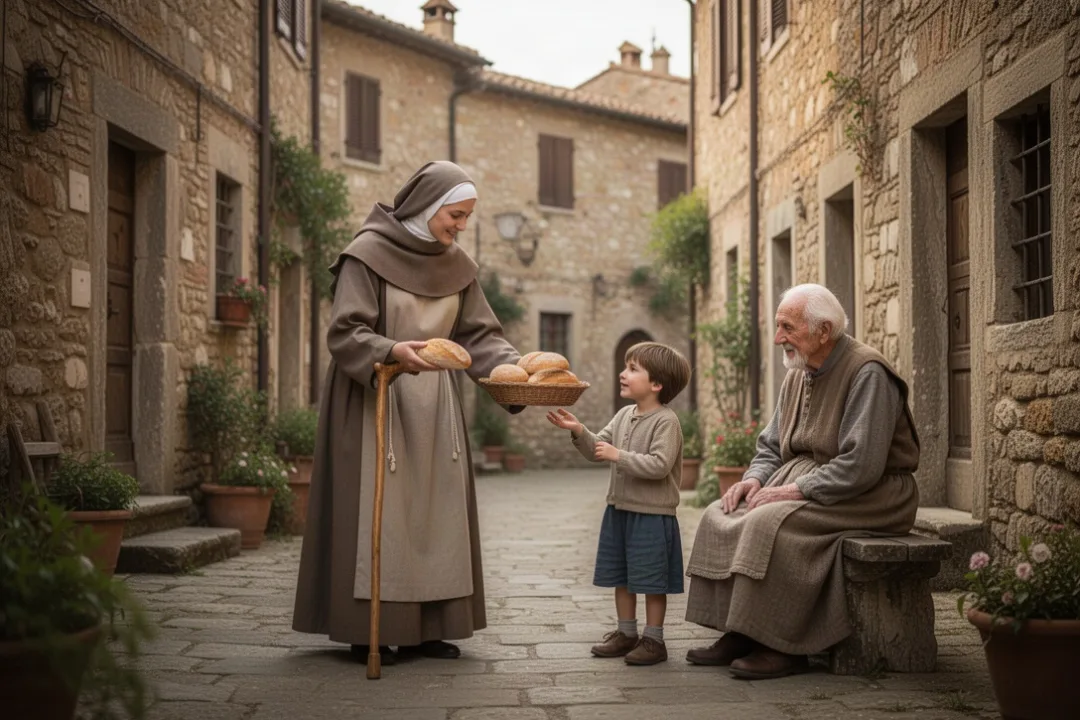
Accounts of Margaret’s adult life describe a wide range of charitable activity. She helped people who were poor, visited prisoners, cared for the sick, and taught or guided children. She also offered prayer and counsel to people who came to her. Her ministry appears to have been local and personal rather than connected to a large institution.
That kind of service required more than good intentions. Margaret had to listen carefully, remember individual concerns, and maintain relationships with people whose needs changed from day to day. Her own dependence may have helped her recognize forms of suffering that others overlooked, but compassion still involved deliberate attention and work.
Her example can be applied carefully today. It does not mean that disabled people are expected to serve others constantly or prove their value through charity. Instead, it suggests that every person can have a meaningful role in community life, while communities have a duty to provide access, protection, and reciprocal support.
Practical lessons from Margaret’s charitable life include:
Make care personal: learn someone’s name, preferences, and actual needs rather than relying on assumptions.
Support participation: remove physical, social, and communication barriers so people can contribute.
Protect the vulnerable: respond to neglect, exploitation, and abuse instead of treating them as private problems.
Respect reciprocal relationships: receiving help does not cancel a person’s ability to offer friendship, insight, or leadership.
Stay close to local needs: consistent support within a neighborhood can matter as much as a large public project.
Miracles, legends, and historical caution
Saint Margaret’s biography includes miraculous and extraordinary elements, as many medieval saints’ lives do. Devotional accounts may describe cures, prophetic insight, visions, or unusual signs of holiness. These stories helped earlier communities express what they believed God had done through Margaret’s life.
Readers should distinguish between historical evidence, later testimony, and theological interpretation. The presence of a miracle story does not require every reader to evaluate the entire biography in the same way. Margaret’s importance does not disappear if a particular detail cannot be verified by modern historical methods.
A balanced approach asks several questions:
What details appear across the earliest available traditions?
Which claims were written down much later?
How does the story reflect medieval ideas about disability, charity, and sanctity?
What can be learned from Margaret’s relationships and actions without turning legend into medical history?
Does the interpretation respect disabled people today rather than presenting disability as a spectacle?
This approach preserves the religious meaning of the tradition while avoiding exaggerated claims. It also allows Margaret to be remembered as a real person whose life involved both profound dependence and genuine agency.
Her death, burial, and continuing devotion
Margaret died on April 13, 1320, in Città di Castello. Local devotion developed around her after death, and people continued to seek her intercession. Her body was preserved and honored in the city, where she remains closely associated with Dominican worship and the community that received her.
The people of Città di Castello remembered not only a woman with extraordinary physical challenges but also a neighbor who had prayed with them, served them, and cared about their troubles. Local devotion is significant because sainthood often grows through sustained relationships between a person and a particular community.
Margaret’s feast day is generally observed on April 13. Churches and Dominican communities may mark the day with Mass, prayer, teaching, charitable activity, or reflection on the dignity of disabled people. The exact customs vary by place.
How Margaret became a canonized saint
Margaret was beatified in 1609 by Pope Paul V. Beatification permitted public veneration within specified settings, while canonization recognizes a person as a saint for the universal Church. For centuries, devotion to Margaret continued even though she had not received a modern canonization.
In 2019, Pope Francis approved her equipollent canonization, sometimes called equivalent canonization. This form recognizes longstanding devotion, a consistent reputation for holiness, and a substantial history of intercession without requiring the same process used for a standard formal canonization case.
The 2019 decision did not create Margaret’s devotion. It confirmed and extended a reputation that had endured for centuries. Her canonization also brought renewed attention to the place of disabled people in the Church, the need for communities of welcome, and the danger of confusing physical difference with diminished human value.
What Saint Margaret of Castello is associated with
Margaret is often invoked by people who are disabled, sick, abandoned, rejected, or caring for vulnerable family members. She is also associated with the poor, children, prisoners, and people who feel excluded because of appearance or social circumstances.
Some lists identify her as a patron saint of the unwanted or disabled. These descriptions can be helpful when they express solidarity, but they should never suggest that disabled people are unwanted by nature. Margaret’s story condemns rejection rather than reinforcing it.
People may ask for her intercession when they need:
strength while living with a disability or chronic illness;
courage after rejection, neglect, or family conflict;
patience and practical wisdom in caregiving;
greater compassion within a parish, school, or household;
protection for people who are poor, isolated, imprisoned, or at risk of abuse;
help in recognizing the gifts and dignity of people whom society overlooks.
How to pray with Saint Margaret’s example
Prayer with Margaret does not need to focus only on physical healing. You might ask for the grace to treat people with respect, to accept help without shame, or to notice someone who is being ignored. Her life supports prayers for healing while also making room for strength, friendship, justice, accessibility, and belonging.
Remember Margaret’s life: recall her abandonment, welcome, Dominican vocation, and service.
Name a real need: bring before God a person, family, illness, injustice, or relationship.
Ask for practical grace: pray for patience, protection, courage, advocacy, or reconciliation.
Choose one act of care: make a call, offer accessible support, visit someone, or challenge dismissive treatment.
Those steps keep devotion connected to action. Asking Saint Margaret’s intercession can become an invitation to build the kind of community she needed: one that welcomes disabled people, protects people at risk, and values care as a shared responsibility.
What her legacy asks of churches and communities
Margaret’s legacy is not fulfilled by displaying her image while leaving disabled people unable to enter a church, receive the sacraments, participate in education, or hold leadership roles. Her story calls communities to examine practical barriers as well as attitudes.
A parish inspired by Margaret might evaluate its entrances, restrooms, seating, communication, transportation, religious education, and emergency procedures. It might also ask whether disabled members are consulted directly rather than spoken about without their participation.
Hospitality must include more than a warm welcome. It involves access, safety, representation, and belonging. Margaret’s life shows how much can change when a community stops treating a person as an embarrassment and begins to recognize that person as a neighbor with gifts, needs, and a rightful place.
Her witness also applies beyond religious institutions. Schools, families, hospitals, workplaces, and civic groups can all learn from the same principle: people should not have to become exceptional, inspirational, or useful before they receive respect and support.
Why Saint Margaret of Castello still matters
Margaret remains meaningful because her life brings together questions that are still urgent: Who gets welcomed? Who receives care? Whose body is considered acceptable? How do communities respond when a person needs substantial assistance? What happens when a family or institution values reputation more than human dignity?
Her answer was not a public career or a position of authority. It was a life rooted in prayer, friendship, service, and perseverance. She received care from others and offered care in return, showing that dependence and dignity are not opposites.
Remembering Saint Margaret of Castello means honoring a disabled woman whose life was shaped by both vulnerability and influence. It means rejecting the idea that suffering makes a person less valuable, and it means building communities where no one must be abandoned before belonging is offered.
Frequently asked questions
When is Saint Margaret of Castello’s feast day?
Saint Margaret of Castello’s feast day is April 13, the date traditionally associated with her death in 1320. Dominican communities and churches may observe the day with Mass, prayer, charitable service, or reflection on disability and human dignity. Local calendars can differ in how the feast is ranked or celebrated.
What disabilities did Saint Margaret of Castello have?
Medieval accounts describe Margaret as blind or severely visually impaired, short in stature, and affected by physical conditions that limited her mobility, including a spinal deformity. These descriptions do not correspond exactly to modern medical diagnoses. Her disabilities shaped her daily experience, but they did not define her entire identity or religious vocation.
Why did Pope Francis canonize Margaret in 2019?
Pope Francis approved Margaret’s equipollent, or equivalent, canonization in 2019 because she had a longstanding reputation for holiness and centuries of public devotion. This process recognized an established tradition rather than beginning devotion from scratch. She had already been beatified in 1609 and honored especially in Città di Castello and Dominican communities.
What is Saint Margaret of Castello the patron saint of?
Margaret is commonly associated with disabled people, the unwanted, the poor, children, prisoners, and those who experience rejection. These associations reflect her life of service and her own experience of abandonment. They should not label disabled people as unwanted; instead, they emphasize the duty of families, churches, and communities to offer dignity, protection, and belonging.















Leave a Reply